

A rapid result is useful when it leads to an appropriate next step. For programs considering rapid screening kits for community health, choosing a test is only one part of the work. Staff time, available space, participant access, result communication, and follow-up all affect whether screening fits the setting and supports care.
Community health teams can make the process more workable by matching the kit and workflow to the program’s purpose, clarifying staff responsibilities, and deciding how to handle results before launch. This illustrative case-study framework shows how to connect those decisions without treating a test as a complete screening or care process.
Use the practical questions below to plan site setup, kit selection, workflow, communication, follow-up, and evaluation. A clear pathway helps stakeholders understand the process and gives staff specific steps to carry out within the resources available.
Key Takeaways
- Use an illustrative program scenario to distinguish rapid screening from the broader care pathway it should support.
- Map each step from outreach through follow-up, and assign responsibilities in line with organizational policy and applicable requirements.
- Compare fixed-site, outreach, and partner-site models against the program’s access, staffing, privacy, and follow-up capacity.
- Choose rapid screening kits for community health based on intended use and workflow, then track measures such as participation and completed follow-up.
- Point of Care Medical distributes rapid diagnostic testing supplies nationally to healthcare and screening organizations.
Why community health programs use rapid screening kits to extend access
Community health programs use screening to make an initial check more accessible, not to replace assessment or care. Rapid screening kits for community health can support services in clinics and other community settings, where a streamlined process may help participants take an earlier step. Their usefulness depends on how well the test fits the program’s purpose and population, and whether the team can respond appropriately to results.
What community health screening is designed to do
Screening is an organized way to identify people who may benefit from further assessment. A screening result alone may not establish a diagnosis. Before choosing a kit, define whom the program intends to reach, why it is screening, and what staff will explain about results and possible next steps.
Each assay has its own labeling and intended use. Follow the product instructions and applicable testing protocols when deciding whether an assay fits the setting and program goals. Background on rapid diagnostic tests and point-of-care use can help explain the role of these tools, but it does not replace assay-specific instructions or organizational requirements.
Illustrative scenario, not a real program case: A community health center plans an outreach session for people who may not routinely visit the clinic. Before choosing an assay, the team defines the screening purpose and intended participants, then decides how staff will explain results and arrange follow-up. The example shows why teams should plan access and next steps together.
Accessible screening can create an opportunity for an earlier conversation with a qualified health professional. It can also help a participant understand whether further assessment may be appropriate. A responsible program does not present screening as confirmation. Staff should be prepared to explain the limits of a result in clear, non-stigmatizing language.
Where a rapid kit fits in the care pathway
A point-of-care test may suit a setting where time, travel, or access makes a centralized process difficult. But choosing a kit is only one operational decision. The program also needs a defined sequence, assigned responsibilities, a private way to communicate results, and a process for connecting participants with appropriate next steps.
- Outreach: Explain the purpose of screening and whom the program is designed to reach.
- Consent and preparation: Follow organizational policy for consent, privacy, and participant information.
- Testing: Use the assay according to its labeling and applicable protocols, with staff responsibilities clearly assigned.
- Communication: Share the result clearly and explain what it does and does not establish.
- Next steps: Connect participants with further assessment or care when indicated, and document the process according to policy.
A screening tool can support one step in care, but it cannot provide the complete care pathway. Keeping this distinction clear helps programs plan access while ensuring each result is handled responsibly.
How a community rapid-screening workflow moves from outreach to follow-up
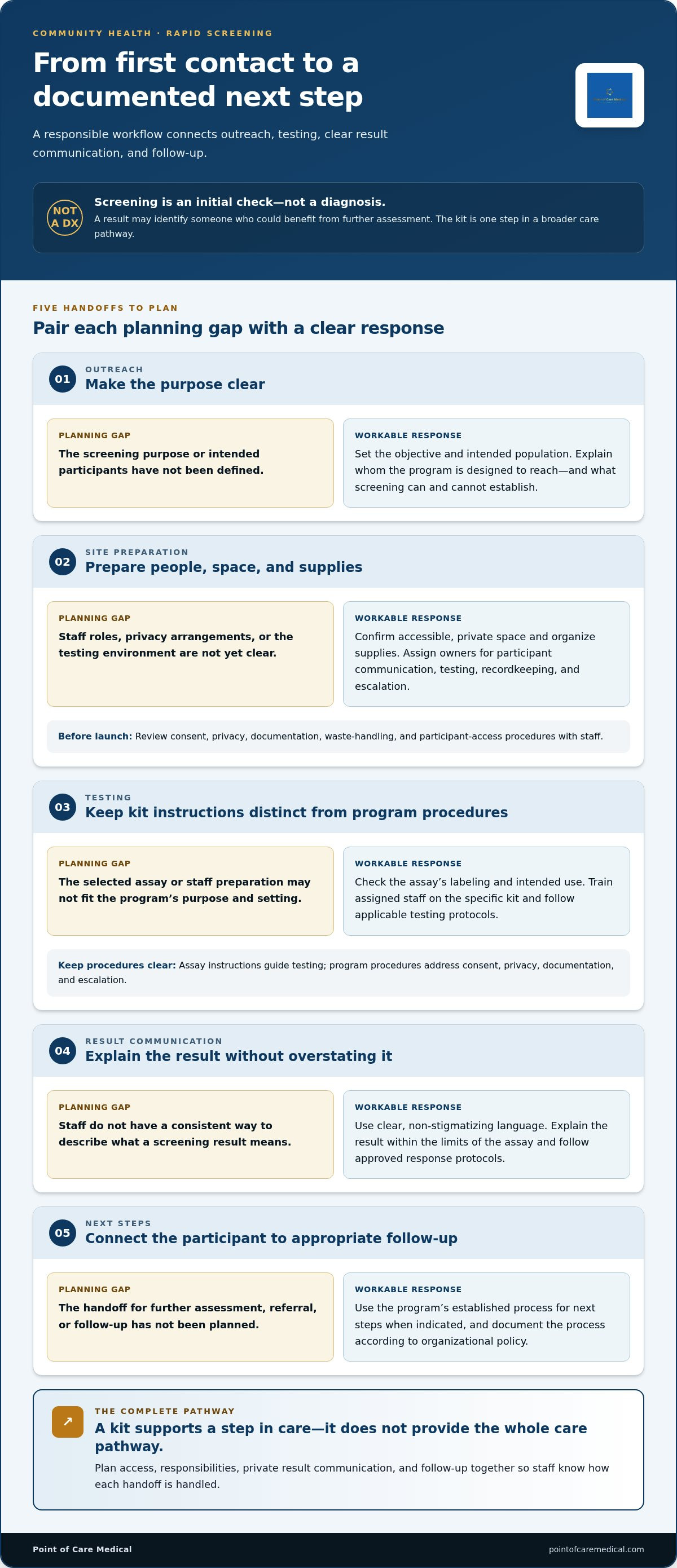
A reliable workflow connects participant contact to a documented next step. Plan each handoff before screening begins so staff know who communicates with participants, who performs testing, and who responds when follow-up is needed. Adapt the sequence to the setting, whether it is a clinic, outreach event, or partner location.
- Define the purpose. Set the screening objective, intended population, and boundaries of the program. Make sure outreach materials explain what screening can and cannot establish.
- Prepare the site. Confirm the space, supplies, staff assignments, privacy arrangements, and procedures for handling materials and waste. Plan for participant access and a suitable testing environment.
- Screen according to the assay instructions. Train assigned staff on the specific kit and its product labeling. Keep assay instructions distinct from program procedures, which should address consent, documentation, privacy, and escalation.
- Communicate the result. Use clear, non-stigmatizing language. Explain the result within the limits of the assay and follow the organization’s approved response protocols.
- Connect to next steps. Use the program’s established process for further assessment, referral, or other follow-up. Record the required information under organizational policy.
Prepare people, space, and supplies before screening
Assign responsibility for participant communication, testing, recordkeeping, and escalation. One staff member may hold several roles, but every task needs a clear owner. Choose a private, accessible area, decide how supplies will be organized, and follow the program’s procedures for waste handling. Before launch, staff should review the specific kit instructions and receive training appropriate to their duties.
Consent, privacy, and documentation policies can vary by organization and setting. Include them in staff guidance rather than relying on informal practice. Identify who will answer questions or manage an unexpected situation, and make sure that person’s role is understood before participants arrive.
Communicate results and organize next steps
Prepare language staff can use consistently without overstating what a screening result means. Participants should understand what the result indicates in the context of the assay, what it does not establish, and what the organization’s protocol recommends next. Staff should know how to discuss results privately and how to respond when a participant requests more information.
Build referral and follow-up steps before outreach begins. Map who makes the connection, what information is documented, and how the program records whether the next step was completed. This closes the gap between sharing a result and supporting further assessment.
From first contact to documented next step, a screening workflow should make every handoff clear. Supply planning is one part of that process. Programs reviewing point-of-care testing supplies can align kit selection with the screening purpose, product instructions, and operational plan.
Choosing a community screening approach: access, capacity, and follow-up
The right screening model depends on whom the program needs to reach and what the team can support after testing. A fixed site can provide continuity, while outreach can reduce travel barriers. A partner site can offer a convenient location but requires clear coordination. No single model is right for every community or screening purpose.
Match the setting to participant and staffing needs
Assess likely travel barriers, expected attendance, privacy needs, and the availability of trained staff. Then consider how the setting affects result communication and follow-up. A familiar clinic may make it easier to connect participants with ongoing services. Outreach may reach people who face access barriers, but the program still needs private space, assigned staff, and a workable way to arrange next steps.
| Model | Access and staffing considerations | Privacy and follow-up considerations |
|---|---|---|
| Fixed site | Uses an established location and may support repeat visits. Participation can depend on whether people can reach the site. | Existing rooms and processes may support private conversations and continuity, subject to site capacity. |
| Outreach | Can bring screening closer to participants. The team must plan staff coverage, transport of supplies, and setup at each location. | Privacy and follow-up arrangements need specific planning, especially when the site is temporary or separate from ongoing services. |
| Partner site | Uses a community location familiar to participants. Responsibilities between the screening team and host organization need to be clear. | Agree on private space, communication roles, documentation, and how participants will access subsequent care. |
Use this comparison to identify trade-offs rather than choosing a model by default. A program might use a fixed site for ongoing access and add outreach where travel is a barrier. Before launch, confirm that the setting supports the intended purpose and participant needs, as well as the staffing and follow-up process.
Assess test fit without overclaiming performance
Start kit selection with the specific assay’s intended use, current labeling, instructions, and applicable requirements. Consider whether staff can follow its workflow in the chosen setting, how results will be explained, and what further steps the program can support. Avoid comparing tests using performance claims that have not been verified for the intended use and context.
For HIV screening, the SURE CHECK HIV 1/2 Assay is one option in Point of Care Medical’s catalog. Its fit depends on its current labeling and the program’s applicable testing requirements. This guide to HIV rapid test kits for clinics can help teams frame selection questions alongside their own protocols.
Consider rapid screening kits for community health alongside referral capacity, not in isolation. Define the follow-up route before selecting a model or beginning outreach. That preparation helps prevent a participant from receiving a result without a clear, responsible next step.
How to plan and evaluate a community screening program responsibly
A responsible program defines readiness before the first participant arrives, then reviews how the process works after launch. A checklist helps teams identify gaps in staffing, supplies, privacy, and follow-up while there is still time to address them. Evaluation can show whether the workflow matches program goals, without treating operational measures as proof of clinical outcomes.
Build a practical readiness checklist
Use a pre-launch review to document whom the program intends to reach, what screening is meant to support, and how staff will carry out each step. Assign responsibility for participant communication, testing, recordkeeping, and escalation. Confirm that the location supports the planned workflow and participant privacy.
- Purpose and population: State the screening objective, intended participants, and limits of the program.
- Setting and workflow: Map participant communication, consent, screening, result handling, and next steps.
- Staffing: Identify role coverage and training needs for each task.
- Supplies and handling: Plan supply storage, preparation, use, and waste handling according to organizational procedures.
- Privacy and records: Establish how participant information and results will be handled and documented under organizational policy.
- Follow-up: Define referral routes, responsible staff, and how completion will be recorded.
- Assay fit: Review the specific assay’s current instructions, intended use, and applicable requirements before implementation.
Involve the people who will perform the work, not only program leaders. Staff may spot practical issues a planning document misses, such as an unclear handoff or a site layout that makes private communication difficult. Resolve these issues before outreach begins.
Evaluate implementation without overstating outcomes
Choose process measures that connect directly to program goals. Participation can show whether the intended audience is engaging. Completed workflows can reveal where participants leave the process before screening or communication is complete. Successful follow-up can indicate whether planned connections to further assessment are being carried out.
Set definitions and review methods in advance, using the organization’s objectives and policies rather than unsupported benchmarks. These measures describe implementation. They do not, by themselves, show that screening caused a clinical outcome. Keep operational tracking separate from clinical outcomes, and avoid causal claims unless the program has evidence to support them.
Review findings with relevant stakeholders, including staff responsible for screening and follow-up. Pair the numbers with staff feedback and, where appropriate, participant input. If records show that referrals are not being completed, examine the handoff process and access barriers before changing the screening model. Guidance on sourcing HIV rapid assays can also inform supply planning as part of the readiness review.
For each review, record what will change, who owns the adjustment, and when the team will assess its effect. For programs planning around rapid screening kits for community health, this creates a practical feedback loop between supplies, workflow, and follow-up. Explore rapid diagnostic testing supplies as one part of that operational plan.
How Point of Care Medical supports community screening supply needs
A screening plan becomes operational when the program aligns its purpose and workflow with appropriate supplies. Test selection is one part of that preparation. Teams also need to consider the setting, staff responsibilities, participant communication, and follow-up. A product does not create those program elements on its own.
Connect program requirements with relevant screening supplies
Before planning procurement, document what the program is designed to do and whom it serves. Then assess the specific assay against its current labeling, intended use, and instructions, as well as the planned setting and workflow. Applicable testing requirements and organizational protocols also inform the decision.
Point of Care Medical distributes rapid diagnostic testing supplies to healthcare and screening organizations across the United States. Its catalog includes respiratory assays such as GenBody COVID-19 Rapid Antigen Tests and ViraDx™ SARS-CoV-2/Flu A+B tests, the SURE CHECK HIV 1/2 Assay, Rapid Test Cups with Fentanyl, and oral fluid drug screens. Choose supplies according to the program’s purpose and requirements. No kit replaces planning for the wider screening and care pathway.
For procurement planning, connect supply needs to practical operating questions:
- Purpose: What screening activity will the supply support, and for whom?
- Setting: Where will testing take place, and what site conditions shape the workflow?
- Staff and instructions: Which staff roles are involved, and what product-specific instructions and training apply?
- Participant process: How will staff communicate results and protect privacy under organizational policy?
- Follow-up: What next steps may be needed, and how will the program connect participants to them?
This context helps teams assess rapid screening kits for community health as part of a broader operating plan. It keeps supply decisions grounded in program needs rather than assumptions about performance or suitability.
Move from planning to a supply discussion
Bring the core planning details together before procurement: screening purpose, intended population, setting, workflow, staffing roles, supply handling, and follow-up process. Include specific assay requirements and applicable organizational procedures. This gives decision-makers a clear basis for evaluating whether a supply choice supports the work staff are expected to perform.
Point of Care Medical’s national distribution connects healthcare and screening organizations with point-of-care rapid diagnostic testing supplies. The catalog includes HIV screening supplies such as the SURE CHECK HIV 1/2 Assay. Review current labeling and intended use as part of your organization’s selection process, while keeping referral planning and program oversight in view.
To align procurement planning with your program’s workflow and requirements, review Point of Care Medical’s screening supplies.
Set the next screening decision in motion
Before expanding or adjusting a program, identify one practical decision your team can resolve next. You might refine how participants move from screening to follow-up, clarify staff responsibilities, or align supply planning with the setting. A defined next step keeps rapid screening kits for community health connected to the program’s purpose.
Use organizational protocols and current assay labeling to guide implementation. Then bring the operational details together for procurement planning, including intended use, workflow, and follow-up requirements. Point of Care Medical distributes supplies to healthcare and screening organizations across the United States, including the SURE CHECK HIV 1/2 Assay.
Review Point of Care Medical’s rapid screening supplies to align your program’s supply planning with its workflow and requirements.
Frequently Asked Questions
What are rapid screening kits for community health?
Rapid screening kits for community health are point-of-care tools used to support an initial screening step within a broader program. The kit is only one part of the setup. Staff also need to understand the assay’s intended use, identify the participants and setting it fits, and plan what information or services may be needed after testing. For an outreach event, that includes planning supplies and a private place to share results.
Can a rapid screening test provide a diagnosis?
No. A screening result alone may not establish a diagnosis. Staff should interpret and communicate results according to the specific assay’s labeling and the organization’s approved protocol. If further assessment is indicated, the program should explain the next step without presenting the screening result as a confirmed condition. This helps participants understand the limits of the test and supports appropriate decisions about care.
How should a community program choose a rapid screening kit?
Start with the screening purpose and the population the program intends to serve. Compare those needs with the assay’s current intended use, labeling, instructions, and applicable requirements. Consider practical fit too: whether the collection process suits the site, what staff training is needed, how supplies will be managed, and whether the team can communicate results and support next steps. Avoid choosing solely on speed or convenience.
What should happen after a reactive screening result?
Follow the response pathway approved for the specific assay and program. Staff should communicate the result privately, explain that a reactive screening result may require further assessment, and avoid describing it as a diagnosis unless the appropriate clinical process establishes one. The protocol should identify who explains next steps, how a referral or further evaluation is arranged, and what information staff document. Use respectful, non-stigmatizing language throughout.
Do community health programs need trained staff to use rapid screening kits?
Programs should ensure that anyone performing or supporting testing is prepared for their assigned role. Training should cover the specific kit instructions, result communication, documentation, and the program’s response process. The organization should also determine what training or qualifications apply to its setting and the assay. Written procedures and a staff coverage plan can help maintain consistent practice when the usual team member is unavailable.
What should a community screening program track?
Track measures that answer operational questions. For example, record how many people were offered screening, how many completed the process, and how many reached the planned follow-up step. Define each measure consistently so staff can compare periods or sites. Protect participant information under organizational policy, and use aggregate reporting where appropriate. Review incomplete workflows to identify practical barriers rather than treating counts alone as evidence of health outcomes.
Can a community health program use an HIV rapid screening assay?
It may be appropriate when the assay’s current labeling, intended use, program setting, and applicable requirements align. The program also needs an approved process for communicating results and arranging any indicated next steps. Point of Care Medical’s catalog includes the SURE CHECK HIV 1/2 Assay. Review its product information alongside the organization’s protocols before implementation. A supply choice does not replace program planning or clinical follow-up.


