

A positive drug screening result is not always proof of drug use. Some medications, including dextromethorphan, ibuprofen, venlafaxine, and sertraline, may trigger false positives on certain tests. The impact of a false positive drug test on employees can include reputational harm or employment consequences, which is why an initial screening result may need confirmation.
It’s understandable to worry when a test result conflicts with an employee’s medication history. Immunoassay screens can react to substances with similar chemical structures, and different tests may produce different results. A positive screen is generally considered presumptive until confirmatory testing helps clarify it.
This article explains which prescription and over-the-counter medications may affect results, how screening and confirmation work, and how workplace policies can shape an employee’s next steps. It also explains why medication disclosure and a fair review process matter when a result is disputed.
Key Takeaways
- Review medication and supplement information when interpreting a positive screen; test methods can react differently to similar compounds.
- Disclose relevant medications through the testing process, and don’t stop prescribed treatment without guidance from a health care provider.
- Understand how confirmatory testing and workplace policy shape the review of a disputed result.
- Keep records of medications and test-related communications to support a clear, timely review.
What Medications Can Cause False Positives on Drug Tests?
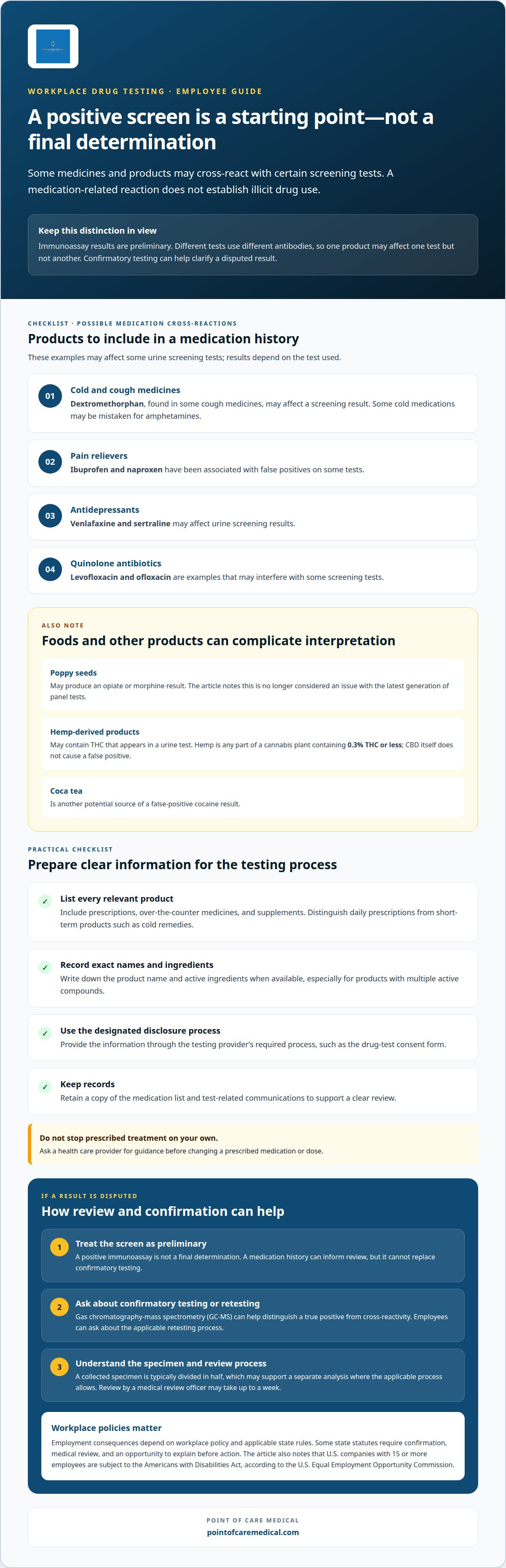
Several medications may cross-react with urine screening tests, depending on the test. Dextromethorphan, found in some cough medicines, may trigger a false positive. Ibuprofen and naproxen, both nonsteroidal anti-inflammatory drugs, may also affect some results. Venlafaxine and sertraline are antidepressants associated with possible false-positive urine results. Levofloxacin and ofloxacin are examples of quinolone antibiotics that may interfere.
Some cold medications may be mistaken for amphetamines. A medication-related reaction does not establish that an employee used an illicit drug. Because immunoassay tests use different antibodies, a medication may affect one test but not another. Employees should document prescription and over-the-counter products through the testing process, and should not stop prescribed medication without guidance from a health care provider.
- Cold medicine: Dextromethorphan may affect a screening result.
- Pain relief: Ibuprofen and naproxen have been associated with false positives.
- Antidepressants: Venlafaxine and sertraline may affect urine testing.
- Antibiotics: Levofloxacin and ofloxacin may cause cross-reactions.
Foods and supplements can also complicate interpretation. Poppy seeds may produce an opiate or morphine result, although this is no longer considered an issue with the latest generation of panel tests. Hemp-derived products may contain THC that appears in a urine test; CBD itself does not cause a false positive. Hemp is any part of a cannabis plant containing 0.3% THC or less. Coca tea is another potential source of a false-positive cocaine result.
A positive immunoassay is a preliminary finding, not a final determination. Confirmatory testing, such as gas chromatography-mass spectrometry, can help distinguish a true positive from cross-reactivity. If an employee disputes a result, they can ask about retesting. A collected specimen is typically divided in half, which may support a separate analysis where the applicable process allows it. Review by a medical review officer may take up to a week.
Can an employee be fired after a false positive, and what remedies are available? Employment consequences depend on workplace policy and applicable state rules; some state statutes require confirmation, medical review, and an opportunity to explain before action. Employees can dispute a result and request retesting, while U.S. companies with 15 or more employees are subject to the Americans with Disabilities Act, according to the U.S. Equal Employment Opportunity Commission.
Urinalysis and sweat-patch testing use different specimen types, so their results are not interchangeable. False negatives can also occur: improper collection, dilution, or tampering may affect a result. These limitations make the testing method, specimen handling, and confirmation process important when interpreting positive and negative findings.
Prescription and over-the-counter medications that may trigger false positives
Drug screens can react to medication ingredients that resemble targeted substances. A prescription or over-the-counter product may affect one assay but not another. The medication name alone may not identify the relevant ingredient, especially when a product combines several active compounds. Before the testing appointment, record the product name and its active ingredients.
Cross-reactivity is not limited to prescription medications. Cold remedies, pain relievers, antidepressants, antibiotics, supplements, and hemp-derived products may be relevant to interpreting results. The specific result depends partly on the test’s antibody technology. A medication history can support the review, but it cannot replace confirmatory testing.
Before drug testing, disclose prescription medications, nonprescription products, and supplements through the testing provider’s required process. Employees may list them on the drug-test consent form. Include each product’s name and distinguish daily prescriptions from short-term medicines, such as cold remedies. This context can help a reviewer assess whether a positive screening result needs further analysis.
Keep the information factual. Disclosing a medication does not establish that a result is false, and a positive screen does not by itself prove illicit drug use. The laboratory’s screening method and any confirmatory result help distinguish these possibilities. A medical review officer may consider the reported medication history when reviewing a result.
- List every product: Include prescriptions, over-the-counter medicines, and supplements.
- Use exact names: Record brand names and active ingredients when available.
- Disclose before screening: Use the consent form or other designated process.
- Retain records: Keep a copy of the medication list and testing communications.
Do not stop a prescribed medication before testing without prior approval and guidance from a health care provider. Abruptly changing treatment can affect health, while withholding medication information can complicate the review. Ask the prescribing professional about medication decisions, and provide accurate information to the testing process rather than changing a dose independently.
Detox products and attempts to alter a specimen raise separate concerns. Dilution and tampering can contribute to false-negative results, so they are not a reliable way to address a suspected cross-reaction. If a screening result is disputed, request the applicable review or retesting process instead of trying to mask the result.
Employers evaluating testing options can also consider the specimen type used in their program. Oral Fluid tests are one available testing category; medication disclosure and result review remain important parts of interpreting workplace drug screening.
Workplace drug-testing policies
Workplace policies determine when screening occurs, which specimens are collected, and how positive results are reviewed. Pre-employment and random testing during employment are common approaches. Clear procedures help employees understand how a result will be evaluated before it affects a workplace decision.
Federal workplace urine testing uses defined screening cutoffs. The U.S. Department of Health and Human Services sets the initial marijuana-metabolite screening cutoff at 50 ng/mL and the initial-screening cutoff for cocaine metabolites at 150 ng/mL. The workplace initial-screening cutoff for PCP is 25 ng/mL, according to the U.S. Department of Health and Human Services. These cutoffs guide screening decisions; they do not, by themselves, establish impairment.
Employers in DOT-regulated industries must follow 49 CFR Part 40, including requirements for SAMHSA-certified laboratories, Medical Review Officer procedures, and split-specimen testing rights, according to the U.S. Department of Transportation. Those procedures provide a formal review path. Employees should follow the instructions they receive about reviewing a result or requesting split-specimen testing.
Detection windows depend on the substance and specimen. Urine testing may detect amphetamine for 48 hours, cocaine metabolites for 2 to 4 days, opioids for 2-3 days, and alcohol for 12-24 hours. Urine tests may detect marijuana for 3-30+ days. These ranges describe possible detection, not a precise measure of impairment or the time a person used a substance.
- Blood: May detect alcohol for 12 hours, cocaine for 12-48 hours, and opioids for 24-48 hours.
- Hair: Can detect drug use for up to 90 days, starting 5-7 days after consumption.
- Urine: Detection varies by substance and may begin 1 to 4 hours after consumption.
For employees, the impact of a false positive drug test can extend beyond the screening result if policy treats it as conclusive. A clear process should explain confirmation, review, confidentiality, and how employees can raise concerns. Some employers apply zero-tolerance policies, while others consider the circumstances. Applicable state rules can also shape employer procedures.
Parole or probation testing follows supervision requirements, not an employer’s workplace policy. In Arizona, penalties for failed tests tied to parole or probation violations can range from increased supervision to reincarceration. Military members should follow the testing and review instructions that apply to their service. The impact of a false positive drug test on employees therefore depends on the testing program and the rules governing that setting.
Immunoassay screening and cross-reactivity
Urine immunoassays are commonly used for initial workplace drug screening. They use antibodies designed to react with target substances or related compounds. If another substance produces a similar reaction, the screen may report a presumptive positive. That result indicates a possible match, not definitive proof that a specific drug is present.
Cross-reactivity varies because manufacturers use different antibody technologies. As a result, the same sample can produce different screening results on different immunoassay tests. Medication history and the specific panel matter when interpreting a result. A positive screen should be confirmed with a more specific method, such as gas chromatography-mass spectrometry, before it is treated as conclusive.
Urine panels may screen for THC, opioids, PCP, amphetamines, cocaine, barbiturates, benzodiazepines, tramadol, methadone, fentanyl, LSD, and MDMA. A panel does not necessarily test for every substance on that list. Employers select panels for their testing programs, so employees should understand which categories a test covers. The panel’s targets and cutoffs affect whether a sample is reported as positive.
A result labeled “amphetamine” does not identify the exact compound that caused an immunoassay reaction. Methylphenidate and amphetamine are different substances, so a methylphenidate prescription should not be treated as proof of amphetamine use. The screening result reflects the assay’s response; confirmatory analysis helps identify the specific substance involved. This distinction matters when workplace consequences may follow a preliminary result.
Cold medicines containing dextromethorphan may be mistaken for amphetamines by some drug screens. Other medications, including venlafaxine, sertraline, ibuprofen, naproxen, levofloxacin, and ofloxacin, may also affect particular tests. These examples do not mean every assay will react the same way. The medication, panel design, and test method all shape the outcome.
Interpret results in stages. First, identify the specimen type and panel used. Next, treat an initial positive immunoassay as presumptive. Then use confirmatory testing to assess whether the target substance is present. If the confirmed result conflicts with a disclosed prescription, a medical review officer can consider the relevant medication information through the applicable review process.
- Screening: An antibody-based test identifies possible target reactions.
- Cross-reactivity: A related compound may trigger a similar signal.
- Confirmation: GC-MS can clarify a presumptive positive result.
This sequence separates a preliminary signal from a verified finding. It also gives employees and workplace administrators a clearer basis for discussing the result, the sample, and any appropriate review before decisions rely on screening alone.
Drug test false-positive reliability
Reliability depends on the screening method, specimen collection, and review process. For employees, the key distinction is whether a result is preliminary or confirmed.
Workplace Drug-Test Accuracy
Workplace drug-test accuracy describes how consistently a test identifies its target substance without misclassifying a sample. Immunoassay results can vary because tests use different antibody technologies. Medication cross-reactivity and laboratory errors can also affect findings. This matters because a preliminary result may influence workplace decisions before further review. Policies that separate screening from confirmation provide a clearer basis for interpreting results.
Screening and Confirmation Test Differences
A screening test, commonly an immunoassay, flags a possible substance based on its reaction to a sample. A confirmation test uses a more specific method, such as gas chromatography-mass spectrometry, to identify the substance. This distinction matters because an initial positive is presumptive, while confirmation can help resolve cross-reactivity. A medical review officer can then consider the result alongside relevant medication information.
How accurate are workplace drug tests, and how do screening and confirmation differ? Accuracy depends on the assay, specimen handling, and review steps. Screening flags a possible presence; confirmation uses methods such as mass spectrometry to identify a specific substance.
False positives may occur when a medication or other compound reacts with an immunoassay’s antibodies. Laboratory errors can also produce an incorrect result, though medications are a more common cause than laboratory errors. These are distinct issues: cross-reactivity involves the test’s response, while a laboratory error can occur during processing or reporting. Reviewing a result requires attention to both the assay and the sample’s path through the testing program.
Collection procedures also affect reliability. Improper collection, dilution, or tampering can contribute to false-negative results. A negative finding therefore does not always establish that a substance was absent. Sample-validity checks and documented handling help reviewers assess whether a result accurately reflects the specimen. Workplace programs should apply consistent collection and review procedures rather than treat every result as self-explanatory.
When an employee disputes a positive result, the next step is to follow the employer’s review process and request retesting where available. Confirmatory testing reviewed by a medical review officer may take up to a week. The delay can affect scheduling or employment-status decisions, so policies should explain how pending results are handled. A documented process also helps distinguish a confirmed finding from an initial screen.
For organizations refining collection workflows, review testing options alongside their confirmation and result-review procedures.
Point of Care Medical: Oral Fluid tests
Point of Care Medical supplies Oral Fluid tests for organizations evaluating specimen options for workplace drug-testing programs. Consider the test type alongside the substances screened, collection procedures, and the policy for reviewing positive results. Changing specimen type does not replace the need to interpret results within the program’s testing and confirmation procedures.
Point of Care Medical also offers the Rapid Test Cup "RTC" + Fentanyl, alongside respiratory tests such as the GenBody COVID-19 Rapid Antigen Test and ViraDx™ SARS-CoV-2/Flu A+B Rapid Antigen Test. Select an offering based on the testing need it addresses, rather than treating different test categories as interchangeable.
Contact Point of Care Medical to discuss its Oral Fluid tests and other available testing products.
Build a Clearer Review Process
Review how your workplace communicates test outcomes. A written process can set expectations for employees, managers, and human resources before a disputed result arises. Define who receives results, how medication disclosures enter the review, and how decisions are recorded. Clear roles help prevent a preliminary result from being mistaken for a final employment decision.
The impact of a false positive drug test on employees can extend beyond the test itself, affecting workplace trust and confidence in testing policies. Including result communication in program design gives employees a defined path to raise concerns and helps administrators apply procedures consistently.
For organizations considering testing products as part of their broader program, contact Point of Care Medical to discuss available options. A clear policy and a considered product choice can support a more dependable workplace process.
Frequently Asked Questions
What Happens if You Fail a Drug Test?
A failed workplace test can lead to consequences under an employer’s policy, including suspension or termination. The employer may review the result, test type, and any applicable confirmation process before deciding what follows. For DOT-regulated employees, federal procedures include Medical Review Officer review and split-specimen rights. Read the policy’s review and appeal steps, and keep written records of relevant communications.
What drugs are likely to interfere with urine drug screens?
Some medications can cross-react with urine immunoassays, but the effect depends on the assay. Examples include dextromethorphan, ibuprofen, naproxen, venlafaxine, sertraline, levofloxacin, and ofloxacin. Certain cold medicines may also be mistaken for amphetamines. Employees should report medications through the testing process, since a screening result alone may not identify which compound caused the reaction.
What if I Have a Medical Condition That Requires a Prescription Drug?
Continue following the prescribing health care provider’s instructions, and don’t stop or change medication solely because of a workplace test. Disclose relevant prescriptions through the testing provider’s required process or consent form. For example, an employee taking a prescribed antidepressant can provide its name for review if a result raises questions. Medication disclosure provides context, but does not replace test confirmation or the applicable review process.
What employment consequences can follow a false positive drug test?
A false positive may lead to employment consequences if an employer acts on an unconfirmed result. Possible effects include suspension, termination, a lasting entry in an employment record, or damage to professional reputation. Policies and state requirements differ, so the applicable review procedure matters. Employees can raise a dispute, provide medication information, and request retesting through the process available to them.
How common are false positive workplace drug test results?
There is no single frequency that applies to every workplace drug-testing program. Results depend on the immunoassay, its antibody technology, the panel, and the substances present in a specimen. Different urine tests can react differently to the same medication. Employers should distinguish presumptive screens from confirmed findings and avoid treating a screening result as definitive on its own.
Which medications and substances can cause false positive drug tests?
Examples include dextromethorphan, ibuprofen, naproxen, venlafaxine, sertraline, levofloxacin, and ofloxacin. Poppy seeds may affect opiate or morphine results, while coca tea may affect cocaine screens. Hemp-derived products can contain THC that appears in urine testing; CBD itself does not cause a false positive. Employees should disclose medications, supplements, and relevant foods through the testing process.
What is the MRO review process for a positive employee drug test?
A Medical Review Officer reviews applicable positive results and considers information relevant to interpreting them, including disclosed medication history. In DOT-regulated testing, required procedures include MRO review and split-specimen testing rights. This review helps distinguish a preliminary screen from a result supported by confirmation. Employees should provide accurate medication information through the designated process and retain communications about the result.
How can an employee challenge or appeal a false positive drug test?
Use the employer’s stated dispute process, explain the specific concern, and provide relevant prescription or supplement information. An employee can ask to be tested again. In DOT-regulated testing, an employee has the right to request testing of the split specimen under 49 CFR Part 40 procedures. Keep copies of notices and requests, and note dates so the review process is clearly documented.


