

A rapid result is useful only when the health center can act on it. Choosing diagnostic kits for federally qualified health centers means weighing more than test type: patient needs, clinic flow, staff capacity, result ownership, and follow-up all affect whether testing works in practice.
A new test can add steps for staff, complicate procurement, or leave gaps between a result and the next step in care. Rather than choosing the fastest or most familiar kit by default, match each test to a defined clinical purpose and a workflow the team can sustain.
This guide offers a practical framework for assessing testing needs, comparing kit requirements with your care model, and planning a controlled rollout. It also covers how to assign responsibility for results, follow-up, referrals, inventory, and ongoing review. The goal is a workable plan that supports patient care without creating avoidable disruption to daily clinic operations.
Key Takeaways
- Define the care goal and patient groups each test is meant to support before comparing kits.
- Use current product instructions and official sources to compare intended use, specimen, workflow, and result interpretation.
- Assign responsibility for ordering, performing, documenting, interpreting, and communicating each test result.
- Introduce diagnostic kits for federally qualified health centers through a controlled launch, then review how the workflow affects clinic operations.
- Align procurement with expected use, storage needs, service priorities, and routine inventory and expiration-date tracking.
How diagnostic kits support FQHC care and patient access
Diagnostic kits are tools within a clinical service, not substitutes for clinical assessment, counseling, or treatment. Their value depends on how well a test fits its intended use and how the care team responds to the result. For a Federally Qualified Health Center (FQHC), testing should support the center’s service priorities and patient care model. Those priorities, staffing, workflows, and test availability vary among health centers.
Timely testing can give clinicians information to consider during a visit, help guide next steps, or indicate when additional assessment is needed. The test is only one part of the care pathway: the center also needs a process for explaining and documenting results, arranging follow-up, and connecting patients with appropriate services. Selecting diagnostic kits for federally qualified health centers therefore starts with the care need, not a product category or the promise of a fast result.
Start with patient needs and the services your center provides
Map the patient groups your center serves, its clinical priorities, and the points in care where testing may be useful. Distinguish routine screening from testing prompted by symptoms or a time-sensitive clinical question. These purposes may involve different workflows and follow-up. For each potential use, identify who may be offered testing, who will explain it, and what the care team will do with the result.
Include access considerations in that review. Plan for language support, accessible communication, disability-related accommodations, and a private setting for sensitive conversations or specimen collection. For example, an HIV screening workflow should protect privacy and make the next step clear to the patient. The center’s priorities and current clinical guidance should determine whether and how a test fits its services.
Where point-of-care testing fits in the care pathway
On-site testing can inform a visit when the assay’s intended use, specimen requirements, and instructions match the clinical question and the center’s workflow. It may help the care team consider next steps without waiting for a separate testing appointment. A result does not, by itself, establish that a patient has or does not have a condition in every circumstance. Interpret it within the assay’s stated purpose and the patient’s clinical context.
Make the distinctions between screening, preliminary results, and diagnostic confirmation clear. Screening identifies whether further evaluation may be appropriate. A preliminary result is an initial finding that may require additional action. Diagnostic confirmation follows the process recommended for the situation and applicable guidance. Define in advance who explains each result and how the patient reaches the next step, including when a negative result does not resolve symptoms or other clinical concerns.
HIV testing illustrates why the full pathway matters: selecting a kit is only one part of planning, alongside counseling, result communication, and follow-up. For more background on HIV-specific considerations, see the HIV rapid test kits for clinics guide.
How to assess diagnostic-kit needs before choosing tests
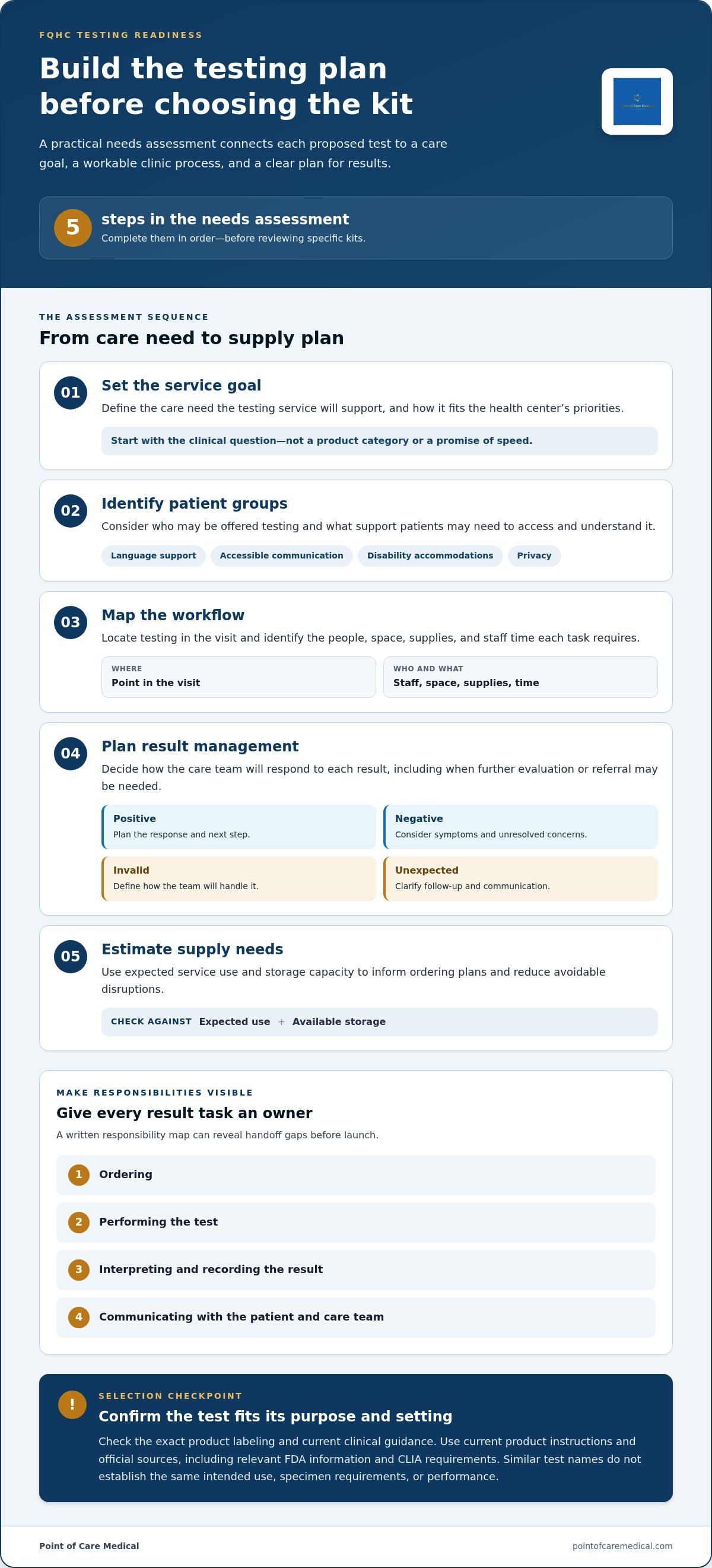
Complete a documented needs assessment before reviewing specific kits. This separates clinical requirements from preferences such as packaging or ordering convenience and helps identify operational gaps before procurement begins. For diagnostic kits for federally qualified health centers, connect each proposed test to a defined service goal and a realistic plan for using and following up on results.
Work through these steps in order:
- Set the service goal. Define the care need the testing service is intended to support and how it fits the center’s priorities.
- Identify patient groups. Consider who may be offered testing and any relevant access, communication, privacy, or accommodation needs.
- Map the workflow. Identify where testing would happen during a visit, who would do each task, and what space, supplies, and staff time the process requires.
- Plan result management. Decide how the care team will respond to each result type, including when further evaluation or referral may be needed.
- Estimate supply needs. Use expected service use and storage capacity to inform ordering plans and reduce avoidable disruptions.
Define the testing purpose and intended use
Start with the clinical question. Is the proposed test intended to support screening, assessment of symptoms, or another defined service? Compare that purpose with the exact product labeling and current clinical guidance. Similar names or test categories do not establish that two assays have the same intended use, specimen requirements, or performance.
Before selection, document the requirements that apply to the specific assay and setting. Use current product instructions and official sources, including relevant FDA information and CLIA requirements, rather than relying on a distributor description or assumptions based on another product. Keep mandatory clinical and regulatory criteria separate from preferences such as ordering format. A kit that does not meet a required intended use should not advance just because it seems easier to procure.
Map capacity, staffing, and follow-up before selection
Check whether the proposed workflow fits available staffing, training responsibilities, space, and visit flow. Assign an owner to each step: ordering, performing the test, interpreting and recording results, and communicating them to the patient and care team. A written responsibility map can reveal handoff gaps before launch.
Plan responses for positive, negative, invalid, and unexpected results. Define when staff should repeat a test, seek additional evaluation, or arrange follow-up, using the exact product instructions and applicable guidance. For HIV testing, sourcing decisions are one part of this broader workflow; the HIV assay sourcing guide offers a focused discussion. For a practical view of rapid-test categories, explore Point of Care Medical’s diagnostic testing supplies.
How to compare diagnostic kits for FQHC workflows
Compare each candidate against the same clinical and operational criteria. A consistent review helps a health center distinguish an appropriate assay from one that merely seems convenient to order or use. Operational fit matters, but first confirm that the test’s intended use and applicable requirements align with the planned service.
Use a comparison worksheet and record the source for each entry. Review the details against current product instructions and official information:
- Intended use: What clinical question is the assay designed to address, and is the proposed service screening or diagnostic testing?
- Specimen: What specimen does the product documentation specify, and can the clinic’s planned collection process support it?
- Workflow: What steps must staff complete, and who is responsible for handling, interpretation, and documentation?
- Result interpretation: What results may occur, and what instructions govern invalid, unclear, or unexpected findings?
- Follow-up: What additional evaluation, communication, or referral may be needed for each result type?
Keep the comparison factual. Do not rank named products unless current, comparable evidence supports the exact use case. Similar product names or categories do not establish equivalent intended uses, performance, or workflow requirements.
Compare test purpose, specimen, and result workflow
Start with current product documentation, not a general description of a test category. Confirm the exact assay name, intended use, specimen requirements, interpretation instructions, and stated limitations. Then map the test steps to clinic roles: who prepares and collects the specimen, performs the test, interprets the result, enters it in the record, and communicates it.
Consider how the result connects to care. A finding may inform a clinical discussion without replacing evaluation or establishing a diagnosis on its own. Document when the pathway calls for additional assessment or confirmation, and who arranges it. Use current clinical guidance rather than assuming the same follow-up applies across assays or patient situations.
Check regulatory status and implementation requirements
Verify the exact assay’s current FDA status and applicable CLIA categorization through official sources, including relevant FDA information and CMS CLIA resources. Do not infer status from a product family, a similar assay, or a broad category. Record when and where verification was completed so the clinic can revisit it if documentation changes.
Product status and facility obligations are related but distinct. A product’s regulatory status does not, by itself, establish that a particular clinic has met its testing responsibilities. Confirm requirements for the specific testing activity and setting, then incorporate them into clinic procedures and staff preparation. A community health screening case-study framework can also help teams consider how test selection connects to practical planning. For a focused look at available categories, review diagnostic testing supplies as one part of the wider comparison process.
How to introduce diagnostic kits into daily clinic operations
Move from selection to routine use in stages. A written implementation plan helps staff understand their roles, keeps patient communication consistent, and surfaces workflow issues before testing becomes part of normal clinic flow. Align each procedure with current assay instructions and applicable requirements. Avoid informal workarounds that may differ between staff or shifts.
Use four stages to structure the rollout:
- Prepare: Finalize the written procedure, required documentation, patient-facing explanations, and result pathways.
- Build staff readiness: Provide role-based training and follow applicable competency processes before staff perform assigned tasks.
- Launch in a controlled way: Start with a manageable workflow and defined staff roles, then review early cases.
- Review and adjust: Track process issues, gather staff feedback, and update procedures when the workflow or applicable instructions change.
Keep ownership explicit. Name who authorizes test use, handles the kit and specimen, documents the result, communicates it, and ensures the next step is completed. This helps prevent tasks from falling between clinical, administrative, and follow-up roles.
Prepare staff, documentation, and patient communication
Train staff for their assigned tasks and the requirements that apply to the assay and setting. Use current product instructions as the reference for test handling and interpretation. Standardize the clinical record entry so staff consistently capture the test performed, result, relevant context, communication, and planned next step. Provide plain-language explanations of privacy practices and how patients will receive results or follow-up.
Launch, monitor, and improve the workflow
A limited launch lets the team test the procedure in actual clinic conditions before expanding use. Review whether roles are clear, documentation is complete, and the process fits visit flow. Monitor delayed follow-up, unclear handoffs, and supply interruptions. Invite staff to report friction points, then review cases and revise written procedures while keeping them aligned with current assay instructions and applicable requirements.
Write a result pathway before launch. Explain how staff handle routine findings, unexpected results, invalid results, and situations requiring additional follow-up. For each pathway, identify the responsible role, required documentation, and how the patient and care team receive the information. Use the assay’s instructions and current clinical guidance to define appropriate next steps. The procedure should also explain how unresolved follow-up is escalated within the clinic.
Keep the workflow usable at the point of care. Store the current procedure where staff can access it, and assign responsibility for reviewing it when product instructions or applicable requirements change. A brief post-launch check-in can show whether staff need clarification or whether documentation creates avoidable delays. Record decisions and updates so the team follows a consistent process.
To connect your planned workflow with available products, explore diagnostic testing supplies.
How to manage diagnostic-kit procurement and ongoing review
Procurement works best when it reflects the testing service the clinic plans to provide. Use expected utilization, storage capacity, and service priorities to guide orders rather than treating kit purchasing as a separate task. This aligns inventory with actual workflows and reduces the risk of stocking products staff cannot use effectively or that do not match current clinical needs.
Create a routine review process that connects purchasing with clinical and operational oversight. Set a review schedule based on clinic procedures, and define who checks stock, assesses upcoming needs, and initiates reorders. Account for planned services and past utilization without assuming historical demand will stay the same.
Build a practical inventory and reorder process
Assign responsibility for receiving supplies, checking product documentation, storing kits according to their instructions, rotating stock, and deciding when to reorder. Record lot information and expiration dates through the center’s established inventory process. Make sure staff can identify which stock to use first and where to find current product instructions. These controls support traceability and help the team identify inventory concerns before they interrupt testing.
Use historical utilization as a planning input, not a fixed forecast. Compare usage with scheduled services and known changes in clinic priorities. If a service expands or demand shifts, update the order plan. Include storage requirements in procurement decisions so the clinic can manage supplies under the conditions specified in current product documentation. Maintain product records using established clinic procedures.
Review testing performance and plan next steps
Schedule periodic reviews of both the testing pathway and inventory process. Examine whether the intended workflow is being completed, documentation is consistent, and results lead to planned follow-up. Review staff feedback alongside stock issues such as expired kits, unexpected usage changes, or supply interruptions. Use the findings to adjust the process, not simply to increase or reduce order quantities.
Reassess test fit when patient needs, clinical guidance, staffing, or workflows change. Confirm that the assay remains aligned with its intended purpose and that current instructions and applicable requirements are reflected in clinic procedures. A change in service priorities may call for a different supply plan or a review of how the existing test fits the care pathway. Document decisions and assign owners for updates.
Keep the review practical. A short record of utilization, inventory concerns, workflow gaps, and resulting actions gives procurement and clinical teams a shared basis for decisions. It also helps distinguish a temporary supply issue from a lasting change in testing need. Regular review supports continuity without making ordering decisions on convenience alone.
Once your clinic has defined its service requirements and workflow, explore rapid diagnostic testing supplies from Point of Care Medical, including respiratory tests such as GenBody COVID-19 Rapid Antigen Tests and ViraDx™ SARS-CoV-2/Flu A+B tests, SURE CHECK HIV 1/2 Assays, Rapid Test Cups with fentanyl, and oral fluid tests.
Build a testing program your team can sustain
A testing program should remain useful as patient needs and clinic priorities evolve. Treat each selection as a decision the team can revisit, supported by clear ownership and a record of why the test fits the service. This gives staff a practical reference when workflows change and keeps procurement connected to patient care.
Selecting diagnostic kits for federally qualified health centers is an ongoing operational decision, not a one-time purchase. Point of Care Medical distributes rapid diagnostic testing supplies to healthcare and screening facilities nationwide, including respiratory, infectious disease, and toxicology testing categories.
Once your center has defined its requirements, explore diagnostic testing supplies for your health center. A clear plan and carefully matched supplies can help your team build a workflow that fits its services and supports consistent care.
Frequently Asked Questions
What does FQHC mean, and how does it relate to diagnostic testing?
FQHC means federally qualified health center, a community-based health center that provides care under applicable program requirements. The designation does not mean every center offers the same tests or services. Diagnostic kits are one possible tool within a center’s care model. A kit does not define the center’s scope or replace the clinical assessment needed to interpret a result for an individual patient.
Can patients without insurance receive diagnostic testing at an FQHC?
Insurance status alone does not determine whether a patient can access testing at an FQHC, but services, eligibility steps, and charges can vary by center. Patient-facing information should explain the center’s applicable fees, consent steps, privacy practices, and how results will be communicated. When selecting diagnostic kits for federally qualified health centers, include these details in the testing workflow.
Can an FQHC offer walk-in diagnostic testing?
Walk-in testing depends on the center’s services, staffing, hours, and clinical procedures. A rapid test format does not automatically mean testing is available without an appointment or an initial assessment. Centers can reduce confusion by publishing clear access instructions and explaining what patients should bring. They should also plan how walk-in patients will receive result explanations and any needed next-step instructions.
Can a rapid diagnostic test provide same-day results at an FQHC?
Some rapid tests are designed to provide results during a visit, but timing depends on the specific assay and its instructions. A same-day result does not necessarily mean the care pathway is complete. If a result is still pending when a patient leaves, staff need a defined way to communicate it later. Explain what is known, what remains uncertain, and how the patient will receive updates.
Do FQHCs need a separate workflow for outreach or community events?
Outreach settings can raise practical issues that a routine clinic visit may not, including private conversations, reliable recordkeeping, and clear routes back to care. Before an event, decide how staff will identify participants, document testing, protect conversations from being overheard, and explain how results will be shared. Make sure participants know how follow-up information will be provided. Event procedures should fit the center’s clinical protocols and the setting.
What should an FQHC do when a patient needs follow-up after testing?
Follow the center’s clinical protocol and the guidance for the specific test and situation. A practical safeguard is to track pending follow-up in a designated work queue, with an assigned owner and a documented next action. If staff cannot reach a patient, the procedure should explain how to record contact attempts and escalate the case for review. This helps prevent an unresolved result from disappearing between visits or staff handoffs.


