

What should you do first when a drug test comes back positive and you believe the result is wrong? Don’t assume an initial screen is the final determination. Bulk rapid drug test cups can support screening workflows, but a rapid screening result does not independently confirm or resolve a disputed result.
It’s reasonable to be concerned about possible effects on your job, care, or program status. First find out whether the result is preliminary or confirmed, and note when and how you were notified. Keep relevant medication information, test records, and policy documents together. Review processes and deadlines vary by program, so follow the instructions provided with your result.
This step-by-step guide explains how to document your concern, request the appropriate review, and understand when confirmatory testing or qualified review may be appropriate. You’ll also learn which records to gather and how to identify the right review contact. A screening result is a signal to follow the applicable process, not necessarily a final conclusion.
Key Takeaways
- Check whether the result is a preliminary screen or has gone through further review.
- Gather the result notice, test date, specimen type, and available testing records before raising a concern.
- Follow the applicable policy to notify the designated contact and request the appropriate review.
- Possible explanations for a screening result depend on the substance, assay, specimen, and test instructions.
- Use bulk rapid drug test cups as part of a documented screening workflow, not as a substitute for result review or confirmation.
Received a Positive Drug Test? First Identify What the Result Means
A positive screening result may require review under the protocol that governs the test. Before drawing conclusions or responding to a workplace, clinical, or program decision, find out which test was performed and whether a confirmation step occurred. The wording on a notice matters: “positive,” “non-negative,” and “preliminary” can be used differently across testing procedures.
A false positive is a positive result that later review does not substantiate. The term describes the relationship between an initial result and the outcome of review, not the reason the result occurred. For a general explanation, see Understanding False Positives. The meaning of a specific drug test result depends on the test type, its instructions, the applicable program rules, and whether confirmation has taken place.
A preliminary screen flags a result for follow-up; it is not the same as a laboratory-confirmed result. Even a laboratory-confirmed result may be subject to a separate review process under the applicable policy. Read the notice carefully, and don’t treat a test result by itself as proof of impairment or misconduct.
Is the result a rapid screen or a laboratory-confirmed result?
Start by identifying the testing method. Check the result notice and available records for the specimen type, test method, and any reference to laboratory confirmation. If the notice doesn’t make the result’s status clear, ask the contact named in the notice or policy what stage the result represents.
Rapid cups provide screening results according to their instructions. A screening result indicates that the finding should be handled under the applicable workflow; it does not establish a final determination on its own. For organizations sourcing bulk rapid drug test cups, written procedures should state how staff record each result and what steps follow. Interpret the result according to the specific test instructions and program rules.
Who issued the result and who handles review?
The appropriate review contact depends on the testing context. A workplace, clinical setting, treatment program, or other screening program may have different procedures and responsible contacts. Start with the result notice, consent materials, or written policy. Direct your question to the named program contact and follow the process provided.
Some workplace programs involve a Medical Review Officer (MRO), who may review laboratory-confirmed results as part of the program’s process. An MRO is not involved in every type of test. Confirm who handles review in your case, whether the result is a screen or laboratory finding, and what the applicable policy requires next. Keep a record of whom you contacted and any instructions you receive.
Why Can a Drug Screen Produce a False Positive?
Some drug screens use immunoassays, which detect substances through reactions with specific antibodies. A target substance and another compound may share characteristics that cause a similar reaction in a particular assay. This is called cross-reactivity. It can contribute to a non-negative screening result, but it doesn’t prove the result is false or identify what caused it.
Possible interference depends on the substance being tested, the assay, the specimen, and the test instructions. Results from one test format can’t automatically be interpreted using assumptions about another. For facilities using bulk rapid drug test cups, staff should follow the instructions for the specific test and record results using the terminology and process in the applicable protocol.
A screening method may flag a reaction, while a different laboratory method can assess the specimen using a more specific analytical approach. That distinction is one reason a screening result may require confirmation or review under the program’s procedures. Applicable workplace requirements vary, so consult the relevant SAMHSA Guidelines for Drug Testing when determining whether federal workplace guidance applies to a particular program.
How medications and other substances may affect screening
Don’t assume a medication caused a result based on a general list or online example. Potential cross-reactivity is assay-specific, and the same substance may not affect every test in the same way. Without information tied to the assay and its instructions, treat possible interference as a question for qualified review, not as an explanation for a particular result.
If asked to provide relevant information, accurately record prescription medicines, over-the-counter products, and supplements. Include names and use details you can provide, and share them through the review process identified by the program. Don’t stop or change a prescribed medication without direction from your clinician. Complete information helps the responsible reviewer assess the result in context.
What confirmation testing can add
Depending on the testing program, a laboratory may use methods such as gas chromatography-mass spectrometry (GC-MS) or liquid chromatography-tandem mass spectrometry (LC-MS/MS) to confirm a finding. These methods differ from an immunoassay screen and can provide a more specific analytical assessment. Whether confirmation is performed, and which procedure applies, depends on the program and its policy.
A repeat screen isn’t automatically equivalent to confirmation, and a repeat test can’t be assumed to reverse or explain an earlier result. Follow the designated process before arranging additional testing independently. Ask the program contact what method was used, whether confirmation occurred, and what review options apply to your case.
For screening facilities, written procedures can connect test instructions, result documentation, and escalation steps. Point of Care Medical supplies toxicology screening products, including rapid test cups, to healthcare and screening organizations. Explore toxicology screening supplies for your organization’s workflow.
What Evidence Should You Gather Before Challenging a Result?
A clear, factual record helps the designated reviewer understand what happened and identify the relevant procedure. Gather the materials you have; don’t alter, discard, or withhold relevant information. If a record is missing, note that rather than recreating it as though it were original.
Start with these materials, when available:
- The result notice, including its wording and the date you received it
- The test date and specimen type, such as urine or oral fluid
- Available test documentation, including instructions, collection records, or laboratory reports
- Relevant prescription, over-the-counter, and supplement use, with timing details you can accurately provide
- Related policies, consent forms, messages, letters, and notes from conversations
Medication information may be relevant to a review, but an example in a general resource doesn’t establish the cause of a particular result. Any possible effect depends on the test and circumstances. For background, Medications Causing False Positives discusses medicines associated with false-positive reports. Share medication details through the designated review process, and don’t stop prescribed treatment without direction from your clinician.
Build a clear, factual record
Write down the dates, names or roles of people involved, the testing context, and what each person said or requested. Keep the wording neutral, and distinguish what you know from what you want the reviewer to clarify. For example, record “the notice says positive” as a fact and “I’d like to know whether confirmation occurred” as a question.
Retain copies of notices, policies, consent forms, result documents, and communications. Keep original files when possible and save a copy of anything you submit. A simple timeline can help you track when you received the result, whom you contacted, and what response or next step followed. Don’t make assumptions about specimen handling or what a result proves unless you have documentation to support them.
Identify the review pathway before submitting
Procedures differ across employers, clinical facilities, treatment programs, and agencies. Review the written instructions for the specific test and context. Identify the person or office responsible for questions, confirmation, or review, then check the applicable policy for required forms and deadlines. One program’s process may not apply to another.
Submit copies through the stated channel and keep a record of the submission date and any acknowledgment. If instructions are unclear, ask the named program contact where the materials should go and what information is required. This keeps the review organized and helps prevent sensitive records from going through an unintended channel. If the test was part of an institutional workflow using bulk rapid drug test cups, follow the facility’s written procedure for preserving and escalating screening documentation.
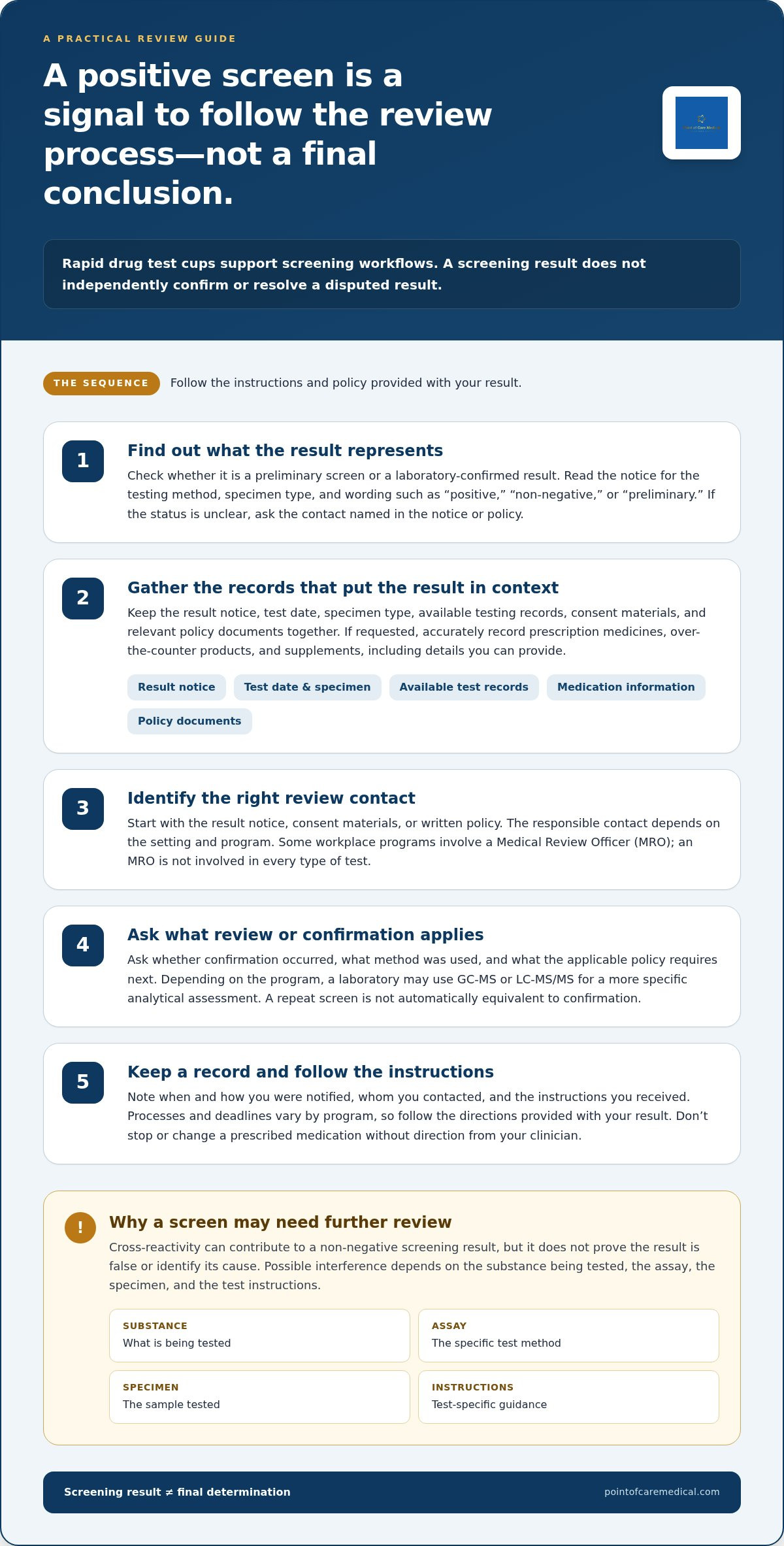
How to Dispute a False Positive Drug Test: A Practical Sequence
Use the process set out in the policy for the specific testing context. Workplace, clinical, treatment-program, and other procedures may differ in their contacts, forms, and timelines. Act promptly, keep your request factual, and retain a copy of everything you submit.
Submit a timely, specific written request
Send written notice to the designated contact using the channel identified in the applicable policy. State which result you’re challenging, when you received it, and why you’re requesting review. Refer to relevant records or medication information without claiming a cause you can’t verify. Keep a dated copy of your request and any response.
- Locate the governing instructions. Review the notice, consent materials, and current policy for the process that applies to your test. Identify the person or office responsible for questions, and check for submission deadlines or required forms. Don’t assume another employer’s or program’s process applies to your situation.
- Send a clear written notice. Identify the test and result, provide the test and notification dates if known, and state that you’re requesting review. Keep the tone neutral. For example, ask whether the result was preliminary or confirmed and which review procedure applies. Attach copies of relevant records, not originals, unless the policy instructs otherwise.
- Ask what confirmation or review is available. Use the established channel to ask whether confirmation occurred, whether additional review applies, and what documentation or action is required from you. Follow instructions about specimen handling, laboratory review, or medical review. A retest or other review step isn’t automatic, so don’t arrange one independently and assume it will be accepted instead of the program’s process.
- Track the response and next step. Record the date and method of each communication, the name or role of the person who responded, and any instructions or decisions. If you don’t receive a response within the timeframe stated in the policy, follow its escalation process or contact the designated office again. Keep new documents with your original records.
Follow confirmation, review, and response instructions
Provide requested information accurately and through the channel specified by the program. If instructions are unclear, ask the designated reviewer what is required and how the outcome will be communicated. Preserve each response and note any follow-up date. For questions about your legal rights or a specific deadline, consult qualified counsel familiar with the relevant jurisdiction and testing context.
A strong dispute is factual, documented, and guided by the applicable policy. For screening facilities, clear procedures also help staff route rapid-screen results consistently. If your organization is planning its screening workflow, explore bulk rapid drug test cups for its supply needs.
How Rapid Drug Test Cups Fit into a Fair Screening Workflow
A rapid drug test cup can support an initial screening workflow by providing a result for staff to handle under the facility’s procedures. It doesn’t decide whether a disputed result is accurate, confirm a finding through laboratory analysis, or determine impairment or misconduct. Keep that boundary clear in staff training, result notices, and conversations with tested individuals.
Fairness depends on a consistent process, not just the screening supply. Document how staff follow test instructions, record results, communicate them, and escalate results that need further review. Explain the process before testing begins, including who will communicate an outcome and which review steps may apply.
Set expectations for screening results
Train staff to follow the specific product instructions and facility procedures, and document the steps taken. Explain to tested individuals what the result represents, how it will be communicated, and where questions or review requests should go. Keep product selection separate from clinical, employment, or legal decisions, which belong to the appropriate decision-makers and processes.
- Document the workflow. Specify how staff record the result, test date, specimen type, and any observations or records required by facility policy.
- Define escalation. Identify who receives questions and how the facility routes results that need confirmation or qualified review.
- Standardize communication. Use clear, consistent language to distinguish a screening result from a later review or determination.
- Review procedures. Update staff guidance when applicable policies or test instructions change.
Support consistent procurement and workflow planning
Match screening supplies to the organization’s documented workflow and intended use. Before procurement, align the test instructions, staff training, documentation process, and escalation pathway so the supply fits a defined procedure. Product selection does not replace decisions about confirmation, clinical care, employment action, or dispute resolution.
Point of Care Medical supplies the Rapid Test Cup "RTC" + Fentanyl for screening workflows. Keep the product’s role within initial screening, and use applicable procedures to determine what happens after a result. For product-focused planning, the rapid test cup with fentanyl guide offers related purchasing context for facilities evaluating screening supplies.
Organizations sourcing bulk rapid drug test cups can use a written workflow to coordinate staff practice, result documentation, communication, and escalation. For institutional screening supplies, explore Point of Care Medical.
Make Your Next Screening Step Clear and Consistent
Use the review process as an opportunity to strengthen how your organization communicates and documents screening decisions. Clear roles and practical written procedures help staff respond consistently while giving individuals a defined path for questions or review. Keep the screening tool’s role distinct from any later clinical, employment, or program decision.
For facilities planning procurement, align bulk rapid drug test cups with the documented screening workflow and intended use. Point of Care Medical supplies rapid diagnostic and toxicology products to organizations across the United States, including the Rapid Test Cup "RTC" + Fentanyl for screening workflows. The product supports screening; it does not replace result review or confirmation procedures.
Build a process your team can follow, communicate, and maintain. Explore Point of Care Medical screening supplies to support your organization’s screening needs.
Frequently Asked Questions
Can a rapid drug test cup give a false positive?
Yes. A rapid drug test cup can produce a positive screening result that later review does not substantiate. Read the instructions for the specific test and follow its interpretation steps; don’t infer a final outcome from the cup alone. If a result is unexpected, ask the program contact whether it is preliminary, which review route applies, and whether further analysis is part of that process. This applies to individual units and bulk rapid drug test cups.
How do I dispute a false positive drug test at work?
Follow your employer’s current written procedure and notify the contact it identifies. In your message, identify the test date and result, state that you’re requesting review, and ask which process applies. Keep a copy of the notice and your message. If a deadline or required form is unclear, ask the designated contact for clarification. Workplace procedures and rights vary, so consult qualified legal counsel for advice about your circumstances.
Can prescription medication cause a false positive drug test?
Some substances may interfere with particular screening assays, but a medication’s presence doesn’t by itself explain a specific result. Record the medication name and relevant use details accurately, along with any over-the-counter products or supplements. Provide this information through the appropriate review channel. Don’t stop or change prescribed medication without guidance from your clinician. The reviewer can consider the information alongside the test method and applicable procedure.
What happens if a drug test is confirmed positive?
The next steps depend on the reason for testing and the policy or clinical protocol involved. A confirmed laboratory finding may still receive medical or program review in some settings, and its consequences aren’t the same in every context. Ask the designated contact for the written result and the procedure that governs what follows. If you have questions about employment or legal rights, seek advice from a qualified professional.
Can I request a second drug test after a positive result?
You can ask the responsible program contact whether confirmation, specimen review, or another test is available under its procedure. The options may depend on the specimen and testing context. A newly collected sample may not serve the same purpose as a review of the original specimen, so don’t assume it replaces the initial result. Ask about any deadline, follow the instructions provided, and keep the request and response with your records.
How long does it take to dispute a false positive drug test?
There’s no single timeline for every workplace, clinic, treatment program, or testing method. A policy may set a deadline for requesting review, while laboratory or medical review can take a different amount of time. Check the written instructions as soon as you receive the result. If the timing isn’t clear, ask the named contact which deadline applies and how to submit your request. Keep dated copies of your submission and any response.


