

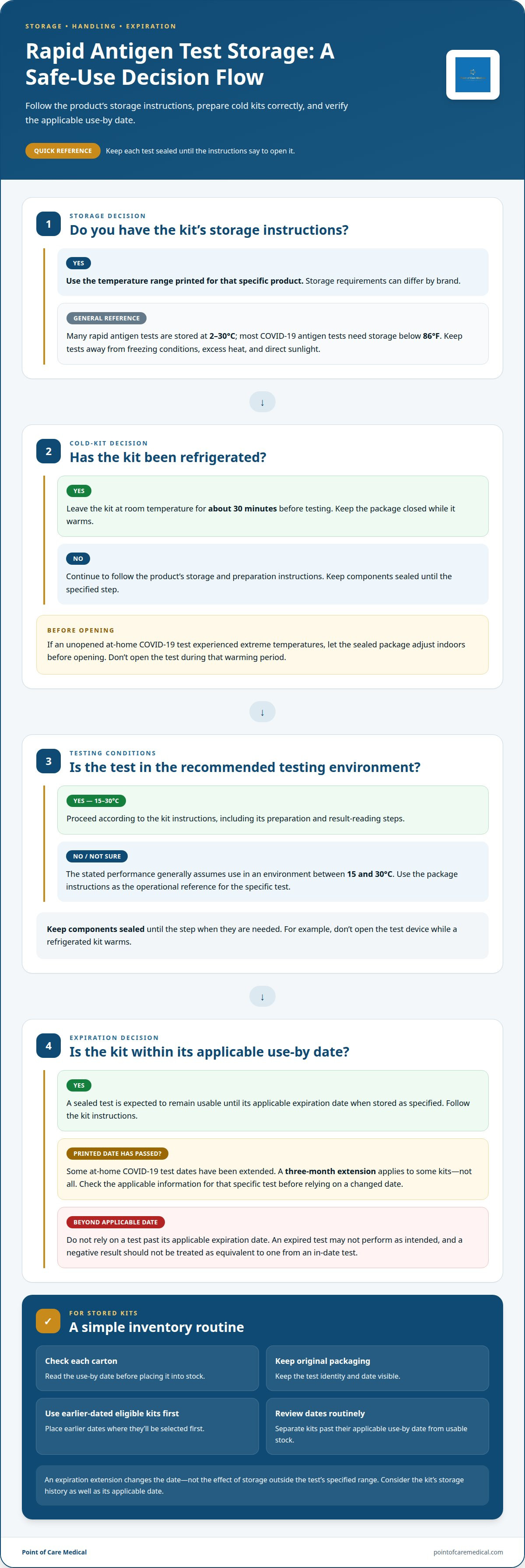
Storage conditions matter: rapid antigen tests should generally be kept at 2-30°C and protected from freezing. The practical answer to how to properly store rapid antigen tests is to follow the temperature range on the package and keep each test sealed until use. If a kit has been refrigerated, let it sit at room temperature for about 30 minutes before testing.
It’s reasonable to expect a sealed test to remain usable until its printed expiration date, but an expired kit may not perform as intended. Some at-home COVID-19 test expiration dates have been extended, so the printed date may not always be the final use-by date.
This guide explains how temperature, refrigeration, heat exposure, and expiration dates affect rapid antigen tests. You’ll learn what to do before using a cold kit, how to read its date, and when storage conditions may affect reliability.
Key Takeaways
- Use the temperature range printed on the kit, and keep tests away from freezing conditions, excess heat, and direct sunlight.
- If a kit has been refrigerated, allow it to sit at room temperature for about 30 minutes before use.
- Check the carton’s use-by date. Some at-home COVID-19 test expiration dates have been extended, so the applicable date can differ from the one printed on the box.
- For testing programs, match the test type to the need: Point of Care Medical offers respiratory antigen tests and Oral Fluid tests.
Bringing refrigerated test kits to room temperature before use
A refrigerated rapid antigen kit needs time to adjust before testing. Leave it at room temperature for about 30 minutes before use. This interval helps bring the kit’s components closer to the conditions expected during the test. Keep the package closed while it warms, and use the specific instructions supplied with the kit.
Cold storage and extreme delivery conditions call for different handling. If an at-home COVID-19 test has been exposed to extreme temperatures, let the unopened package adjust indoors before opening it. This step allows the sealed kit to adjust gradually. Don’t open the test during that warming period.
Temperature during testing matters, too. The stated performance of an at-home COVID-19 test generally assumes the test is used in an environment between 15 and 30 degrees Celsius. After warming a refrigerated kit, perform the test in that range when possible. The package instructions remain the operational reference for the specific test, including preparation and result-reading steps.
Keep each component sealed until you’re ready to begin. Opening a pouch early can expose its contents to the room environment before testing. Set out the unopened kit, read the directions, and open components only at the specified step. For example, don’t open the test device while a refrigerated kit warms.
Testing timing also affects how to interpret a negative result. If you have symptoms, follow the test’s instructions for when to test and what to do next. If you have no symptoms after an exposure, wait about five days before taking an at-home COVID-19 test. A negative result may not settle the question, so use the recommended repeat-testing schedule.
- After a negative at-home rapid test, repeat testing 24 to 48 hours later.
- According to the U.S. Food and Drug Administration, repeat an at-home COVID-19 antigen test 48 hours after a negative result.
- For people without symptoms, the U.S. Food and Drug Administration recommends at least three antigen tests, spaced 48 hours apart after each negative result.
Repeat-testing intervals apply to negative results, not positive ones. Keep the test components sealed until each testing step begins, and follow the kit instructions. This supports consistent handling from warming through result interpretation.
Expiration dates and test performance
The use-by date indicates the period during which the manufacturer supports the test’s performance under specified storage conditions. Check the carton before testing, then compare its date with any date on the individual test packaging. If the carton is missing or damaged, a sealed pouch’s date may help identify the kit, but follow the package instructions to interpret it.
At-home COVID-19 rapid tests do expire. Their components can become less dependable over time, which may affect whether the test can detect its target. Stability testing evaluates performance during storage at different temperatures, including hot- and cold-weather shipping. That testing supports the assigned shelf life, but it doesn’t mean a kit remains reliable indefinitely after its use-by date.
Some at-home COVID-19 test expiration dates have been extended. A three-month extension has been applied to some kits, so an eligible kit may have a later use-by date than the one printed on its box. This does not mean every test receives the same extension. Check the applicable information for the specific test before relying on a changed date.
Use a consistent date-check process when managing stored kits:
- Read the use-by date on each carton before placing it into stock.
- Keep the original packaging so the test identity and date remain visible.
- Separate kits that are past their applicable use-by date from usable stock.
- Place earlier-dated kits where they’ll be selected first, then review dates during routine inventory checks.
These steps help prevent newly received stock from being used ahead of older stock. For example, when two cartons have different dates, use the earlier-dated eligible carton first. Don’t assume cartons with the same product name have the same expiration date. The production date, package labeling, and any applicable extension determine the date for each kit.
Do not rely on a test beyond its applicable expiration date. COVID-19 test results are no longer reliable beyond the three-month extension described for eligible kits. An expired test can therefore produce a result that doesn’t reflect the infection status the test is designed to detect. A negative result from an expired kit should not be treated as equivalent to a result from an in-date test.
Storage history still matters. An expiration extension changes the date, not the effect of storage outside the test’s specified range. Keep the carton and instructions together, and consider the expiration date alongside the kit’s storage history. Accurate date tracking supports sound inventory decisions and helps prevent use beyond the applicable period.
Recommended temperature for storing rapid antigen tests
Storage limits protect test components before use, but the permitted range depends on the kit. Follow the temperature instructions for that specific product.
Understanding Storage Temperature Requirements
Storage temperature requirements define the conditions a rapid antigen test should remain within before use. Many rapid antigen tests should be stored at 2-30°C, and most COVID-19 antigen tests need storage below 86 degrees. These limits matter because test components are evaluated under specified conditions. Teams planning how to properly store rapid antigen tests should use the package range to organize each product, rather than applying one rule to every kit.
Checking Brand-Specific Storage Guidance
Yes, storage requirements can differ between rapid antigen test brands. For a specific U.S. test, start with the carton and included instructions, which state that kit’s temperature specifications. Identify the exact product before reviewing its guidance, since products in the same category may have different limits. This matters when receiving mixed inventory: one brand’s label cannot establish another brand’s storage conditions.
Refrigerating or Freezing Rapid Tests
Some COVID-19 test kits can be refrigerated, while others cannot. Follow the individual package rather than assuming refrigeration is suitable. Rapid antigen tests should not be allowed to freeze because freezing can damage kit components. The liquid reagent may freeze and make the test inefficient. For teams deciding how to properly store rapid antigen tests, distinguishing permitted refrigeration from prohibited freezing helps prevent one storage choice from being applied to all products.
Protecting Tests from Environmental Exposure
Keep kits within their labeled range and away from direct sunlight, heat, and damp areas. During transport, move cartons promptly into an appropriate indoor storage location and avoid leaving them in hot vehicles. If an at-home COVID-19 test has been left in high heat beyond normal shipping time, such as outside for several days, consider using a different test. Storage history matters alongside the printed expiration date.
For routine handling, keep each product’s packaging and instructions with its inventory. This keeps temperature requirements accessible during storage and use, especially when several test brands share a supply area.
Stability testing provides context for storage guidance: test developers perform stability testing to check that at-home COVID-19 test performance remains stable when tests are stored at various temperatures, including during hot- and cold-weather shipping. This does not replace the instructions for a particular kit. Some COVID-19 test kits can be refrigerated, while others cannot; the package lists each kit’s temperature specifications. Keep that information available when assessing a kit’s storage history or deciding whether its conditions were suitable.
Expiration is another part of readiness. At-home rapid COVID-19 tests expire, although some expiration dates have been extended. The FDA stated that three months can be added to the expiration date printed on at-home COVID-19 test kit boxes. Some COVID-19 antigen tests have expiration dates six months or a year after production, while others may expire sooner, so check the applicable package guidance rather than assuming a shared shelf life. The CDC recommends using a COVID-19 test before and after traveling.
Can rapid antigen tests be stored in a refrigerator or freezer?
Refrigeration is acceptable only for kits whose packaging permits it. Some COVID-19 test kits can be refrigerated, while others cannot. Freezing is different: rapid antigen test kits should not be allowed to freeze because freezing can damage kit components. Use the individual package’s temperature specifications to decide where each kit belongs.
A refrigerator is not suitable for every test kit. Before placing a kit in cold storage, read its carton and instructions for the permitted range. If refrigeration is allowed, keep the kit in its original packaging and away from items that could crush or wet the box. If the label calls for room-temperature storage, follow that guidance. Temperature limits can vary by test.
Freezing can affect a test’s liquid reagent. If the reagent freezes, the test may become inefficient, even after it thaws. Don’t put kits in a freezer or in places where temperatures may fall below freezing. Don’t assume a frozen test is usable simply because its contents look normal after thawing.
For refrigerated kits, plan the transition before testing. Take the sealed package out of the refrigerator and leave it at room temperature for about 30 minutes before use. Keep the components unopened during this period. Then follow the kit’s instructions for opening, preparing, and reading the test. This sequence helps avoid starting while the test is still cold.
Use a clear storage routine for mixed inventories:
- Group kits by their labeled storage requirements, not by brand appearance.
- Keep each carton’s instructions with its test so staff can identify refrigeration limits.
- Mark refrigerated stock clearly to distinguish it from kits stored at room temperature.
- Move a permitted refrigerated kit to room temperature before beginning the test.
- Keep all kits away from freezer compartments and other freezing conditions.
These distinctions matter because temperature limits are product-specific. The general storage range for rapid antigen tests is 2-30°C, but that range does not mean every kit can be refrigerated. The package determines whether cold storage is permitted. For example, two kits stored in the same facility may require different locations if their labels give different conditions.
If a kit was exposed to freezing temperatures, separate it from unaffected stock and consult its instructions before use. A printed expiration date alone cannot confirm that the kit stayed within its storage conditions. The date covers the stated use period, while the package’s temperature range guides refrigeration and freezing decisions.
How should rapid antigen tests be protected from heat, sunlight, and humidity?
Protect rapid antigen tests by keeping them within the temperature range printed on each package. The general range is 2-30°C, and most COVID-19 antigen tests need storage below 86 degrees. Keep cartons indoors, dry, and out of direct sunlight. A shaded shelf away from windows and heat sources is a practical choice for routine stock storage.
Heat exposure can happen during storage or transport. A test left in a hot car or outdoor shed may face conditions beyond its labeled range. Los Angeles summer temperatures can exceed 100 degrees, making those locations unsuitable for storing COVID-19 tests. Choose a stable indoor location instead, and avoid leaving kits in vehicles between delivery and use.
Protect tests from sunlight and humidity. Keep them in their original cartons, away from windows, damp counters, and places where water could reach the packaging. For example, don’t store test boxes beside a sink or in a sunlit window. Keeping the packaging dry and closed helps protect the kit until use.
For transport, plan the route and handoff to minimize time in uncontrolled conditions. Arrange delivery to an indoor location and move cartons promptly from the vehicle to their designated storage area. Avoid leaving test kits in direct sunlight while unloading or outdoors during a prolonged handoff.
- Store each test according to its printed temperature limits.
- Keep cartons away from direct sunlight, heaters, hot vehicles, and damp areas.
- Move deliveries indoors promptly and protect packages during transport.
- Separate kits exposed to extreme heat from unaffected stock.
If an at-home COVID-19 test has been left in a high-temperature environment beyond normal shipping time, such as outside in the heat for several days, consider using a different test. A printed expiration date does not establish that a kit remained within its storage range. Account for both the date and the storage conditions before using it.
Consistent environmental controls support orderly inventory handling. Store cartons in a designated area, keep package instructions with each product, and avoid unnecessary moves between hot and cool locations. These steps make it easier to track exposure and identify stock that may have experienced conditions outside its labeled range.
For rapid testing supplies, explore testing options suited to your program’s needs.
Keep each test unopened until ready to start, follow its included instructions, and do not share a single at-home COVID-19 test with others.
Point of Care Medical: Oral Fluid tests
Point of Care Medical offers Oral Fluid tests for organizations considering testing options beyond respiratory antigen testing. Its offerings also include the GenBody COVID-19 Rapid Antigen Test, Rapid Test Cup "RTC" + Fentanyl, and ViraDx™ SARS-CoV-2/Flu A+B Rapid Antigen Test. Select an option based on the type of testing your program requires, and apply the product’s own storage instructions to its inventory.
For operational planning, keep storage conditions and expiration-date checks part of the same inventory process. The requirements can differ between test kits, so use each package’s instructions rather than applying one product’s temperature limits to another. Contact Point of Care Medical to discuss its Oral Fluid tests and other listed testing products for your organization’s needs.
Build a dependable testing routine
Make storage and date checks a consistent part of your testing process. Clear inventory practices help teams identify suitable kits, plan replenishment, and choose products that fit their testing needs. Applying the same care to how to properly store rapid antigen tests supports more orderly use across your program.
Point of Care Medical offers the GenBody COVID-19 Rapid Antigen Test, Rapid Test Cup "RTC" + Fentanyl, and ViraDx™ SARS-CoV-2/Flu A+B Rapid Antigen Test. Consider these options when selecting supplies for respiratory antigen testing or toxicology screening. Follow the storage instructions for each product as part of your organization’s handling routine.
For the next step, contact Point of Care Medical to discuss the available testing products for your organization. A practical, well-managed inventory begins with choosing supplies that match your program’s needs.
Frequently Asked Questions
What temperature range should rapid antigen tests be stored at?
Many rapid antigen tests are stored within 2-30°C, but the package for the specific test takes priority. For example, if a kit label gives a narrower range, follow that range rather than the general one. Keep the temperature information with the product during inventory handling. A storage location that stays within the kit’s stated limits helps staff manage stock consistently and identify products requiring different conditions.
How can you check a rapid antigen test's expiration date and storage instructions?
Read the carton’s use-by date and storage directions, and keep the original packaging with the test. If the date appears to have passed, check whether an expiration extension applies to that specific test before deciding it has expired. Don’t assume tests from the same brand share a date or extension. During inventory reviews, record each product’s applicable use-by date and storage conditions separately.
How should opened rapid antigen test kits and unused components be stored?
Keep test components sealed until you’re ready to test, and follow the kit instructions if its outer carton has been opened. An opened carton does not necessarily mean its inner components are open, so leave sealed pouches intact. If an individual component pouch has been opened, don’t assume it can be stored for later use or resealed. Follow the manufacturer’s instructions for handling that kit.
Where can you find FDA storage requirements for a specific U.S. rapid antigen test?
Check the test’s carton and included instructions for its temperature specifications.


