

The fastest result isn’t automatically the best fit for a clinic. Choosing HIV rapid test kits for clinics also means weighing the assay, specimen collection, staff capacity, and the steps that follow screening. A result may be available quickly, but the workflow still needs to support correct testing and clear patient communication.
A rapid screening result is not automatically a definitive answer. A reactive result is preliminary and requires follow-up testing. The window period matters too: a test may not detect HIV soon after exposure, and timing varies by test type. Clinics need a process that explains what a result means and what happens next.
This guide covers how clinic-based rapid HIV tests work and what to assess when comparing assay formats, specimen requirements, and result timing. It also outlines practical workflow considerations, including staff readiness, applicable testing requirements, result communication, and follow-up. Use these points to plan a consistent testing process that fits your clinic and supports responsible care.
Key Takeaways
- Assess HIV rapid test kits for clinics by intended use, specimen requirements, procedure, timing, and operational fit.
- Follow each assay’s current instructions for specimen collection, testing, result interpretation, and documentation.
- Build a consistent workflow that assigns responsibility for preparation, testing, recording results, and follow-up.
- Plan procurement around labeling, staff workflow, documentation needs, and replenishment.
- Consider the SURE CHECK HIV 1/2 Assay as one clinic supply option from Point of Care Medical.
HIV Rapid Test Kits for Clinics: Capabilities and Limits
HIV rapid test kits for clinics are point-of-care screening tools that provide an initial result using the specimen and procedure specified in the assay instructions. Their role is specific: they can support timely screening during a clinic visit, but they don’t replace clinical assessment, follow-up testing, or linkage to care. Treat the test as one step in a broader process, not as a complete care pathway.
Rapid screening identifies whether follow-up is indicated; confirmatory testing follows the recommended diagnostic process to determine whether HIV is present. This distinction helps staff explain results clearly and set expectations before testing begins.
Where rapid HIV screening fits in clinic care
Primary care practices, urgent care settings, and community health programs may incorporate rapid screening into routine or targeted services. Point-of-care testing can create an opportunity to discuss the result and next steps while the patient is still with the care team. Its practical value depends on more than speed: clinics also need trained staff, appropriate procedures, a private way to communicate results, and a defined follow-up plan.
Rapid testing can support access when a clinic visit is a convenient opportunity to screen, but it doesn’t guarantee that every patient will receive a result or complete follow-up. Build the process around patient consent, clear communication, and an identified next step for each result. For background on how rapid assays fit within broader testing approaches, see this overview of the HIV test.
What a rapid screening result can and cannot tell you
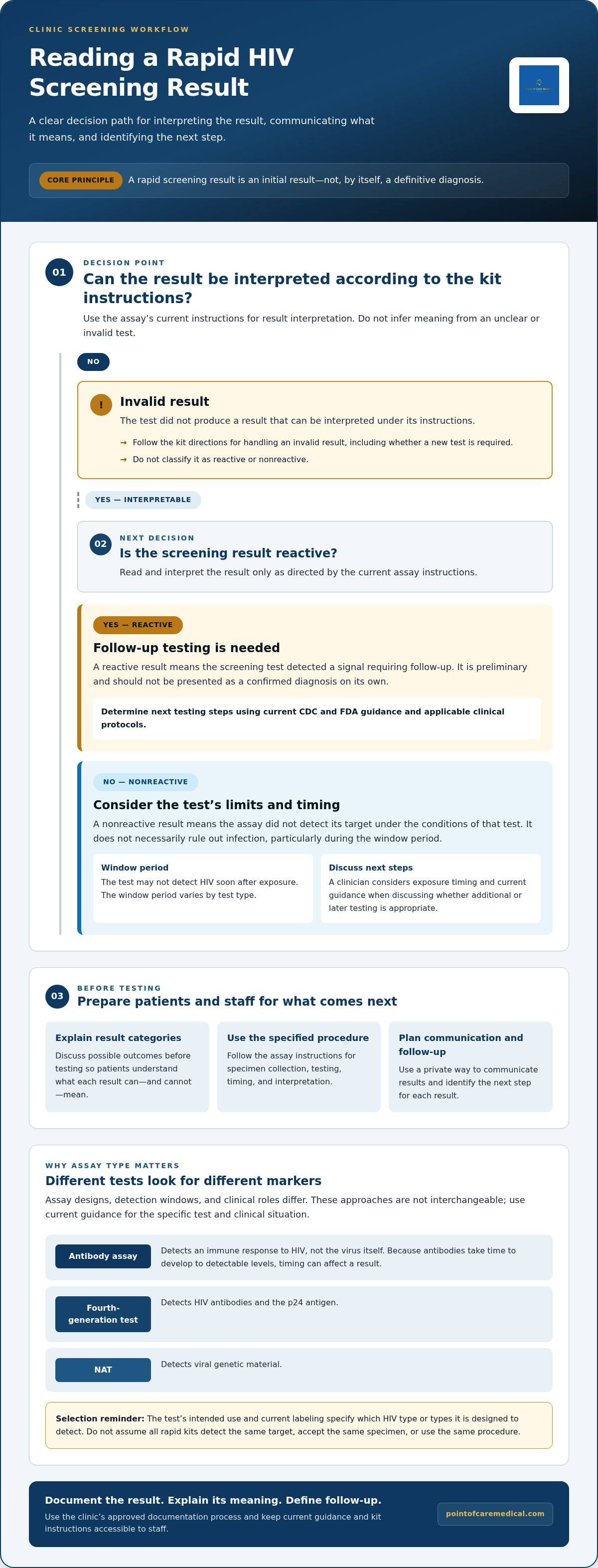
Use the exact terms and interpretation in the current kit instructions. In general, a reactive result indicates that the screening test detected a signal requiring follow-up. It is preliminary and should not be presented as a confirmed diagnosis on its own. Follow current CDC and FDA guidance, along with applicable clinical protocols, to determine the next testing steps.
A nonreactive result means the assay did not detect the target under the conditions of that test. It doesn’t necessarily rule out infection, particularly if testing occurs during the window period, before the assay can reliably detect infection. The window period varies by test type. A clinician should consider exposure timing and current guidance when discussing whether additional or later testing is appropriate.
An invalid result means the test didn’t produce a result that can be interpreted according to its instructions. Staff should follow the kit’s directions for handling invalid results, including whether a new test is required. Don’t classify an invalid result as reactive or nonreactive.
- Explain the possible result categories before testing.
- Document the result using the clinic’s approved process.
- Set a clear follow-up plan for reactive, invalid, or clinically concerning results.
Keep current CDC and FDA guidance accessible to staff, and review the kit instructions before use. Consistent explanations help patients understand screening and support appropriate next steps.
How Clinic HIV Rapid Tests Work: Assays, Specimens, and Timing
Rapid HIV tests use different assay designs, so clinics shouldn’t assume every kit detects the same target or follows the same procedure. Many rapid screening assays look for antibodies, proteins the immune system produces in response to HIV. Other approaches, including antigen/antibody tests and nucleic acid tests (NAT), look for different markers. These methods have different detection windows and clinical roles. Follow current, assay-specific guidance when considering a result in relation to possible exposure.
HIV-1 and HIV-2 are distinct types of HIV. A test’s intended use and labeling specify which type or types it is designed to detect. The “1/2” in an assay name isn’t a substitute for reading its current instructions or understanding the scope of its result.
Antibody assays and other screening concepts
An antibody-based assay detects an immune response, not the virus itself. Because antibodies take time to develop to detectable levels, a result can depend on when testing occurs. Fourth-generation tests detect HIV antibodies and the p24 antigen, while NAT detects viral genetic material. These approaches are not interchangeable, and no single window-period estimate applies to every assay. Use current guidance for the specific test and clinical situation.
For clinics, this distinction matters when selecting a test and explaining its role. A rapid antibody screen can support an initial assessment, while clinical concerns about recent exposure may call for a different testing approach under applicable guidance. The assay’s intended use determines what conclusions its result supports.
Specimen collection and result timing
Specimen type and collection technique are product-specific. Current labeling identifies the permitted specimen, collection materials, required volume or handling steps, and test procedure. Don’t assume one kit accepts the same specimens as another, even if both are described as rapid HIV tests. Before adopting HIV rapid test kits for clinics, align staff training and supplies with the selected assay’s instructions.
Assay instructions connect specimen collection to valid result interpretation: use the specified specimen, follow each procedure step, and read the result only as directed. A collection error, missed step, or incorrect reading time can affect whether the result is interpretable. Advertised turnaround times are also product-specific. Follow the timing on the current label rather than applying a time stated for another assay.
If a test produces an invalid result, follow the action stated in its instructions. The required response may depend on the particular kit; staff shouldn’t reinterpret an invalid result as reactive or nonreactive. Document what occurred and proceed according to the product directions and facility protocol.
- Keep current instructions with testing supplies and make them accessible to trained staff.
- Train staff on the selected specimen and each collection and reading step.
- Base patient communication on the assay’s intended use and applicable clinical guidance.
Consistent procedures help clinics use point-of-care screening appropriately. For procurement planning, clinic rapid testing supplies can be considered alongside labeling, specimen requirements, and workflow fit.
How Clinics Can Compare HIV Rapid Test Kits
A useful comparison separates facts stated on a kit’s current labeling from operational questions the clinic must answer. Product claims, specimen types, result timing, and intended users are label-specific. Staffing, patient flow, documentation, and replenishment depend on the facility. Review both sets of criteria before selecting HIV rapid test kits for clinics.
Compare each kit’s intended use, authorized users, specimen, procedure, result timing, regulatory status, and fit with your facility’s staffing and patient flow.
Match the assay to intended use and facility requirements
Start with the current instructions for use and labeling. Verify the test’s intended purpose, specified users and settings, accepted specimen types, result interpretation, and any stated limitations. Treat these as product-label facts, not assumptions based on another rapid assay. Confirm the applicable regulatory status using current FDA information.
CLIA categorization and facility requirements depend on the specific test and how the facility performs testing. Don’t assume every rapid test has the same CLIA status or that one facility’s requirements apply to another. Consult current CMS CLIA resources and FDA information, then determine what applies to the selected assay and site.
Compare practical workflow and supply considerations
Next, assess how the labeled procedure fits clinic operations. Account for the steps staff must perform, training needs, required materials, storage and handling instructions, quality controls, and waste disposal procedures. Use the kit instructions and facility policies as the basis for these details. Don’t compare products by a single advertised timing claim; consider the complete process, including collection, setup, reading, and documentation.
Expected testing volume also affects workflow fit. Consider when screening occurs, who performs each task, and whether testing can be completed without disrupting other patient-care responsibilities. Procurement planning should account for how the clinic tracks stock and replenishes supplies, without assuming a particular shelf life, delivery schedule, or inventory level.
| Comparison factor | Verify from current product labeling | Assess for your clinic |
|---|---|---|
| Intended use | Purpose, target, users, setting, and limitations | Whether use aligns with the clinic’s testing program |
| Specimen | Accepted type and collection procedure | Staff readiness and collection workflow |
| Steps and timing | Required procedure and result-reading time | Fit with appointment flow and staff capacity |
| Operational requirements | Storage, controls, handling, and disposal directions | Space, training, documentation, and supply management |
| Regulatory status | Applicable product information and test categorization | Facility-specific CLIA requirements and testing policies |
Record verified label details separately from the clinic’s workflow assessment. This gives staff a clear reference for training and procurement, and makes it easier to reassess the selection when labeling or facility procedures change.
Plan a Responsible Clinic Workflow for Rapid HIV Screening
A dependable workflow covers more than running a test. It gives staff a consistent sequence, protects patient privacy, and identifies what happens after each result. For clinics using HIV rapid test kits for clinics, current kit instructions and facility protocols should govern every testing step. This overview supports planning, but it doesn’t replace facility policy, clinical judgment, or applicable guidance.
Prepare staff, supplies, and the testing area
Before testing begins, assign roles for patient communication, specimen collection, test processing, result review, and documentation. Train staff on the specific assay and keep its current instructions accessible. Prepare the workspace and supplies required by those instructions. Use controls, personal protective equipment, and waste-handling procedures as specified by the assay labeling and facility policy.
Protect privacy during registration, collection, and result discussions. Explain the purpose and limits of screening in clear, nonjudgmental language, and follow the facility’s process for informed consent or acknowledgment. Make sure staff know how to pause and resolve a problem, such as missing supplies or an invalid test, rather than improvising outside the written procedure.
Follow a consistent sequence
Use a simple sequence to keep responsibilities clear: prepare, collect, run, read, document, and follow up. Preparation includes checking readiness and reviewing the instructions. Collection and testing must follow the specified steps and timing. Read results only as directed, then record them in the appropriate facility system. Close the loop by communicating the result and arranging the next step where indicated.
Build this sequence into patient flow. For example, decide who remains responsible for communicating the result if the staff member performing the test is called away. Define how the team will protect confidentiality when discussing results in shared clinical spaces. These operational details can prevent missed handoffs without changing the assay procedure.
Document results and plan follow-up
Record the result and relevant testing details according to facility policy, such as the test used and the date of testing. Include information needed to support interpretation and follow-up, while following the facility’s privacy and recordkeeping requirements. The specific documentation fields should reflect the clinic’s approved systems and applicable guidance.
Plan distinct next steps for each outcome:
- Reactive: Explain that the screening result requires follow-up. Arrange the next testing and care steps under current CDC recommendations and facility protocols.
- Nonreactive: Discuss the result in context, including exposure timing and whether further testing is appropriate under current guidance.
- Invalid: Follow the kit instructions and facility procedure for resolving the result. Don’t record it as reactive or nonreactive.
Before implementation, review the workflow with the clinical team and update it when assay instructions or facility protocols change. For clinic testing supplies, explore rapid HIV testing supplies from Point of Care Medical.
Source Clinic HIV Rapid Test Kits with a Clear Procurement Plan
Procurement works best when clinical requirements and day-to-day operations are reviewed together. Before ordering HIV rapid test kits for clinics, document the assay’s intended use, current labeling, required supplies, staff workflow, and facility procedures. This gives clinical, operations, and purchasing teams a shared basis for evaluating the selection and maintaining a repeatable process.
Create a repeatable purchasing checklist
Record the selected assay and the setting where staff will use it. Capture the supplies required by the product instructions, the staff roles involved, and the workflow for testing and documentation. Keep product-specific storage and handling directions with the purchasing record so inventory practices remain consistent with the instructions for use.
Estimate replenishment needs using the facility’s testing volume and stock-management process. Avoid relying on a generic shelf-life assumption or ordering pattern. Instead, use the product’s current storage instructions and the clinic’s own usage records to plan inventory reviews and reduce avoidable workflow interruptions.
- Document the assay, its intended setting, and the current instructions for use.
- List required testing materials and the staff workflow they support.
- Align inventory review with clinic testing volume and product-specific storage directions.
- Keep procurement, training, and documentation records easy for relevant staff to access.
A written checklist also helps teams reassess a selection when clinic procedures or testing needs change. The HIV 1/2 rapid assay sourcing guide can support that review by organizing key considerations for healthcare settings.
Explore a clinic-focused HIV assay option
Point of Care Medical distributes rapid diagnostic supplies to healthcare and screening facilities across the United States. Its infectious disease offerings include the SURE CHECK HIV 1/2 Assay, an option for organizations sourcing HIV screening supplies. Use the current product labeling and product information to evaluate details such as intended use, specimen requirements, procedure, result timing, and handling within your facility’s workflow.
Keep the purchasing decision tied to the clinic’s actual needs. A suitable option must align with the assay’s labeled use and the facility’s staff capacity, documentation process, and follow-up protocols. Procurement planning should also establish who reviews stock and coordinates replenishment, so supply management remains part of routine clinic operations.
For a practical next step, explore HIV rapid testing supplies from Point of Care Medical as you assess clinic requirements and procurement priorities.
Make Your Clinic’s Testing Plan Ready for the Next Step
Use your procurement decision as a starting point for a sustainable testing program. Assign responsibility for reviewing clinic needs, maintaining staff readiness, and keeping purchasing aligned with the established workflow. Clear ownership helps HIV rapid test kits for clinics remain part of a consistent process as service needs evolve.
Point of Care Medical distributes rapid diagnostic supplies to healthcare and screening facilities nationwide. Its infectious disease testing offerings include the SURE CHECK HIV 1/2 Assay, giving clinic teams a specific option to consider as they align supply decisions with their testing protocols.
For your next procurement review, consider how the available options fit your clinic’s intended use and operating plan. Explore HIV rapid testing supplies for clinics from Point of Care Medical.
Turn your testing criteria into a practical supply plan. Explore HIV rapid testing supplies from Point of Care Medical.
Frequently Asked Questions
How accurate are rapid HIV tests used in clinics?
Accuracy depends on the specific assay, specimen, timing, and whether staff follow the instructions correctly. No single accuracy figure applies to every rapid test. Review the current product labeling for its performance information and intended use, and consider possible exposure timing when interpreting a result. A test can also miss an infection during its window period, so clinical assessment and recommended follow-up remain important.
How long does a rapid HIV test take to produce results?
Result timing varies by product. The time listed in a test’s current instructions applies to that assay and its specified procedure, not to every rapid HIV test. Clinics should distinguish the assay’s stated reading time from the full visit, which may include registration, consent, specimen collection, result communication, and documentation. Build patient flow around the labeled timing and avoid promising a result time based on another kit.
Can a rapid HIV test detect a recent infection?
It may not detect HIV soon after exposure, particularly if the assay detects antibodies that have not yet reached detectable levels. Window periods vary by test type and product. If a patient reports a recent exposure or has symptoms concerning for acute infection, a clinician should consider the timing and select testing in line with current guidance. A nonreactive rapid result may not resolve concerns about very recent exposure.
What does a reactive rapid HIV test result mean?
A reactive result means the screening assay detected a signal that requires further evaluation; it isn’t, by itself, a confirmed HIV diagnosis. The clinic should explain this distinction clearly and arrange the next step under the applicable diagnostic algorithm and facility protocol. Staff should document the result and follow-up plan, then support the patient through confirmatory testing and appropriate care coordination.
Do clinics need CLIA requirements for rapid HIV testing?
Applicable CLIA requirements depend on the test’s categorization and how the facility performs testing. A clinic performing waived testing generally needs the appropriate CLIA Certificate of Waiver; don’t assume a test is waived because it is rapid or simple to use. Verify the specific test’s current status and the facility’s obligations through current CMS and FDA information before adding it to a testing program.
What specimens can HIV rapid test kits use?
Specimen options vary by assay. A particular kit may specify a blood specimen, oral fluid, or another labeled specimen, but clinics shouldn’t infer permitted types from the test category or a different product. Check the current instructions for accepted specimen sources, collection materials, and handling steps. For HIV rapid test kits for clinics, matching the specimen to the label is essential for valid testing.
Can a clinic use a rapid HIV test as the only test?
A rapid test can serve as an initial screening method, but a reactive screening result needs follow-up testing under current recommendations. A nonreactive result may also require additional testing if exposure timing or clinical assessment raises concern. The right pathway depends on the patient’s situation and the assay used. Clinics should establish procedures for follow-up before offering screening, rather than treating one rapid result as the entire diagnostic process.


