

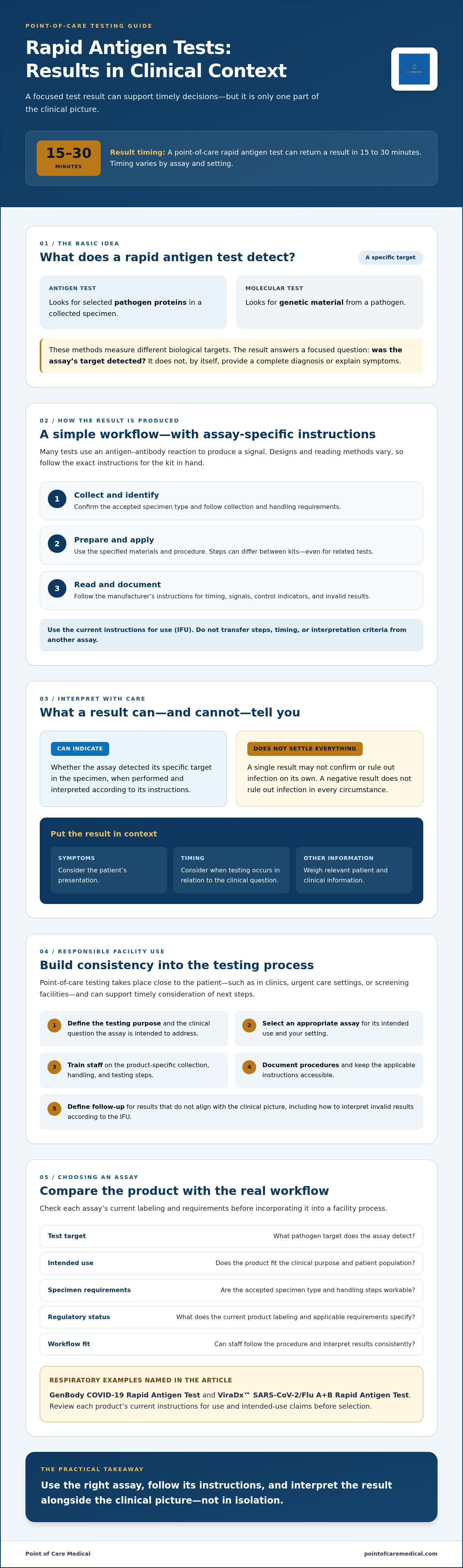
A point of care rapid antigen test can return a result in 15 to 30 minutes, but a negative result doesn’t always settle the clinical question. These tests detect specific viral proteins, and results need to be interpreted alongside symptoms, timing, and other relevant clinical information.
That distinction matters in a busy facility. Rapid testing can support timely decisions, but a single result may not confirm or rule out infection on its own. Consistent specimen collection, correct use of the manufacturer’s instructions, and a defined follow-up process help teams use results responsibly.
This article explains how point-of-care rapid antigen tests work, what positive and negative results can establish, and where their limitations matter. It also covers practical workflow considerations, including test selection, specimen handling, and what to do when results don’t align with the clinical picture. Use these considerations to interpret results in context and build a testing process that supports sound decisions.
Key Takeaways
- Understand how a point of care rapid antigen test detects selected pathogen proteins and why detection alone doesn’t provide a complete diagnosis.
- Check the assay’s instructions for specimen collection, application, and result reading. Procedures can differ between kits.
- Interpret results in light of the clinical question and relevant patient information. A negative result may not rule out infection in every circumstance.
- Build a consistent facility process by defining the testing purpose, selecting an appropriate assay, training staff, and documenting procedures.
- Compare test targets, intended use, specimen requirements, regulatory status, and workflow fit before selecting an assay.
What Is a Point-of-Care Rapid Antigen Test?
A point-of-care rapid antigen test is performed near the patient and provides a result without relying solely on a central laboratory. It detects specific proteins, called antigens, associated with a pathogen in a collected specimen. The result addresses a focused question: whether the assay detected its target. It doesn’t, by itself, establish a complete diagnosis or explain the cause, severity, or course of a patient’s symptoms.
Clinics, urgent care settings, and screening facilities may use these tests when an assay’s intended use and operating requirements fit the situation. Suitability depends on the specific product and context. Check the test’s purpose, accepted specimen type, intended patient population, and instructions before building it into a workflow.
How Does an Antigen Test Differ from Other Diagnostic Tests?
Antigen tests look for selected pathogen proteins. Molecular tests look for genetic material from a pathogen. The methods measure different biological targets and have their own procedures and instructions for use. Choose based on the clinical question and the specific assay, not the test category alone. Follow current product labeling and applicable requirements. For a general overview of the underlying approach, see Rapid antigen test (RAT).
What Does Point-of-Care Testing Mean in Practice?
Point-of-care testing takes place close to the patient, such as in a clinic or another care or screening setting, rather than depending only on a central laboratory. A point-of-care rapid antigen test makes a result available within the local workflow, which can support timely consideration of next steps. The process and result timing vary by assay and setting.
Staff collect and handle the specimen, perform the test according to its instructions, and interpret the result in context. A detected antigen is evidence related to the assay’s specific target, not a substitute for clinical assessment. Consider the result alongside the patient’s presentation and the reason for testing.
Facilities assessing respiratory testing needs can compare available assays against their workflow. Point of Care Medical distributes rapid diagnostic test kits to healthcare and screening facilities across the United States. Its respiratory catalog includes the GenBody COVID-19 Rapid Antigen Test and ViraDx™ SARS-CoV-2/Flu A+B Rapid Antigen Test. Review each product’s current instructions for use and intended-use claims before selecting an assay.
How Point-of-Care Rapid Antigen Tests Produce a Result
A rapid antigen test turns a collected specimen into a result through a process defined by the specific assay. Many use an antigen-antibody reaction: test components are designed to bind to a target antigen, producing a signal that staff interpret according to the test instructions. Designs and signal-reading methods vary, so don’t assume every kit works in the same way.
What Happens During the Test Process?
The basic workflow has three stages: collect and identify the specimen, prepare and apply it as directed, then read and document the result according to the assay’s instructions. These are general stages, not a substitute for the manufacturer’s instructions for use (IFU).
Specimen collection and handling matter. If a specimen isn’t collected, handled, or applied as directed, it may not provide a useful basis for interpretation. Before testing, confirm the required specimen and materials. Follow the specified steps and timing, then use the IFU to interpret the test’s signals, including control indicators and invalid results. Don’t infer a result from an appearance the instructions don’t describe.
Why Do Test Instructions Vary by Assay?
Assays can differ in their target, accepted specimen types, preparation steps, and result-reading procedure. Steps for one SARS-CoV-2 test may not apply to another SARS-CoV-2 assay or to a test for influenza A and B. Use the exact IFU for the product in hand. Don’t transfer steps, timing, or interpretation criteria between products without confirming they apply.
For any named test, check the current manufacturer instructions before use. Confirm the intended specimen, collection and handling requirements, and result-reading procedure. The CDC’s point-of-care testing guidance can also inform facility planning. Apply current product labeling and requirements relevant to your setting.
To support a consistent workflow, keep the applicable instructions accessible to staff and include assay-specific steps in training and procedures. When comparing respiratory testing options, check each product’s instructions against the workflow your facility can support. Point of Care Medical distributes respiratory rapid antigen test kits, including the GenBody COVID-19 Rapid Antigen Test and ViraDx™ SARS-CoV-2/Flu A+B Rapid Antigen Test. Check current product labeling before selecting or using an assay.
What a Rapid Antigen Result Can, and Cannot, Tell You
A rapid antigen result answers a limited question: whether the assay detected its specified target in the specimen. It isn’t a complete clinical diagnosis and doesn’t determine treatment on its own. Interpret it alongside the person’s symptoms, exposure history, timing, and reason for testing. The implications of a result depend on the clinical context and the assay’s intended use.
False results are possible. A false positive means the test indicates the target when it isn’t present; a false negative means the test doesn’t detect the target even though infection may be present. The likelihood and implications depend on the assay and circumstances. The FDA’s COVID-19 test basics explains how test types differ and why results should be interpreted with care.
How Should a Positive Rapid Antigen Result Be Interpreted?
A positive result indicates that the assay detected its target according to its instructions. Consider the finding with the person’s presentation and the test’s intended use. Don’t treat it as a complete diagnosis or an automatic treatment decision. Clinical staff should follow applicable facility protocols, current public-health guidance, and product labeling to determine whether additional assessment or action is appropriate.
Can a Negative Result Rule Out Infection?
No. A negative result isn’t universally conclusive and may not rule out infection in every circumstance. Timing, specimen quality, and assay characteristics can affect whether the target is detected. If the result conflicts with symptoms, exposure history, or the clinical question, consult the test labeling and current guidance for possible follow-up or confirmatory testing. The appropriate next step can vary by assay and situation.
Build result interpretation into the point of care rapid antigen test process. Make sure staff know how to handle positive, negative, and invalid results, and where to find the relevant instructions and protocols. When a result doesn’t fit the clinical picture, use applicable guidance rather than relying on the result alone.
How Facilities Can Use Point-of-Care Antigen Tests Responsibly
A reliable workflow starts before a test is ordered. Define the question the test is meant to address, identify the intended population, and decide how the result will inform the facility’s process. Then confirm that the assay’s intended use and instructions fit that purpose. A point of care rapid antigen test should be part of a defined process, not a stand-alone substitute for clinical judgment or facility protocols.
What Should a Facility Decide Before Testing?
Set the testing purpose first, such as evaluating a clinical concern or supporting a screening process. Confirm the intended population, accepted specimen, and collection and handling instructions in the current product labeling. Decide who will perform the test, how staff will document the result, and what steps follow positive, negative, or invalid results. For deployment planning, consult this COVID antigen testing clinical workflow guide.
Translate these decisions into written procedures and staff training. Check product-specific storage conditions and any required quality checks against the manufacturer’s instructions. Define how staff competency will be assessed and how results will be communicated through appropriate facility channels. These are operational items to verify, not universal specifications: requirements depend on the assay, setting, and applicable rules.
How Do Compliance and Quality Fit into the Workflow?
Before procurement and implementation, confirm which CLIA requirements apply to the testing site and verify the product’s current regulatory status and permitted use. Don’t assume a test is waived, exempt, or appropriate for a particular setting based on its format or similarity to another product. Check the relevant documentation and current requirements for the specific assay and facility. This CLIA-waived COVID antigen test checklist offers additional compliance-planning detail.
- Purpose: Document the clinical or screening question and the intended population.
- Assay: Verify intended use, specimen requirements, instructions, and applicable status.
- Staff: Provide assay-specific training and a method to assess competency.
- Process: Document storage, quality checks, testing steps, result recording, and communication procedures as applicable to the product.
- Review: Recheck procedures when product instructions or relevant requirements change.
Facilities sourcing respiratory assays can compare their requirements with available respiratory rapid-test options. Align product selection with verified labeling and a workflow the facility can support.
Choosing a Rapid Antigen Test and Planning the Next Step
Choose an assay by matching its documented use to the facility’s testing needs. A point of care rapid antigen test should fit the target being assessed, the intended population, the permitted specimen, and the process staff can reliably follow. No single feature makes an assay right for every setting. Review current product labeling and applicable regulatory information before procurement and use.
Which Questions Should a Facility Ask When Comparing Tests?
Use the same review process for each product. Confirm which pathogen or targets the assay detects and whether they match the clinical or screening purpose. Check intended use, specimen requirements, collection and handling instructions, and result interpretation steps. Then assess applicable regulatory details for the specific product and facility. For COVID-19 procurement considerations, review this COVID-19 rapid test wholesale guide.
Consider the full workflow, not just the test. Can staff follow the instructions as written? What training and competency checks will be needed? How will results be documented and communicated, and what will staff do when results don’t align with the clinical picture? Answering these questions before standardizing an assay can help identify training or process requirements in advance. Avoid comparing products using unsupported rankings or performance claims. Verify product-specific information against current manufacturer documentation.
Where Can Facilities Find Relevant Rapid Antigen Test Supplies?
Point of Care Medical distributes rapid diagnostic test kits to healthcare and screening facilities across the United States. Its respiratory offerings include the GenBody COVID-19 Rapid Antigen Test and ViraDx™ SARS-CoV-2/Flu A+B Rapid Antigen Test. These are options for facilities assessing respiratory testing needs, not recommendations for a particular use. Confirm each product’s current instructions, intended-use claims, and applicable regulatory status before selecting it.
Once the facility has defined its testing purpose and compared assay requirements with its workflow, sourcing can be considered as a practical next step. Apply the same selection criteria to every product under review, and make sure the facility can support the assay’s instructions and result procedures. To review available options, review rapid antigen test supplies.
Build a Testing Process Your Facility Can Support
A point of care rapid antigen test is most useful when it fits a defined clinical or screening purpose and a consistent facility workflow. Follow the assay’s current instructions, train staff on the required procedures, and interpret each result in context. A negative result may not rule out infection in every circumstance, so establish how staff will assess results that don’t align with the clinical picture.
Before choosing an assay, verify its target, intended use, specimen requirements, and applicable regulatory details. Then decide how staff will document and communicate results and manage follow-up within existing protocols. These steps help facilities make informed selections without treating any one test as suitable for every setting.
Point of Care Medical distributes rapid diagnostic test kits to healthcare and screening facilities across the United States. Its respiratory offerings include the GenBody COVID-19 Rapid Antigen Test and ViraDx SARS-CoV-2/Flu A+B Rapid Antigen Test. Review current product information as you assess your facility’s needs, then review rapid antigen test supplies.
With clear procedures and verified product information, your team can make testing decisions more consistently.
Frequently Asked Questions
How does a rapid antigen test work?
A rapid antigen test uses components designed to bind to a particular antigen in the collected specimen. That interaction produces a signal, which staff interpret according to the assay’s instructions. Test designs and steps can vary. Follow the specific manufacturer instructions for specimen collection, preparation, timing, and result reading. Don’t transfer procedures from one test to another without confirming they apply.
How accurate are point-of-care rapid antigen tests?
Accuracy depends on the specific assay and how it’s used. Factors can include intended use, timing, specimen quality, and whether staff follow the instructions correctly. No single accuracy figure applies to every test or situation. Review the manufacturer’s current performance information and interpret results with symptoms, exposure history, and the clinical question. A test result alone isn’t a complete diagnosis.
Can a negative rapid antigen test rule out infection?
No. A negative result doesn’t rule out infection in every circumstance. The target may not be detected because of factors such as timing, specimen quality, or assay characteristics. If a negative result doesn’t fit the person’s symptoms or exposure history, consult the test labeling and current guidance for appropriate follow-up or confirmatory testing. The next step may differ by assay and situation.
How quickly do point-of-care antigen tests provide results?
Many rapid antigen assays provide results in approximately 15 to 30 minutes, but the actual time depends on the specific test and its instructions. The full workflow may also include specimen collection, preparation, and documentation. Check the manufacturer’s current instructions for the assay’s stated read time and follow them precisely. Reading too early or too late may affect how staff should interpret the result.
What is the difference between an antigen test and a molecular test?
An antigen test detects selected proteins associated with a pathogen. A molecular test detects genetic material from the pathogen. These tests measure different biological targets and may have different specimen requirements, procedures, and intended uses. Don’t select a test based on broad assumptions about its category. Compare the specific assay’s labeling with the clinical question and facility workflow.
Do healthcare facilities need CLIA certification to perform rapid antigen testing?
Facilities should confirm applicable CLIA requirements before performing testing on patient specimens. Requirements can depend on the test’s current classification, intended use, and the facility’s circumstances, so don’t assume every rapid antigen test has the same status. Verify the specific assay’s current regulatory information and check requirements with the appropriate authority. Follow the manufacturer’s instructions and establish procedures for staff training, quality checks, documentation, and result communication.


