

What if the test kit is the easiest part of budgeting for rapid testing? The financial burden of rapid test implementation often extends well beyond procurement. Staff time, training, quality oversight, documentation, supplies, waste handling, and follow-up testing can all affect the operational plan.
Starting with the unit price makes sense, but that figure alone won’t show what a program requires or whether it delivers value. A useful estimate covers the full testing workflow and compares costs with measurable clinical or operational outcomes, such as timely decisions, changes in downstream resource use, or fewer employee absences where relevant. Costs vary by setting, test purpose, and who performs each step.
This guide explains how to identify direct, startup, and ongoing expenses; build a facility-specific budget; and evaluate potential returns using transparent assumptions. It also covers how testing volume, staffing, test selection, quality processes, and inventory planning affect total cost. With a consistent framework, your organization can compare approaches and assess whether a rapid testing program is operationally sustainable before committing resources.
Key Takeaways
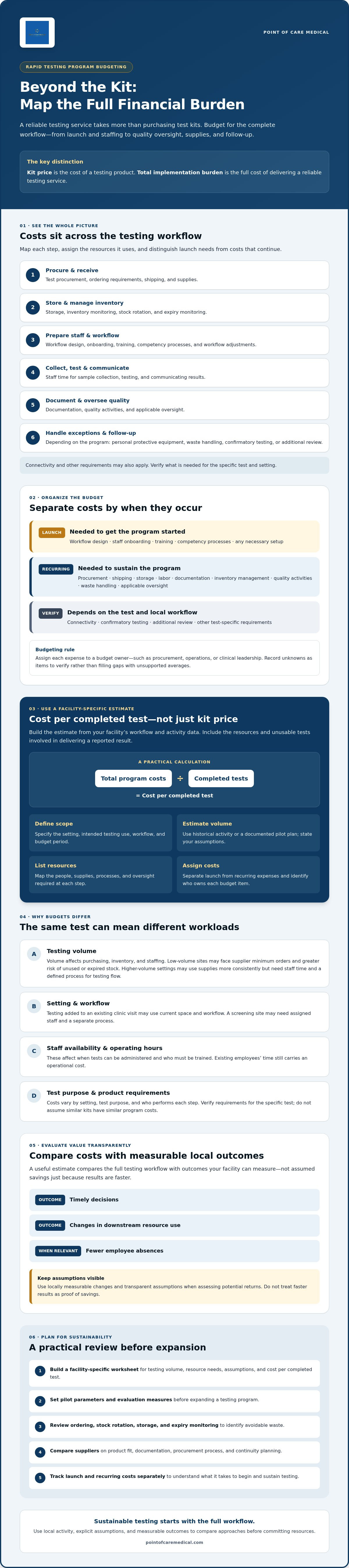
- Use a facility-specific worksheet to estimate testing volume, resource needs, and cost per completed test.
- Weigh the financial burden of rapid test implementation against locally measurable changes in resource use, not assumed savings from faster results.
- Set pilot parameters and evaluation measures before expanding a testing program.
- Review ordering, stock rotation, storage, and expiry monitoring to identify avoidable waste.
- Compare suppliers on product fit, documentation, procurement process, and continuity planning.
What creates the financial burden of rapid test implementation?
The financial burden of rapid test implementation includes more than the amount paid for test kits. It covers the resources a facility needs to procure, store, administer, document, and oversee testing, as well as the work required to launch or change the program. The kit price is the cost of a testing product; the total implementation burden is the full cost of delivering a reliable testing service.
Rapid antigen tests may support screening or clinical decisions when timely results are useful, but the test itself is only one part of the workflow. Budget for direct costs, such as test procurement, shipping, storage, and inventory management; operational costs, such as staff time for sample collection, testing, result communication, and documentation; and ongoing costs, including quality processes, supply monitoring, and oversight. Connectivity or additional review may also be required. Verify these requirements for the specific test and setting.
Which costs belong in a rapid testing program budget?
Map each step, from ordering supplies to recording a result. Include staff onboarding, competency processes, and workflow adjustments, even when existing employees take on the work. Their time still carries an operational cost. Depending on the program, account for personal protective equipment, waste handling, and confirmatory testing. Separate expenses needed to start the program from those that recur with each testing cycle or volume level.
Why does the financial burden vary between facilities?
Expected volume affects purchasing, inventory, and staffing. A low-volume site may need to meet a supplier’s minimum order while using tests slowly, which can increase the risk of unused or expired stock. A higher-volume setting may use supplies more consistently but need dedicated staff time and a defined process for managing testing flow.
Setting matters, too. A clinic that adds testing to an existing visit may use its current space and workflow, while a screening site may need to assign staff and organize a separate process. Operating hours and staff availability affect when tests can be administered and who must be trained. Don’t assume similar test kits will have similar program costs.
Distinguish launch expenses from recurring costs. Initial workflow design, staff onboarding, and any required setup are startup items. Procurement, storage, inventory monitoring, documentation, and quality activities may continue throughout the program. Track these categories separately so the budget reflects both the effort to begin testing and the resources needed to sustain it.
How to calculate the full cost of rapid test implementation
A useful budget starts with your facility’s workflow and activity data, not a broad industry average. The financial burden of rapid test implementation becomes clearer when you define what the program includes, identify who owns each resource, and calculate costs against completed tests. Cost per completed test differs from kit price because it includes the resources and unusable tests involved in delivering a reported result.
Build a facility-specific cost inventory
Separate launch expenses from recurring program costs. Assign each expense to a department or budget owner, such as procurement, operations, or clinical leadership. This makes it easier to identify costs that sit outside the test-kit line item.
- Launch: workflow design, staff onboarding, training, competency processes, and any necessary setup.
- Recurring: test procurement, shipping, storage, labor, documentation, inventory management, quality activities, waste handling, and applicable oversight.
- Variable or unconfirmed: connectivity, confirmatory testing, and other requirements that depend on the test and local workflow.
Record unknowns as items to verify rather than filling gaps with unsupported averages. For procurement, compare product fit and ordering requirements alongside the rest of the budget. Reviewing rapid test procurement options can help facilities scope test supplies as one part of that assessment.
Estimate testing volume and cost per completed test
Use historical demand where available. For a new program, base the estimate on a documented pilot plan and state your assumptions. Then complete this worksheet:
- Define scope: Specify the setting, intended testing use, workflow, and period being budgeted.
- Estimate volume: Project tests administered from historical activity or a documented pilot, not an unsupported forecast.
- List resources: Include the expenses in your inventory and identify which are fixed, recurring, or volume-dependent.
- Validate assumptions: Confirm staffing time, purchasing requirements, storage needs, and any locally applicable quality or oversight processes.
Calculate total included program expenses ÷ completed tests. Define “completed” consistently, such as a test with a valid, documented result. State whether the numerator includes launch expenses, recurring costs, or both. If you include one-time setup costs, show them separately as well so decision-makers can see how they affect the result.
Where local records are reliable, track invalid, repeated, expired, and unused tests. These affect usable volume and can change the calculated cost per completed test. Model low, expected, and high utilization scenarios to see how the budget responds if demand differs from the estimate. This gives your team a clearer basis for reviewing its assumptions.
Does rapid testing ROI justify the financial burden?
Not automatically. Faster results may improve decisions or workflow, but they don’t prove that a program will produce a positive financial return. To assess whether the financial burden of rapid test implementation is justified, compare the program’s full costs with outcomes your facility can measure and reasonably connect to testing.
Set the evaluation around the test’s intended use. For example, a facility might track whether results change follow-up actions, treatment decisions, referral patterns, or time to action. A screening program may instead assess process measures, such as time spent coordinating next steps. Keep financial returns separate from clinical, access, and workflow outcomes. Each can matter, but count as monetary savings only benefits with a defensible financial link.
Which benefits can a facility measure?
Choose a baseline and a consistent measurement period before implementation. Compare results after launch with that baseline, and document other factors that could explain a change. Don’t claim that testing reduced costs simply because a related expense fell. Local data should support that relationship.
| Cost or outcome | Potential value | Measurement method | Uncertainty to assess |
|---|---|---|---|
| Testing labor and supplies | Clear view of program expenditure | Track staff time, supply use, and completed tests | Volume, repeat tests, and time spent may vary |
| Follow-up and referrals | Changes in downstream resource use | Compare follow-up actions before and after implementation | Other care changes may affect the pattern |
| Time to action | Potential workflow or access improvement | Record intervals from testing to the next decision or action | Faster action may not reduce total spending |
| Clinical outcomes | Possible improvement in care decisions | Use measures aligned with the test’s intended purpose | Clinical benefit does not itself establish financial return |
How should facilities interpret published economic evaluations?
Check the population, comparator, setting, time horizon, and included cost categories before applying a published result. A model based on one test and clinical workflow may not reflect your staffing, patient volume, follow-up practices, or procurement arrangements. Treat it as scenario evidence, not a forecast for your facility.
Test the conclusion against alternative assumptions. Ask whether the result changes with lower utilization, different labor requirements, or a narrower set of measurable benefits. Report financial results separately from clinical, access, and workflow findings. If local evidence doesn’t establish a monetary return, say so clearly while still documenting other outcomes that matter to the program.
How can facilities control rapid testing program costs?
Cost control starts with matching program design to actual demand. A limited pilot can reveal where staff time, supplies, and workflow create avoidable expense before the facility commits to broader implementation. Set the pilot’s scope in advance, then use consistent measures to decide whether to adjust, continue, or expand. This ties the financial burden of rapid test implementation to observed needs rather than untested assumptions.
Plan a pilot before expanding testing
Document a baseline, pilot period, eligible population, and accountable program owner. Define the workflow and staff roles before testing begins. Track utilization, completed tests, invalid results, staff time, and outcomes connected to the program’s purpose. Agree on decision thresholds in advance, based on local priorities and available resources. No single utilization or performance benchmark fits every setting.
Standardize staff onboarding, test-specific instructions, and documentation. Confirm requirements for the selected test and setting with the appropriate internal leads. Consistent procedures make pilot results easier to interpret and can reduce repeated work caused by unclear steps or incomplete records.
Reduce waste through procurement and workflow controls
Use documented demand to guide order quantities. Check product shelf-life information before placing orders, then assign staff to review storage conditions, stock rotation, and expiry dates. Set an ordering cadence that fits usage and replenishment needs. Monitor unused and expired inventory alongside testing volume so purchasing decisions reflect usable stock, not just kits ordered.
Procurement guidance can support category-specific planning. For respiratory screening, review this COVID-19 rapid test wholesale guidance as one example of considerations to assess. If toxicology testing is in scope, consult the fentanyl test cup procurement guidance. Product sourcing is one input to the budget, not a guarantee of lower total costs.
Before expanding, compare pilot results with the baseline and review unexpected workload, waste, or process gaps. If your facility is assessing supply options as part of that review, explore rapid test supply options for relevant testing categories.
Choosing a sustainable rapid test implementation approach
A sustainable program aligns the test, workflow, purchasing plan, and review process with a defined facility need. Use a consistent decision sequence before committing to ongoing volume. This makes the financial burden of rapid test implementation easier to assess and helps teams identify gaps while changes are still manageable.
- Confirm the use case: Define who will be tested, why, and how results will inform the next step.
- Verify requirements: Check the specific test’s intended use, current regulatory status, instructions, storage conditions, and facility requirements.
- Model workload: Estimate staff time, supply needs, documentation, and expected testing volume within the actual care pathway.
- Pilot and reassess: Review operational and outcome measures, then adjust the approach before expanding.
What should decision-makers verify before selecting tests?
Check test-specific instructions, training needs, and result documentation requirements with the appropriate clinical and operational leads. Confirm that the product fits expected patient volume and the existing care pathway. A test that appears suitable on paper may create extra steps if the facility lacks a clear process for administering it, recording results, or managing follow-up.
Compare suppliers on more than product fit. Review available product documentation, ordering and procurement processes, and how the facility will plan for ongoing supply needs. Confirm details directly rather than assuming requirements are identical across tests or categories.
How to move from evaluation to a purchasing decision
Bring finance, clinical, and operational stakeholders the same summary. Show expected costs alongside items with greater uncertainty, such as variable demand or staff time. Document pilot findings, unresolved assumptions, and the person responsible for ongoing review. This gives the team a practical basis for deciding whether to continue, revise, or pause the program.
Match sourcing to the confirmed use case. Point of Care Medical distributes rapid diagnostic test supplies for healthcare and screening organizations, with respiratory, infectious disease, and toxicology categories. These can serve as procurement examples when scoping needs, but verify product fit and current status for each specific test. Once your facility has defined its requirements, review Point of Care Medical's rapid testing supplies as one input to the purchasing assessment.
Build a Testing Program Your Facility Can Sustain
The financial burden of rapid test implementation depends on the full operating model, not just the kit price. Build a facility-specific cost inventory, calculate cost per completed test, and assess financial returns against locally measured outcomes. A defined pilot can help your team validate workload, purchasing assumptions, and workflow before expanding.
Keep the review practical: confirm the test’s fit and requirements, identify recurring costs, and assign ownership for ongoing reassessment. These steps help finance, clinical, and operational teams make decisions using shared assumptions rather than uncertain projections.
Point of Care Medical distributes rapid testing supplies to healthcare and screening organizations across the United States. Its catalog includes respiratory, infectious disease, and toxicology categories, including GenBody COVID-19 Rapid Antigen Tests and ViraDx SARS-CoV-2/Flu A+B tests. As you finalize your facility’s requirements, review rapid testing supplies for your facility.
A measured approach gives your team a clear basis for planning and adapting a sustainable program.
Frequently Asked Questions
How much does it cost to implement a rapid testing program?
There’s no single reliable figure for every facility. The financial burden of rapid test implementation depends on the selected test, expected volume, staffing, training, storage, quality processes, and workflow changes. Build a local estimate from supplier quotations and facility resource data. Separate one-time launch expenses from recurring costs, and document your assumptions. Review the estimate as utilization changes so budget decisions reflect actual demand and workload.
What costs should a rapid test implementation budget include?
Include test procurement, shipping, inventory handling, staff time, training, documentation, storage, quality processes, and workflow adjustments. Some programs may also need to account for connectivity or oversight requirements. Confirm which items apply to the specific test and setting rather than assuming every program has the same needs. Label expenses as one-time or recurring, and assign an owner to each budget line so costs are less likely to be missed.
Can rapid testing reduce healthcare costs?
Rapid testing may affect downstream resource use when results change a clinical or operational decision, but savings aren’t automatic. The outcome depends on the test, patient population, existing workflow, and how staff act on results. Track relevant outcomes locally and compare them with a documented baseline. Published economic evaluations can inform your assumptions, but they reflect specific scenarios and shouldn’t be treated as proof that your facility will achieve the same financial result.
How do you calculate the ROI of a rapid testing program?
Define program costs, the comparison period, and measurable outcomes before calculating a return. Include relevant direct and operational expenses, then compare them with financial benefits supported by local evidence. Keep clinical or access benefits distinct from cash savings. Test different utilization assumptions and disclose uncertainties. If your facility can’t measure financial benefits reliably, report the evaluation as incomplete rather than presenting an unverified positive ROI.
What happens if rapid test volume is lower than expected?
Lower utilization can raise the effective cost per completed test and leave inventory unused or expired. Model a low-volume scenario before purchasing, and consider a limited pilot to better understand demand. Monitor orders, completed tests, repeat tests, and expired stock. Use actual results to review workflow and purchasing cadence before expanding or continuing the program. Revisit assumptions when demand changes rather than relying on the original forecast.
Is a rapid test program financially worthwhile for a small clinic?
It depends on the clinic’s use case, expected volume, available staff, and the value of timely results within its care pathway. Estimate fixed launch expenses separately from recurring costs, then test assumptions with a pilot or documented demand estimate. Compare relevant outcomes with the current process. A published result from a larger facility may help frame questions, but it isn’t a direct forecast for your clinic.
How can a facility reduce the financial burden of rapid test implementation?
Start with a defined use case and a realistic estimate of testing volume. Pilot the workflow, track staff time and test utilization, and review inventory rotation and expiry monitoring. Confirm training needs and test-specific requirements before launch. These controls can help identify avoidable waste and show whether the program fits local operations. They don’t guarantee savings, so use facility data to guide purchasing and reassess the program over time.


