

A completed training module doesn’t prove that staff can perform a point-of-care test consistently. Whether a facility is evaluating GenBody COVID-19 rapid test wholesale options or using another assay, dependable testing depends on following the specific test instructions and the facility’s workflow.
Training should cover the basics, but facilities also need a way to keep instruction consistent across shifts, document competency, and update procedures when a test or workflow changes. Generic training can leave gaps if it doesn’t reflect the assay staff actually use.
This guide explains how to build a repeatable, role-based training and competency process for point-of-care diagnostics. It covers how to tailor instruction to each test’s current instructions, assess staff against their assigned tasks, and maintain organized training records. It also explains how to review changes and confirm applicable CMS, CLIA, state, and facility requirements before updating your process. Product access is one part of a testing program, not a substitute for staff preparation.
Key Takeaways
- Separate general orientation from assay-specific instruction, competency assessment, and ongoing updates.
- Build training around the test staff will use, starting with its current instructions and facility procedures.
- Choose competency checks that match the test and each staff member’s assigned duties.
- Use a consistent record checklist to track training, assessment outcomes, and follow-up needs.
- When considering GenBody COVID-19 rapid test wholesale, treat supply planning as one part of a testing program, alongside staff preparation and procedure review.
Why staff training for point-of-care diagnostics needs a repeatable process
Point-of-care testing (POCT) refers to diagnostic testing performed near the patient rather than in a central laboratory. In a clinic or screening facility, several people may handle testing, documentation, and communication of results. A consistent process helps keep those steps aligned, from preparing the test to recording and communicating the result.
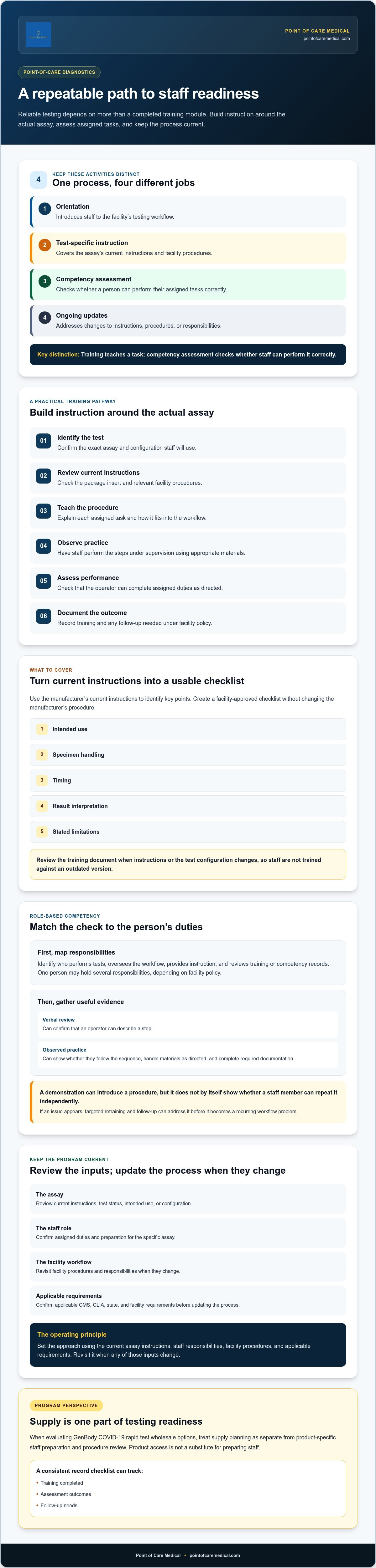
A repeatable process separates four activities that are easy to conflate. Orientation introduces staff to the facility’s testing workflow. Test-specific instruction covers the assay’s current instructions and facility procedures. Competency assessment checks whether a person can perform assigned tasks correctly. Ongoing updates address changes to instructions, procedures, or responsibilities.
Training teaches staff how to perform a task; competency assessment checks whether they can perform it correctly. The process and documentation a facility needs depend on its setting, the test, applicable requirements, and the manufacturer’s current instructions. A facility reviewing GenBody COVID-19 rapid test wholesale options should treat reliable supply and product-specific staff preparation as separate parts of its testing plan.
Which staff roles need test-specific preparation?
Identify who performs tests, oversees the workflow, provides instruction, and reviews training or competency records. One person may hold several responsibilities, depending on facility policy. Assign each task clearly, then confirm that the person is prepared for the specific assay and duties involved. Staff should perform only tasks assigned under facility procedures and applicable requirements.
Why a single demonstration may not be enough
A demonstration can introduce a procedure, but it doesn’t show whether a staff member can repeat it independently. Infrequent testing can make steps harder to recall. Shift changes can create uneven handoffs, and updates to a test or procedure can leave experienced staff relying on outdated habits.
Observed practice provides useful evidence. A verbal review may confirm that an operator can describe a step; observation can show whether they follow the sequence, handle materials as directed, and complete required documentation. If an issue appears, targeted retraining and follow-up can address it before it becomes a recurring workflow problem.
Don’t assume one competency schedule or assessment method fits every test and facility. Set the approach by reviewing the assay’s current instructions, staff responsibilities, facility procedures, and applicable requirements. Revisit it when any of those inputs change. This makes training a maintained process rather than a one-time sign-off.
How to build CLIA-waived test training around the actual assay
Build instruction around the specific test and the tasks each operator will perform. A CLIA-waived designation doesn’t replace the need to follow the manufacturer’s current instructions or facility procedures. Before rollout, verify the test’s current status and intended use, then confirm which requirements apply to your facility and testing setting.
Use this sequence to create a consistent training pathway:
- Identify the test. Confirm the exact assay and configuration staff will use.
- Review current instructions. Check the package insert and relevant facility procedures.
- Teach the procedure. Explain each assigned task and how it fits into the workflow.
- Observe practice. Have staff perform the steps under supervision using appropriate materials.
- Assess performance. Check that the operator can complete assigned duties as directed.
- Document the outcome. Record the training and any follow-up needed under facility policy.
Turn manufacturer instructions into a training checklist
Use the current instructions to identify key points, including intended use, specimen handling, timing, result interpretation, and stated limitations. Turn those points into a facility-approved checklist without changing the manufacturer’s procedure. Review the document whenever instructions or the test configuration changes, so staff aren’t trained against an outdated version.
Teach the complete testing workflow
Cover the full sequence relevant to the operator’s role, from preparation and patient identification through collection, test execution, interpretation, and reporting. Include quality-control steps and escalation procedures only as specified by current guidance and facility procedures. A trainer can demonstrate the workflow, then observe supervised practice and correct missed or out-of-sequence steps.
Requirements can vary by test and setting. Don’t assume the CLIA status of one assay applies to another, or that a test’s status resolves every facility obligation. Review the requirements that apply to your operation. For non-waived testing, consult the CMS guidance on CLIA competency assessment requirements and confirm which provisions apply.
Once the training workflow is defined, facilities comparing GenBody COVID-19 rapid test wholesale options can review products as a separate sourcing step. Point of Care Medical distributes the GenBody COVID-19 Rapid Antigen Test and other diagnostic tests to healthcare and screening facilities across the United States. Review available diagnostic products, then confirm each selected test’s current instructions and applicable requirements before use.
How to assess point-of-care test competency consistently
Choose assessment methods that match the assay, the operator’s assigned duties, and applicable facility requirements. A written quiz may confirm that someone understands a procedure, but it can’t show whether they perform each step correctly. Pair methods where needed, and assess the work the person is authorized to do.
| Method | What it can show | Best fit |
|---|---|---|
| Knowledge check | Understanding of interpretation, test limitations, and escalation steps | Confirming that staff can explain decisions and required responses |
| Direct observation | Whether procedural steps are performed as instructed | Assessing hands-on tasks that must be completed in sequence |
| Simulated practice | How staff respond to a defined scenario | Rehearsing approved procedures with appropriate materials |
| Record review | Whether documentation is complete and consistent | Checking assigned recording and reporting responsibilities |
Use questions to check understanding, but don’t rely on answers alone for tasks that require hands-on performance. Simulations should reflect approved procedures and use appropriate materials. Review records for completion and consistency, but don’t treat that review as a substitute for observing practical performance when observation is part of the role.
Choose assessment methods that fit the testing task
Set clear criteria before assessing staff. For example, an evaluator can use a checklist based on current test instructions and facility procedures to note whether an operator completes assigned steps, interprets results as directed, and follows reporting or escalation processes. Keep each criterion specific to the test and the operator’s responsibilities.
Respond to gaps with documented follow-up
If an assessment identifies a gap, record the specific step or knowledge area involved, the feedback provided, and the planned follow-up. Provide targeted retraining, then reassess the relevant task before documenting the staff member as ready for assigned duties. If concerns remain unresolved, refer them to facility leadership and follow established procedures.
A competency assessment documents what an operator demonstrated, what support was provided, and whether follow-up confirmed readiness for assigned duties. Set the assessment schedule according to the specific test, facility policy, and applicable requirements. Don’t assume one frequency applies across all facilities or testing types.
A sourcing decision, such as evaluating GenBody COVID-19 rapid test wholesale options, addresses access to a test, not staff competency. Keep those workstreams connected in planning but distinct in the records: supply records track products, while competency records show staff preparation and assessment outcomes.
How to maintain training records and keep staff current
Consistent records help facility leaders confirm who was prepared for which test, when training occurred, and whether follow-up remains open. Use one standard template across shifts, while keeping legally required records distinct from additional operational records the facility chooses to maintain. Confirm retention and access rules against current applicable requirements and facility policy rather than assuming one period applies to every record.
Create an audit-ready training record
For each training or assessment, capture the staff member, test or assay, training date, evaluator, outcome, and any follow-up action. Identify the procedure version used and retain supporting documents, such as completed checklists, according to facility policy. Version control helps connect an assessment to the instructions in effect at the time. Limit access to authorized personnel and follow the facility’s approved record-retention practices.
- Staff: Name or other facility-approved identifier and assigned role.
- Test: Assay and relevant configuration.
- Training: Date, procedure version, and topics covered.
- Evaluation: Evaluator, method, observed outcome, and feedback.
- Follow-up: Retraining or reassessment needed, responsible person, and completion status.
For assay-specific onboarding, connect the record to the instructions and workflow staff were prepared to use. The COVID-19 rapid test wholesale procurement guide can provide sourcing context, but procurement information doesn’t replace current test instructions or facility training procedures.
Refresh training when workflows or tests change
Review training after a test or its instructions change, after a facility procedure or equipment change, and when staff responsibilities shift. Documented errors and staff feedback can also point to steps that need reinforcement. For example, recurring issues with recording results may call for focused instruction on that task and a check that staff understand the updated process.
Assign a responsible lead to monitor procedure revisions, identify affected staff, track completion, and follow unresolved concerns through facility channels. Link the update record to the applicable procedure version and note whether staff need retraining, reassessment, or both. For facilities comparing GenBody COVID-19 rapid test wholesale options, plan assay onboarding alongside supply decisions so the selected test’s current instructions can inform preparation. Review available diagnostic products as one part of that planning.
How to put a point-of-care training program into operation
Set ownership and scope before training begins. A designated lead can coordinate procedures, operator preparation, and follow-up across shifts. Confirm each test’s current instructions and applicable facility requirements before rollout. Supply planning supports continuity, but having tests on hand doesn’t establish that staff are prepared to use them.
Launch with a defined owner and scope
Name a program lead and specify which tests, staff roles, and locations the process covers. Set completion milestones that fit operational needs and applicable requirements. Decide how staff will report questions, observed errors, and procedure changes to the lead, and how the lead will track responses through completion.
Use a brief launch checklist to keep responsibilities visible:
- Assign an owner: Name the lead responsible for coordination and unresolved follow-up.
- Define the scope: List the tests, operator roles, supervisors, and locations included.
- Select procedures: Confirm current test instructions and facility-approved workflows.
- Prepare operators: Schedule test-specific instruction and assessment for assigned duties.
- Review records: Check training completion, assessment outcomes, and open actions before the process goes live.
Connect training plans with test procurement
Before training, make sure the selected assay’s current instructions and the facility workflow are available to the people preparing and delivering instruction. The GenBody COVID-19 Rapid Antigen Test can be included in planning where it is selected for use. Confirm its current package information and intended use rather than assuming details from a previous test or configuration still apply.
For facilities considering GenBody COVID-19 rapid test wholesale, align procurement planning with the operational readiness review. Confirm that the selected test fits the facility’s intended workflow and that staff preparation is based on its current instructions. Diagnostic supply continuity is one input to a functioning program. It doesn’t replace role-specific preparation, demonstrated performance, or review of applicable requirements.
Point of Care Medical distributes diagnostic tests to healthcare and screening facilities across the United States. To explore products as one part of your planning, review available diagnostic test supplies. Product selection and supply access remain separate from staff training and facility compliance decisions.
Put a Consistent Testing Process in Place
A dependable point-of-care program connects assay-specific instruction with observed competency and organized records. Start by assigning clear responsibilities, then train staff using each test’s current instructions and facility procedures. Review readiness when tests, workflows, or staff duties change, and confirm applicable requirements before rollout.
Keep supply planning distinct from staff preparation. If you’re evaluating GenBody COVID-19 rapid test wholesale options, verify the current product information for the assay you select and plan operator preparation around it. Point of Care Medical distributes the GenBody COVID-19 Rapid Antigen Test and other diagnostic supplies to healthcare and screening facilities across the United States. Product access supports a testing program, but it doesn’t replace facility-led training or competency assessment.
Review Point of Care Medical’s diagnostic test supplies as you plan your program. With clear ownership and a repeatable process, your team can make staff preparation easier to manage and maintain over time.
Frequently Asked Questions
What should staff training for point-of-care diagnostics include?
Training should cover the specific test, the operator’s assigned tasks, and the facility’s testing workflow. Review the test’s current instructions, including specimen handling, procedure steps, result interpretation, limitations, and required documentation. Include quality-control or escalation procedures when current guidance and facility procedures call for them. Pair instruction with a demonstration and supervised practice, then document completion and any follow-up so staff preparation is consistent across operators and shifts.
How do you assess competency for point-of-care testing?
Assess competency by checking whether staff can perform their assigned duties, not only describe them. Use direct observation for hands-on steps, questions to confirm understanding of interpretation and limitations, and record review for documentation tasks. Simulated practice can help when scenarios reflect approved procedures and use appropriate materials. Record the method, observed results, feedback, and any retraining or reassessment. Match the assessment to the test, role, facility policy, and applicable requirements.
Does CLIA-waived testing require staff training?
CLIA-waived status doesn’t remove the need to follow the test’s current manufacturer instructions and the facility’s procedures. Staff should receive preparation appropriate to the tasks they perform, and facilities should verify the test’s current status and applicable requirements for their setting. Confirm details using authoritative, current sources before rollout. Don’t assume that one assay’s status or instructions apply to another test in the facility.
How often should point-of-care testing staff be reassessed?
There isn’t one reassessment interval that applies to every test and facility. The appropriate schedule depends on the testing category, applicable requirements, accreditation or facility policy, and the operator’s role. Confirm current requirements rather than relying on a generic calendar. Review competency sooner when a test, its instructions, equipment, workflow, or staff responsibilities change, or when observed performance indicates a need for focused retraining and follow-up.
What should be included in a point-of-care test competency record?
A practical record identifies the staff member, test or assay, training and assessment dates, evaluator, assessment method, outcome, and follow-up actions. Include the procedure or instruction version used and retain relevant checklists or supporting documents under facility policy. Keep records organized so reviewers can connect an operator’s assessment with the applicable test and workflow. Confirm retention and access practices against current requirements and facility policy.
Can one training program cover every rapid diagnostic test?
A general orientation can introduce shared facility practices, but it shouldn’t replace test-specific instruction. Assays may have different intended uses, procedures, specimen requirements, interpretation criteria, and limitations. Train staff using the current instructions for each test they’re assigned to perform. Facilities considering GenBody COVID-19 rapid test wholesale should verify current information for the selected assay and build preparation around those instructions, rather than relying on training for another test.
Who can train staff on point-of-care diagnostic tests?
The facility should identify a responsible trainer who is prepared to teach the specific test and workflow, consistent with facility policy and applicable requirements. The trainer should use current manufacturer instructions and approved procedures, and be able to observe assigned tasks and document results. Determine any required trainer qualifications from current rules that apply to the facility and test. A diagnostic supplier can provide product access, but that doesn’t establish staff competency.


