

The HHS emergency declaration for COVID-19 diagnostics terminates on December 26, 2026, marking a critical shift in how facilities must manage COVID antigen test kits for clinics. This transition requires more than just a change in paperwork. It demands a total optimization of your operational logistics. You likely understand that maintaining a high-volume testing site is difficult when supply chain instability and CLIA-waived documentation requirements create constant administrative friction. Logistical bottlenecks shouldn't compromise patient care or your regulatory standing.
Managing these hurdles while maintaining high standards is a balancing act that often leads to staff burnout and increased audit risks. You need a system that works as hard as your clinical team. This guide will help you master the operational logistics of high-volume testing to ensure both clinical efficiency and strict regulatory compliance. We will examine how to integrate high-performance assays like GenBody into a seamless, audit-ready workflow. You'll learn to stabilize your supply chain and implement standardized protocols that reduce administrative burdens across your entire organization.
Key Takeaways
- Implement modular testing station designs that maximize patient throughput while maintaining a secure chain of custody for all diagnostic samples.
- Evaluate the performance benefits of the GenBody COVID-19 Rapid Antigen Test compared to multiplex assays like ViraDx for precise respiratory surge management.
- Streamline the procurement of COVID antigen test kits for clinics by leveraging national B2B fulfillment to eliminate supply chain instability.
- Ensure continuous regulatory compliance by establishing standardized documentation protocols for all CLIA-waived testing procedures.
The Role of COVID Antigen Test Kits for Clinics in 2026
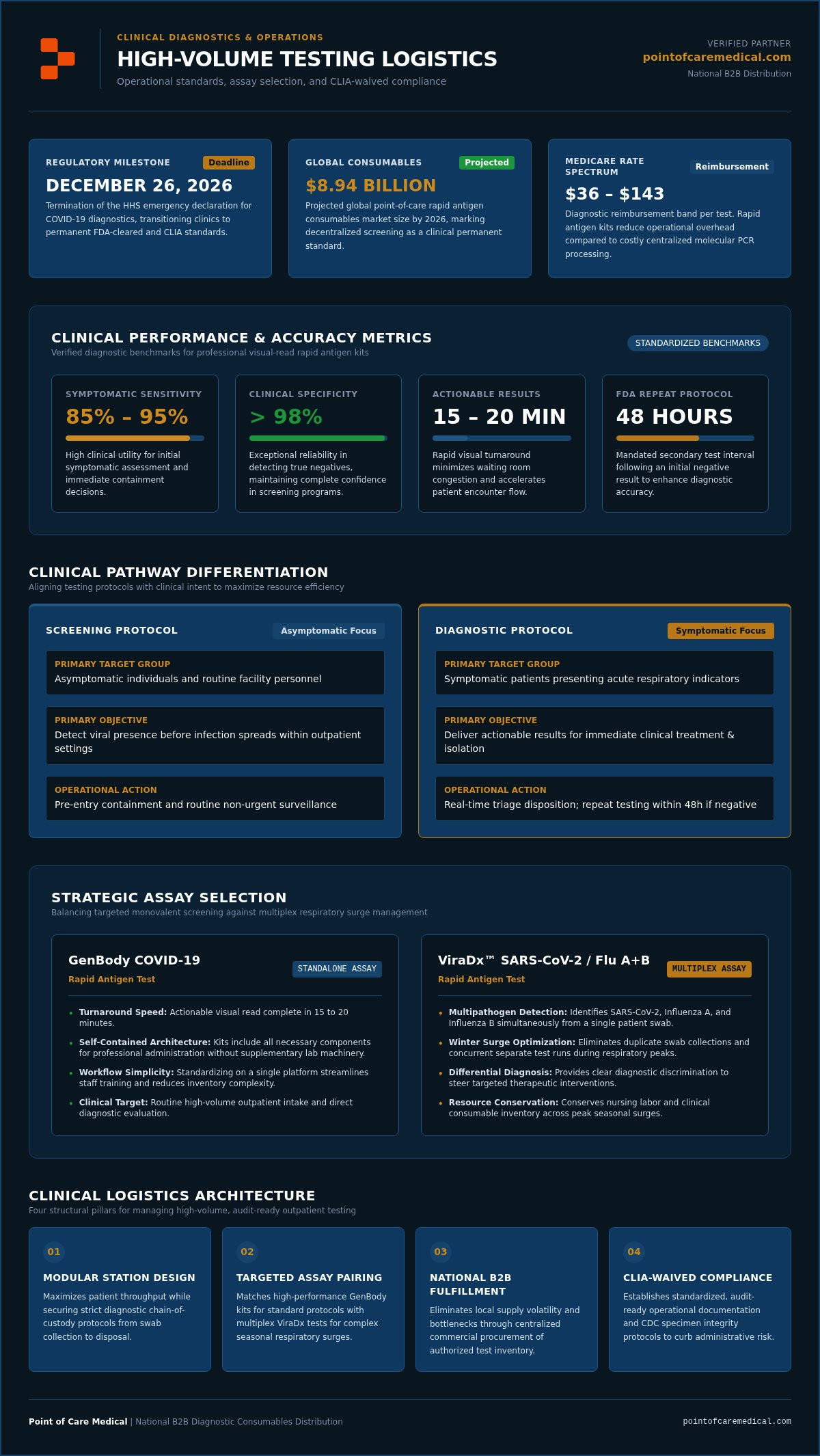
The healthcare industry faces a pivotal transition as the HHS emergency declaration for COVID-19 diagnostics concludes on December 26, 2026. This regulatory shift forces outpatient facilities to re-evaluate their diagnostic strategies. Modern COVID-19 rapid antigen tests have evolved from emergency stop-gaps into permanent fixtures of clinical efficiency. High-volume environments now rely on these assays to maintain patient flow without the delays inherent in centralized laboratory processing. The global market for these consumables is projected to reach $8.94 billion in 2026, reflecting a permanent shift toward decentralized, point-of-care testing. As a national B2B distributor, Point of Care Medical facilitates this transition by providing reliable access to FDA-cleared diagnostics that meet updated marketing authorization standards.
Why High-Volume Facilities Prioritize Rapid Assays
Clinical managers prioritize speed to prevent waiting room congestion. Visual-read assays provide actionable results within 15 to 20 minutes, allowing for immediate patient disposition. This rapid turnaround optimizes clinic throughput by shortening the total encounter time. COVID antigen test kits for clinics also offer a significant cost advantage over molecular methods. While PCR tests remain highly sensitive, their higher operational costs and longer processing times often create logistical friction. Medicare's reimbursement for diagnostic tests ranges from $36 to $143, but the administrative overhead of molecular testing often strains clinic resources. By utilizing antigen assays, facilities reduce their reliance on external laboratory logistics and lower the per-test expense for routine screening.
Distinguishing Between Screening and Diagnostic Protocols
Effective deployment requires a clear distinction between screening and diagnostic workflows. Screening involves testing asymptomatic individuals to identify potential infections before they spread within a facility. Diagnostic protocols focus on symptomatic patients where rapid results guide immediate treatment decisions. In symptomatic cases, antigen tests demonstrate a sensitivity of 85% to 95%, providing high clinical utility for initial assessment. Integrating these kits into a symptomatic pathway allows providers to make real-time decisions regarding isolation. Current FDA guidance emphasizes repeat testing for negative results to improve accuracy, typically recommending a second test after 48 hours. Actionable results simplify the patient journey and ensure that clinical resources are allocated to those with the highest medical need. It's a pragmatic approach that balances precision with operational speed.
Selecting the Right Assay: GenBody vs. Multiplex Options
Selecting appropriate diagnostic tools is a strategic decision for clinical administrators. You must balance the need for rapid results with the specific pathogens circulating in your community. Professional-grade COVID antigen test kits for clinics must maintain high sensitivity and specificity to ensure patient safety and regulatory compliance. While standalone tests are ideal for targeted screening, multiplex assays provide a broader diagnostic picture during peak respiratory seasons. Antigen tests typically demonstrate a specificity exceeding 98 percent. This high level of accuracy in detecting true negatives is vital for maintaining confidence in your screening programs. When sensitivity reaches the 85 to 95 percent range for symptomatic individuals, these tests become powerful tools for rapid intervention.
GenBody COVID-19: A Clinical Standard
The GenBody COVID-19 Rapid Antigen Test serves as a foundational tool for high-volume outpatient settings. It provides results in 15 to 20 minutes through a simple visual read format. Each kit includes all necessary components for professional administration, minimizing the need for additional laboratory equipment. Standardizing on a single platform like GenBody simplifies staff training and inventory management. Adhering to CDC specimen collection guidelines ensures that your team maintains the integrity of each sample, maximizing the assay's performance. This reliability is essential for maintaining a high-throughput environment without sacrificing result quality.
ViraDx™ and the Rise of Differential Diagnosis
During the winter months, distinguishing between SARS-CoV-2 and influenza becomes a primary operational challenge. The ViraDx™ SARS-CoV-2/Flu A+B Rapid Antigen Test addresses this by identifying multiple pathogens from a single swab. This multiplex approach improves clinical efficiency by eliminating the need for separate tests for each virus. It's an essential resource for managing respiratory surges where differential diagnosis is required for proper treatment. Using these comprehensive kits reduces the time patients spend in the facility and streamlines the diagnostic pathway. Facilities that maintain a reliable supply of both standalone and multiplex assays are better prepared for shifting diagnostic demands. You can browse professional diagnostic assays to secure the inventory needed for your specific clinical workflow. Reliability in procurement ensures that your diagnostic capabilities remain uninterrupted during periods of high demand.
Optimizing the Clinical Workflow for Rapid Testing
High-volume clinical environments require a disciplined approach to physical floor management. While selecting high-performance assays is a critical first step, the layout of your facility determines the ultimate speed of patient throughput. Bottlenecks often occur when testing stations aren't modular or when the chain of custody for samples is poorly defined. To maintain a seamless operation, you must treat the testing process as a linear production line. This minimizes movement for clinical staff and reduces the risk of administrative errors. Implementing a structured workflow ensures that your procurement of COVID antigen test kits for clinics translates into actual operational capacity.
Step-by-Step Testing Station Setup
Designate a specific, low-traffic area for sample collection and processing. A modular station should include clearly labeled zones for intake, swabbing, and result interpretation. Ensure that every station is equipped with essential supplies: professional-grade PPE, biohazard waste containers, and dedicated timers. Because visual-read assays like GenBody require precise timing, using individual timers for each test prevents interpretation errors. Establish a one-way patient flow to maintain social distancing and prevent cross-contamination. Use physical or digital tracking logs to record the patient’s name, the lot number of the kit, and the exact time the swab was collected. This documentation is vital for audit readiness and ensures a reliable chain of custody from the moment of collection to the final result entry.
Staff Training and Quality Control
Standardizing the swabbing and processing technique across all personnel is essential for result consistency. Conduct regular proficiency testing to verify that staff members can accurately perform the assay and interpret the results. This is particularly important when using multiplex tests like ViraDx, where clinicians must distinguish between multiple indicator lines. Refer to the FDA EUA antigen tests database to ensure your team is following the specific Instructions for Use (IFU) for each cleared device. Implement Internal Quality Control (IQC) protocols by running positive and negative control swabs with every new lot or shipment. These routine checks verify that the kits are functioning correctly and that storage conditions haven't compromised the reagents. By focusing on these logistical details, you reduce the administrative burden on your staff and ensure that COVID antigen test kits for clinics are used to their full diagnostic potential.
Regulatory Compliance and CLIA-Waived Protocols
Adherence to federal standards is the foundation of any professional diagnostic program. As the HHS emergency declaration for COVID-19 diagnostics concludes on December 26, 2026, clinics must ensure their testing programs align with traditional regulatory frameworks. For facilities utilizing COVID antigen test kits for clinics, this means operating under the Clinical Laboratory Improvement Amendments (CLIA) guidelines. A Certificate of Waiver allows non-laboratory sites to perform simple, low-risk tests. However, this status requires strict compliance with specific administrative standards. Non-compliance can lead to significant penalties, including the suspension of your testing privileges. Maintaining a robust compliance posture protects your facility from legal risk and ensures the highest level of patient care.
Maintaining Your CLIA Certificate of Waiver
Administrative oversight is essential for keeping your waiver active. You must renew your CLIA Certificate of Waiver every two years to maintain your legal standing. Verify that every diagnostic assay your facility uses is officially classified as CLIA-waived. Using a test outside of its waived status reclassifies your facility as a moderate or high-complexity laboratory, which requires much stricter personnel and quality control standards. Document the specific roles of your facility director and all testing personnel. Clear role definitions ensure that every staff member understands their responsibility in the diagnostic chain. This organization is a key focus for inspectors during unannounced facility audits.
Audit-Ready Reporting and Record Keeping
Organized record-keeping serves as your primary defense during a clinical audit. Maintain a comprehensive log for every diagnostic event. This log should include the date of the test, the patient identifier, and the specific lot number and expiration date of the kit used. Tracking lot numbers allows you to respond quickly to manufacturer recalls or quality alerts. Store all results in a manner that complies with HIPAA and privacy laws, ensuring that patient data is secure yet accessible for official reporting. Many facilities now automate their reporting to state and federal health agencies to reduce manual errors. You must follow the Manufacturer’s Instructions for Use (IFU) exactly as written. Any deviation from the IFU protocol can invalidate a result and trigger a non-compliance finding. Order compliant diagnostic kits to ensure your facility remains audit-ready and fully stocked with verified assays.
Securing Your Supply Chain with Point of Care Medical
Operational excellence in high-volume testing is impossible without a resilient supply chain. While optimized workflows and regulatory compliance provide the framework, consistent access to diagnostic inventory is the engine. Clinics often face supply chain instability during peak respiratory seasons, which can lead to testing gaps and administrative strain. Securing a reliable national distributor allows you to focus on patient care rather than inventory shortages. Point of Care Medical specializes in B2B fulfillment, providing a steady flow of COVID antigen test kits for clinics that maintain high throughput standards.
National Distribution for Institutional Needs
Large healthcare systems and multi-site organizations require logistics that go beyond retail capabilities. You need a partner capable of fulfilling high-volume orders for the GenBody COVID-19 Rapid Antigen Test and ViraDx™ SARS-CoV-2/Flu A+B multiplex assays. National fulfillment ensures that your facilities remain operational regardless of regional demand spikes. Establishing a recurring procurement schedule eliminates the friction of manual reordering. It also provides price stability in a fluctuating market. By consolidating your diagnostic needs with a single national distributor, you reduce shipping complexity and ensure that all sites operate with the same high-performance assays. This standardization is critical for maintaining audit-ready documentation across an entire organization.
Partnering for Clinical Excellence
Procurement officers need an ally who understands the technical requirements of professional diagnostics. Point of Care Medical offers more than just COVID-19 supplies. Our specialized catalog includes the SURE CHECK HIV 1/2 Assay, Rapid Test Cup "RTC" + Fentanyl, and various oral fluid tests for comprehensive screening. Accessing professional-grade toxicology and infectious disease kits from one source simplifies your vendor management. We provide dedicated support to help you navigate the transition toward traditional FDA marketing authorization by December 2026. This partnership ensures that your diagnostic inventory always meets current regulatory benchmarks. You can view our complete respiratory diagnostic catalog to begin building a more resilient procurement strategy. Reliable access to COVID antigen test kits for clinics isn't just a logistical goal; it's a requirement for institutional stability and patient safety.
Optimizing Your Clinical Diagnostic Strategy
Efficient testing relies on the intersection of standardized workflows and reliable procurement. By implementing modular stations and rigorous documentation, clinics can maintain audit readiness while managing high patient volumes. Selecting the right assays ensures your facility remains prepared for shifting diagnostic demands. It's essential to use GenBody for targeted screening or ViraDx for multiplex respiratory assessment to maintain precise patient management during surge periods. These tools provide the actionable results necessary for immediate clinical decisions.
Maintaining a steady supply of COVID antigen test kits for clinics is the final step in securing operational stability. Point of Care Medical serves as an authorized distributor of GenBody and ViraDx diagnostics, offering national shipping capabilities for clinical facilities. Our specialized focus on CLIA-waived rapid screening kits helps you navigate the transition toward traditional FDA marketing authorization with confidence. Establishing a recurring procurement schedule now protects your facility from future supply chain instability and administrative friction. We're ready to support your facility's long-term diagnostic success through methodical logistics and verified quality.
Order GenBody COVID-19 Rapid Antigen Tests in Bulk
Frequently Asked Questions
What is the difference between EUA and FDA-cleared COVID tests for clinics?
Emergency Use Authorization (EUA) is a temporary regulatory pathway used during public health emergencies. Traditional FDA clearance or marketing authorization is the permanent standard for medical devices. The HHS emergency declaration for COVID diagnostics terminates on December 26, 2026. After this date, tests must have traditional authorization to remain on the market. Clinics should verify their inventory's status to ensure long-term compliance with these evolving federal standards.
How long should a clinic keep records for CLIA-waived COVID tests?
Facilities operating under a CLIA Certificate of Waiver must generally maintain testing records for at least two years. These records include patient results, quality control logs, and manufacturer instructions. Proper documentation ensures you're prepared for unannounced inspections. Accurate record-keeping also helps track lot numbers and expiration dates for your COVID antigen test kits for clinics. Check specific state requirements, as some jurisdictions might mandate longer retention periods for clinical data.
Can a clinic use over-the-counter (OTC) tests for patient diagnosis?
Professional clinical settings should use tests specifically cleared for point-of-care use under a CLIA waiver. Over-the-counter (OTC) tests are generally intended for home use and may not meet the documentation or performance standards required for professional diagnosis. Using OTC tests in a clinic can complicate regulatory compliance and reimbursement. Always select assays like GenBody that are designed for professional administration to ensure accurate results and audit-ready reporting.
What are the benefits of using a multiplex SARS-CoV-2/Flu A+B test?
Multiplex tests like ViraDx allow for differential diagnosis from a single patient swab. This identifies whether a patient has COVID-19, Influenza A, or Influenza B simultaneously. This approach improves clinical efficiency by reducing the number of patient encounters and swabs required. It's particularly useful during respiratory surges when multiple viruses are circulating. Providing a broader diagnostic picture helps clinicians make faster, more accurate treatment decisions for symptomatic patients.
How do I ensure my staff is properly trained for antigen test administration?
Staff training begins with a thorough review of the Manufacturer’s Instructions for Use (IFU). You should conduct initial proficiency testing to verify that each team member can perform the swab and interpret results correctly. Regular competency assessments help maintain high standards and reduce interpretation variance. Use the free training resources provided by the CDC for CLIA-waived settings. Consistent training ensures that your COVID antigen test kits for clinics yield reliable, actionable results.
What should be included in a clinical point-of-care testing log?
A comprehensive testing log must include the test date, patient identifier, and the specific assay performed. You must also record the kit lot number and expiration date to ensure traceability during recalls. Include the test result and the name of the staff member who performed the interpretation. Maintaining these logs in a digital or physical format is a core requirement for CLIA compliance. Organized logs simplify the reporting process to state health agencies.
Are GenBody COVID-19 tests suitable for high-volume screening facilities?
The GenBody COVID-19 Rapid Antigen Test is specifically engineered for high-volume professional environments. It provides visual results within 15 to 20 minutes, which maximizes patient throughput in busy outpatient clinics. The simple visual-read format eliminates the need for expensive laboratory instrumentation. Because it's a reliable, standardized platform, it reduces the training burden on your clinical staff. This makes it an ideal solution for facilities that require fast, actionable results at scale.
How does bulk procurement of rapid tests improve clinic ROI?
Bulk procurement improves ROI by lowering the per-unit cost of diagnostic assays. It also reduces shipping expenses and administrative overhead associated with frequent reordering. Maintaining a stable inventory protects your clinic from supply chain disruptions during peak demand periods. Reliable access to kits prevents lost revenue from turned-away patients. Partnering with a national B2B distributor like Point of Care Medical ensures you receive verified, high-performance kits with consistent fulfillment capabilities.


