

Choosing the right oral fluid drug screen supplier involves more than comparing test formats. A kit supplier and a laboratory testing service support different workflows, and the distinction affects who collects specimens, where testing takes place, and how results are handled.
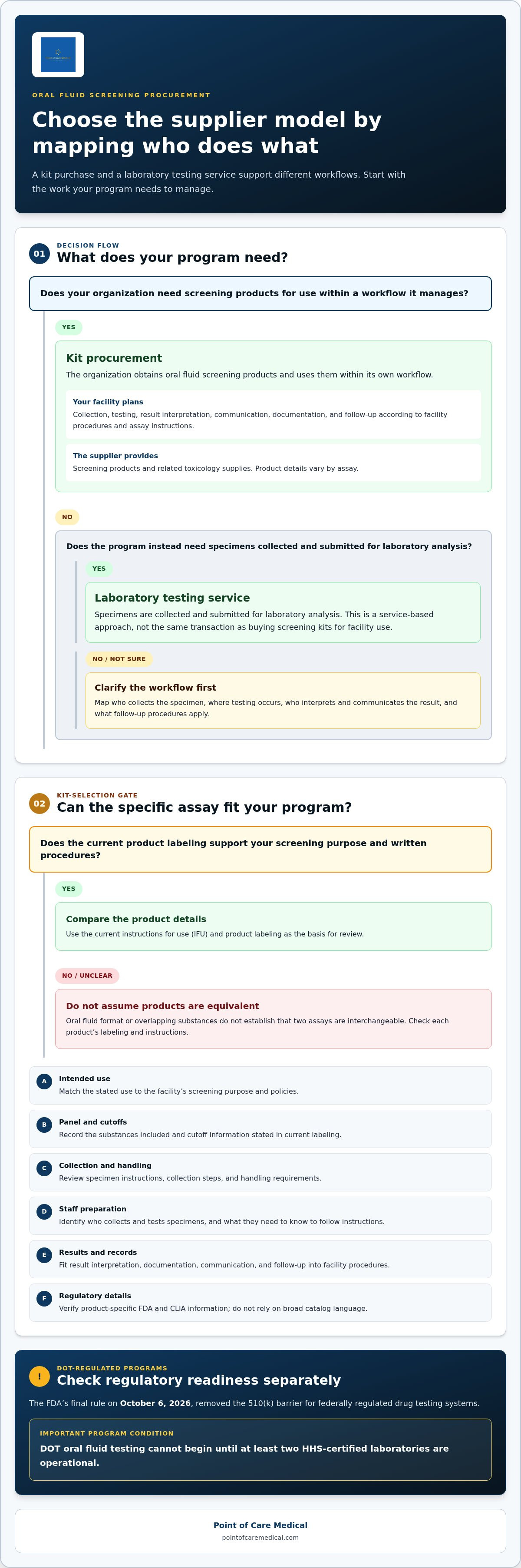
A sound procurement decision accounts for panel scope, collection procedures, documentation, and intended use. For DOT-regulated programs, regulatory readiness also matters: the FDA’s October 6, 2026, final rule removed the 510(k) barrier for federally regulated drug testing systems, but DOT oral fluid testing cannot begin until at least two HHS-certified laboratories are operational.
This guide compares supplier models and lays out product, workflow, and compliance criteria for healthcare, workplace, and treatment settings. It explains how procuring oral fluid test kits differs from using a lab-based service, what to review in current product labeling, and how Point of Care Medical’s oral fluid tests can fit into a supply strategy.
Key Takeaways
- Distinguish kit procurement from laboratory services by identifying who supplies, collects, and processes specimens in your program.
- Use your screening objective, facility policies, and current product labeling to assess panel scope and cutoffs.
- Compare supplier models by where testing occurs and who manages each part of the workflow.
- Plan procurement in stages, from defining program needs to preparing staff and organizing replenishment.
- Choose an oral fluid drug screen supplier that fits your organization’s setting and supply needs, whether healthcare, workplace, or treatment.
What an oral fluid drug screen supplier provides, and what it does not
An oral fluid drug screen supplier provides screening products for organizations; a testing laboratory analyzes specimens and reports results. This difference helps facilities plan purchasing, collection, and result handling without treating a kit order and a lab service as interchangeable.
Oral fluid is the specimen matrix used by these assays. Each screening kit is designed for a defined use and produces results according to its test method and labeling. For background on oral fluid and how it fits within drug testing, see this oral fluid drug screen overview. For procurement, the key question is which products and workflow steps your organization needs to manage.
What facilities source from an oral fluid screening supplier
Facilities can source oral fluid test kits and related toxicology screening supplies. An oral fluid drug screen supplier such as Point of Care Medical provides oral fluid tests as part of a broader point-of-care diagnostic and toxicology supply offering. Product details vary by assay, so compare the specific test rather than assuming the category is uniform.
Before selecting a kit, review its current labeling for intended use, panel, cutoff levels, collection procedure, result interpretation, and stated limitations. These details help determine whether the assay suits your screening purpose and written procedures. Do not assume that two products are equivalent because both use oral fluid or include some of the same substances. Compare each product’s labeling and instructions.
This review also shapes staff preparation. Staff using a screening kit need to understand the stated collection and testing steps, how to interpret results as directed, and what facility policy requires afterward. The supplier provides the product; the organization is responsible for using it within its program and following the assay instructions.
How does a supplier differ from a laboratory testing service?
With kit procurement, the organization obtains screening products for use within its own workflow. A lab-based service works differently: specimens are collected and submitted for laboratory analysis. Quest Diagnostics’ oral fluid testing page illustrates this service-based approach. It is not the same transaction as sourcing screening kits for facility use.
The right model depends on program requirements. Your facility may need screening supplies for a workflow it manages, or a service that includes laboratory processing. Before purchasing, map the responsibilities: who collects the specimen, where testing occurs, who interprets and communicates the result, and what follow-up procedures apply. Defining these roles early helps prevent gaps between purchasing and program delivery.
Keep the distinction clear in procurement documents and internal procedures. Specify whether the purchase is for oral fluid screening kits or a laboratory testing service. Then match that model to the facility’s setting, written policies, and intended use. Procurement, clinical or workplace staff, and administrators can then work from the same understanding of what the supplier provides and what the organization manages.
Evaluate oral fluid drug screen suppliers against facility requirements
Start a supplier review with the facility’s program, not a product’s headline features. Define the setting, screening objective, and written policies first. A healthcare provider, employer, and treatment center may have different workflows and documentation needs, so a kit that suits one program may not suit another.
Use the same checklist for each product so you can compare both the assay and the work required to use it:
- Intended use: Match the assay’s stated use to the facility’s screening purpose and policies.
- Panel and cutoffs: Record the substances included and the cutoff information stated in current product labeling.
- Collection workflow: Review specimen instructions, collection steps, and any handling requirements.
- Staff preparation: Identify who will collect and test specimens and what they need to know to follow the instructions.
- Result records: Decide how results, documentation, and follow-up actions fit into facility procedures.
- Regulatory details: Verify product-specific FDA and CLIA information instead of relying on broad catalog language.
Which assay details should procurement teams compare?
Use the current instructions for use (IFU) as the basis for comparison. Check panel contents, cutoff information, intended use, specimen collection instructions, result interpretation, and stated limitations. These details are assay-specific. Do not apply one product’s performance claims to another, even when both use oral fluid. For more product-level comparison criteria, see this oral fluid drug test kit comparison guide.
Claims about intended use, panel, cutoff, collection instructions, performance, or FDA or CLIA status should match the assay’s current labeling and applicable records. A general catalog description is not a substitute for product-specific documentation. Keep the relevant IFU and labeling accessible to staff who select, use, and interpret the test.
How should compliance and documentation fit into supplier review?
Identify the organizational, program, and jurisdictional requirements that apply before purchasing. Federal workplace programs, for example, have specific guidance. Consult the federal oral fluid drug testing guidelines when relevant, and confirm current requirements for your program. A product’s regulatory status applies to that specific assay. Do not infer it from a supplier’s general description or another product in its catalog.
Document the selected assay, the labeling reviewed, staff responsibilities, and the facility’s process for recording and acting on results. This gives procurement and day-to-day users a shared reference. Organizations sourcing oral fluid tests can include Point of Care Medical’s oral fluid screening supplies in their review alongside facility requirements.
Compare oral fluid supplier models for screening programs
Supplier models serve different functions. A kit distributor helps an organization procure screening supplies for facility use. A laboratory service provides testing within its stated service scope. A manufacturer’s assay portfolio centers on developing or supplying tests. These models are not interchangeable; organizational policies and program requirements determine which responsibilities the facility must manage.
Kit distributor, laboratory service, or manufacturer portfolio?
Compare each model by what it supplies, where testing occurs, and who manages each step. The examples below describe business models, not rankings. Quest Diagnostics’ oral fluid service content illustrates a lab-service format; AlcoPro’s product page illustrates an individual kit format; Thermo Fisher’s assay overview illustrates a manufacturer portfolio format.
| Model | What it supplies | Where testing occurs | Who manages the workflow |
|---|---|---|---|
| Kit distributor | Screening kits and related supplies for organizational use | At the facility or location specified by the assay instructions | The facility manages collection, test use, documentation, and follow-up under its procedures |
| Laboratory service | A testing service for submitted specimens, within the stated service scope | At the laboratory | The laboratory manages its analysis process; the organization manages its own program and service coordination |
| Manufacturer portfolio | Assays or testing products developed or supplied under the manufacturer’s portfolio | Depends on the specific assay and its instructions | Responsibilities depend on whether the organization obtains a kit or uses a separate laboratory service |
Use the table to map the handoffs your program must support. A distributor helps source products, but that does not include specimen processing by itself. A laboratory service is a testing pathway, not simply a supply order. Manufacturer content can describe assay options, but the instructions for the specific product determine how to use it.
When might oral fluid fit a facility’s screening workflow?
Consider where collection will take place, who is available to perform each step, and how the organization will document and handle results. Oral fluid may fit a workflow that can follow the selected assay’s collection instructions. Operational fit depends on staffing, setting, written policy, and intended use. Keep the specimen matrix in mind: oral fluid and urine differ in what their tests detect and in detection period, so choose according to the program objective, not convenience alone.
Facilities with broader toxicology needs may also source other screening categories. Point of Care Medical offers rapid test cups with fentanyl detection; the fentanyl test cup buyer’s guide covers that adjacent supply category. Point of Care Medical also distributes oral fluid tests for healthcare providers, employers, and treatment centers. Compare these supplies against the products and procedures that fit your organization’s documented workflow.
Plan oral fluid screening procurement and implementation
A supply order works best when it supports a defined program. Set the intended use, staff responsibilities, and result-handling process before choosing a product. Document the review so procurement, program leads, and staff share the same operating plan.
What should teams settle before placing a supply order?
Define the intended population, screening purpose, collection setting, and staff roles. Estimate supply needs using your facility’s own planning data, such as expected screening activity and current inventory. Avoid relying on a universal order quantity. Identify which labeling, product specifications, and procurement records staff must retain, and align the purchase with written policies and applicable professional guidance.
Use this sequence to move from planning to routine supply management:
- Define the program. Record who will be screened, why testing is conducted, where collection will occur, and who oversees each stage.
- Review the product. Compare intended use, panel, cutoffs, and collection steps with current product labeling and program requirements. Retain the relevant instructions for use (IFU) and product documentation.
- Set operational procedures. Use the IFU and facility-approved procedures to establish responsibilities for collection, testing, result recording, and escalation.
- Prepare staff and supplies. Train assigned staff using the current instructions. Follow product-specific directions for storage, handling, and disposal; do not assume these requirements are the same across assays.
- Plan replenishment. Track usage and inventory against facility planning data. Assign responsibility for reviewing supply levels and initiating repeat orders.
How can facilities prepare staff for consistent use?
Training should reflect the selected assay and the facility’s approved procedure. Staff need a consistent way to record and communicate results, including who receives them and who determines next steps under policy. Keep the current IFU available during training and routine use. Review procedures when the selected product or organizational protocol changes.
Result interpretation must follow the assay’s instructions and the facility’s program policy. Handle a screening result and any follow-up according to product labeling and the organization’s documented process. Do not apply another assay’s interpretation rules or assume every non-negative result follows the same pathway.
Before implementation, make sure the workflow accounts for collection, documentation, staff coverage, and replenishment. If a test is used for screening, define in advance how the organization will handle results that require additional review. This connects procurement decisions to program responsibilities, not just product selection.
Point of Care Medical distributes oral fluid tests and toxicology screening supplies nationally across the United States. Review oral fluid screening supplies as part of your facility’s procurement planning.
Source oral fluid drug screening supplies through Point of Care Medical
Point of Care Medical distributes point-of-care diagnostic and toxicology supplies nationally across the United States. Its drug screening supplies include oral fluid tests, making the category relevant to healthcare providers, employers, and treatment centers assessing oral fluid screening for their programs.
For procurement teams, a distributor provides a supply source for organizations planning to use screening kits within a facility workflow. Assess each product against the organization’s requirements. Review current labeling for the specific test’s intended use, panel, cutoff information, collection instructions, and result interpretation. This keeps the purchasing decision tied to product documentation and the program the test must serve.
How Point of Care Medical fits institutional sourcing needs
A diagnostic supply distributor helps organizations source products for point-of-care use. Point of Care Medical distributes oral fluid tests nationally across the United States for institutions reviewing screening supplies for healthcare and workplace settings. Healthcare providers, employers, and treatment centers can assess the category against their documented needs without assuming every assay has the same specifications.
Procurement and program leads can use a shared review process:
- Program leads define the screening purpose, intended population, and applicable written procedures.
- Product reviewers compare the assay’s current labeling with those requirements.
- Procurement staff retain product information needed for purchasing and internal records.
- Assigned staff follow product instructions and facility-approved procedures during use.
This division connects product selection to implementation. It also separates decisions about the test from those about staffing, documentation, and follow-up. The distributor provides the supply route; facility policies and assay instructions guide how the test fits the program.
What to do next when sourcing oral fluid tests
Review oral fluid tests alongside the facility’s screening objectives and current assay documentation. Compare product details with written program requirements, then use facility planning data to guide purchasing and replenishment. Keep current instructions available to staff responsible for test use and result handling.
Point of Care Medical’s broader diagnostic and toxicology supply catalog also includes other screening categories, such as rapid test cups with fentanyl detection. Consider adjacent supplies when they align with the organization’s separate screening needs and procedures.
Include Point of Care Medical’s oral fluid tests and related diagnostic supplies in your procurement review.
Turn your screening criteria into a clear next step
A procurement decision can establish a useful baseline for future program reviews. Record why the selected assay fits the current workflow, who owns product documentation, and what changes would prompt reassessment. If staffing, policies, or screening objectives change, revisit the criteria before the next order. This keeps purchasing connected to the program rather than turning it into a routine choice made without context.
The right oral fluid drug screen supplier should fit the requirements your organization has defined. Use that framework to review available supplies and identify options suited to your facility’s needs.
Explore Point of Care Medical’s oral fluid testing supplies to support your screening program’s procurement planning.
Frequently Asked Questions
How does an oral fluid drug screen supplier differ from a testing laboratory?
An oral fluid drug screen supplier provides screening products for an organization to use under its own procedures, while a laboratory service receives or processes specimens as part of its testing pathway. Responsibilities vary by product and service. A facility planning on-site screening should assign who collects the specimen, performs the test, records the result, and handles follow-up before choosing its sourcing model.
What should a facility compare when choosing an oral fluid drug screen?
Compare intended use, panel scope, cutoff information, collection instructions, result interpretation, and product-specific regulatory status. Assess whether the test’s steps fit staff roles and facility policy, too. A practical review record identifies the product, the labeling version reviewed, and the procedure staff will follow. Use current product labeling; do not transfer performance claims or instructions from one assay to another.
How long can drugs be detected in oral fluid?
There is no single detection window that applies to every substance, person, or assay. Timing can vary with the drug, use pattern, collection timing, test cutoff, and product design. A general estimate should not be used to predict an individual result or guarantee an outcome for a screening program. Consult the specific assay’s instructions and applicable testing guidance when explaining expected detection to staff or participants.
Are oral fluid drug screen results definitive?
Not necessarily. Interpret a rapid screening result according to the specific assay’s labeling and the organization’s protocol. Some screening products provide preliminary qualitative results, and the program may call for additional review or follow-up. Before acting on a result, staff should know who reviews it and how the organization documents the decision. Establish those steps before testing begins, not after a result raises questions.
Can oral fluid drug screens be used for workplace testing?
They may be considered for workplace programs, but suitability depends on the assay’s intended use, employer policy, and applicable requirements. Requirements can differ by jurisdiction and program, so do not assume a test appropriate for one workplace use fits another. Before adoption, document the policy basis for testing, identify who oversees collection and result handling, and review current authoritative guidance alongside the product labeling.
How should oral fluid drug screening kits be stored?
Storage conditions are specific to each product. Follow its current package labeling and instructions for use for temperature, handling, expiration, and any preparation steps. Inventory staff can record expiration dates and use the product’s stated storage conditions when organizing supplies. Remove items that no longer meet their labeled conditions. Do not apply one kit’s storage directions to another assay simply because both use oral fluid.


