

A kit that looks more comprehensive on paper may be the wrong choice for your screening program. Comparing oral fluid drug test kits means matching the documented capabilities and collection procedure to the program’s purpose, staff workflow, and procurement requirements. Two products can look similar while supporting different screening procedures.
To compare options, use a consistent checklist for intended use, analytes, cutoffs, collection steps, result format, storage, and limitations. Then check whether the product’s instructions fit your staff’s workflow and documentation process. Point of Care Medical supplies oral fluid tests as part of its toxicology offering for professional organizations.
This guide walks through how to compare product documentation, plan a repeatable workflow, and align purchasing with your organization’s needs. The goal is a clear selection process, not an assumption that every oral fluid kit works the same way.
Key Takeaways
- Compare oral fluid drug test kits by intended use and documented capabilities, not by appearance or assumptions.
- Use the same checklist for each product: analytes, specimen requirements, procedure, result format, storage, and limitations.
- Match the kit to the screening setting, program objectives, documentation needs, and staff workflow.
- Build a repeatable process around policy review, kit instructions, staff training, documentation, and result escalation.
- Align ordering with program needs. Point of Care Medical supplies oral fluid tests to professional organizations across the United States.
What Oral Fluid Drug Test Kits Do, and What Buyers Should Compare
Oral fluid drug test kits screen a specimen collected from the mouth for substances specified in the product documentation. They do not all test for the same substances or support the same use. A kit’s intended purpose, analytes, cutoffs, collection instructions, and interpretation guidance depend on its labeling.
Start by separating documented capabilities from assumptions based on the kit’s format. Two products may both use oral fluid but differ in the substances they screen for, how results are reported, and the settings described in their labeling. A general overview of the oral fluid drug test can provide background on testing methods, but product-specific documentation should guide operational decisions.
What does an oral fluid drug screening kit measure?
An assay screens an oral fluid specimen for the substances or substance markers identified in its product documentation. Collection must follow the specific kit’s instructions. Do not assume that collection steps are interchangeable across products; check the labeled specimen requirements and procedure before training staff.
Compare the analyte list and cutoff information for each test. A result indicates whether the screen meets its stated interpretation criteria. It does not, by itself, establish a person’s behavior, impairment, or fitness for duty. Do not assume a kit covers a substance simply because other oral fluid tests do. Instead, compare the labeled analytes and interpretation guidance with the purpose defined in your program.
How should buyers distinguish screening from confirmation?
An initial screen is not automatically a definitive analytical result. Interpret screening results according to the kit’s instructions and the organization’s written procedures. A result that requires further evaluation may be sent for laboratory confirmation. Depending on the program and laboratory protocol, methods such as liquid chromatography-tandem mass spectrometry (LC-MS/MS) may be used for confirmation.
Keep the screening and confirmation stages distinct in staff training and records. A screening result is not a diagnosis, proof of impairment, or a standalone conclusion about when a substance was used. Its meaning and the appropriate response depend on the assay, the program, and established procedures. Do not treat a preliminary finding as equivalent to a confirmed result.
Before introducing a kit, document who reviews results, which findings require escalation, and how follow-up is handled. Write down the decision path so staff know when to record a result, seek review, or follow the program’s confirmation process. This supports consistent handling while keeping conclusions within what the test and its documentation establish.
Compare Oral Fluid Drug Test Kits by Documentation and Workflow
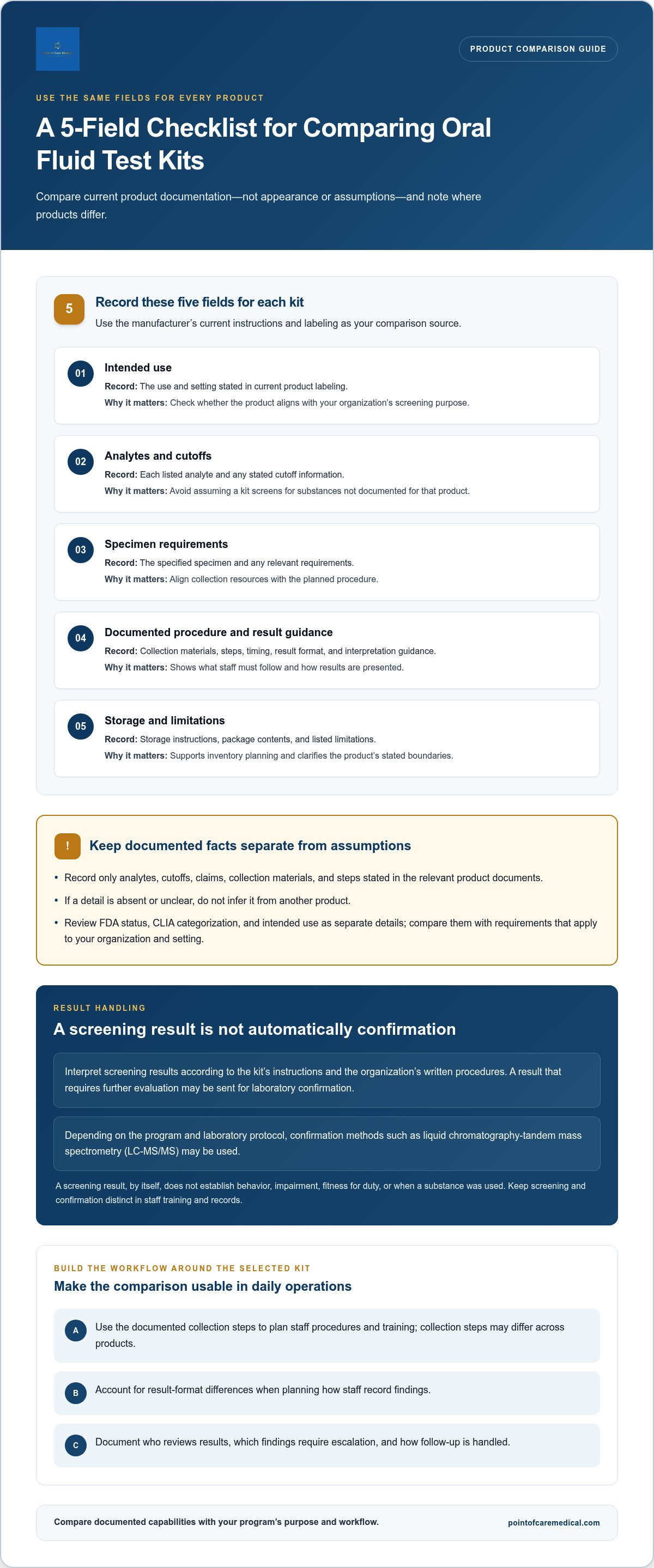
Start a comparison with current product documents, not assumptions about what an oral fluid format can do. Record the same details for every product and note where they differ. This gives purchasing and operational teams a shared basis for evaluating oral fluid drug test kits against the program’s actual workflow.
| Comparison field | What to record | Why it matters |
|---|---|---|
| Intended use | The use and setting stated in current product labeling. | Helps determine whether the product aligns with the organization’s screening purpose. |
| Analytes and cutoffs | Each listed analyte and any stated cutoff information. | Prevents assumptions that a test screens for substances not documented for that product. |
| Specimen | The specified specimen and any relevant requirements. | Supports alignment between collection resources and the planned procedure. |
| Documented procedure | Collection materials, steps, timing, result format, and interpretation guidance. | Shows what staff must follow and how results are presented. |
| Storage and limitations | Storage instructions, package contents, and listed limitations. | Helps teams plan inventory handling and understand the product’s stated boundaries. |
Which product details belong in a kit comparison?
Use the manufacturer’s current instructions and labeling as your comparison source. Record only the analytes, cutoffs, claims, collection materials, and steps stated in those documents. Note package contents and result-reading guidance as written. If a detail is absent or unclear, do not infer it from another product. Keep the comparison limited to information supported by the relevant documentation.
Make the comparison useful for daily operations. A difference in result format can affect how staff record findings. Different collection procedures can require separate training materials. Consider specimen type in the context of your wider testing program, too. The oral fluid drug screens versus urine cups guide provides context for comparing specimen approaches without treating them as interchangeable.
How do regulatory and facility requirements affect selection?
Review FDA status, CLIA categorization, and intended use as separate product details. These terms describe different aspects of a test. They should not be treated as interchangeable evidence that a product suits every facility or workflow. Compare current product documentation with the requirements that apply to your organization and screening setting. The CLIA-waived versus FDA-cleared rapid tests guide offers broader context for these distinctions.
Use the completed comparison to guide purchasing and staff procedures. Point of Care Medical supplies oral fluid tests as part of its broader toxicology offering for professional organizations. Teams can include oral fluid tests for organizational screening in their procurement review.
Match Oral Fluid Drug Test Kits to the Screening Setting
The same screening format can serve different program workflows. A healthcare facility may prioritize consistent patient documentation and follow-up. A workplace program may need clear responsibilities and policy-based result handling. Treatment settings have their own communication and recordkeeping needs. Match oral fluid drug test kits to the setting’s workflow and documented purpose, not simply to the fact that they use oral fluid.
| Setting | Screening objective | Documentation needs | Staff workflow |
|---|---|---|---|
| Healthcare | Support the facility’s defined screening process. | Record the procedure followed, result, and any required follow-up. | Assign trained staff to collection, result review, and record completion. |
| Treatment | Integrate screening into the organization’s established care or program process. | Apply the facility’s documentation and communication protocols consistently. | Clarify who explains the procedure, handles the result, and coordinates next steps. |
| Workplace | Conduct screening under the employer’s written program and applicable requirements. | Document policy basis, roles, result handling, and escalation according to procedure. | Define who collects, reads, records, reviews, and escalates results. |
What should healthcare and treatment programs consider?
Assign responsibilities before screening begins. Staff should know who explains the process, follows the product’s instructions, records the result, and manages follow-up under facility procedure. Clear communication and appropriate privacy practices help keep the process consistent. Build the workflow around the organization’s documentation standards and the specific kit’s labeling, rather than a generic assumption about oral fluid testing. Facility teams can use point-of-care drug screening facility protocols as implementation context.
What should workplace programs consider?
Operational convenience does not replace written policy. Employers should define the screening purpose, authorized roles, documentation path, and result escalation before selecting a kit. Applicable requirements and workplace policies should guide program design. A screening result alone should not be presented as proof of impairment or a policy violation. Staff should follow the organization’s procedures for review and any further action. For employer-specific planning, consult the workplace toxicology screening strategy guide.
Use this setting-based review to identify workflow needs before comparing product documentation. Point of Care Medical supplies oral fluid tests as part of its broader toxicology offering. Organizations can include oral fluid tests for screening programs in their procurement planning.
Plan a Consistent Oral Fluid Screening Workflow
A written workflow helps staff handle each screening consistently, from the decision to test through any follow-up. It also gives supervisors a practical basis for staff training, supply management, and record review. Build procedures around facility policy and the selected kit’s documented use.
Current product instructions govern kit handling. Staff should follow the specific kit’s directions for collection, timing, storage, and interpretation. Do not transfer steps from another product.
- Review the program policy. Define the screening purpose, who is authorized to initiate testing, and which facility or program requirements apply.
- Assign staff responsibilities. Identify who prepares the testing area, conducts collection, reads results, completes records, and handles escalation. Train assigned staff before they perform these tasks.
- Prepare and manage inventory. Follow the product’s storage instructions. Establish a process for checking inventory, tracking expiration dates, and rotating supplies so staff can identify items that should not be used.
- Confirm identity and procedure. Use the facility’s established process to verify the individual and document the screening event. Follow the kit-specific collection steps rather than relying on an informal or remembered procedure.
- Read and interpret as directed. Follow the timing and result-reading instructions in the product documentation. If a result is invalid or cannot be interpreted, use the kit directions and the facility’s written procedure to determine next steps.
- Complete the record. Document the required identity, specimen, date or event details, result, staff actions, and follow-up according to facility policy. Keep records clear enough for an authorized reviewer to understand what occurred.
- Escalate when indicated. Follow the written process for unexpected, disputed, or consequential results. Use the program’s designated review or confirmation process when policy or applicable requirements call for it.
How can facilities standardize collection and result recording?
Make the procedure usable at the point of screening. Give staff approved instructions and a consistent record format, then train them on their specific responsibilities. Records should distinguish what the kit reported from the actions taken afterward. If a result is invalid, staff should not improvise. They should follow the kit’s instructions and facility policy, then document the response.
When should a screening result receive additional review?
Set escalation criteria before testing begins. The policy should identify who reviews unexpected or disputed findings, what follow-up is appropriate, and when a confirmation process applies. Document the reason for escalation, the reviewer, and the next step. Keep conclusions within the limits of the screening result; do not interpret it as proof of impairment or another finding the test does not establish.
Include staff training, inventory rotation, storage, and applicable quality procedures in periodic workflow reviews. When procedures or product documentation change, update training materials and forms to keep them aligned. Point of Care Medical supplies oral fluid tests for professional organizations. Source oral fluid screening supplies as part of a consistent facility process.
Source Oral Fluid Drug Test Kits for Your Organization
Procurement works best when the purchasing decision reflects the program’s actual requirements. Before ordering oral fluid drug test kits, align intended use, product documentation, staff workflow, and inventory planning. This gives clinical, treatment, and workplace teams a record of why a product was selected and how staff are expected to use it.
What should procurement teams document before ordering?
Use a brief checklist to connect the operational need to the product’s current labeling. Record the screening purpose, the product characteristics required by the program, and the documents reviewed. Compare the labeled use and instructions with facility procedures and applicable requirements. Make the record specific enough for purchasing and operational teams to refer to later.
- Intended use: Describe the program’s screening purpose and the setting where the test will be used.
- Documentation: Retain current product labeling and instructions. Record the relevant analytes, specimen requirements, procedure, result interpretation, and stated limitations.
- Workflow: Identify who handles collection, result review, documentation, and escalation under facility policy.
- Training: Plan how assigned staff will learn and follow the product-specific instructions and the organization’s procedure.
- Inventory: Define how supplies will be stored and monitored according to product instructions, including how staff will track inventory rotation.
Complete this review before supplies reach the testing area. It can reveal practical gaps, such as a procedure that does not identify who reviews an unexpected result or an inventory plan that overlooks labeled storage instructions. Keep product-specific decisions tied to the relevant documentation rather than assuming that oral fluid tests share the same capabilities.
How can buyers connect oral fluid kits with broader toxicology needs?
Review oral fluid tests alongside the other toxicology screening supplies used across your organization. A consolidated procurement review can help teams maintain clear product records and distinguish procedures for different screening formats. Point of Care Medical supplies oral fluid tests to professional organizations across the United States, with a broader toxicology offering that includes Rapid Test Cups with Fentanyl.
These are different product configurations, so keep their instructions, labeling, and facility procedures distinct. For context on the urine-cup category, the rapid test cups with fentanyl buyer’s guide offers a related procurement reference. Use each product’s own documentation to guide selection and staff procedures.
Once your team has aligned intended use, documentation, training, and inventory plans, explore oral fluid drug testing supplies from Point of Care Medical for your organization’s screening program.
Put Your Selection Framework Into Practice
Turn your comparison into a procurement record your team can use. Document why a kit fits the program, who owns the workflow, and how staff will maintain consistent use. Revisit the decision when program needs or product documentation change. This keeps oral fluid drug test kits connected to current operational requirements rather than treating the purchase as a one-time choice.
Point of Care Medical distributes oral fluid tests to professional organizations across the United States. Its broader toxicology catalog also includes Rapid Test Cups with Fentanyl for organizations sourcing multiple screening supplies.
Explore oral fluid drug testing supplies from Point of Care Medical for your organization’s screening program.
Frequently Asked Questions
How long can drugs be detected in oral fluid?
There is no single detection period that applies to every oral fluid test. Results can depend on the substance, assay design, cutoff, time since use, and individual factors. Two tests may differ in the substances they screen for or the criteria used to report a result. Do not use a screening result to calculate an exact time of use or infer impairment. Follow the specific product documentation and facility protocol.
Can an oral fluid drug test show whether someone is impaired?
No. A screening result alone does not establish impairment. It indicates whether the test’s stated screening criteria were met, within the limitations described in its instructions. Do not use a result by itself to determine when a substance was taken or whether a person was impaired during a particular event. Before testing, define how consequential findings will be reviewed and whether confirmation is required under program policy.
Are oral fluid drug test kits the same as saliva drug tests?
The terms are often used conversationally for screening tests that collect a specimen from the mouth, but the product label is the reliable reference. Check whether it specifies oral fluid and review its intended use, analytes, collection method, and interpretation instructions. Similar wording does not mean two products have the same capabilities. Do not assume that similar product names indicate matching substance panels or procedures.
Do oral fluid drug screening results need laboratory confirmation?
Not in every situation. The need depends on the program, result, product documentation, decision involved, and applicable requirements. A screening result is not automatically a definitive laboratory finding. A facility may require additional review before acting on a result with significant consequences. Establish who makes that decision, what confirmation process applies, and how the rationale is recorded before screening starts.
Can oral fluid drug test kits be used in workplace programs?
They may be used when the product’s stated intended use, current documentation, workplace policy, and applicable requirements align. Employers should decide in advance who is authorized to collect a specimen, review and record results, and manage follow-up. A screening finding alone does not prove impairment or a policy violation. Managers should follow the organization’s review process rather than treating a test result as a complete employment decision.
What should I do if an oral fluid drug test result is invalid?
Follow the product instructions and your facility’s written procedure. Do not record an invalid result as positive or negative. Document what occurred and use the designated next step, which may depend on the test directions and program policy. The procedure may specify whether to repeat testing or use another process. Train staff on this response before testing so an invalid result does not lead to improvised handling.
How should oral fluid drug test kits be stored?
Store each kit according to its current labeling. Requirements can differ, so check the stated temperature range, handling instructions, expiration date, and any restrictions after opening rather than relying on a general rule. Build routine stock checks into inventory management. Use the facility’s rotation process to identify expired kits before use and document inventory checks consistently. Do not use a kit outside its labeled storage conditions or past its expiration.


