

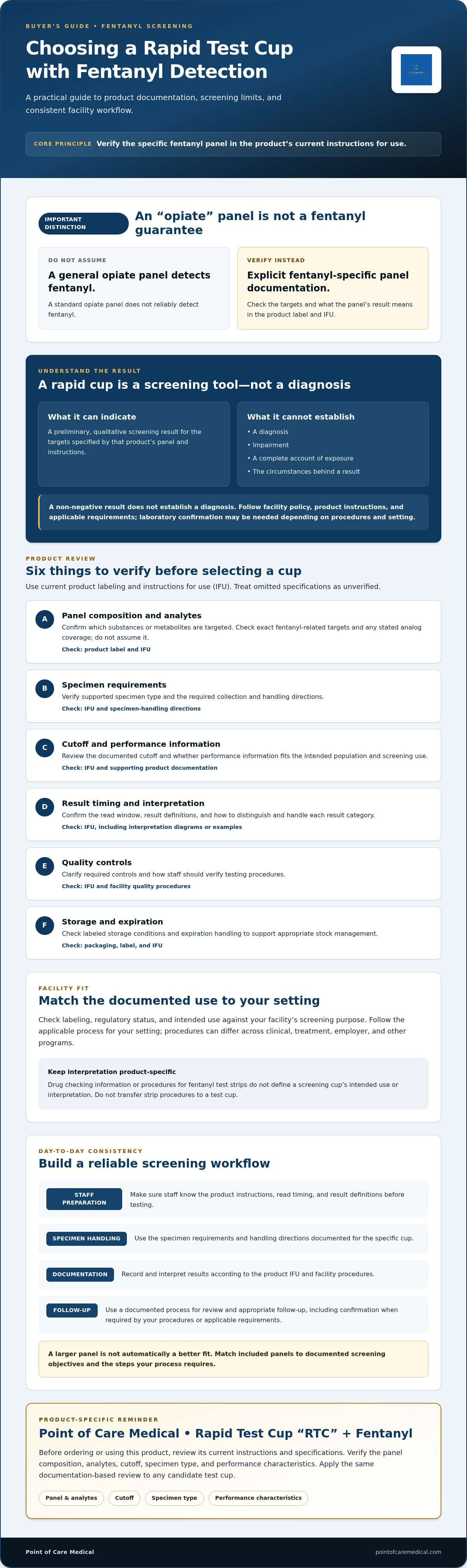
A cup with an opiate panel may not detect fentanyl. If your facility needs fentanyl screening, don’t rely on the product name alone. Evaluate a rapid test cup with fentanyl detection by its specific panel, intended use, and instructions for use.
Panel composition, cutoff levels, specimen requirements, and documentation can vary. Check which analytes the test targets and whether its labeling and instructions fit your facility’s screening process. Rapid cup results are preliminary, qualitative screens. A non-negative result does not establish a diagnosis and may require laboratory confirmation, depending on your procedures and applicable requirements.
This 2026 buyer’s guide explains how to assess fentanyl test cups against your screening needs, documentation requirements, and day-to-day workflow. It covers what to verify in product documentation, how to interpret screening results, and how to plan consistent result handling and follow-up. Point of Care Medical distributes the Rapid Test Cup "RTC" + Fentanyl. Confirm its current instructions and specifications before ordering.
Key Takeaways
- Confirm that a rapid test cup with fentanyl detection has a fentanyl-specific panel. Don’t assume a general drug panel includes it.
- Compare panel composition, specimen type, cutoff, result timing, and interpretation using the product’s instructions for use.
- Check labeling, regulatory status, and intended use against your facility’s setting before selecting a test.
- Set a consistent workflow for staff preparation, specimen handling, documentation, and result follow-up.
- Review current product documentation for Point of Care Medical’s Rapid Test Cup "RTC" + Fentanyl before ordering.
What a Rapid Test Cup with Fentanyl Detection Can and Cannot Tell You
A rapid test cup with fentanyl detection is a presumptive screening device. Its labeling and instructions for use (IFU) specify its targets, specimen requirements, and result interpretation. Use the product’s IFU, rather than a general description, to determine what a specific cup is designed to indicate and how staff should use it.
A fentanyl-specific panel matters because a standard opiate panel does not reliably detect fentanyl. Don’t infer fentanyl coverage from a list of other drug classes or from the word “opiate.” Check that the product documentation explicitly identifies a fentanyl panel and explains what its result means.
What does the fentanyl panel indicate?
Panel targets depend on the assay. Before selecting a cup, verify the analyte, cutoff, and any stated fentanyl analog coverage in the IFU. A panel may target a particular substance or metabolite, so its result should not be treated as a complete account of exposure. It also does not establish impairment or explain the circumstances behind a result.
Drug testing products serve different purposes. For broader context on public health approaches, see this overview of drug checking services. Information about drug checking generally does not define the intended use or interpretation of a facility’s screening cup.
Screening results versus confirmatory testing
A rapid cup provides a screening result, not a definitive diagnostic conclusion. Handle a non-negative result according to facility policy, the product’s instructions, and requirements applicable to the setting. Follow-up may differ across clinical, treatment, employer, and other programs, so don’t apply one setting’s process to another.
Interpret results only as the IFU directs. Before staff begin testing, confirm specimen handling, read timing, and result definitions. If a result may affect a clinical or administrative decision, make sure the facility has a documented process for review and appropriate follow-up. The cup alone cannot establish a diagnosis, determine impairment, or replace the facility’s established decision-making procedures.
Before ordering or using Point of Care Medical’s Rapid Test Cup "RTC" + Fentanyl, verify its panel composition, analytes, cutoff, specimen type, and performance characteristics in the current product IFU. Apply the same standard to any candidate product: its documented specifications and permitted use should match the facility’s screening purpose.
How to Compare Rapid Fentanyl Test Cups Before You Buy
Compare documentation, not assumptions. Assess a rapid test cup with fentanyl detection against your facility’s screening objectives and workflow. If a supplier description omits a specification, treat it as unverified until you check the current product labeling or instructions for use (IFU).
| What to verify | Why it matters | Where to check |
|---|---|---|
| Panel composition and analytes | Confirms which substances or metabolites the fentanyl panel targets. Don’t assume analog coverage. | Product label and IFU |
| Specimen requirements | Shows which specimen types are supported and how they must be collected or handled. | IFU and specimen-handling directions |
| Cutoff and performance information | Helps determine whether the documented test characteristics fit the intended population and screening use. | IFU and supporting product documentation |
| Result timing and interpretation | Defines the read window and how to distinguish and handle result categories. | IFU, including interpretation diagrams or examples |
| Quality controls | Clarifies required controls and how staff should verify test procedures. | IFU and facility quality procedures |
| Storage and expiration | Supports proper stock management and helps prevent use outside labeled conditions or dates. | Packaging, label, and IFU |
Which product specifications should buyers verify?
Use current product documents to confirm each specification, including exact fentanyl-related targets, specimen, cutoff, read window, storage conditions, and expiration handling. Check whether performance information applies to your facility’s intended population and use. CDC guidance on how to use fentanyl test strips addresses strips specifically. Don’t transfer strip procedures or interpretation to a test cup.
How do panel size and workflow affect selection?
Match the included panels to documented screening objectives. A larger panel is not automatically a better fit if it adds steps or targets your process does not require. Review result readability, staff instructions, and compatibility with existing procedures before procurement. A cup’s screening result is not a confirmatory conclusion. Establish how non-negative results will be reviewed and followed up under facility policy and applicable requirements.
Procurement check: Treat product specifications as verified only when they appear in current labeling or the IFU, not solely in a supplier summary. Confirm the Rapid Test Cup "RTC" + Fentanyl’s documentation before selecting it. Facilities comparing toxicology screening supplies can review Point of Care Medical product information as part of their evaluation.
Does a Fentanyl Test Cup Fit Your Facility’s Use and Compliance Needs?
A product’s suitability depends on more than its panel. Before purchasing a rapid test cup with fentanyl detection, match its current labeling and intended use to the setting, staff responsibilities, and procedures that will govern testing. Requirements may differ across treatment, clinical, employer, and other screening programs. Don’t assume one facility’s approval or process applies to another.
| Documented factor | Potential advantage if verified | Potential limitation to assess |
|---|---|---|
| Intended use and setting | Supports a clear match between product labeling and the facility’s planned screening use. | Labeling may not support the facility’s specific program or population. |
| FDA status | Product-specific documentation clarifies the status the manufacturer identifies. | Don’t infer status from a supplier summary or from another product in the same category. |
| CLIA categorization or waiver status | Helps the facility evaluate whether the product aligns with its testing environment. | CLIA status is distinct from FDA status. Verify both independently and confirm facility-use limits. |
| Instructions and result interpretation | Clear procedures can support consistent staff training and documentation. | Missing or unclear instructions may complicate implementation and result handling. |
What should clinical and treatment facilities assess?
Ask facility leadership to confirm intended use, staff roles, documentation, and follow-up processes before procurement. Review the current IFU alongside organizational policies and applicable requirements. FDA status and CLIA categorization answer different questions, so verify each in current, product-specific documentation. Use a facility protocol guide when available, and ensure it reflects the product selected.
What should employers and screening programs assess?
Confirm that product labeling matches the planned program before adoption. Review workplace policies and applicable legal requirements with qualified compliance counsel. SAMHSA’s workplace drug testing resources can inform that review, but general guidance is not a substitute for setting-specific advice. A screening result alone is not proof of impairment or misconduct.
Use the table as a procurement checklist, not as a blanket rating of test cups. A documented feature may support one program while remaining unsuitable for another. If the manufacturer’s current labeling does not confirm a specification or permitted use, treat it as unverified and seek clarification before purchase or implementation.
How to Set Up a Reliable Fentanyl Screening Workflow
A dependable process makes the product instructions and facility policy easy to follow at each step. Use the framework below as a starting point, then reconcile it with the current IFU for the specific cup and your facility’s approved procedures. This workflow does not replace product-specific directions.
Before testing: prepare staff and materials
Assign trained personnel, make the current IFU accessible, and review role-specific responsibilities before testing begins. Check labeled storage conditions, expiration dates, packaging integrity, and quality-control requirements. Use the facility’s approved process to identify and handle specimens, including any documentation or safeguards required in that setting.
Follow a consistent process
- Confirm intended use. Check that product labeling and facility policy support the planned screening purpose.
- Prepare staff and materials. Make sure staff have the current instructions and required materials, and complete any controls specified by the IFU.
- Follow the exact IFU. Use the stated specimen, handling steps, timing, and reading window. Don’t substitute steps from another product.
- Document the outcome. Record the result and relevant test details in the facility’s approved system, following its documentation rules.
- Escalate according to protocol. Apply the IFU and facility policy to valid, invalid, unreadable, or non-negative results, including any required communication and follow-up.
After testing: document and follow up
Interpret each result using the product’s instructions, not memory or an assumed universal convention. If a result is invalid or unreadable, follow the IFU’s direction. Don’t improvise a repeat test. Qualified professionals should make decisions about repeat or confirmatory testing under established protocols and applicable requirements.
Keep the process consistent across shifts. A rapid test cup with fentanyl detection can support screening when staff follow its labeled procedures and the facility has a defined plan for handling results. The cup’s result alone is not a definitive conclusion.
Before adopting a workflow, review the current IFU alongside facility policy. Point of Care Medical distributes toxicology screening supplies nationally, including the Rapid Test Cup "RTC" + Fentanyl. Review Point of Care Medical’s toxicology screening supplies as part of your procurement evaluation, and confirm product-specific instructions before use.
Evaluating Point of Care Medical’s RTC + Fentanyl Test Cup
Point of Care Medical distributes toxicology screening supplies nationally, including the Rapid Test Cup "RTC" + Fentanyl. Before ordering, confirm product-specific details such as panel composition, specimen requirements, cutoff, result timing, regulatory status, packaging, and availability. These details determine whether the cup fits your facility’s screening needs and workflow.
Use your facility’s screening objectives and the selection criteria in this guide to assess the rapid test cup with fentanyl detection. Request current product documentation and compare verified details with your requirements before placing an order or standardizing procurement.
What to confirm about the RTC + Fentanyl
Ask for the current instructions for use (IFU) and product labeling. Review the details that determine whether the cup fits your process:
- Panel and test procedure: Confirm the listed analytes, any stated fentanyl-related targets, required specimen, cutoff, result timing, and interpretation guidance.
- Use and status: Verify intended use, current FDA status, CLIA categorization or waiver status, and any facility-use limitations in product-specific documentation.
- Procurement and handling: Confirm packaging, availability, storage requirements, expiration handling, and ordering details before planning inventory or routine use.
These details affect product fit and implementation. For example, a specimen requirement must align with the facility’s approved collection process, while documented read timing must fit staff procedures. If an item is not addressed in current documentation, ask for clarification rather than relying on a general description.
A practical procurement checklist for the next step
Before contacting a supplier, write down the required panel targets, intended screening setting, workflow needs, and documentation your facility expects. Then compare each requirement with confirmed product information. Flag unresolved items for review by the appropriate clinical, operational, or compliance lead.
- Document the screening purpose and facility-approved use.
- List product specifications and supporting documents required for review.
- Identify workflow, storage, and ordering questions to resolve before procurement.
Contact Point of Care Medical with questions about the Rapid Test Cup "RTC" + Fentanyl, product information, or ordering details. Review the current documentation against your facility’s requirements before making a decision.
Make Your Next Screening Decision with Confidence
Selecting a rapid test cup with fentanyl detection starts with confirming that its labeled panel and intended use match your facility’s needs. Review the current instructions for use, including analytes, specimen requirements, cutoff, result timing, and interpretation. Then verify product status and permitted use for your setting, and establish consistent procedures for staff, documentation, and follow-up.
Keep screening results in context. A rapid cup supports screening, but it does not by itself establish a diagnosis, impairment, or misconduct. Facility policies and qualified professionals should guide decisions about additional testing and next steps.
Point of Care Medical distributes the Rapid Test Cup "RTC" + Fentanyl and supplies healthcare and screening organizations nationally. Review the product information and confirm its fit with your requirements before procurement. Review the Rapid Test Cup RTC + Fentanyl.
Frequently Asked Questions
What does a rapid test cup with fentanyl detection detect?
It screens for the fentanyl-related analytes specified in that product’s labeling and instructions for use (IFU). Targets and cutoffs can differ, so check the current documentation rather than assuming every cup detects the same substances. A result is presumptive and is not a complete account of exposure or impairment. A standard opiate panel alone does not reliably indicate fentanyl detection.
Can a fentanyl test cup detect fentanyl analogs?
Only if the product’s labeling or IFU says it detects specific analogs. Don’t infer analog coverage from a fentanyl panel label or information about a different assay. Review the listed analytes and stated limitations before selecting a test. If the documentation does not identify analog coverage, treat it as unconfirmed and ask the supplier or manufacturer for product-specific clarification.
How accurate are rapid fentanyl test cups?
Accuracy depends on the specific assay, its documented performance, and whether testing follows the IFU. Review product-specific performance information, including the population and intended use it applies to. Don’t rely on a general claim about all test cups. Rapid cups provide preliminary screening results, not definitive conclusions. Follow facility policy for interpreting results and deciding whether additional testing or professional review is appropriate.
What should I do if a fentanyl test cup result is positive?
Follow the product’s interpretation instructions and your facility’s established policy. A positive or non-negative screening result alone does not establish a diagnosis, impairment, or misconduct. Document the result as required, communicate it through the appropriate process, and refer follow-up decisions to qualified professionals. Whether to repeat testing or obtain confirmation depends on the setting, applicable requirements, and facility protocol.
Are fentanyl test cups CLIA-waived?
Don’t assume all fentanyl test cups have the same CLIA status. Verify the current, product-specific documentation for CLIA categorization or waiver status, intended use, and any facility-use limitations. Check FDA status separately because it is a distinct question. If the labeling or IFU is unclear, request clarification before purchasing or using the product in your setting.
What specimen do rapid fentanyl test cups use?
Specimen requirements vary by product, so check the specific cup’s IFU and labeling before planning collection or workflow. Confirm the accepted specimen, collection and handling directions, and any timing requirements. Don’t assume a specimen type based on another product or a general description of fentanyl testing. For the Rapid Test Cup "RTC" + Fentanyl, verify the current product documentation for its specimen requirements.
How do I choose a fentanyl test cup for a treatment or screening program?
Start with your program’s intended use, required analytes, and workflow. Compare documented panel targets, specimen requirements, cutoff, result timing, interpretation, quality controls, storage, and expiration handling. Then confirm the product’s current regulatory status and permitted use for your setting. Establish staff procedures for documentation and follow-up before adoption. Choose based on verified fit, not panel size or unconfirmed supplier assumptions.


