

Does a multi-panel urine cup automatically test for fentanyl? Not necessarily. When evaluating multi panel drug test cups fentanyl detection is a detail to assess separately from the number of substances on the panel. Panel contents vary, and a standard opioid screen doesn’t reliably detect fentanyl because it has a different chemical structure.
A rapid cup can provide a clear screening result, but that initial result is not a diagnosis. A non-negative result is presumptive and may require laboratory confirmation, such as GC/MS, under your organization’s established protocol. The product’s instructions for use (IFU) define how to handle and interpret that specific test.
This article explains what “multi-panel” means, how fentanyl fits into a urine screen, and why confirmation matters. It also outlines responsible result interpretation and introduces Point of Care Medical’s Rapid Test Cup RTC + Fentanyl as a product example. Use these distinctions to align screening supplies and follow-up steps with your organization’s procedures.
Key Takeaways
- Panel counts don’t guarantee identical contents. Review the documented analytes to understand what a specific cup screens for.
- Multi panel drug test cups fentanyl require an analyte-specific fentanyl screen. A standard opioid screen may not detect fentanyl.
- Treat a non-negative cup result as presumptive and follow your organization’s protocol for appropriate confirmation.
- Use a consistent workflow: define the testing purpose, follow the instructions for use, document results, and escalate when needed.
- Consider the Rapid Test Cup RTC + Fentanyl when assessing point-of-care testing supplies for your program.
What Are Multi-Panel Drug Test Cups with Fentanyl?
A multi-panel urine drug test cup is a specimen container with multiple screening assays built into or used with the cup. In a point-of-care setting, one urine specimen can be screened for several specified drug classes or analytes using a single test format. “Multi-panel” describes the format, not a universal list of substances.
That distinction matters when evaluating multi panel drug test cups fentanyl. A cup may include a fentanyl-specific assay, but its other targets and the compounds each assay detects depend on the product. Before adding a cup to a screening workflow, check the product label and current instructions for use (IFU). For procurement criteria, see the 2026 fentanyl test cup buyer’s guide.
What does multi-panel mean on a urine drug test cup?
Each panel is a separate screening assay directed at a drug class or a particular analyte. Multiple panels let one cup screen the same specimen for several listed targets. They don’t mean the cup detects every substance, or that products with the same panel count test for identical drugs. Check the label and IFU for the exact analytes, specimen requirements, and test-specific directions.
Why is fentanyl listed as its own panel?
Fentanyl is a synthetic opioid and a distinct testing target. A fentanyl-specific screen is not interchangeable with a general opiate screen: the results address different assay targets. In an immunoassay, antibodies produce a test response associated with the target analyte. The immunoassay principle underlies many rapid screening formats.
Detection of fentanyl analogues or related compounds depends on the specific assay. Don’t assume a fentanyl panel covers every substance in that broader group. Review the assay documentation for its stated target and cross-reactivity information, and interpret results only within the scope of the product’s instructions. This keeps panel selection aligned with the screening purpose without treating a multi-panel label as a guarantee of broad or universal detection.
How Does Fentanyl Detection Work in a Multi-Panel Cup?
A fentanyl panel in a urine cup typically uses an immunoassay. In plain terms, assay components respond to a target analyte or to compounds the assay recognizes, and the device displays a result according to its design. Each panel operates against its own target, so a result on one panel doesn’t determine the result on another.
That response is a screening signal, not a complete account of a person’s health or circumstances. For multi panel drug test cups fentanyl results must be interpreted according to the specific assay’s instructions and the facility’s established protocol. The IFU defines result criteria, specimen handling, and the required reading time. Follow those directions rather than applying timing or interpretation rules from a different test.
What does a fentanyl screening result indicate?
A non-negative screen is a presumptive finding. It indicates that the test response met the device’s criteria for the target. By itself, it doesn’t establish impairment, when exposure occurred, the amount involved, or a clinical diagnosis. Consider the result alongside the purpose of testing and the facility’s procedures for documentation and follow-up.
A screening cup provides a preliminary result; confirmatory laboratory testing uses a more specific analytical method to assess the finding. When confirmation is required, follow the organization’s protocol for next steps and result handling. For workplace programs, consult SAMHSA’s information on federal workplace drug testing programs and apply the requirements relevant to the program.
What can affect fentanyl assay coverage and results?
Assay targets, cutoff criteria, and cross-reactivity vary by product. An assay may respond to certain related compounds, but that doesn’t establish that it detects every fentanyl analogue. Review the current IFU for the specific assay’s stated target and any documented cross-reactivity. Don’t extend a result beyond what that documentation supports.
Use the product’s reading window and result criteria, and document findings as your facility’s protocol requires. If a result is invalid or unclear, follow the IFU rather than interpreting it as positive or negative. This helps teams use point-of-care screens consistently without treating a preliminary result as definitive.
Point of Care Medical supplies point-of-care testing supplies, including the Rapid Test Cup RTC + Fentanyl.
How Should You Interpret Fentanyl and Other Panel Results?
A multi-panel cup reports a separate result for each listed assay. A result on one panel doesn’t establish the status of every other panel, and a single cup can’t answer every clinical or workplace question. Interpret each result against the panel’s analyte target, the product’s stated criteria, and the purpose of testing.
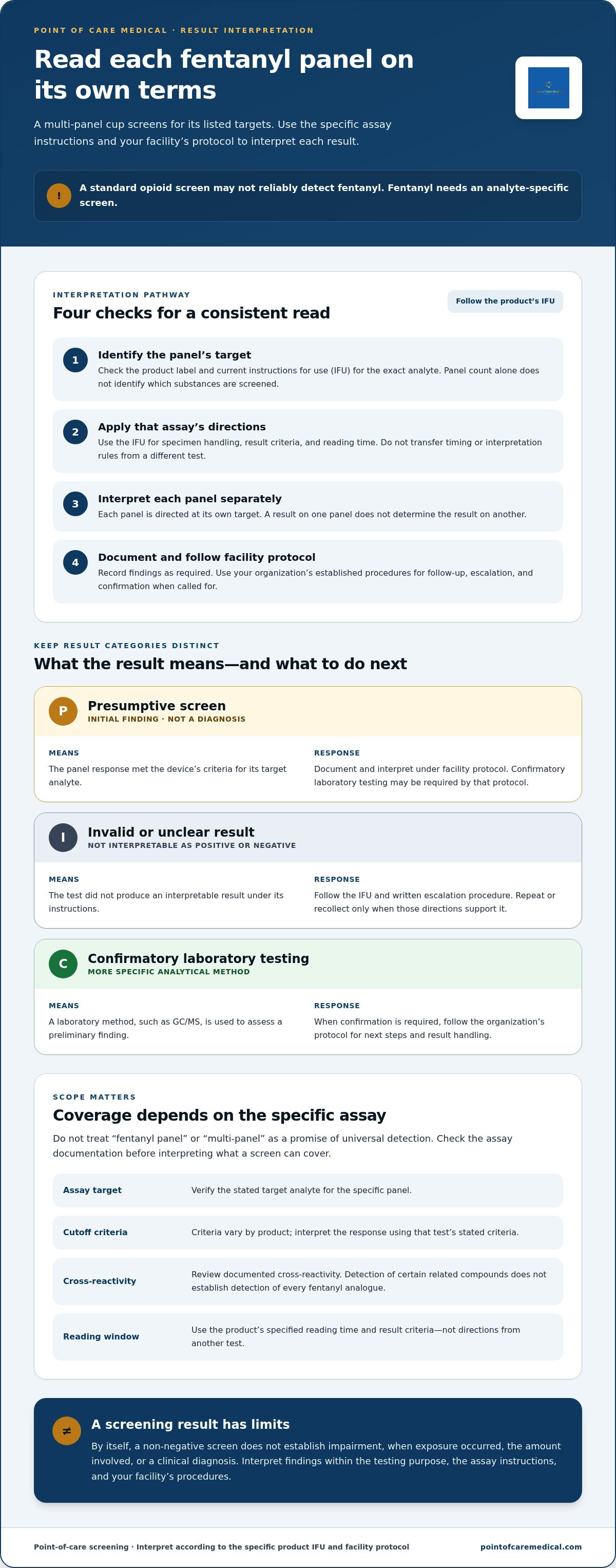
Keep result categories distinct. A presumptive screen is an initial finding, an invalid result can’t be read as positive or negative, and confirmatory testing uses a more specific laboratory method. The table summarizes how these outcomes differ.
| Result type | What it means | Appropriate response |
|---|---|---|
| Presumptive screen | The panel response meets the test’s criteria for its target analyte. | Document and interpret under facility protocol. Consider confirmation when the protocol calls for it. |
| Invalid result | The test did not produce an interpretable result under its instructions. | Follow the IFU and written escalation procedure. Repeat or recollect only when they support that action. |
| Confirmatory testing | A laboratory method, such as LC-MS/MS, assesses a finding with greater analytical specificity. | Use when indicated by the applicable clinical or organizational protocol. |
What is the difference between a presumptive and confirmed result?
A presumptive screen is an initial result, not definitive identification of a substance. Confirmation may be appropriate when required by clinical judgment, workplace procedures, or another organizational protocol. Methods such as LC-MS/MS are examples, not a universal next step for every setting. Federal workplace programs have their own applicable requirements. Consult the Mandatory Guidelines for Federal Workplace Drug Testing rather than assuming a point-of-care screen serves the same role.
What should staff do with an unexpected or invalid result?
Pause before drawing a conclusion. Check the product instructions and follow the facility’s written procedures for escalation, documentation, and any additional testing. Don’t repeat a test or recollect a specimen unless the IFU and established protocol support that step. Interpretation should remain with qualified personnel who can account for the relevant clinical or workplace context.
For a practical process for handling screening steps and results, use the point-of-care drug screening workflow guide. Point of Care Medical supplies point-of-care testing products for healthcare and screening organizations.
How Can Facilities Use Multi-Panel Fentanyl Cups Consistently?
Consistency starts before specimen collection. Define the screening purpose, identify the analytes relevant to your facility’s protocol, and select a cup with documented panels that match that purpose. Multi panel drug test cups fentanyl should be used within a defined process, not treated as a stand-alone answer to clinical, treatment, or workplace questions.
Requirements and follow-up can differ by setting. Clinical care may involve decisions guided by a patient’s circumstances and clinical protocols. Treatment programs may use screening to support established care processes. Workplace programs must follow the organization’s policies and applicable requirements. This overview is operational guidance, not legal advice or a substitute for facility policy.
Which questions help define panel needs?
Before selecting a cup, answer practical questions that connect the product to the intended workflow:
- What is the screening purpose, and which analytes does the facility’s protocol call for?
- Does the product documentation specify the required specimen type, panel list, cutoff information, and result criteria?
- Who is responsible for reviewing results, documenting them, and escalating unexpected findings?
- What process applies when a result is invalid or further testing is indicated?
Use the current product label and IFU to verify assay details. Don’t infer panel coverage from a product name or panel count alone.
How can teams standardize point-of-care screening?
Write a procedure that follows the specific cup’s IFU and assigns clear responsibilities. Include preparation, specimen handling, timing, result reading, documentation, and escalation. Train authorized staff on the exact product they’ll use, including its interpretation criteria and quality practices. Consistent training helps reduce variation between operators and makes results easier to review.
Protect specimen privacy throughout collection, handling, and recordkeeping. Document each panel’s result according to facility procedure, along with relevant test details and any follow-up action. If staff encounter an unexpected or invalid result, use the written escalation process. Repeat or recollect only when the IFU and protocol support it.
Treatment teams can use this drug test cup selection guide for treatment centers to consider product fit within their workflow. For point-of-care supply needs, explore drug screening cups from Point of Care Medical, including the Rapid Test Cup RTC + Fentanyl.
Where Does the RTC + Fentanyl Cup Fit in a Testing Program?
Point of Care Medical’s Rapid Test Cup "RTC" + Fentanyl is one example of a multi-panel urine screening cup. Its place in a testing program depends on how the documented assay fits the organization’s screening purpose and established procedures. The product name alone doesn’t define every panel detail or determine how a result should be used.
Before incorporating multi panel drug test cups fentanyl into a workflow, review the current product IFU. Confirm the stated analytes, specimen requirements, result criteria, and assay limitations. Check that staff can follow the product-specific directions and that the facility has clear procedures for documenting results and handling findings that require additional review.
What should professionals review in product documentation?
Use the label and IFU as the working reference, not assumptions based on panel count or similarities between products. Focus on what the assay is designed to screen for, how results are read, and what limitations the manufacturer documents. Ensure the product instructions align with your facility’s procedures for specimen handling, staff training, result review, and follow-up. These checks help teams compare documented capabilities with program needs.
Keep roles clear. Staff performing the screen should know how to follow the IFU, while designated personnel should review and interpret results within the relevant clinical, treatment, or workplace context. Facility protocols should also state how to document an invalid or unexpected result and when additional testing may be appropriate. A screening cup supports a process; it doesn’t replace that process.
How can organizations take the next step?
Start by summarizing your screening purpose and the information the cup must provide. Identify the required analytes, specimen type, product instructions, and internal pathway for result review. Then compare those needs with the product’s current documentation. This keeps selection grounded in documented details rather than assumptions that all multi-panel cups are equivalent.
For an example to assess within your program, review the Rapid Test Cup "RTC" + Fentanyl and its instructions alongside your facility protocol. Explore Point of Care Medical testing supplies for point-of-care screening needs.
Build a Consistent Fentanyl Screening Process
Multi-panel cups bring several screening assays together, but panel contents and fentanyl assay coverage vary by product. Check the label and instructions for use to understand the specific targets and result criteria. A cup’s screening result is presumptive, so interpret it within your organization’s protocol and use confirmation when appropriate.
For multi panel drug test cups fentanyl, consistency depends on more than selecting a product. Define the screening purpose, train staff on product-specific instructions, document results, and establish clear steps for unexpected or invalid findings. These practices help teams use point-of-care screening responsibly across clinical, treatment, and workplace settings.
Point of Care Medical supplies the Rapid Test Cup RTC + Fentanyl and distributes point-of-care testing supplies to organizations across the United States. Explore options that support your organization’s screening workflow with Point of Care Medical testing supplies.
Frequently Asked Questions
What does a multi-panel drug test cup with fentanyl detect?
It screens a urine specimen for the analytes named on that specific cup’s panel. “Multi-panel” means the cup includes more than one target, but the panel list varies by product. Fentanyl is a specific analyte, not a synonym for every opioid. Check the product label and current instructions for use to identify the targets, result criteria, and limitations before using the cup in a screening workflow.
Is a fentanyl result on a drug test cup definitive?
No. A point-of-care cup generally provides a presumptive screening result, not definitive identification or a diagnosis. Interpret the result according to the product instructions and your facility’s established protocol. If a finding is unexpected or consequential, qualified personnel may consider confirmatory testing under that protocol. A screening result alone doesn’t establish impairment, dose, timing, or the circumstances of exposure.
Can a multi-panel drug test cup detect fentanyl analogues?
That depends on the specific assay. Don’t assume a fentanyl panel detects every fentanyl analogue or related compound. Review the current instructions for use for stated targets, cross-reactivity information, and limitations. If analogue coverage matters to a clinical or organizational decision, follow the relevant protocol and appropriate confirmation pathway. The panel name alone isn’t evidence that a cup detects a particular analogue.
What is the difference between a fentanyl test and an opiate test?
They may target different analytes. A general opiate panel doesn’t automatically indicate fentanyl detection, while a fentanyl-specific panel should be interpreted according to its documented targets. Panel names and assay characteristics vary by product. Review the cup’s instructions for use to determine what it screens for, then follow facility procedures for positive, unexpected, or otherwise consequential findings.
How should staff handle an unexpected fentanyl screening result?
Follow the product instructions and the organization’s written procedures. Those procedures should define documentation, review by qualified personnel, communication, and whether confirmatory testing is appropriate. Don’t treat a presumptive screen as a stand-alone diagnosis or make decisions beyond your role. Repeat testing or recollect a specimen only when the specific instructions and established protocol support that action.
Do all multi-panel drug test cups include fentanyl?
No. “Multi-panel” describes a format, not a fixed set of analytes. The substances included can differ between products, so check the panel list and current instructions for use before selecting or using a cup. Confirm that fentanyl is specifically named as a target when relevant. Review the stated assay limitations as well, rather than relying on the number of panels alone.
How do facilities choose the right fentanyl panel for point-of-care screening?
Start with the screening purpose, applicable procedures, and analytes of interest. Compare the cup’s documented panel targets, specimen requirements, result criteria, and limitations with those needs. Plan how staff will document and escalate findings, including when confirmation may be appropriate. For multi panel drug test cups fentanyl, use the organization’s review and training process to assess product fit. A label alone doesn’t establish suitability for every setting.


