

The best rapid antigen tests for clinics aren’t necessarily the ones with the broadest assay panel. The right choice depends on the clinical question, patient population, and how well the test fits your staff’s workflow. Product listings can make options look interchangeable, but assay targets, intended use, and facility requirements matter.
To compare options, look at target coverage, specimen requirements, labeled result timing, documentation needs, and current product labeling. This guide uses practical criteria to help you decide whether a COVID-only assay or a combined SARS-CoV-2 and influenza test better fits your setting.
We’ll use the GenBody COVID-19 Rapid Antigen Test and ViraDx SARS-CoV-2/Flu A+B Rapid Antigen Test as examples. Before selecting any test, verify its intended use, specimen type, storage conditions, result timing, regulatory status, and fit with your facility’s requirements. Use the comparison to build a shortlist, then confirm each product’s current labeling before making a decision.
Key Takeaways
- Define what “best” means for your clinic by matching the assay to the clinical question, intended setting, and staff workflow.
- Compare the best rapid antigen tests for clinics by target coverage, while recognizing that a combined assay may not suit every testing need.
- Check current product labeling, intended use, specimen type, regulatory status, and facility requirements before selecting a test.
- Review staff steps, training, result documentation, and escalation pathways to assess how each option fits your workflow.
- Build a shortlist using consistent criteria, then verify current product details and facility fit before approval.
Best rapid antigen tests for clinics: define what “best” means
The best rapid antigen tests for clinics are the tests that fit the clinical question, intended setting, staff workflow, and current product labeling. A popular consumer product may not be appropriate for a clinic’s intended use. This comparison focuses on rapid respiratory antigen tests, not other diagnostic categories or a universal ranking of every available test.
A Rapid antigen test (RAT) detects specific viral antigens, but a shared test format doesn’t make products interchangeable. Compare each option with its current instructions for use (IFU), facility requirements, and the way results will inform care.
Which clinic needs should guide the comparison?
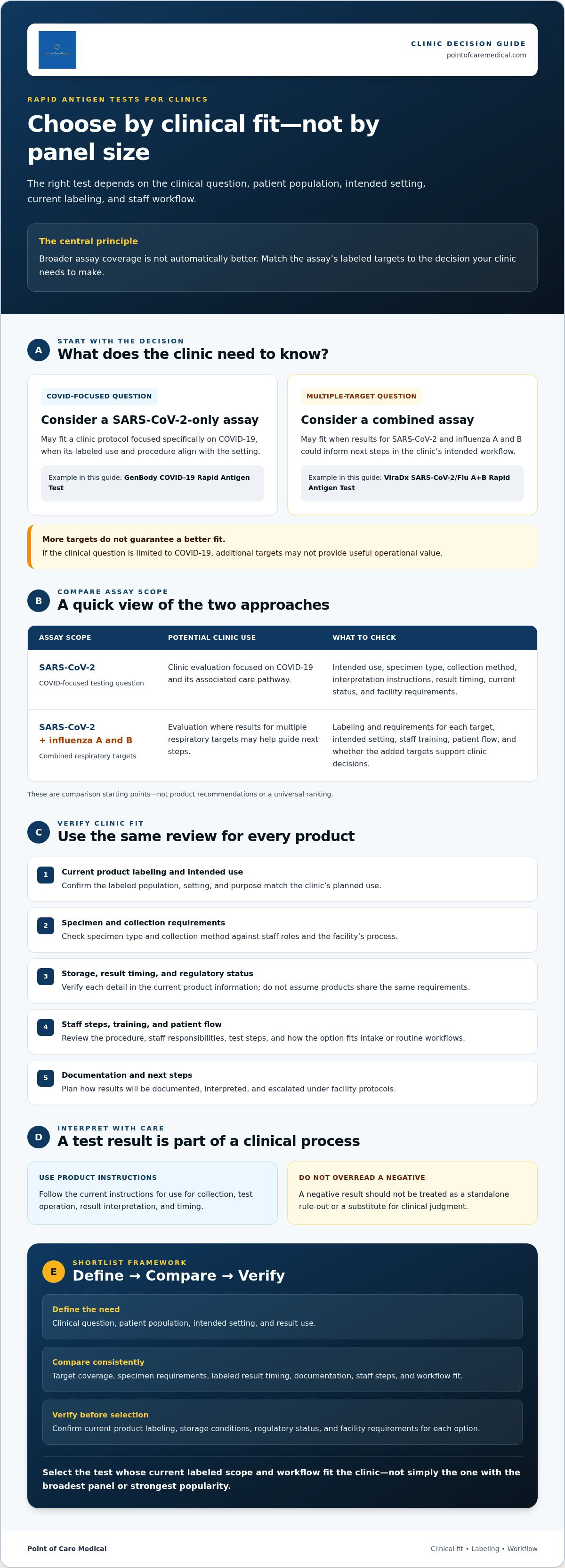
Start with the decision the result needs to support. A COVID-only assay may suit a clinic assessing for SARS-CoV-2. A combined SARS-CoV-2 and influenza A+B assay may be relevant when results for multiple targets could inform next steps. Broader coverage isn’t automatically better; it should match the clinical question.
Next, consider the patient population, expected testing volume, staff roles, and how results will be documented or acted on. Routine clinic workflows may differ from outbreak response or time-sensitive intake. Before shortlisting a test, check that its labeled use, specimen requirements, and procedure fit the setting.
| Assay target | Potential use case | Verification needs | Workflow fit |
|---|---|---|---|
| SARS-CoV-2 | Clinic evaluation focused on COVID-19 | Confirm intended use, specimen type, current status, and facility requirements | Review collection, test steps, read time, and result documentation in the IFU |
| SARS-CoV-2 and influenza A+B | Evaluation where results for multiple respiratory targets may help guide next steps | Confirm labeling and requirements for each target and intended setting | Assess whether the combined procedure fits staff training and patient flow |
These categories are starting points for comparison, not product recommendations. Point of Care Medical’s catalog includes the GenBody COVID-19 Rapid Antigen Test and ViraDx™ SARS-CoV-2/Flu A+B Rapid Antigen Test. Verify current labeling and facility fit before considering either option.
Why popularity alone doesn’t identify the right test
Sales rankings show marketplace activity, not whether an assay suits your patient population, testing purpose, or clinic process. Consumer OTC listings focus on self-testing and shouldn’t substitute for a clinic-use review. Check the manufacturer’s current labeling and your facility’s requirements before adding a test to your shortlist.
Once requirements are defined, review sourcing and ordering considerations in this COVID-19 rapid test wholesale procurement guide. Use procurement details alongside clinical and workflow verification, not in place of it.
Compare COVID-only and combo rapid antigen tests by assay scope
Assay scope tells you which viral targets a test can detect. A COVID-only test addresses a defined SARS-CoV-2 testing question. A combined SARS-CoV-2 and influenza A+B test covers additional targets in the same assay. That broader panel may be useful when a clinic needs information on multiple respiratory viruses, but extra targets don’t automatically make it a better fit. The best rapid antigen tests for clinics are those whose labeled scope supports the facility’s intended use.
When might a COVID-only rapid antigen test fit?
A COVID-only assay may fit when the clinic’s protocol calls specifically for SARS-CoV-2 testing and results will be used within that pathway. Before shortlisting one, check the current labeling for intended population, specimen type, collection method, interpretation instructions, and result timing. Confirm that these details align with local protocols and staff responsibilities.
Do not treat a negative result as a standalone rule-out or substitute for clinical judgment. Follow the product’s current instructions and the facility’s process for interpreting results and determining next steps. The CDC’s guidance for point-of-care testing can inform clinic planning for specimen collection and test operations.
When might a combined SARS-CoV-2 and flu A+B assay fit?
A combined assay may fit when the clinic needs results for SARS-CoV-2 and influenza A and B in one testing workflow, such as when evaluating overlapping respiratory symptoms. First confirm that results for all included targets support the facility’s intended decisions. If the clinical question is limited to COVID-19, the additional targets may not provide useful operational value.
Point of Care Medical’s respiratory catalog includes the GenBody COVID-19 Rapid Antigen Test and ViraDx™ SARS-CoV-2/Flu A+B Rapid Antigen Test. These illustrate COVID-only and combined assay scope, not ranked recommendations. For either product, verify current labeling for specimen, population, interpretation, intended use, and timing. Review the SARS-CoV-2 and influenza testing guide for broader point-of-care context.
Apply the same checks to every candidate: Does its target coverage match the clinical question? Does its labeled use fit your patients and setting? Can staff follow its procedure and document results as required? Once those requirements are clear, review respiratory test options from Point of Care Medical as part of your supplier evaluation.
Evaluate clinic fit: performance, labeling, and result limitations
Performance figures can help compare options, but they aren’t meaningful in isolation. The best rapid antigen tests for clinics are those with evidence and labeling relevant to the facility’s patient population, specimen collection process, and intended use. Don’t assume a figure from one study applies equally to another product or clinic workflow.
How should clinics compare sensitivity and specificity?
Sensitivity describes how well a test identifies people who have the target infection. Lower sensitivity can mean more infected patients receive a negative result. Specificity describes how well it identifies people who don’t have the infection. Lower specificity can mean more false positives. Compare figures only when the study population, symptom status, specimen, collection and testing conditions, and reference method are relevant to your setting. Verify product-specific performance figures against current manufacturer documentation before relying on them.
Rapid antigen results have limitations. Interpret them within clinical protocols, the product’s instructions, and the patient’s circumstances. A result shouldn’t be treated as a diagnosis or a replacement for clinical judgment.
What should teams verify before adopting a test?
Review the current instructions for use (IFU) and confirm the test’s intended population, setting, specimen type, storage conditions, result timing, and interpretation process. Then check current FDA status and CLIA categorization against the facility’s requirements. These terms describe distinct aspects of a test’s status and use. Don’t treat authorization, clearance, and complexity categorization as interchangeable.
The FDA’s FDA-Authorized Rapid Antigen Tests page is a reference for antigen tests with EUAs and their listed complexity levels. Confirm a product’s current status and applicable conditions before selection, rather than relying on an old listing or supplier description. For facility-level review, use this CLIA-waived COVID antigen compliance checklist as a verification resource.
Also document how staff will train, perform quality control, record results, and escalate results under facility policy. Apply the same checks to each candidate, including the GenBody COVID-19 Rapid Antigen Test and ViraDx™ SARS-CoV-2/Flu A+B Rapid Antigen Test. Once your criteria are set, review Point of Care Medical’s rapid test options as part of supplier evaluation.
Match rapid antigen tests to clinic workflow and supply needs
A test can meet the clinical need and still create workflow friction if staff can’t complete its steps consistently or the facility can’t maintain usable stock. Workflow fit means the labeled process, staff responsibilities, documentation, and inventory requirements can be sustained within the clinic’s operating procedures.
Use this four-step review before adopting a test as a routine option:
- Define use: Specify the testing purpose, patient flow, and how results will be used.
- Check labeling: Review the current instructions for use for specimen collection, test setup, read timing, storage, and interpretation.
- Assess staff process: Confirm who collects and tests specimens, what training is needed, where testing occurs, and how results are documented and communicated.
- Plan inventory: Set stock rotation, expiration monitoring, demand review, and replenishment procedures.
Will the test fit the clinic’s staffing and patient flow?
Map the steps from collection to result communication. Include hands-on time, any required read interval, documentation, and the pathway for results that need follow-up. Check the current instructions rather than assuming tests with similar targets use the same process.
Confirm which staff members are authorized and trained under facility policy, and whether the testing location supports the required procedure. The COVID antigen clinic deployment workflow guide offers additional implementation context. Use it alongside product-specific instructions and local procedures.
Can the facility maintain usable inventory?
Base stock levels on facility activity and planned seasonal needs, not unsupported demand forecasts. Follow the product’s labeled storage conditions, monitor expiration dates, and rotate stock so older usable inventory is addressed first. Assign responsibility for routine checks and document how the facility will respond to low stock or expired kits.
Before standardizing on a product, confirm current supplier availability and replenishment terms directly. Don’t assume lead times or ordering conditions will be the same across products or suppliers. Point of Care Medical distributes rapid diagnostic kits to healthcare and screening facilities across the United States, including the GenBody COVID-19 Rapid Antigen Test and ViraDx™ SARS-CoV-2/Flu A+B Rapid Antigen Test. Verify current availability and product requirements as part of your review.
Once your workflow and inventory criteria are clear, review respiratory test options with Point of Care Medical to assess potential supplier fit.
Build a clinic shortlist and verify the right rapid antigen test
A defensible shortlist turns clinical and operational requirements into a documented decision. The best rapid antigen tests for clinics depend on intended use and current product labeling, not a generic ranking. Use consistent criteria to identify suitable options, flag details that need confirmation, and record why a product fits your facility.
- Define the assay need: Specify the target or targets, patient population, and clinical purpose.
- Compare labeled options: Review current manufacturer documentation for each candidate.
- Verify facility fit: Confirm the labeled setting, workflow, training, storage, and applicable facility requirements.
- Document approval: Record the evidence reviewed, unresolved questions, and the facility’s selection decision.
What belongs in a defensible comparison matrix?
Use one row per test and include assay targets, intended population, specimen type, labeled setting, and result timing. Add fields for hands-on workflow, training, storage, expiration monitoring, regulatory verification, quality processes, documentation, and supply review. Mark details as “unverified” or “not stated” when current documentation doesn’t confirm them. Don’t infer a capability from a product name or category.
Point of Care Medical’s catalog includes the GenBody COVID-19 Rapid Antigen Test and ViraDx™ SARS-CoV-2/Flu A+B Rapid Antigen Test. These are catalog examples, not universal recommendations or ranked winners. Verify current labeling and availability for each before including it in a facility decision.
How can clinics move from shortlist to supplier review?
Confirm the exact product name and obtain current product documentation before requesting procurement information. Then share anticipated use, facility requirements, and operational questions with the supplier. Ask for clarification on anything still unverified in the matrix, including current availability or replenishment terms, before making a product standard.
Keep the comparison and approval record with the facility’s testing procedures so staff can refer to the same verified information. Revisit the record if product labeling, facility requirements, or workflow changes.
After defining clinical and operational requirements, review rapid diagnostic test options for your facility with Point of Care Medical as part of your supplier evaluation.
Make a confident, well-documented test selection
The best rapid antigen tests for clinics are the options that align with your clinical question, intended setting, and staff workflow. Compare COVID-only and combined respiratory assays by target coverage, then verify performance claims against relevant study conditions and current manufacturer documentation.
Before approving a test, confirm its intended use, specimen requirements, regulatory status, storage conditions, and facility fit. Include workflow and supply considerations in the decision record so your team can apply the same criteria when reviewing future options.
Point of Care Medical’s catalog includes the GenBody COVID-19 Rapid Antigen Test and the ViraDx SARS-CoV-2/Flu A+B Rapid Antigen Test. Treat them as options to evaluate, not universal recommendations. Verify current labeling and availability against your facility’s requirements.
Once your clinical and operational criteria are clear, review rapid diagnostic test options for your facility with Point of Care Medical. A consistent review process can help your team move forward with clarity and confidence.
Frequently Asked Questions
What are the best rapid antigen tests for clinics?
There isn’t one best test for every clinic. The best rapid antigen tests for clinics match the clinical question, intended setting, patient population, staff workflow, and current product labeling. A COVID-only assay may fit a defined SARS-CoV-2 testing need, while a combined assay may suit a workflow requiring multiple respiratory targets. Compare documented features consistently, then verify facility requirements before selecting a test.
What is the difference between a COVID-only test and a COVID-flu combo test?
A COVID-only test targets SARS-CoV-2, while a COVID-flu combo test targets SARS-CoV-2 and influenza A and B. A combined assay may help when the clinic needs results for several respiratory targets in one workflow. Broader coverage doesn’t automatically make it preferable. Check the current labeling, intended use, specimen requirements, and whether results for all included targets support your facility’s clinical process.
Are rapid antigen tests accurate enough for clinical use?
They may be appropriate for clinical use when the specific test is labeled for the setting and its limitations are accounted for in facility protocols. Review sensitivity and specificity data in context, including the study population, specimen, and testing conditions. Don’t assume a performance figure applies equally across products or patient groups. Verify product-specific claims against current manufacturer documentation and use results alongside clinical judgment.
Can a negative rapid antigen test rule out COVID-19 or influenza?
No. A negative result doesn’t necessarily rule out infection. Follow the test’s current instructions and your facility’s clinical protocol for interpreting results and deciding whether further evaluation or testing is appropriate. The significance of a result may depend on the patient and the testing circumstances. Don’t use a negative antigen result by itself to replace clinical judgment or a required follow-up pathway.
How do clinics verify whether a rapid antigen test is appropriate for their facility?
Review the current instructions for use and confirm the intended population, setting, specimen type, storage conditions, result interpretation, and timing. Check FDA status and CLIA categorization separately, then compare them with facility requirements. Also confirm staff training, quality control, documentation, and result escalation procedures under facility policy. Record any details that remain unverified and resolve them before approving the product for use.
Are at-home OTC antigen tests the same as clinic-use tests?
Not necessarily. OTC tests are labeled for consumer self-testing, while some products are intended for professional use in clinical settings. Similar targets or test formats don’t mean the instructions, intended users, or facility conditions are interchangeable. Before considering an OTC product for a clinic workflow, review its current labeling and verify applicable facility requirements, including any requirements tied to staff involvement in testing.
How should clinics compare rapid antigen test turnaround time and workflow?
Compare the labeled result time alongside the full testing process. Account for specimen collection, setup, any required wait before reading, interpretation, documentation, and communicating results. Check who will perform each step, where testing will occur, and what training the procedure requires. A short stated result time may not reflect the time or staffing needed to complete the clinic’s entire workflow.
How should clinics store rapid antigen tests and monitor expiration dates?
Follow the storage conditions and expiration information in the current product labeling. Establish a routine to check dates, rotate stock, and remove expired or unusable kits according to facility policy. Assign responsibility for inventory checks and document stock levels as needed. Plan replenishment around facility activity and expected seasonal needs, and confirm current availability and ordering terms with the supplier before relying on a product as a standard option.


