

Which HIV 1 2 rapid assay supplier can support your facility’s workflow and purchasing requirements? A product listing may identify an assay, but it may not answer practical questions: Does the assay’s documented intended use fit your screening setting? Do its current instructions align with your organization’s procedures?
These questions matter when sourcing SURE CHECK HIV 1/2 Assays. Healthcare and screening organizations can compare current product labeling with their requirements and review operational details before ordering. A written review helps teams assess product fit and plan procurement with fewer unanswered questions.
This guide outlines a practical way to review intended use, assay specifications, documentation, and facility requirements. It also explains how to source the SURE CHECK HIV 1/2 Assay through Point of Care Medical, which distributes rapid diagnostic tests to organizations across the United States. Use the steps below to organize your review and identify the information your team needs before purchasing.
Key Takeaways
- Check whether the assay’s documented intended use fits your facility’s screening workflow. Keep testing decisions within your established clinical protocol.
- Use current product labeling to review SURE CHECK HIV 1/2 Assay details, including specimen type, timing, storage, and package contents.
- Evaluate an HIV 1 2 rapid assay supplier by product documentation, product identification, ordering steps, and fit with your organization’s purchasing process.
- Use a facility-based checklist that covers requirements, ordering, receiving, staff preparation, and inventory control.
- Point of Care Medical offers the SURE CHECK HIV 1/2 Assay for healthcare and screening organizations sourcing rapid diagnostic tests in the United States.
What healthcare buyers need from an HIV 1 2 rapid assay supplier
Access to a product is only one part of a sound purchasing decision. Buyers also need to determine whether the assay fits the intended setting and whether its current documentation supports the facility’s operational requirements. A supplier listing can help identify a product, but it does not replace review of the assay’s labeling and instructions.
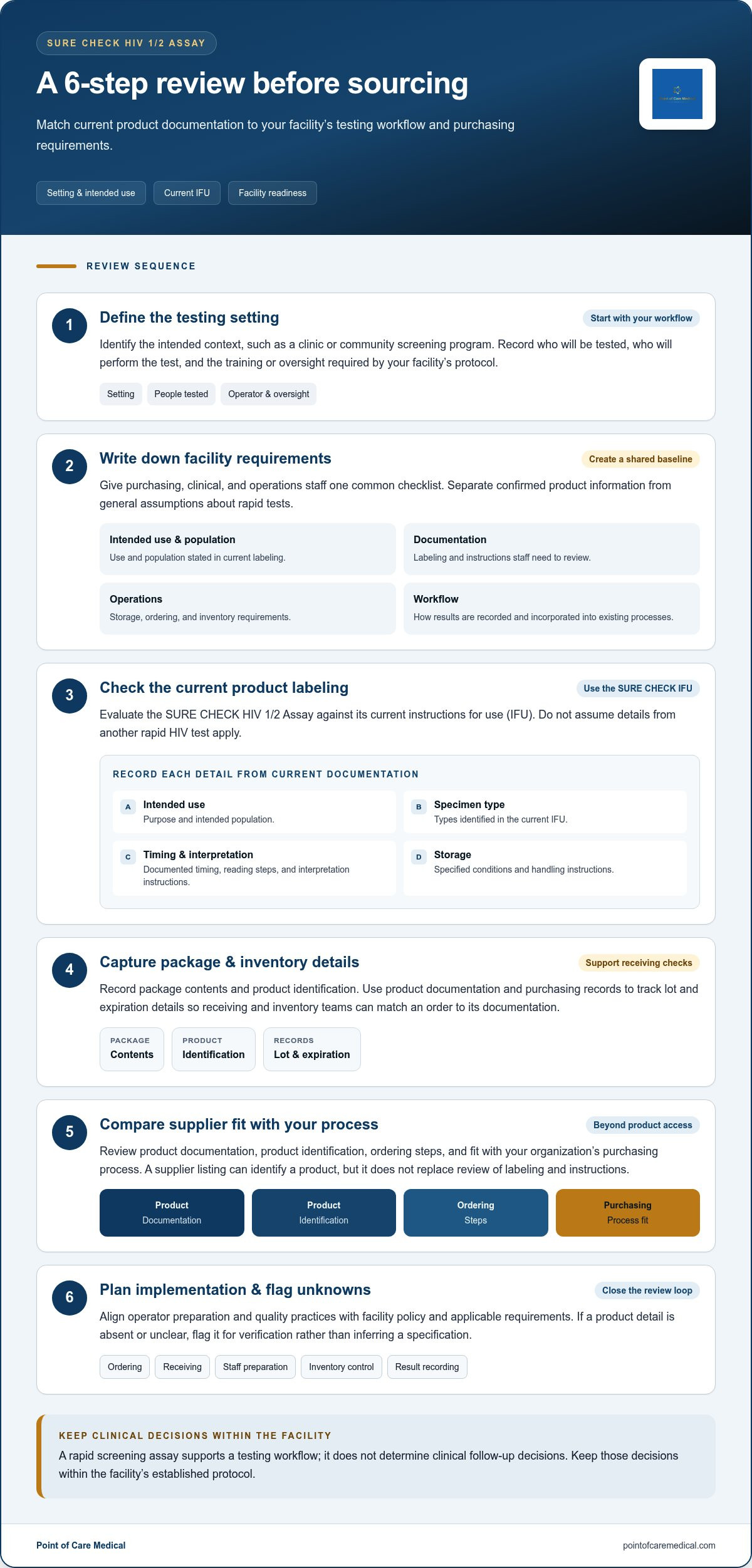
Start by defining the testing context, such as a clinic or community screening program. Identify who will be tested, who will perform the test, and what training or oversight the facility’s protocol requires. Then map ordering, storage, inventory, and result-recording needs to the organization’s existing processes. This gives your HIV 1 2 rapid assay supplier review a practical basis beyond product access alone.
A rapid screening assay supports a testing workflow; it does not determine the facility’s clinical follow-up decisions. Those decisions should remain within the facility’s established protocol. For background on HIV testing methods and their context, see this HIV testing overview.
Define the intended testing setting before comparing suppliers
A clinic may integrate testing into an established care workflow, while a community screening program may have different staffing, space, or documentation needs. Don’t assume procedures from one setting will fit another. Before reviewing purchasing options, identify the intended operator and the training and oversight required by your protocol. Keep clinical decisions, including how results are handled, within the facility’s designated process, separate from supplier access and ordering.
Build a requirements list for HIV 1/2 assay sourcing
Write down the criteria your team will use to assess product fit and readiness to purchase. Check assay-specific details against current labeling rather than relying on assumptions about rapid tests generally. A shared list also helps purchasing, clinical, and operations staff review the same requirements.
- Intended use and population: Record the use and population stated in current product labeling.
- Documentation: List the labeling and instructions staff need to review before adoption.
- Operations: Note the facility’s storage, ordering, and inventory requirements.
- Workflow: Define how results will be recorded and incorporated into the existing testing process.
Use this baseline to separate confirmed product information from general claims about rapid HIV assays. It also lets your team compare suppliers on documentation and purchasing workflow, without treating listing volume or supplier activity as evidence of clinical suitability.
How to evaluate SURE CHECK HIV 1/2 Assay documentation and fit
Evaluate the SURE CHECK HIV 1/2 Assay against its current instructions for use (IFU), not assumptions based on other rapid HIV tests. A practical product-fit review matches the assay’s labeling to the facility’s setting and workflow. Keep this review separate from general product descriptions or claims copied from unrelated listings.
Use the table as a record for your procurement review. Complete each field using current product documentation and applicable facility procedures. If a detail is absent or unclear, flag it for verification rather than inferring a specification.
| Review point | What to record |
|---|---|
| Intended use | Labeling language, including the stated purpose and intended population. |
| Specimen type | Specimen types specifically identified in the current IFU. |
| Timing and interpretation | Documented timing, result-reading steps, and interpretation instructions. |
| Storage | Specified storage conditions and any handling instructions. |
| Package and inventory | Package contents, product identification, lot, and expiration details from product documentation and purchasing records. |
Which assay details belong in a procurement comparison?
Include operator requirements, specimen handling, result interpretation, and storage only as stated in current labeling. Record package and lot details so receiving and inventory teams can match an order to its documentation. Don’t transfer performance figures or operating details from another HIV rapid-test product. Similar product categories do not establish identical intended use, procedures, or limitations.
How should buyers review instructions for use?
Review the IFU before purchase and again during implementation. Focus on intended use, specimen handling, the testing procedure, interpretation, and limitations. Then align operator preparation and quality practices with facility policy and applicable requirements. The WHO HIV testing guidelines provide broader context for testing strategies; the product’s own labeling governs assay-specific details.
Verify each product-specific claim used in a purchasing decision against current documentation, including regulatory or testing-complexity statements. Point of Care Medical distributes the SURE CHECK HIV 1/2 Assay to healthcare and screening organizations across the United States. Include SURE CHECK HIV 1/2 Assay sourcing information in your procurement review.
Compare HIV rapid assay suppliers using a practical decision framework
A supplier listing can identify a product, but it does not establish that the assay fits your facility or that your organization’s requirements are met. Compare product-level evidence separately from distributor-level purchasing factors. This helps clinical, quality, and procurement teams assess the same information without treating listing volume or response figures as proof of clinical suitability.
Use a consistent comparison record for each HIV 1 2 rapid assay supplier. Mark details as documented, pending verification, or not applicable. A verification task is a prompt for review, not evidence that a product has a particular feature. Keep clinical performance comparisons out of the record unless supported by authoritative, product-specific evidence.
What should a supplier comparison table include?
Organize the review around product evidence and purchasing workflow. Tie product details to current labeling, and record distributor processes separately. For example, first assess whether documentation supports the facility’s intended use, then note how the organization identifies and orders the product.
- Product documentation: Current labeling and instructions for use, with intended use and assay-specific details checked against those materials.
- Product identification: The product name and other identifiers used to match the listing, order, shipping record, and received goods.
- Ordering details: Ordering steps and purchasing information relevant to your organization’s process.
- Facility workflow: Whether documentation and ordering records can be incorporated into internal review, receiving, and inventory procedures.
- Open verification tasks: Missing or unclear information assigned for review, not treated as a product claim.
Don’t infer assay type, performance, or intended use from a broad category label. The NIH explains distinctions among HIV test types; use product-specific labeling for claims about the assay under consideration.
How do regulatory and facility requirements affect sourcing?
Review current FDA information and the assay’s labeling for product-specific status and intended use. Assess CLIA requirements based on the testing site, test system, and applicable rules. Requirements can depend on the testing arrangement, so don’t generalize from another facility’s setup. Use current CDC guidance and facility protocols for clinical decisions and follow-up pathways.
For purchasing, separate what product documentation establishes from what your organization must determine under its own policies. Point of Care Medical distributes the SURE CHECK HIV 1/2 Assay to healthcare and screening organizations across the United States. A structured review helps your team assess this sourcing option alongside documentation and purchasing needs.
Prepare an HIV rapid assay procurement and implementation checklist
A defined process connects the purchasing decision to the facility’s actual testing workflow. Use current assay instructions and internal policies at each stage. Storage, staff preparation, and inventory procedures may differ across organizations, so base each step on your facility’s requirements.
What should procurement confirm before placing an order?
Before submitting an order, align purchasing records with product documentation and the operational plan. This keeps procurement staff and testing personnel working from the same requirements.
- Review facility requirements. Confirm the intended setting, testing workflow, documentation needs, and applicable facility procedures.
- Match the product record. Compare the requested SURE CHECK HIV 1/2 Assay name and package details with current purchasing records and product documentation.
- Plan the order. Confirm quantity, ordering details, and inventory needs through the organization’s established procurement process.
- Prepare staff and oversight. Plan operator preparation and test oversight under facility policy and current assay instructions. Keep clinical decisions within facility protocols.
What should the facility document when kits arrive?
Receiving controls create a record of what arrived and help staff identify inventory that needs review before use. Apply the facility’s standard receiving process alongside the assay instructions.
- Check product identity. Match the received product name and package details to the order and purchasing records.
- Inspect the shipment. Record packaging condition and follow facility procedures for damaged or unsuitable inventory.
- Log identifying details. Document receipt, lot information, and expiration details according to policy. Retain records needed to trace inventory through the organization.
- Store as directed. Follow current product instructions for storage and handling. Don’t substitute general assumptions about rapid assays for product-specific directions.
- Maintain inventory control. Track stock rotation and route damaged, expired, or otherwise unsuitable inventory through the facility’s established escalation process.
- Complete implementation preparation. Ensure staff can access current instructions and know how results are recorded within the existing testing workflow.
Documented receiving and storage controls support consistent operations by making product identity, condition, and handling traceable. This checklist helps translate requirements into routine practice without replacing facility policy or assay instructions.
Point of Care Medical distributes the SURE CHECK HIV 1/2 Assay to healthcare and screening organizations across the United States. Source the SURE CHECK HIV 1/2 Assay as part of your organization’s procurement process.
Source SURE CHECK HIV 1/2 Assay through Point of Care Medical
Point of Care Medical distributes rapid diagnostic testing supplies to healthcare and screening organizations across the United States. Its catalog includes the SURE CHECK HIV 1/2 Assay, providing institutional buyers with a product-specific sourcing option as they apply the documentation and workflow review outlined in this guide.
Connect the sourcing decision to your facility’s requirements. Review the assay’s current product information and labeling alongside documented intended use, testing setting, and operational processes. Product-specific details, including instructions and specifications used in a purchasing decision, should come from current documentation rather than assumptions about rapid HIV assays generally.
Where does the SURE CHECK HIV 1/2 Assay fit in sourcing?
Point of Care Medical supplies the SURE CHECK HIV 1/2 Assay. Include it in your organization’s established procurement review: match product information to facility requirements, then assess whether documented details align with the planned workflow. Clinical testing, interpretation, and follow-up decisions remain with the healthcare organization and its established procedures.
This distinction helps teams assign responsibilities clearly. Procurement staff can manage product review and purchasing records. Clinical and quality personnel can assess current assay labeling and determine how it fits the facility’s protocols. Keep claims about intended use, specimen type, timing, storage, package contents, or regulatory status tied to current authoritative product documentation.
What is the next step for institutional buyers?
Bring the purchasing and clinical review together before proceeding. Compare documented organizational requirements with current product information, and ensure relevant personnel can access the applicable instructions. This creates a clear reference for ordering, receiving, storage, staff preparation, and inventory control without substituting a supplier listing for product review.
For a healthcare organization sourcing an HIV 1 2 rapid assay supplier, a documented process supports an orderly handoff from evaluation to purchasing. Point of Care Medical serves organizations across the United States with rapid diagnostic testing supplies and offers the SURE CHECK HIV 1/2 Assay as a sourcing option.
Review the SURE CHECK HIV 1/2 Assay information on the Point of Care Medical site and use your facility’s requirements to guide the next procurement step.
Make Your Next Sourcing Decision With Confidence
A reliable HIV 1 2 rapid assay supplier supports more than product access. Connect the assay’s current labeling and intended use to your facility’s testing workflow, then carry those requirements through ordering, receipt, storage, and inventory control. Keep clinical decisions within established facility protocols.
Point of Care Medical distributes the SURE CHECK HIV 1/2 Assay to healthcare and screening organizations across the United States. Use your documented requirements to guide purchasing and keep product-specific decisions grounded in current information.
Explore SURE CHECK HIV 1/2 Assay sourcing through Point of Care Medical. Use your facility’s review process to move forward with a practical, well-documented procurement decision.
Frequently Asked Questions
What should an HIV 1 2 rapid assay supplier provide?
An HIV 1 2 rapid assay supplier should make product identification and current labeling and instructions for use clear. Buyers should review intended use, handling requirements, and purchasing information, then assess fit with the facility’s testing workflow and applicable requirements. A supplier listing alone does not establish clinical suitability. Use assay-specific documentation and facility procedures to guide product review and procurement before ordering.
Is SURE CHECK HIV 1/2 Assay available from Point of Care Medical?
Yes. Point of Care Medical distributes the SURE CHECK HIV 1/2 Assay as part of its rapid diagnostic testing catalog and serves healthcare and screening organizations across the United States. Institutional buyers can compare product information and current labeling with their intended setting and established procedures. Base decisions about specimen types, timing, package contents, or regulatory classifications on current product documentation, not assumptions or general descriptions of rapid HIV assays.
How do I compare HIV 1/2 rapid assay suppliers?
Start by identifying the exact product and reviewing its current instructions for use. Compare documented intended use, handling directions, operator requirements, ordering details, and fit with your organization’s workflow. Separate verified product information from general rapid-testing claims, and record details that need verification. Before purchasing, review applicable facility and regulatory requirements. Listing volume or supplier response figures do not establish whether an assay suits your testing setting.
Are HIV rapid tests CLIA-waived?
Not necessarily. CLIA categorization depends on the specific test system and its current regulatory status, so don’t assume every rapid HIV assay is waived or has the same testing complexity. Review current authoritative records and product labeling for the assay under consideration. Then determine which requirements apply to your testing site and follow the facility’s established compliance and oversight processes. Keep product-specific regulatory claims tied to verified documentation.
What should a facility check before ordering HIV rapid assays?
Document the intended testing setting, workflow, operator responsibilities, product requirements, and inventory needs. Review current instructions for use and compare product information with planned use. Before implementation, establish receiving, storage, stock rotation, and recordkeeping procedures under facility policy. Include applicable regulatory and quality requirements in the purchasing review. This preparation connects the order to the facility’s operational needs instead of relying on a supplier listing alone.
What happens if an HIV rapid test result is reactive?
Follow the current testing algorithm and your facility’s clinical protocol when a screening result is reactive. A reactive screening result alone should not be presented as a complete clinical determination. Staff should use established procedures for result communication, further testing, documentation, and appropriate care. Confirm the applicable follow-up pathway against current authoritative guidance and facility policy. The assay supports the testing workflow, while clinical decisions remain governed by the organization’s protocol.
Can healthcare organizations use rapid HIV assays in community screening programs?
Use in a community screening program depends on the specific assay’s intended use and labeling, program procedures, staff readiness, and applicable requirements. Before implementation, define how testing, documentation, result communication, and follow-up fit together. Review current product instructions and program protocols. Don’t assume all rapid assays or screening settings share the same requirements; assess product fit and operational readiness for the specific program.


