

The wrong test-kit fit can create more than a purchasing issue. It can complicate patient screening, staff workflows, and documentation. Choosing a medical diagnostic test kit supplier starts with a clearer question than price alone: does the test match your facility’s intended use and how care is delivered?
That fit matters. A kit suited to one patient or screening workflow may not align with another. Before procurement, your team needs to review the product information and confirm how the test fits the facility’s process. A repeatable checklist helps staff assess those details consistently.
This guide will help you define testing requirements, review product information, and plan next steps for sourcing point-of-care kits. It covers respiratory, infectious disease, and toxicology categories, with examples such as GenBody COVID-19 Rapid Antigen Test, ViraDx™ SARS-CoV-2/Flu A+B Rapid Antigen Test, SURE CHECK HIV 1/2 Assay, Rapid Test Cup “RTC” + Fentanyl, and oral fluid tests. Point of Care Medical distributes rapid diagnostic testing supplies nationally to healthcare and screening facilities. Use the checklist to assess each test and supplier against your patient needs, workflows, and recordkeeping practices.
Key Takeaways
- Define the intended testing purpose and users before comparing catalog options.
- Match specimen requirements and testing steps to your facility’s established workflow.
- Compare manufacturer-direct, distributor, and directory sourcing routes against your procurement needs.
- Use a repeatable checklist to review product information, workflow fit, and internal approvals.
- Evaluate a medical diagnostic test kit supplier against your facility’s requirements, then explore relevant point-of-care test categories.
What a Medical Diagnostic Test Kit Supplier Should Help Your Facility Solve
A medical diagnostic test kit supplier helps facilities source tests for clinical or screening workflows. Your facility defines how testing fits its operations and who is responsible for clinical decisions. A supplier helps source test products; it does not provide clinical interpretation of patient results.
Supplier roles differ. A manufacturer develops or produces its tests and may supply them directly. A distributor provides access to products from manufacturers. Catalogs and directories help facilities discover suppliers or product categories. These routes serve different procurement needs, so start with the testing requirement and choose a sourcing route that supports your process.
Start with the facility’s testing purpose
Describe who will be tested and where testing will take place. A workflow for patients receiving care may have different operational needs from a screening program. Define each purpose before reviewing products, and keep distinct use cases separate.
For example, respiratory testing, infectious disease screening, and toxicology testing are separate requirements, not interchangeable catalog labels. Point of Care Medical distributes kits across these categories, including GenBody COVID-19 Rapid Antigen Test and ViraDx™ SARS-CoV-2/Flu A+B Rapid Antigen Test, as well as infectious disease and toxicology tests. A Rapid diagnostic test can support different applications and settings, so the facility’s specific purpose should guide its evaluation.
Record whether each test supports screening, immediate clinical assessment, or another facility-defined workflow. This helps staff check whether the product’s intended use aligns with the task instead of choosing a kit based only on a familiar category name.
Set the scope before comparing catalogs
Build a short requirements outline before browsing. Include the test categories, expected users, and locations where testing will occur. Map the workflow from test administration through documentation and follow-up. This gives procurement, clinical, and operations teams a shared basis for review.
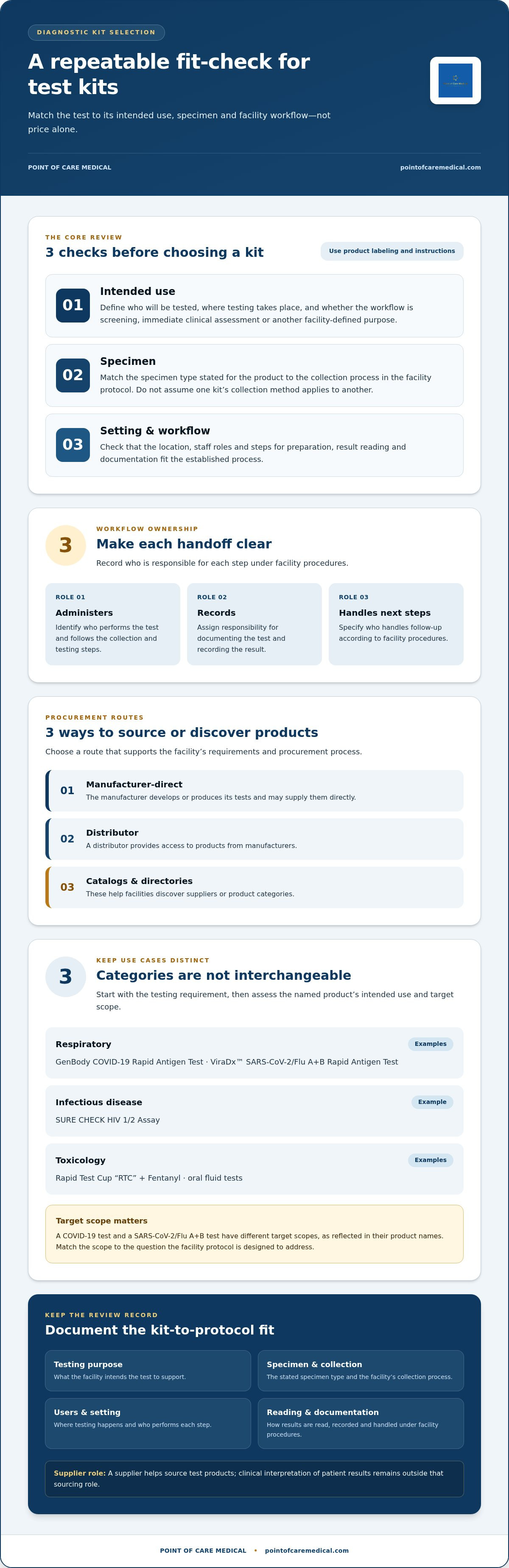
- Testing roles: Identify who administers the test, who records the result, and who handles the next step under facility procedures.
- Workflow needs: Note how specimen collection, preparation, result reading, and documentation fit into the existing process. Identify which staff need access to instructions and records.
- Product information: Gather the kit labeling and supporting materials your team needs to assess intended use and operational fit.
Keep these requirements connected to facility protocols. A catalog description alone cannot establish whether a test fits your setting or staff workflow. Regulatory terms also have distinct meanings, so use the CLIA-waived versus FDA-cleared rapid tests guide when reviewing those distinctions. With scope defined, your team can compare sourcing options against specific needs and maintain a consistent procurement record.
Match Diagnostic Test Kits to the Specimen, Setting, and Workflow
Catalog categories are a starting point, not a selection rule. A kit’s intended use and specimen type need to align with the facility’s established testing process. Review all three elements: intended use, specimen, and workflow. If one differs from the protocol, staff may face extra steps or unclear documentation.
For a clear review record, document how the selected kit maps to the facility’s protocol. Capture the testing purpose, specimen and collection process, user roles, and steps for reading and documenting results. Use the product’s labeling and instructions in that review, and keep the rationale with the relevant protocol materials.
Organize requirements by diagnostic category
Keep use cases distinct. Respiratory workflows may involve SARS-CoV-2 or influenza testing, while infectious disease screening, including HIV testing where appropriate, follows a separate purpose and process. Scope toxicology screening independently as well. This prevents teams from treating tests with different purposes as interchangeable because they appear in the same broad catalog.
Also distinguish single-target tests from multiplex options. A COVID-19 test and a SARS-CoV-2/Flu A+B test have different target scopes, as reflected in their product names. Neither format is automatically the better fit. Match the target scope to the question the facility’s protocol is designed to address, then document the reason for the selection.
Check the practical fit of each test format
Start with the specimen. Record the specimen type specified for the kit and how the facility’s collection procedure supports it. Don’t assume that a collection method used for one product applies to another. The written protocol should describe the steps staff follow, including preparation, result reading, and documentation specified by the product materials and facility procedures.
Next, review the setting and users. Consider where testing occurs, which staff roles perform each step, and whether the process fits existing procedures. Unclear handoffs can make records inconsistent. Assign responsibility for documenting the test, recording the result, and handling follow-up under facility protocols.
- Specimen: Match the product’s stated specimen type to the collection process in the protocol.
- Setting and users: Confirm the workflow fits the location and staff roles responsible for testing.
- Recordkeeping: Identify where the result and relevant process details will be documented.
For point-of-care workflows, consult the CDC Guidelines for Waived Point-of-Care Tests when reviewing resources on waived tests. The guide to choosing compliant rapid test kits offers a deeper framework for evaluating product fit. Once your criteria are documented, review relevant respiratory, infectious disease, and toxicology options through Point of Care Medical’s point-of-care testing supplies.
Compare Medical Diagnostic Test Supplier Models Without Losing Clinical Fit
Procurement routes differ in what they help a facility do. A manufacturer develops and produces its tests. A distributor supplies products from its portfolio. A broad supplier directory helps users discover organizations and product categories, but a listing alone does not establish that a test matches a clinical workflow. The right route depends on the facility’s testing scope, documentation needs, and purchasing process.
Understand what each supplier model offers
Manufacturer-direct sourcing provides access to a manufacturer’s own product information and portfolio. A distributor brings together products across its catalog categories. Point of Care Medical distributes point-of-care rapid diagnostic testing supplies nationally, including respiratory, infectious disease, and toxicology tests. A focused catalog can make relevant categories easier to browse, but the facility still needs to assess each test against its intended workflow.
Directories serve a different purpose. They organize supplier discovery, sometimes across medical and nonmedical sectors. Treat directory entries as leads for procurement research, not evidence of a product’s suitability, intended use, or regulatory status. A distributor’s role is product distribution, not test manufacture or clinical decision-making for the facility.
Use consistent comparison criteria
Compare each route against your facility’s documented requirements. Consider whether the product focus aligns with your test categories, whether relevant options are easy to find, and whether product information supports a workflow review. Then assess the specific test, not just the supplier model. Review its labeling, instructions, intended use, and applicable regulatory status as part of your facility’s evaluation.
| Sourcing route | Product focus | Discovery process | Workflow alignment |
|---|---|---|---|
| Manufacturer-direct | The manufacturer’s own tests | Explore the manufacturer’s product information | Assess each test against facility requirements |
| Distributor catalog | A selected portfolio from product categories | Browse a distributor’s catalog | Compare individual products with documented workflows |
| Supplier directory | Listings across supplier types or sectors | Search and filter directory entries | Evaluate product suitability separately |
No route is universally best. Manufacturer-direct sourcing may suit a focused product search, while a distributor catalog can help teams browse across relevant test categories. A directory can help identify sourcing options but requires additional product-level review. Assess a medical diagnostic test kit supplier by how its products and information support the facility’s defined needs, not by catalog breadth alone.
For a focused review of FDA-cleared rapid diagnostic tests, use this practical guide to FDA-cleared rapid diagnostic tests. Apply the same comparison criteria to each sourcing route, then retain the product-specific review with procurement documentation. This gives your team a clear basis for explaining how a selected test fits the facility’s intended use and operations.
Use This Medical Test Kit Supplier Checklist Before Procurement
Use this checklist before browsing catalogs or starting procurement review. It turns a general testing need into criteria your facility can apply consistently. A medical diagnostic test kit supplier can provide products for review, while your facility defines intended use, workflow, documentation, and approvals.
Complete the requirements checklist
Record the operational requirements first. Keep the completed checklist with the product review so staff can see how the decision relates to the approved testing process.
- Define the testing purpose. Record the intended use, patient or screening population, and whether the workflow supports screening, clinical assessment, or another facility-defined purpose. Identify the category, such as respiratory, infectious disease, or toxicology.
- Specify the specimen. Note the specimen type and collection process required by the facility’s protocol. Use the product’s instructions and labeling during review. Don’t assume a process used for one test applies to another.
- Identify the setting and users. Record where testing will occur and which staff roles are involved. Clarify who administers the test, documents results, and carries out follow-up under facility procedures.
- Review product information. Set criteria for checking the test’s intended use, instructions, labeling, and applicable regulatory information. Focus on the specific product under consideration. For additional context, consult dedicated guidance on CLIA-waived versus FDA-cleared rapid tests.
- Assess workflow fit. Map collection, preparation, result reading, documentation, and follow-up to existing procedures. Note any handoffs or staff steps that need clarification before the kit is incorporated into the workflow.
- Document internal approval. Identify the roles responsible for reviewing product information and approving procurement. Record why the kit was selected and how it aligns with the facility’s testing protocol.
Prepare a repeatable review and ordering process
Assign ownership for maintaining product information and facility records. Use the same checklist for each review, and store the completed assessment with the relevant protocol materials. This connects the testing need, the kit reviewed, and the facility’s decision in one traceable record.
Revisit the record when testing needs, protocols, or product requirements change. A completed review may no longer reflect the current workflow. Update the assessment and use the facility’s established approval process before relying on it for a new procurement decision.
Once your criteria are documented, use them to explore relevant respiratory, infectious disease, and toxicology test categories. Explore Point of Care Medical’s diagnostic test categories as a next step in your sourcing review.
How Point of Care Medical Fits a Facility’s Diagnostic Supply Checklist
With your requirements documented, connect them to relevant product categories. Point of Care Medical distributes point-of-care rapid diagnostic testing supplies nationally to healthcare and screening facilities. As a medical diagnostic test kit supplier, Point of Care Medical offers products across respiratory, infectious disease, and toxicology testing. Your facility’s intended use and established protocols remain the basis for evaluating each product.
Review the diagnostic categories available
Start with the category that matches the requirement you recorded, then review individual products against your facility’s process. The catalog includes examples across these areas:
- Respiratory testing: GenBody COVID-19 Rapid Antigen Test and ViraDx™ SARS-CoV-2/Flu A+B Rapid Antigen Test.
- Infectious disease screening: SURE CHECK HIV 1/2 Assay.
- Toxicology screening: Rapid Test Cup “RTC” + Fentanyl and oral fluid tests.
This organization gives procurement and clinical teams a practical starting point without treating categories as interchangeable. Review a respiratory testing requirement against the facility’s respiratory workflow. Consider HIV screening and toxicology needs separately, in relation to their own intended purposes and protocols.
Product names identify catalog examples, not a substitute for product-level review. For each option under consideration, compare product information with the facility’s requirements. Focus on intended use, staff procedures, and the documentation process established for that test category.
Turn the checklist into a focused next step
Bring the completed checklist to your catalog review. Match each documented need to a relevant category, then assess the specific product against the facility’s protocol and approval process. This keeps sourcing decisions connected to operational requirements rather than category labels alone.
For example, a respiratory requirement can guide a review of the GenBody or ViraDx test listing, while an infectious disease screening requirement can direct attention to SURE CHECK HIV 1/2 Assay. Toxicology requirements can lead the team to review the RTC + Fentanyl or oral fluid test offerings. These examples help organize the search, but do not determine clinical suitability. The facility’s review of product information and established protocols does that.
Keep the completed assessment with your procurement records so the rationale is available to the staff responsible for review and approval. If testing needs or procedures change, revisit the criteria before applying an earlier assessment to a new decision.
Explore Point of Care Medical’s diagnostic test kits to review categories relevant to your facility’s documented requirements.
Put Your Testing Requirements Into Practice
Make the next procurement decision easier to explain and maintain. Create a working record that connects each test choice to its intended use, product review, assigned responsibilities, and approved protocol. Keep that record accessible to staff involved in procurement and testing, and revisit it when facility needs or procedures change.
A consistent review process also gives your team a practical way to assess new options. Use the same criteria each time, document the reason for a decision, and keep product sourcing aligned with the facility’s established workflow. A medical diagnostic test kit supplier can support sourcing, while your facility retains responsibility for product review and protocol decisions.
Point of Care Medical distributes point-of-care rapid diagnostic testing supplies nationally, with respiratory, infectious disease, and toxicology categories for facility review. Explore Point of Care Medical diagnostic test kits and use your documented requirements to guide the review. A clear process helps your team move forward with confidence.
Frequently Asked Questions
How do I determine which diagnostic test kits my facility needs?
Start with the decision the test is intended to support, then check how it fits the facility’s care or screening process. A screening station and a clinical assessment area, for example, may have different staff responsibilities and follow-up steps. Document those differences before comparing products. This helps prevent a kit selected for one use case from being carried into another workflow without a separate review.
What is the difference between a diagnostic test kit distributor and a manufacturer?
A manufacturer develops or produces a test, while a distributor supplies products to organizations. A medical diagnostic test kit supplier may be a distributor, so distinguish its sourcing role from the organization responsible for developing the test. Keep the product’s own labeling and documentation with the specific kit review. This helps separate product information from the supplier’s role.
Can one supplier support respiratory, infectious disease, and toxicology testing?
Yes. A distributor may carry products across these categories, but one review is not sufficient for every test. Keep separate requirement records for each category because the purpose, specimen process, and staff workflow may differ. A shared supplier can simplify catalog discovery, while product-level review remains necessary. This helps procurement teams organize sourcing without blending protocols or documentation across unrelated testing needs.
What documentation should a facility review before sourcing a rapid test kit?
Review the product labeling, instructions for use, intended use, specimen requirements, and applicable regulatory information for the exact test. Record which materials were reviewed and who completed the assessment, following facility procedures. Retain the reviewed information alongside the internal procurement rationale rather than relying on a general catalog description. Handle staff training, result recording, and quality procedures under the facility’s established protocols.
How should a facility assess whether a rapid test fits its workflow?
Walk through a typical test from the staff member’s perspective. Identify who receives the specimen, performs each step, reads the result, records it, and handles follow-up. Note where instructions need to be available and how the result enters the facility’s recordkeeping process. Compare that walkthrough with the product instructions and approved procedures. Clarify any handoff that is unclear before implementation.
Are all rapid diagnostic tests CLIA-waived or FDA-cleared?
No. A test’s status and applicable conditions are specific to the product and its intended use. CLIA-waived and FDA-cleared describe different regulatory considerations, so don’t infer one from the other or from a supplier’s catalog category. Review the documentation for the exact test under consideration, and use dedicated regulatory guidance and facility procedures to interpret it. Keep the basis for the review with the product assessment.
When should a facility review its diagnostic test kit sourcing checklist again?
Review the checklist whenever the testing population, location, protocol, or diagnostic need changes. Reassess it when product information changes or staff report a workflow issue. A new testing location, for example, may introduce different handoffs or documentation steps even if the test purpose stays the same. Update the checklist and route the revision through the facility’s established review process so procurement decisions reflect current operations.


