

Speed matters, but a test must also suit its specimen, screening purpose, and setting. Rapid diagnostic test kits provide preliminary screening results, often using lateral flow methods that deliver results within minutes. Point of Care Medical distributes rapid diagnostic test kits to healthcare and screening facilities, helping them find products suited to their testing needs.
Choosing a kit involves more than comparing turnaround times. Performance data, supported specimen types, storage requirements, product documentation, and manufacturer qualifications all affect how well a test fits an organization’s workflow.
This guide explains how rapid diagnostic test kits work and how to assess key details before building a portfolio. You’ll learn what to review in sensitivity and specificity data, how to match tests to specimens, and what to check in storage instructions, regulatory documents, and batch records. It also shows how different test types can meet respiratory, infectious disease, and toxicology screening needs, helping you make an informed, practical selection.
Key Takeaways
- Compare sensitivity and specificity data for each test, then match its approved specimen types to your screening workflow.
- Assess packaging condition, remaining shelf life, and product-specific storage instructions before planning inventory.
- Match U.S. product documentation to the test’s exact name and applicable FDA pathway, and review CE documents for the intended market.
- Review a manufacturer’s quality-system certificate, batch traceability, and batch-specific Certificates of Analysis as part of qualification.
- Build a portfolio around testing needs, such as respiratory, infectious disease, and toxicology screening, rather than test format alone.
Sensitivity, specificity, and specimen types
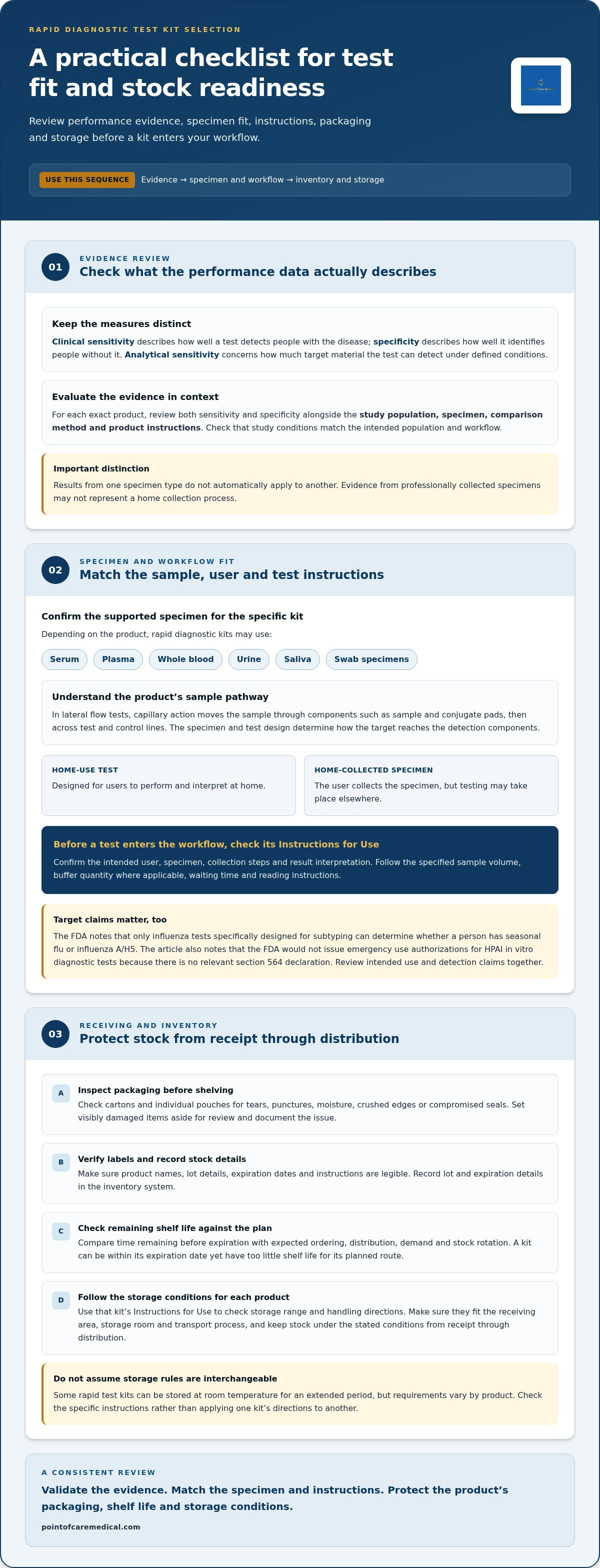
Performance figures are useful for comparing tests only when their intended uses and specimens match. Sensitivity describes how well a test detects people with the disease; specificity describes how well it identifies people without it. Review both measures for each test, rather than relying on a general performance claim. Check the study population, specimen, comparison method, and product instructions alongside the figures. Results from one specimen type do not automatically apply to another. Swab-based and blood-based assays use different collection and detection processes.
Clinical sensitivity and specificity describe performance under clinical testing conditions. They differ from analytical sensitivity, which concerns how much target material a test can detect under defined conditions. Relate each measure to the test’s intended population and specimen, and check whether the study conditions match the intended workflow. For example, results from professionally collected specimens may not represent a home collection process. Record these distinctions in product evaluations and procurement documents.
Specimen fit affects both collection and test operation. Depending on the product, rapid diagnostic kits may use serum, plasma, whole blood, or urine. Lateral flow tests may also use saliva or swab specimens. In these tests, capillary action moves the sample through components such as sample and conjugate pads, then across test and control lines. The specimen and test design determine how the target reaches the detection components. Oral fluid tests show why it is important to review each product’s specimen pathway rather than assume all assays use the same sample.
Distinguish home-use tests from tests that use home-collected specimens. A home-use test is designed for users to perform and interpret at home. With a home-collected test, the user collects the specimen, but testing may take place elsewhere. Check the package insert for the intended user, specimen, collection steps, and result interpretation. Healthcare professionals should follow the manufacturer’s Instructions for Use, including sample volume, buffer quantity where applicable, waiting time, and interpretation. Following these steps keeps collection and reading consistent with the product’s validated process.
- Compare sensitivity and specificity for the exact product and intended specimen.
- Check whether performance evidence matches the intended population and collection setting.
- Match each assay to its supported specimen, such as urine, blood, saliva, or swab.
- Review the collection and result-reading instructions before adding a test to a workflow.
Some clinical questions require a test designed to distinguish specific disease types. The FDA notes that only influenza tests specifically designed for subtyping can determine whether a person has seasonal flu or influenza A/H5. The FDA also says it would not issue emergency use authorizations for HPAI in vitro diagnostic tests because there is no relevant section 564 declaration. These distinctions show why intended use and detection claims must be reviewed together. Performance figures cannot substitute for a product’s defined target, specimen, and instructions.
Shelf life and storage conditions
Check packaging condition, complete labeling, storage requirements, and remaining shelf life. These checks can help identify damaged shipments, unsuitable storage, and stock that may expire before its planned use.
On receipt, inspect cartons and individual pouches before adding stock to inventory. Look for tears, punctures, moisture, crushed edges, or compromised seals. Confirm that product names, lot details, expiration dates, and instructions are legible. Separate visibly damaged items from usable stock and document the issue. Compare expiration dates with expected ordering, distribution, and screening timelines. A kit may still be within its expiration date but have too little shelf life remaining for its planned route.
- Inspect outer cartons and pouches for damage before shelving.
- Check labels for clear, complete product and expiration information.
- Record lot and expiration details in the inventory system.
- Set aside damaged stock for review instead of distributing it.
Follow the storage conditions in each test’s Instructions for Use. Check the range and handling directions for the specific kit, then make sure they fit the receiving area, storage room, and transport process. Do not apply one product’s instructions to another, even if both are rapid tests. Make the applicable instructions accessible to staff who receive, store, and issue stock. If the manufacturer specifies special handling, include it in routine inventory procedures.
Some rapid test kits can be stored at room temperature for an extended period, but storage conditions vary by product. Use the product’s instructions to determine whether room-temperature storage applies and how the kit should be handled. Do not assume two assays have the same requirements just because both arrive in sealed pouches. Keep stock under the stated conditions from receipt through distribution, and train relevant staff on the product-specific process.
Shelf life affects purchasing as well as storage. Compare the time remaining before expiration with expected demand, sales cycle, and stock rotation plans. Organize products with earlier expiration dates so staff can identify them for appropriate first use. Link lot and date records to inventory so staff can locate affected stock if a quality issue arises. Clear records also help distinguish current stock from earlier deliveries during routine checks.
For HIV screening inventory, apply these checks to the SURE CHECK HIV 1/2 Assay using its product-specific instructions. Review the SURE CHECK HIV 1/2 Assay as part of your purchasing and storage workflow. Keep the relevant instructions available where staff receive and manage the kits.
FDA and CE product documentation
For U.S. distribution, match a test’s FDA documentation to its applicable pathway, such as 510(k), EUA, or registration. Start with the exact product name on the package, then compare it with the documentation. Check for a product-specific identifier where applicable. A broad claim that a test is “FDA approved” without an identifier is a red flag. Keep the supporting record with the product information used by purchasing and inventory teams.
For products intended for a market that uses CE documentation, review the Declaration of Conformity or certificate. It should identify the exact product and the applicable EU requirements for its intended market. Compare the legal manufacturer and product details across documents. A CE mark or general certificate alone does not show whether the document covers the specific kit under consideration. Obtain product-specific package inserts, too. They describe the intended use, specimen, procedure, result interpretation, and performance details such as sensitivity.
Keep product codes and pack information consistent across purchasing records. Match the product name and identifier in the documentation to the label, package insert, brochure, and ordering record. Record the kit size or package configuration exactly as shown in product materials. This helps staff distinguish products with similar names and reconcile the order with the delivered package. A distributor’s internal reference is not a substitute for the product-specific identifier.
Brochures can support product comparisons, but they should not replace formal documentation. Use them to summarize intended use, specimens, workflow, and result timing, including whether results are available within minutes. Confirm each summarized claim against the product-specific insert and applicable regulatory records. If a brochure lists sensitivity, make sure the figure refers to the same product and specimen. Retain the version used for purchasing decisions so teams can trace the information behind their selection.
Keep price and ordering details separate from performance and regulatory claims. A purchasing sheet can list the product, package configuration, ordering unit, and applicable price without implying that price establishes test quality. Tie every entry to its exact product identifier. This helps procurement teams compare equivalent pack sizes and avoid applying a quote for one configuration to another.
- Match the exact product name and identifier across records.
- File the applicable FDA pathway documentation for U.S. products.
- Check that CE documents identify the product and intended market.
- Use product-specific inserts to support testing and performance information.
- Keep brochure, package, and purchasing details aligned.
Make document review a repeatable part of procurement and receiving. Create a product record for each test and keep its package insert, applicable FDA or CE documentation, brochure, and ordering details together. Staff can then review product claims, codes, kit size, and testing instructions before purchasing or restocking.
Manufacturer qualification and certification checks
For U.S. qualification, separate product-specific FDA documentation from manufacturer quality certification. ISO 13485 is the quality management system standard for medical devices, according to the International Organization for Standardization. It is a manufacturer-system credential, not proof that each device has been reviewed or registered for every market.
Review the manufacturer’s ISO 13485 certificate for its scope, validity, issuing body, and covered legal entity. Confirm it is current and covers the relevant product category. A certificate for one company or activity does not automatically cover another legal entity or device. Keep the certificate with the manufacturer record, then compare its details against the name used on product documents.
For each rapid test, assess product documentation separately. Match the exact device name and legal manufacturer across the package, product insert, and applicable FDA records. The U.S. pathway may include 510(k), EUA, or registration, depending on the product. A manufacturer’s quality-system certificate does not replace this product-level review. Treat each infectious disease or antigen test as a distinct device when recording its documentation.
Influenza products need particular attention to their stated targets. The FDA notes that only influenza tests specifically designed for subtyping can determine whether a person has seasonal flu or influenza A/H5. Compare the manufacturer’s device name and intended claims with its supporting product documents. A general influenza label does not establish that a test identifies a subtype.
Quality assurance also depends on batch-level records. Ask manufacturers about batch traceability and recall handling, and request a batch-specific Certificate of Analysis for each product planned for an order. At receipt, compare the lot number on the outer carton with the corresponding CoA. Keep records connecting the manufacturer, device name, lot, and certificate. These links help clarify the review if a quality concern or recall arises.
- Record the manufacturer’s legal entity and certificate scope.
- Check certificate validity, issuing body, and product-category coverage.
- Match the device name to its applicable U.S. product documentation.
- Retain a batch-specific CoA and reconcile it with carton lot details.
- Document the manufacturer’s traceability and recall process.
These checks form a practical qualification file, not a substitute for following applicable product requirements. Keep manufacturer certification, product records, and batch evidence distinct. For example, an ISO 13485 certificate supports review of a manufacturer’s quality system; it does not establish authorization for a specific influenza antigen test. Revisit the file when the legal manufacturer, device name, or product documentation changes.
Rapid diagnostic test kit portfolio
Build a resilient portfolio around distinct testing needs, not a broad collection of similar kits. Rapid tests may support individual testing or a limited number of samples, and many provide preliminary screening results. Lateral flow formats provide results within minutes; other rapid tests use agglutination, immuno-dot, or immuno-filtration techniques. Point of Care Medical organizes rapid diagnostic test kits across respiratory, infectious disease, and toxicology screening categories, helping facilities compare products with their actual workflow needs.
Group products by the question each test is designed to answer. Infectious disease screening, drug testing, pregnancy testing, and food safety are distinct applications for lateral flow tests. A portfolio for one area does not automatically meet another’s needs. For example, respiratory infection screening involves different targets and workflow considerations from drug testing. Define the testing purpose first, then compare product claims and operating instructions.
Let specimen and workflow fit guide your next decision. Compare the specimens each test supports with your collection process and setting. A saliva-based workflow differs from a swab-based one in collection, handling, and staff training. Consider who collects the sample, who runs the test, and who interprets the result. Mapping these steps helps determine whether a product from a rapid diagnostic test kits distributor suits your facility’s intended users and procedures.
Use a portfolio matrix to organize comparisons. Include each test’s intended application, method, supported specimen, user setting, and result timing. Add product documentation and storage requirements so purchasing and receiving teams work from consistent details. This approach distinguishes products that look similar but serve different purposes. Keep the matrix specific to each product rather than grouping every rapid test under one general label.
- Sort products by screening purpose, such as infectious disease, drug testing, or food safety.
- Record whether each method is lateral flow, agglutination, immuno-dot, or immuno-filtration.
- Match specimen collection and test operation to the facility’s workflow.
- Distinguish preliminary screening from each product’s intended use.
A balanced portfolio includes complementary options without assuming every method belongs in every facility. A limited-sample program may prioritize a convenient workflow, while a laboratory may need a different mix of methods and documentation. Review demand, staff processes, specimen handling, and intended screening roles together. Remove products that duplicate a function without adding a clear workflow benefit.
Build a focused supply plan around the testing categories your organization serves. Explore rapid test supply options to connect portfolio planning with available point-of-care testing categories.
Point of Care Medical: GenBody COVID-19 Rapid Antigen Test
Point of Care Medical supplies the GenBody COVID-19 Rapid Antigen Test for facilities seeking a respiratory screening option. Its diagnostic offerings also include the ViraDx™ SARS-CoV-2/Flu A+B Rapid Antigen Test, SURE CHECK HIV 1/2 Assay, and Rapid Test Cup "RTC" + Fentanyl. These products address distinct testing categories, so align selection with your facility’s intended screening needs and product-specific instructions.
Use the performance, specimen, documentation, and storage criteria in this guide to assess product fit and organize procurement records. For respiratory testing, compare GenBody and ViraDx™ options with your workflow requirements. Contact Point of Care Medical to discuss your rapid testing supply needs.
Build the Next Supply Decision with Confidence
Turn your evaluation process into a repeatable purchasing standard. Document how your facility weighs intended use, workflow fit, product records, and portfolio coverage. This gives teams a consistent basis for future orders and keeps procurement decisions aligned with operational needs. Point of Care Medical supports this process by distributing products across distinct screening categories.
Point of Care Medical offers the GenBody COVID-19 Rapid Antigen Test and ViraDx™ SARS-CoV-2/Flu A+B Rapid Antigen Test for respiratory testing needs. Its offerings also include Rapid Test Cup "RTC" + Fentanyl. Match each option to your facility’s testing requirements and product-specific instructions before adding it to your purchasing plan.
When you’re ready to discuss supply options, contact Point of Care Medical. A clear next step can help your team move from product review to a more organized procurement workflow.
Frequently Asked Questions
What Are Rapid Diagnostic Test Kits?
Rapid diagnostic test kits screen for a target using a defined sample and procedure. Lateral flow is one common format; other methods include agglutination, immuno-dot, and immuno-filtration. A clinic might select a respiratory assay for one screening program and a drug test for another. Review the test’s intended use and instructions to understand who performs it and how to interpret results.
Which distributors sell rapid diagnostic test kits in the United States?
Point of Care Medical distributes rapid diagnostic testing supplies to healthcare and screening facilities across the United States. A rapid diagnostic test kits distributor can serve organizations with specific screening needs, such as respiratory or toxicology testing. Point of Care Medical’s offerings include GenBody COVID-19 Rapid Antigen Test, ViraDx™ SARS-CoV-2/Flu A+B Rapid Antigen Test, and Rapid Test Cup "RTC" + Fentanyl. Match the product category to your program.
Which types of rapid diagnostic tests are available for clinical and at-home use?
Rapid tests cover areas such as infectious disease, drug screening, pregnancy, and food safety. The intended user and collection process distinguish clinical from home-use products. A clinical test may be designed for trained staff, while a home-use test is intended for users to collect a specimen, run the test, and interpret the result at home. Home-collected specimens may instead be sent elsewhere for testing, so check the product’s intended workflow.
How can I verify a rapid test kit distributor's FDA authorization and compliance?
Match the exact product name and identifier on its package to the applicable U.S. FDA documentation. Relevant pathways may include 510(k), EUA, or registration. Treat a broad “FDA approved” claim without a product-specific identifier as a red flag. Review manufacturer quality records separately: a quality-system certificate concerns the manufacturer’s system and does not, by itself, establish product-specific FDA status.
How much do rapid diagnostic test kits cost wholesale and in bulk?
Wholesale pricing varies by test, package configuration, order volume, and purchasing terms. Compare the same product and pack size rather than treating unlike products as equivalent. Include expected use and remaining shelf life in your assessment, since unused stock can affect the value of a bulk order. For an accurate comparison, evaluate quotes against the exact product and configuration your facility plans to purchase.
What are the minimum order quantities and shipping options from U.S. test kit distributors?
Minimum quantities and shipping arrangements depend on order terms, package configurations, and delivery requirements. Plan around the quantity your facility can receive, store, and use within the product’s shelf life. Assign a receiving contact and establish how incoming orders will be inspected and entered into inventory. Review delivery arrangements during procurement so the receiving team can plan storage and stock rotation after the shipment arrives.
How can healthcare providers or businesses open a wholesale account with a test kit distributor?
Start by identifying your organization’s purchasing contact, required test categories, and intended order configuration. Then follow the distributor’s account process and provide the requested business details. An account with a rapid diagnostic test kits distributor gives procurement teams a structured way to manage product selection and orders. Point of Care Medical supplies rapid testing products to healthcare and screening facilities, including respiratory and toxicology options.
How can I find local rapid diagnostic test kit distributors near me?
Search by your location and the product category your facility needs, then compare delivery arrangements with your receiving and storage workflow. Local availability is only one factor in procurement. Point of Care Medical serves customers nationally across the United States, so facilities can consider its products alongside their operational requirements. Focus on test purpose, product documentation, and whether your organization can receive and store the kits as directed.


