

FDA clearance is a starting point, not proof that a test fits your facility. For FDA cleared rapid diagnostic tests, 510(k) clearance means the FDA found a device substantially equivalent to a legally marketed predicate. The test’s labeling still determines which uses, specimens, and settings are covered.
“Cleared,” “approved,” “authorized,” and “registered” describe different regulatory statuses. A database result alone may not show whether a test matches your point-of-care workflow. Before making procurement or implementation decisions, verify the specific test and review its intended-use information.
This guide explains what FDA clearance does and doesn’t establish, how to search FDA resources, and what to check in a product’s labeling. It also shows how to apply those details to decisions about respiratory, HIV, toxicology, and oral-fluid testing. Use the steps to connect regulatory information with the way your team plans to use a test.
Key Takeaways
- “Rapid” describes workflow or result timing, not an FDA regulatory status.
- Distinguish clearance, approval, and authorization by the FDA pathway and decision involved.
- Search the relevant FDA database, then compare the result with the product’s manufacturer, name, model, and intended use.
- For FDA cleared rapid diagnostic tests, review labeling details such as specimen, user, and setting before assessing fit with your workflow.
- Document the product identity, FDA record, labeling, and intended-use review as part of procurement.
What FDA-Cleared Rapid Diagnostic Tests Mean in Clinical Practice
Concise definition: An FDA-cleared rapid diagnostic test is a specific medical device for which the FDA has issued a clearance decision, generally through the 510(k) pathway, for defined indications and conditions of use. “Rapid” describes the workflow or time to result, not a regulatory status. To assess FDA cleared rapid diagnostic tests, review both the regulatory record and the product labeling.
This distinction matters in point-of-care settings. A test’s clearance status identifies an FDA decision about a device. Its labeling describes the reviewed use, including what the test detects and the conditions under which it is intended to be used. Those details are related, but they are not interchangeable.
What does FDA clearance establish?
For a 510(k) decision, clearance means the FDA determined that the device is substantially equivalent to a legally marketed predicate device. The decision applies to the identified device and its reviewed indications. It does not automatically apply to every product from the same manufacturer or to similar-looking tests.
Clearance is a regulatory finding, not a guarantee of diagnostic accuracy in every population, facility, or clinical situation. Performance can depend on using the test as labeled, including with the specified specimen and intended user. For a broad overview of how devices are regulated and classified, see Medical Device Regulation and Classification.
For a facility review, locate the current FDA decision record and compare it with the product labeling. Match the manufacturer and device identity, then check the stated indications and use conditions. A similar product name or a general claim of FDA status is not enough to show that the record applies to the item being considered.
Why is rapid testing a separate concept from clearance?
“Rapid” describes how a test fits into a workflow or how soon it produces a result. It does not identify the FDA pathway or establish that the FDA reviewed a particular device. A quick result alone cannot demonstrate clearance, approval, or authorization.
Rapid tests can use different technologies and specimens. Depending on the device, testing may involve a nasal swab, blood, oral fluid, or another specimen. The technology, specimen, setting, and user can all affect whether the labeled use fits a facility’s process.
Separate these questions during procurement:
- Regulatory status: What FDA decision applies to this exact device?
- Clinical use: What indication, specimen, user, and setting does the labeling specify?
- Workflow fit: Do those conditions match how the facility plans to collect, run, and interpret the test?
Keeping these questions separate prevents speed from being mistaken for regulatory evidence. It also helps staff evaluate the product against its documented use.
FDA Cleared, FDA Approved, and FDA Authorized: Understand the Differences
FDA status terms describe different regulatory decisions. They are not interchangeable, and a rapid test’s workflow doesn’t determine which term applies. The pathway depends on factors such as device type, risk classification, and the FDA review route. Identify the exact decision recorded for the specific device rather than inferring status from a product description or broad marketing language.
How does FDA clearance differ from FDA approval?
Clearance generally refers to a 510(k) decision. The FDA determines that a device is substantially equivalent to a legally marketed predicate device for its intended use. This differs from PMA approval, which applies to certain high-risk devices and involves FDA review of evidence supporting safety and effectiveness.
Not every diagnostic device follows either route. A novel, low- to moderate-risk device without a suitable predicate may go through the De Novo pathway. If the FDA grants a De Novo request, it establishes a new classification for that device type. Describe the device according to its own FDA record, not assumptions about similar tests.
What does FDA authorization mean for a test?
“Authorized” can refer to a specific FDA mechanism rather than clearance or approval. An Emergency Use Authorization (EUA), for example, may permit use of an unapproved medical product, or an unapproved use of an approved product, during a declared emergency when statutory criteria are met. An authorization can include conditions, and its status can change.
Don’t treat past authorization as proof of current authorization. Before describing a test as authorized, verify the current FDA record and the terms that apply to its use. Check whether the authorization remains in effect, and review any conditions or limitations. This matters when older materials or product pages may not reflect the current regulatory record.
For quick reference, distinguish the common terms this way:
- 510(k) cleared: The FDA found the device substantially equivalent to a legally marketed predicate for a stated use.
- De Novo granted: The FDA granted a request for a novel device with no suitable predicate and established its classification.
- PMA approved: The FDA approved a premarket application for a device subject to that pathway.
- EUA authorized: The FDA authorized specified emergency use under applicable conditions.
These summaries are an orientation, not a substitute for the device-specific decision record. Compare the record with the product identity and labeling, and use the FDA’s wording when documenting status. Registration or listing alone should not be described as clearance or approval.
Apply the same product-identification checks when procuring respiratory, infectious disease, or toxicology testing supplies. Point of Care Medical distributes rapid diagnostic test supplies for facilities to evaluate alongside their regulatory and intended-use checks.
How to Verify an FDA-Cleared Rapid Diagnostic Test
Use a repeatable process instead of relying on a product page or a broad claim of FDA status. For FDA cleared rapid diagnostic tests, verification means matching the exact product and its labeled use to an FDA record. A similar name or assay category can help locate a record, but it doesn’t confirm that the record applies to the test being reviewed.
Which information should you use in an FDA database search?
Start with the full product name and manufacturer shown on the test labeling. Include a model or catalog identifier if provided. Search the FDA In Vitro Diagnostic (IVD) database using the product name, manufacturer, test type, or a relevant keyword. The FDA IVD database can help locate records on FDA-approved or cleared home and laboratory tests.
If the first search doesn’t return a clear match, try alternate spellings or assay terms. Treat those as search aids, not evidence that a record applies. Note the FDA decision identifier and pathway shown in the result, then compare them with the product documentation. Depending on the pathway, the relevant record may also appear in an FDA database for 510(k), PMA, or De Novo decisions.
How do you confirm that an FDA record matches the test?
Review the record alongside the product labeling and instructions for use. First compare the manufacturer and device identity, then check the model or assay name, specimen, indication, and intended user or setting. A brand-name match alone is insufficient. If a detail differs or the record doesn’t clearly identify the product, flag the discrepancy for further review rather than assuming the items are equivalent.
Follow these steps in order:
- Identify the product. Capture the manufacturer, complete product name, model or catalog identifier, and version shown on the packaging and labeling.
- Search FDA records. Use the IVD database and, where relevant, the database for the identified regulatory pathway. Search exact terms first, then reasonable alternate spellings or assay terms.
- Compare the match. Check the record’s manufacturer, device name, identifiers, decision type, and decision number against the product documentation.
- Review the labeled use. Confirm that the FDA record and current labeling align on the specimen, intended use, and user or setting relevant to your facility.
- Document the outcome. Save the record identifier and note any discrepancies that need resolution before accepting the match.
For example, a search result for a respiratory assay may share a manufacturer or part of a product name with the test under review. That resemblance doesn’t establish that the same specimen or indication is covered. Compare the specific details in the record and labeling before documenting a conclusion.
Keep the search record with procurement documentation. This gives staff a clear reference for product identity and intended use, and distinguishes a verified device match from an unresolved search result.
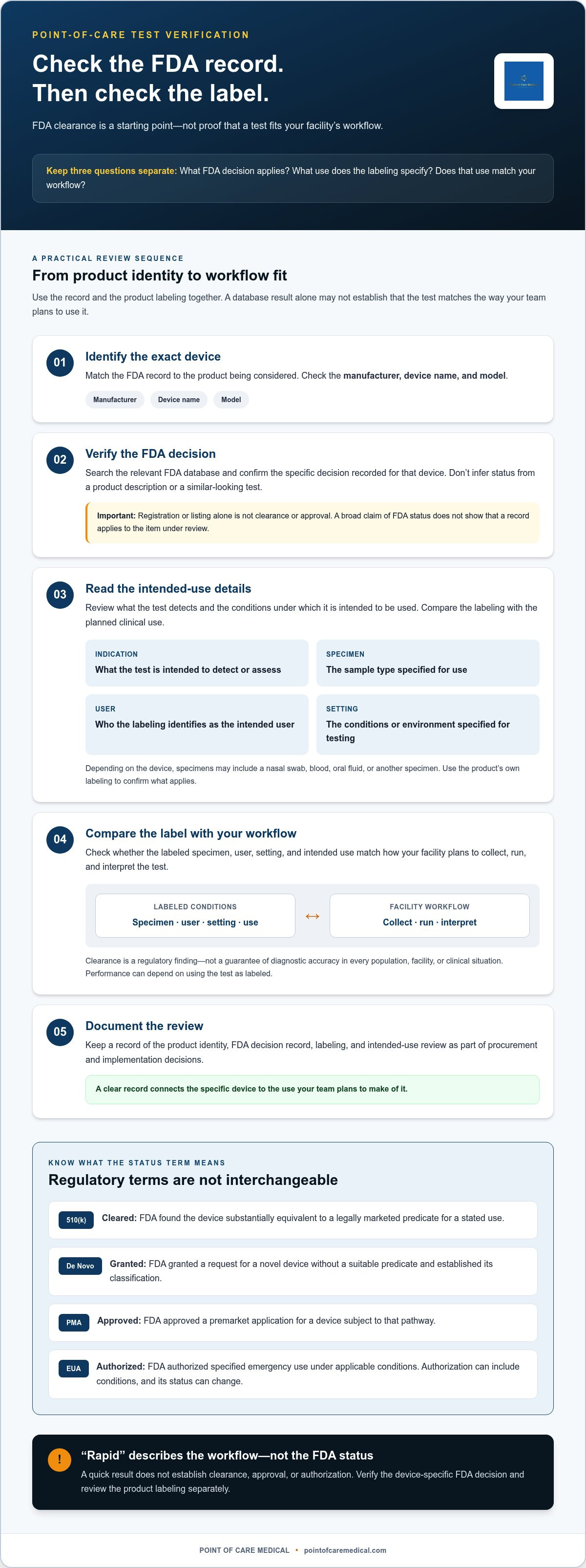
What FDA Clearance Does, and Does Not, Tell a Testing Facility
FDA clearance records a regulatory decision for a device and its reviewed use. It doesn’t, by itself, establish that the test will perform the same way in every patient population or clinical context. Facility teams must also assess whether the labeled intended use, specimen, user, setting, and instructions fit the planned workflow. FDA cleared rapid diagnostic tests still require appropriate clinical interpretation and facility procedures.
Why do intended use and labeling matter?
Labeling sets boundaries for use. It may identify the specimen type, indicated population, intended user, and testing setting. A record for one specimen or user context doesn’t establish that a different specimen or workflow is covered. During evaluation, save the labeling version reviewed and document how its stated conditions compare with the facility’s intended use.
Use the instructions for use to assess how staff will collect the specimen, perform the test, and interpret results. Consider results within the facility’s clinical protocols, including any steps for follow-up or additional evaluation. FDA status alone doesn’t determine the clinical response to an individual result or replace professional judgment.
- Intended use: Does the labeled indication fit the clinical question?
- Specimen: Does the collection method match the specimen named in the labeling?
- User and setting: Do the specified user qualifications and testing environment align with local operations?
- Instructions: Can staff follow the labeled procedure and apply established result-interpretation protocols?
Does FDA clearance replace facility compliance review?
No. Regulatory status doesn’t resolve every operational or laboratory requirement that may apply to a facility. Review applicable policies and testing conditions separately, including relevant CLIA considerations. Clearance and CLIA categorization are distinct, so don’t use one as a substitute for checking the other. For a focused explanation, see this guide to CLIA-waived versus FDA-cleared rapid tests.
Make the review traceable. Keep the FDA record, product labeling, date or version reviewed, intended-use assessment, and facility decision together in procurement documentation. If the labeling or workflow changes, repeat the fit assessment rather than relying on an earlier review. This helps staff distinguish regulatory evidence from local operational approval.
For facilities assessing point-of-care options, connect the documented review to the test category and workflow under consideration. Explore rapid diagnostic testing supplies for respiratory, infectious disease, and toxicology testing needs, and assess each product using its current records and labeling.
Apply FDA Status Checks to Rapid-Test Procurement and Documentation
A verified FDA record is one input to procurement, not a complete selection decision. Also assess whether the product’s labeled use fits the intended workflow and meets operational needs. A consistent review file helps clinical, laboratory, and purchasing teams work from the same product information instead of relying on different names, outdated documents, or assumptions about regulatory status.
What should a facility record during test review?
Create a record that identifies the exact product and captures how its FDA status was checked. Include the product name and manufacturer as they appear on the labeling, along with the specimen and intended use. Record the FDA database result or decision identifier and the date of review. Retain the labeling version used so staff can trace the basis for the decision.
Document any difference between the labeled use and the planned workflow. For example, note if the facility’s intended specimen, user, or setting doesn’t align with the reviewed labeling. Make discrepancies visible for follow-up rather than burying them in a purchasing file. This record supports a clear decision without treating an FDA listing as a substitute for local clinical and operational review.
- Product identity: Record the full product name, manufacturer, and available model or catalog identifier.
- Regulatory reference: Save the FDA database result, decision identifier, and review date.
- Labeling: Retain the current instructions and note the version or date shown.
- Use assessment: Document the intended specimen, user, setting, and any differences from the facility’s planned use.
How can teams make the review repeatable?
Use the same review steps for each new or replacement test. Assign responsibility for maintaining the record and reviewing product changes, such as updated labeling or a different product identifier. Define how unresolved differences are routed for review. A repeatable process reduces confusion when clinical and purchasing teams use different terminology for a product or compare tests across categories.
Keep procurement documentation accessible to the teams that evaluate, order, and use the test. A shared reference supports consistent product identification and makes it easier to revisit the rationale when a workflow changes. Regulatory verification remains one part of selection, alongside workflow fit, intended use, and facility requirements. Apply these criteria consistently when comparing rapid test kits.
Point of Care Medical supplies respiratory, infectious disease, and toxicology testing categories. Evaluate these options against your facility’s documented criteria for FDA cleared rapid diagnostic tests and intended use. Explore rapid diagnostic testing supplies as part of your procurement review.
Build a Consistent Review Into Your Next Purchase
Make regulatory review part of the procurement record, not a one-time search. A consistent file gives clinical and purchasing teams a shared reference when workflows change, products are replaced, or a decision needs to be revisited. It also keeps product selection grounded in current documentation rather than assumptions based on familiar names or rapid results.
Use that process as you assess FDA cleared rapid diagnostic tests and other testing options for your facility. Point of Care Medical distributes respiratory, infectious disease, and toxicology testing supplies, including GenBody, ViraDx, and SURE CHECK offerings. Evaluate each option against its product-specific records, labeling, and your facility’s intended use.
Review rapid diagnostic testing supplies for your facility as you plan your next procurement review. A clear, documented approach can support more consistent decisions across your team.
Frequently Asked Questions
What does FDA-cleared mean for a rapid diagnostic test?
FDA-cleared means the FDA issued a clearance decision for a specific device, generally through the 510(k) pathway. The decision relates to that device and its reviewed indications, not every product with a similar name. For FDA cleared rapid diagnostic tests, use the decision record to identify the product and use it covers. Don’t extend that finding to a different model or use without supporting documentation.
How can I check whether a rapid diagnostic test is FDA-cleared?
Search the FDA’s In Vitro Diagnostic (IVD) database using the manufacturer and full product name from the package. If needed, try an assay term or alternate spelling to locate possible records, then confirm the exact match in the product details. Check the manufacturer, device identifiers, specimen, and intended use. Save the decision identifier and review date with procurement records so the result can be revisited.
Is an FDA-cleared test the same as an FDA-approved test?
No. Clearance usually refers to a 510(k) decision based on substantial equivalence to a legally marketed predicate. Approval generally refers to a Premarket Approval (PMA) decision for a device reviewed through that pathway, which applies to certain higher-risk devices. These terms describe different FDA decisions, not a simple ranking that applies to every diagnostic. Use the terminology in the specific FDA record rather than relying on informal product descriptions.
Can a rapid diagnostic test be FDA-authorized instead of cleared?
Yes. A test may have an Emergency Use Authorization (EUA), a distinct mechanism that can permit specified emergency use of an unapproved product or an unapproved use of an approved product. An EUA includes conditions, and its status can change. If a package insert, procurement file, or online listing uses “authorized,” verify the current FDA record and applicable conditions before treating that wording as current.
Does FDA clearance mean a test is appropriate for every patient or setting?
No. A clearance decision doesn’t establish suitability for every patient, specimen, or clinical workflow. For example, a facility assessing use in a population or setting outside the test’s labeled indication should not assume that clearance covers that use. Review the applicable labeling and follow clinical protocols for interpreting results. Facility policy and professional judgment remain necessary when deciding how a result informs care.
What information should a facility verify on a rapid test’s labeling?
Check the indicated use, target or condition, specimen type, population, and specified user or setting. Review the instructions for collection, test procedure, result interpretation, and any stated limitations. For example, confirm that the specimen collected in your workflow is the one named in the instructions. Retain the version reviewed so staff have a shared reference if packaging or labeling changes.
Does FDA clearance mean a rapid test is CLIA-waived?
No. FDA clearance and CLIA categorization are separate statuses. A cleared test may have a CLIA categorization that needs its own verification; clearance alone doesn’t establish waiver status. Search the FDA CLIA database for the specific test and review the result for the applicable categorization. Facilities should also apply their own testing policies and requirements to the setting where testing will occur.


