

A rapid test can be FDA-cleared and still not be appropriate for every testing site. Product claims can place regulatory terms side by side, making them easy to confuse. The question behind CLIA waived vs FDA cleared rapid tests isn’t which label is better. FDA clearance concerns the device and its review; CLIA waiver concerns test complexity and the requirements for the facility performing the test.
Healthcare teams need clear regulatory information before introducing point-of-care testing. These terms aren’t interchangeable, and a single test may have both FDA clearance and a CLIA waiver. Its specific authorization, intended use, labeling, and instructions determine how and where it can be used. A general product claim alone may not show whether the test fits your facility’s setting.
This article explains how FDA device review differs from CLIA test classification, how the statuses can overlap, and what to verify in current product documentation. It also covers facility obligations, including applicable CLIA certificate and state requirements. Use these distinctions to match a test to your workflow and support a well-documented selection.
Key Takeaways
- CLIA waived vs FDA cleared rapid tests describe different regulatory considerations: device review and test complexity.
- Some tests may have both statuses, so assess each designation separately rather than treating them as alternatives.
- Use intended use, specimen type, test-system identity, current status, and labeling to guide your product review.
- Match the test’s complexity and instructions to your facility’s CLIA certificate and applicable state requirements.
- Align procurement with your testing workflow and replenishment needs. Point of Care Medical distributes rapid diagnostic testing supplies to healthcare and screening facilities nationwide.
CLIA-Waived vs. FDA-Cleared Rapid Tests: What Each Term Means
FDA clearance concerns a diagnostic device and its specified intended use. A CLIA waiver concerns the test system’s complexity and the requirements for the site performing the test. These are separate regulatory dimensions, not competing labels. One rapid-test system may have both designations, while another may have a different CLIA complexity category.
FDA clearance describes a device’s regulatory review, while CLIA waiver describes a test system’s complexity classification for testing under CLIA. That distinction is central to CLIA waived vs FDA cleared rapid tests. Neither term, by itself, establishes that a test suits every patient, specimen, setting, or workflow.
What does FDA clearance mean for a rapid test?
FDA review applies to a specific device for its stated intended use. That use can define factors such as the analyte, specimen type, and user or setting. Authorization for one specimen type or testing environment should not be assumed to cover another. Review the current FDA record alongside the product labeling and instructions, and compare the exact test system with the use your facility is considering.
Clearance and approval are distinct FDA pathways, not synonyms. A common clearance pathway, 510(k), evaluates whether a device is substantially equivalent to a legally marketed predicate. FDA approval is a separate pathway used for certain devices. A general claim such as “FDA authorized” doesn’t identify the specific status or its scope. Check the current record and product labeling rather than relying on shorthand claims.
What does CLIA-waived mean for a testing site?
CLIA organizes laboratory tests by complexity: waived, moderate complexity, or high complexity. Waived tests are considered simple to perform and to have a low risk of erroneous results when used as directed. The Clinical Laboratory Improvement Amendments (CLIA) overview describes this framework. For operational decisions, facilities should use current official records and the instructions for the specific test.
Waived doesn’t mean error-free, suitable for unrestricted use, or exempt from following the manufacturer’s instructions. Specimen collection, timing, storage, and result interpretation still matter. A waiver applies to the test system under specified conditions; it doesn’t automatically settle every obligation of the facility conducting testing.
Keep the two questions separate: What is the FDA status and authorized use of this device? And what CLIA complexity applies to this exact test system? A facility performing waived testing generally needs the appropriate CLIA Certificate of Waiver, subject to applicable exceptions and state requirements. The test’s category and the site’s certification or licensing obligations are related, but they are not the same determination.
How FDA Review and CLIA Waiver Apply to the Same Rapid Test
A rapid test can have an FDA status and a CLIA complexity category at the same time because those designations answer separate questions. FDA review addresses the device and the scope of its authorized use. CLIA classification addresses the test system’s complexity and the testing conditions associated with that category. A facility needs to establish both before deciding whether a test fits its workflow.
Waived status can arise in different ways. Some tests are waived by regulation, while manufacturers can submit an application asking FDA to grant a waiver for a specific test system. A device’s clearance or approval alone does not establish waived status. As the CDC Waived Tests Information explains, waived tests remain subject to conditions for use and should be performed according to their instructions.
How does a test receive CLIA-waived status?
For waiver by application, the manufacturer submits evidence to FDA that the test meets the statutory criteria for waiver. FDA evaluates whether it is simple to perform and has a low risk of erroneous results when used as directed. The decision applies to the identified test system, not automatically to every test with a similar purpose, method, or brand family. Check FDA’s current waiver decision records for the exact system.
Waiver by regulation is another route. Certain tests fall within categories designated as waived under applicable requirements. Don’t infer that a test qualifies because it is rapid, sold for point-of-care use, or resembles a waived test. The regulatory designation must match the product being considered.
Why intended use and test instructions matter
Authorization and waiver decisions are tied to defined use conditions. The permitted specimen type, intended operator, setting, and instructions can affect whether a facility’s planned use fits the product’s labeling. A test authorized for one specimen or user context should not be assumed appropriate for a different one. Review the complete instructions for use, not just a product summary or package claim.
Verify FDA status and CLIA complexity for the exact test system, not merely for its product category or brand. This is the practical rule for CLIA waived vs FDA cleared rapid tests. Match the system name, manufacturer, specimen, and intended use in the labeling to the current FDA record and CLIA waiver information. If a version or configuration differs, verify that it falls within the documented decision before adoption.
Use this sequence to organize the review:
- Identify device status. Confirm the current FDA record and the specific intended use.
- Determine complexity. Verify whether the exact test system is waived, moderate complexity, or high complexity.
- Assess facility requirements. Match the category and proposed use to the site’s CLIA certificate and applicable state requirements.
Keeping these checks together supports a documented selection and procurement process. Point of Care Medical distributes rapid diagnostic testing supplies to healthcare and screening facilities across the United States, including products for respiratory, infectious-disease, and toxicology testing.
CLIA-Waived vs. FDA-Cleared Rapid Tests: A Practical Comparison
For procurement, compare FDA device status and CLIA complexity as separate fields. One describes the device’s regulatory pathway and authorized use; the other helps determine the testing requirements associated with the test system. Neither label alone tells a facility whether a product matches its intended workflow or clinical protocol.
FDA-cleared
Describes: FDA review of a device for a specified intended use. Clearance is distinct from FDA approval.
Oversight: The U.S. Food and Drug Administration (FDA).
Review: Current FDA record, device identity, intended use, and product labeling.
CLIA-waived
Describes: A test system classified as waived under CLIA, based on the applicable criteria and conditions.
Oversight: The Centers for Medicare & Medicaid Services (CMS) administers CLIA, with FDA decisions relevant to waiver status.
Review: Current waiver information, exact test-system identity, instructions, and the facility’s CLIA certificate obligations.
Moderate- or high-complexity
Describes: A test system assigned a complexity category other than waived. This is not a third FDA status.
Oversight: CLIA requirements apply to the testing site and its work.
Review: The test’s complexity categorization, labeling, and the certificate and requirements applicable to the facility.
A waived test still requires compliance with applicable CLIA requirements, including using the system within its instructions and the conditions tied to its waived status. A test’s category doesn’t, on its own, determine every obligation that may apply to a facility. State requirements may also affect site operations.
What the labels do and do not tell you
FDA clearance alone doesn’t establish which CLIA certificate a site needs. A CLIA waiver alone doesn’t establish that a test is suitable for every patient, specimen, setting, or clinical purpose. Regulatory status is also different from performance claims and operational fit. Evaluate the evidence and labeled use for the specific device, then determine whether the facility can perform it as directed.
Rapid screening tests and follow-up decisions
A screening result may call for follow-up under the test’s labeling or the facility’s clinical protocol. Requirements differ by assay and context. Some drug-screening or infectious-disease workflows may include additional evaluation, but one follow-up rule doesn’t apply to every test. Review the instructions for use and applicable clinical procedures before setting result-management steps.
In practice, CLIA waived vs FDA cleared rapid tests is not a choice between two competing product types. Compare the exact system’s FDA record, CLIA category, labeled use, and facility requirements together. This grounds procurement decisions in both regulatory status and the workflow the facility intends to support.
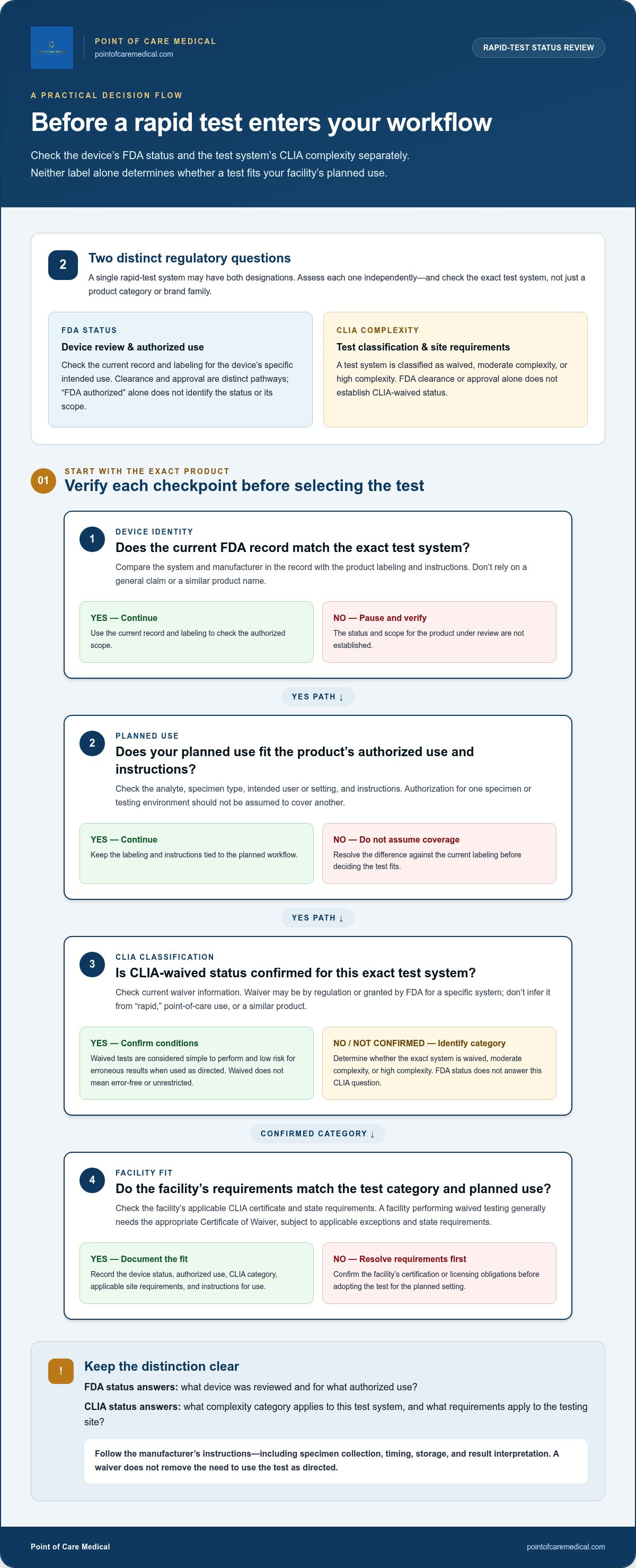
A Facility Checklist for Evaluating Rapid-Test Status and Use
Build the review around the test’s planned use, not a broad product category. For CLIA waived vs FDA cleared rapid tests, keep a record of what you verified and how it matches the facility’s workflow. This gives procurement, laboratory leadership, and testing staff a consistent basis for selection and review.
Verify the test before procurement
- Define the intended use and specimen type. Identify the condition or analyte being tested, the patient or screening context, and the specimen the facility plans to collect. Compare these details with the product’s stated intended use.
- Match the exact test system. Record the manufacturer, assay name, and relevant system identifiers. Don’t assume a decision for a similar test, product family, or specimen applies to the system under review.
- Check current FDA status and CLIA complexity. Consult the current FDA record and applicable CLIA status information. Note whether the test is cleared, approved, or otherwise authorized as applicable, and whether its complexity is waived, moderate, or high.
- Review the complete labeling. Read the current instructions for use, including specimen collection, operator and setting limits, storage conditions, test procedure, limitations, and result interpretation. Confirm that the facility’s proposed use fits those instructions.
- Confirm facility obligations. Determine which CLIA certificate applies to the testing activity and review state-specific laboratory requirements. Requirements can depend on the test category and location, so include the facility’s compliance lead in the review where appropriate.
- Document the verification. Save the records and labeling reviewed, the source of each status check, and the date of review. Revisit the documentation if the test system, labeling, or intended use changes.
This process complements the broader Selecting Compliant Diagnostic Tests for Your Facility guide: start with the clinical use, then confirm product identity and site requirements before adding the test to a workflow.
Prepare the testing workflow
Regulatory review is only one part of implementation. Assign staff responsibilities and training in line with the test instructions. Plan how the facility will manage storage, required quality practices, result documentation, and escalation when a result is invalid, unexpected, or needs further clinical review. Follow the specific assay instructions and facility protocols rather than applying one procedure to every test type.
For operational planning, connect these steps with the principles in Establishing Audit-Ready Point-of-Care Testing Protocols. Keep applicable instructions and workflow records accessible to staff, and establish who reviews them when procedures change.
Once the review is complete, align procurement with the test system and documentation that fit your facility’s intended use. Explore rapid testing supplies for healthcare facilities from Point of Care Medical, a national distributor serving healthcare and screening facilities.
Putting Compliant Rapid-Test Procurement Into Practice
Sound procurement connects a test’s regulatory status with its intended use, the facility’s workflow, and ongoing supply planning. A product that appears suitable by category still needs a product-specific review. Keep the decision grounded in the exact test system and the work the facility plans to perform.
Align product documentation with facility needs
Use the facility checklist to define the assay type, specimen, setting, and workflow before comparing products. Then match those requirements to the product’s current labeling and regulatory records. Don’t assume every product in a category, or every test under one brand, has the same FDA status, CLIA complexity, or permitted use.
Keep product-specific documentation with procurement records. Include the instructions for use, the status information reviewed, and a record of when the review took place. This gives procurement, laboratory leadership, and testing staff a shared reference if questions arise or the facility later reviews its selection. For CLIA waived vs FDA cleared rapid tests, the purchasing record should make clear which designation applies to the exact system and which requirements govern the facility’s planned use.
Connect documentation to the operational decision. For example, a respiratory test and a toxicology screening test may involve different intended uses, specimens, labeling, and result workflows. Evaluate each against its own product records rather than relying on a general description of rapid testing.
Source rapid diagnostic supplies for ongoing use
After selecting a test, incorporate it into routine supply planning. Estimate demand based on the facility’s testing activity, coordinate replenishment with procurement procedures, and ensure staff can identify the approved system when supplies arrive. Keep product identity aligned across purchasing records, instructions, and the test used at the site. If a product or its labeling changes, route it through the facility’s review process before updating the workflow.
A focused distributor catalog can help facilities source supplies across relevant testing categories without treating those categories as interchangeable. Point of Care Medical distributes rapid diagnostic testing supplies to healthcare and screening facilities across the United States, including respiratory, infectious-disease, and toxicology tests. Product-specific labeling and status still guide each selection.
For a practical next step, explore Point of Care Medical’s rapid diagnostic test supplies and align product documentation with your facility’s testing needs. A consistent review process supports documented procurement and organized replenishment.
Make Test Selection a Repeatable Process
Turn each rapid-test review into a consistent procurement step. A shared record can help clinical, laboratory, and purchasing teams work from the same product identity, intended use, and documentation. Set a clear point for review when a test system or its labeling changes, or when the facility plans to use it in a different workflow.
This process keeps CLIA waived vs FDA cleared rapid tests from becoming a one-time comparison. It gives your team a practical way to revisit product fit as testing needs evolve, without relying on a broad category label or an outdated record.
For your next procurement review, explore rapid diagnostic test supplies for healthcare facilities from Point of Care Medical. Use the catalog to find supplies for your facility’s testing needs and apply the same product-specific review process to each selection.
Frequently Asked Questions
Are CLIA-waived tests also FDA-cleared?
Not necessarily, because CLIA waiver and FDA clearance are separate designations. Many test systems receive an FDA clearance or approval before obtaining a waiver, while some may be waived by regulation. Don’t infer a test’s FDA status from its waived classification. For a test under consideration, compare its exact name and manufacturer with current FDA records and waiver information. That product-level check helps avoid relying on a broad category claim.
What is the difference between FDA-cleared and FDA-approved tests?
FDA clearance and approval refer to different regulatory pathways. In a common 510(k) review, FDA determines whether a device is substantially equivalent to a legally marketed predicate. Approval follows a separate review pathway for certain devices. These terms shouldn’t be used interchangeably in purchasing records or staff materials. If a supplier or package uses a broad phrase such as “FDA authorized,” check the current FDA record to identify the specific status and its scope.
Can a clinic use a rapid test without a CLIA certificate?
Usually, a clinic that performs testing on patient specimens needs the appropriate CLIA certificate, even if the test is waived. A waived test does not, by itself, remove the site’s certification obligations. Exceptions may apply to specific testing activities or under state arrangements, so determine how the facility is classified before testing begins. Also review state laboratory requirements, which may apply in addition to federal CLIA rules.
Does CLIA-waived mean a rapid test is error-proof?
No. Waived classification reflects regulatory criteria for test complexity and risk when used as directed; it doesn’t guarantee every result is correct. Collection errors, timing deviations, unsuitable specimens, or misreading results can affect performance. For example, a result read outside the time window in the instructions may not be interpretable as directed. Staff should follow the exact test procedure and use the product’s stated limitations when responding to results.
How can I verify whether a rapid test is CLIA-waived?
Search current FDA waiver information using the test system’s exact name and manufacturer, then compare the record with the product labeling. Confirm the assay and specimen match, since a similar product or another specimen type may not be covered by the same decision. Save the record and date checked with procurement files. This creates a traceable reference if the facility later reviews its test inventory or replaces a product version.
Do CLIA-waived rapid tests need quality control and staff training?
Yes, facilities should follow the specific test instructions for quality practices and prepare staff to perform and interpret the test as directed. The exact procedures can vary by system, so don’t assume one quality-control schedule applies to every waived test. Before launch, assign responsibility for training, document staff readiness according to facility policy, and make current instructions accessible where testing occurs. Revisit these materials when the product or procedure changes.
Are rapid screening test results always definitive?
No. A screening result should be interpreted according to the test’s labeling and the facility’s clinical protocol. Depending on the assay and context, a result may call for additional evaluation or follow-up; requirements aren’t identical across drug-screening and infectious-disease tests. For example, use the instructions for the specific assay to determine how to handle a result that is invalid or needs further review. Don’t apply one follow-up rule to every rapid test.


