

A negative rapid flu result doesn’t always mean influenza is absent. An influenza A B rapid test kit can help identify influenza A, influenza B, or both, depending on the assay. Results should be interpreted alongside symptoms and clinical judgment. This matters when a care team decides how to use a result, whether to pursue further evaluation, or whether another clinical pathway is appropriate.
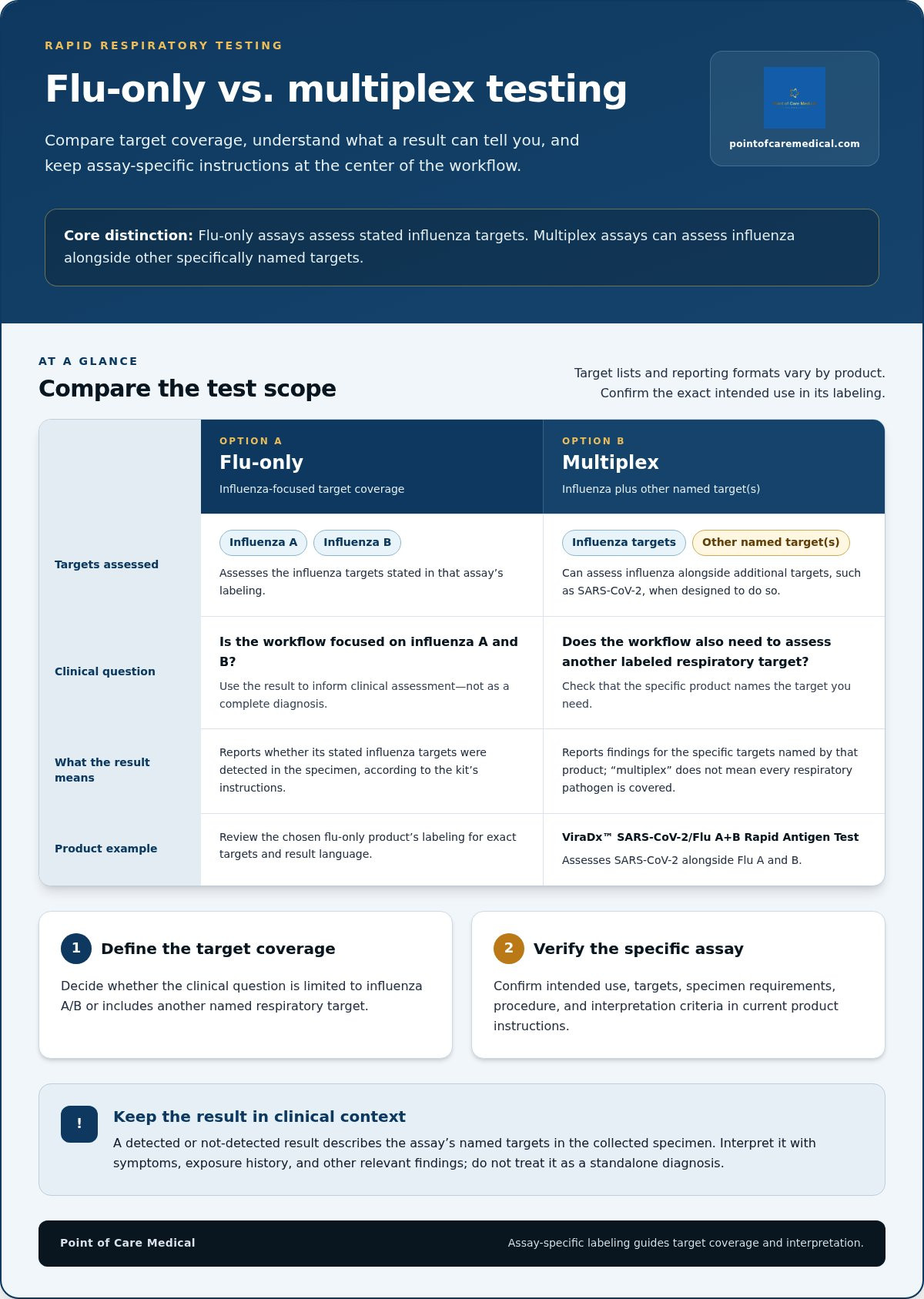
A rapid test is useful only when it fits the clinical question and is used as directed. Its intended use, specimen requirements, collection method, and result criteria are specific to the assay. A flu-only test also differs from a multiplex respiratory test, which can assess additional targets, such as SARS-CoV-2, when the product is designed to do so.
This guide explains how rapid influenza A/B tests work, what positive, negative, and invalid results can tell you, and where test limitations matter. It also covers practical details to review before implementation, including intended use, specimen requirements, result interpretation, and facility procedures. The aim is to help teams build a consistent testing workflow without treating a result as a substitute for clinical assessment.
Key Takeaways
- Use an influenza A B rapid test kit according to its intended use and current package instructions, not as a standalone diagnosis.
- Match specimen collection and test procedures to the specific assay to support consistent implementation.
- Use the kit’s own result language when documenting positive, negative, or invalid outcomes.
- Build a repeatable workflow for assay selection, staff preparation, documentation, and result communication.
- Compare flu-only and multiplex options by target coverage and operational fit. The ViraDx™ test assesses SARS-CoV-2 alongside Flu A and B.
What an influenza A B rapid test kit detects, and what it does not
Featured-snippet definition: An influenza A/B rapid test is an assay designed to detect stated influenza A and influenza B targets in a collected specimen. It reports whether those targets were detected under the test’s instructions. On its own, it does not establish a complete clinical diagnosis.
A result adds information for clinical assessment, but it should be considered with symptoms, exposure history, and other relevant findings. The assay’s scope is specific: an influenza A/B result should not be taken to identify every influenza subtype or strain. Check the product labeling for its exact intended use, targets, and reporting language.
What do influenza A and B test results identify?
A result communicates whether the test detected the influenza targets named in its labeling. Some products report influenza A and B separately, while reporting formats vary across kits. Use the terms printed in the product instructions rather than assuming every assay presents findings in the same way.
Rapid influenza diagnostic tests commonly use immunoassays to detect viral antigens. The overview of the Rapid influenza diagnostic test describes this general approach. It does not replace product labeling, which defines a specific test’s targets, specimen, procedure, and interpretation. A detected target is information relevant to clinical assessment, not a standalone determination of a patient’s condition.
How is an influenza-only test different from a multiplex test?
An influenza-only assay is designed to assess its stated influenza A and B targets. A multiplex respiratory assay can assess influenza alongside other named targets, such as SARS-CoV-2. The target list is product-specific, so “multiplex” does not mean a test covers every respiratory pathogen. Review the instructions to confirm the targets and intended use.
For facilities considering combined testing, the SARS-CoV-2 and flu combo testing guide explains how combination testing differs from flu-only testing. Point of Care Medical’s catalog includes the ViraDx™ SARS-CoV-2/Flu A+B Rapid Antigen Test. Use its product labeling to guide assay-specific decisions, including specimen requirements and result interpretation.
Start by identifying the clinical question: Does the workflow focus on influenza A/B, or does it also need to assess another labeled respiratory target? Defining the target coverage helps teams choose a testing pathway without drawing conclusions beyond what the assay reports.
How influenza A/B rapid antigen testing works in practice
Rapid antigen testing looks for influenza-related viral proteins in a patient specimen. The test reagents interact with the targeted antigens, and the assay indicates whether its stated targets are detected. The method and visible result format depend on the product. This general description is not a substitute for the kit’s package insert.
Product instructions govern specimen handling, timing, and result reading. Follow the current manufacturer instructions and facility procedures for each assay. Don’t transfer steps from one kit to another, even if both test for influenza A and B.
Why specimen collection and handling matter
Use only the specimen type and collection process specified for the selected kit. Flu tests may use different specimen approaches; the MedlinePlus Flu (Influenza) Test overview describes examples, including nasal and nasopharyngeal samples. That general information is not a collection protocol for a specific product.
Collection or handling that departs from the assay instructions can affect whether a specimen is suitable for testing and how reliably its result can be interpreted. Before testing begins, confirm the required collection materials, how the specimen should be prepared or transferred, and any stated handling conditions. Follow the kit’s directions rather than relying on a familiar technique from another assay.
What happens between applying a specimen and reading a result?
The sequence varies by kit, but a typical workflow has three stages:
- Prepare the specimen: Use the specified collection method and complete any required preparation steps.
- Apply it to the assay: Transfer the specimen as directed, using the materials supplied or identified in the instructions.
- Observe and interpret: Read the result at the stated time and apply the product’s interpretation criteria.
Some tests use a visual signal, but its appearance and meaning are product-specific. Materials, timing, and reading criteria can differ. Verify every step against the current manufacturer instructions before use and include those steps in staff training.
For an influenza A B rapid test kit, operational readiness depends on the exact assay, not just its target names. Point of Care Medical’s respiratory testing supplies include the ViraDx™ SARS-CoV-2/Flu A+B Rapid Antigen Test. Review respiratory testing supplies as you plan a workflow that follows product labeling and facility procedures.
How to interpret influenza A/B rapid test results and limitations
Interpret each result using the wording and criteria in that assay’s current instructions. A positive or negative result describes whether the test detected its stated targets in the specimen. It does not, by itself, answer every clinical question. Symptoms, timing, exposure context, specimen quality, and the assay’s stated performance all inform how a result should be used.
Interpret results according to product labeling and the patient’s clinical context.
What can a positive or negative result indicate?
A positive result generally indicates detection of a target identified by the test, such as influenza A or influenza B, as defined in its labeling. A negative result means the assay did not detect its target in that specimen under the test conditions. It doesn’t automatically rule out influenza. The significance of a negative result can depend on when testing occurs, specimen collection and quality, and the specific assay’s performance.
Consider the full clinical picture. For example, a negative result in a patient with compatible symptoms and relevant exposure may call for a different response than the same result when clinical suspicion is low. Follow facility protocols to determine whether further evaluation or another testing approach is appropriate. Don’t apply performance claims from one influenza A B rapid test kit to another. Use product-specific evidence and instructions.
What should a facility do with an invalid or unexpected result?
An invalid result does not provide an interpretable positive or negative finding. An unexpected result may also need review, especially if it conflicts with the clinical presentation or another relevant finding. In either case, pause interpretation and follow the kit instructions and established facility procedures.
Use this table as a general framework, not a substitute for the assay’s exact result terms. Product labels may use different wording or define outcomes differently.
| Outcome | General meaning | Practical response |
|---|---|---|
| Positive | A stated influenza target was detected according to the assay criteria. | Interpret with symptoms and clinical judgment; follow facility procedures. |
| Negative | The assay did not detect a stated target in the specimen. | Do not treat as an automatic rule-out; consider the clinical context and protocol. |
| Invalid | The result did not meet the assay’s criteria for interpretation. | Follow product instructions and facility procedures for next steps. |
Whether to repeat testing, pursue additional evaluation, or take another action depends on product labeling and clinical judgment. Don’t use a universal retest interval or assume every invalid or unexpected result requires the same follow-up. Record and communicate the outcome using the assay’s defined language.
How healthcare facilities can build a reliable influenza rapid-testing workflow
A consistent workflow links assay selection with staff readiness, supply controls, documentation, and result communication. Set the process before testing begins, then align each step with current product instructions and facility procedures. Use this framework to organize implementation while accounting for differences in intended use and test requirements.
- Select the assay. Match the test to the facility’s clinical question and workflow. Review its intended use and target coverage. For an influenza A B rapid test kit, confirm what it detects and how results are reported in the current product labeling.
- Review product and compliance details. Check the specified specimen, collection materials, storage conditions, required controls, and procedure in the current labeling. Verify the specific product’s CLIA categorization and regulatory details before making compliance claims or incorporating it into facility policy.
- Prepare staff. Train personnel on the assay instructions, facility procedures, documentation expectations, and how to handle results that cannot be interpreted. Keep training materials aligned with the current product instructions.
- Set up supply controls. Track inventory by product and lot, monitor expiration dates, and define how staff flag replenishment needs. Store kits under the manufacturer’s stated conditions. The bulk medical test kits B2B guide offers additional procurement context for facilities planning test supplies.
- Perform and document testing. Follow the kit procedure and facility protocol for each test. Record required workflow details and results through the facility’s established documentation process, using the product’s defined result language.
- Communicate results. Use the facility’s process to route results to the appropriate clinical personnel and document communication as required by policy. Keep test findings within the assay’s stated scope and applicable clinical context.
Review the workflow when product instructions, facility procedures, or operational needs change. A periodic review can uncover practical gaps, such as outdated directions, stock nearing expiration, or unclear responsibility for communicating results. Keep the current instructions accessible where testing takes place and make inventory ownership explicit.
Point of Care Medical distributes rapid diagnostic supplies for healthcare and screening facilities, including the ViraDx™ SARS-CoV-2/Flu A+B Rapid Antigen Test. Explore rapid diagnostic testing supplies as part of your facility’s assay and workflow planning.
When a multiplex flu A/B test may fit, and how to review the option
The right assay depends on the clinical question, its intended use, and its fit with the facility’s workflow. An influenza-only assay focuses on its stated influenza targets. A multiplex assay can assess influenza A and B alongside other targets, such as SARS-CoV-2, when those targets are included in the product labeling. Broader target coverage may suit a workflow that needs to assess more than one respiratory pathogen, but it does not replace clinical judgment.
What should facilities compare across influenza A/B test kits?
Compare products using the same operational checklist. A product name alone does not establish that two kits use the same specimen, procedure, or reporting format. Review current labeling for each option, then assess whether its requirements fit staff preparation and facility procedures.
- Intended use and target coverage: Confirm the stated purpose of the assay and which influenza or other respiratory targets it assesses.
- Specimen and procedure: Identify the labeled specimen type, collection requirements, materials, and test steps.
- Interpretation: Review how the product defines positive, negative, and invalid results and how findings should be documented.
- Operational fit: Consider storage conditions, controls, staff training, and how results will move through the facility’s workflow.
Use current product instructions rather than assuming specifications carry across assays. This comparison helps teams evaluate an influenza A B rapid test kit based on its actual role in practice, not just its target names.
Where can a SARS-CoV-2 and flu A/B assay fit?
A multiplex assay may suit a workflow where assessing influenza and SARS-CoV-2 together is relevant to the clinical question. Its labeled targets, specimen requirements, procedure, and interpretation criteria define how it can be used. For additional context on combined testing, see this multiplex testing overview.
Point of Care Medical’s respiratory testing supplies include the ViraDx™ SARS-CoV-2/Flu A+B Rapid Antigen Test for facilities considering these combined targets. Review its current product labeling and align its requirements with your facility’s workflow before implementation.
Include Point of Care Medical’s respiratory testing supplies in your assay planning for combined respiratory testing.
Build a testing pathway your team can use with confidence
An influenza A B rapid test kit can support timely clinical decisions, but its result must be interpreted within the assay’s stated scope and the patient’s clinical context. A negative result does not automatically rule out infection. Symptoms, specimen collection, and facility protocols all matter.
Reliable implementation starts with current product instructions. Confirm the intended use, targets, specimen requirements, procedure, and result criteria. Prepare staff, maintain inventory controls, and define how results will be documented and communicated. If a multiplex assay fits the clinical question, review its additional targets and workflow requirements rather than assuming all combination tests operate the same way.
Point of Care Medical distributes rapid diagnostic supplies nationally to healthcare and screening facilities. Its respiratory testing catalog includes the ViraDx™ SARS-CoV-2/Flu A+B Rapid Antigen Test for facilities assessing influenza alongside SARS-CoV-2. Explore Point of Care Medical respiratory testing supplies to plan your testing pathway.
With clear procedures and assay-specific training, your team can make testing a consistent part of its clinical workflow.
Frequently Asked Questions
What does an influenza A/B rapid test kit detect?
An influenza A/B rapid test kit detects the targets stated in its product labeling and reports whether influenza A, influenza B, or both were detected. Exact targets and result formats vary by product. Check the current instructions for use to confirm the assay’s intended use, specimen type, and interpretation criteria. A result can support clinical assessment, but it does not replace professional judgment or establish a diagnosis on its own.
How accurate are influenza A/B rapid tests?
Performance varies by assay, specimen, collection quality, and testing circumstances. Review the current product labeling for that specific test’s sensitivity and specificity rather than applying one accuracy figure to every kit. A negative result may not exclude influenza in every clinical situation. Interpret findings alongside symptoms, relevant history, and facility protocols. If results and the clinical picture do not align, follow product instructions and facility procedures for additional evaluation.
Can a rapid flu test distinguish influenza A from influenza B?
Some influenza A/B assays report separate findings for influenza A and influenza B, but reporting formats can differ. Check the specific kit’s instructions to confirm which targets it detects and how results appear. Don’t assume that identifying influenza A or B also identifies a subtype or strain. Use only interpretations supported by the product labeling, and consider results within the broader clinical assessment.
What does a negative influenza A/B rapid test result mean?
A negative result means the assay did not detect its stated target in the tested specimen under the test conditions. It does not always rule out influenza. Interpretation may depend on specimen quality, timing, and clinical context. If the result does not fit the patient’s presentation, follow the kit instructions and facility procedures for next steps. A negative finding is not a substitute for clinical judgment.
What should staff do if an influenza rapid test result is invalid?
Staff should follow the kit’s current instructions for handling an invalid result, including any specified control checks or repeat-testing steps. Don’t report an invalid result as positive or negative. Document the outcome and follow facility policy for next steps. Procedures differ by assay, so use the instructions for the specific product rather than applying a general retesting interval or assuming the same response is appropriate for every kit.
Can one rapid test kit detect influenza and COVID-19?
Yes, some multiplex respiratory assays are designed to detect influenza A, influenza B, and SARS-CoV-2. Other kits assess only influenza targets. Review the product labeling to confirm exact targets, intended use, specimen requirements, and interpretation. Multiplex tests do not all use the same procedure or performance criteria. Point of Care Medical’s catalog includes the ViraDx™ SARS-CoV-2/Flu A+B Rapid Antigen Test.
What should a clinic review before introducing an influenza A/B test kit?
Review the assay’s intended use, specimen requirements, procedure, storage conditions, controls, and result interpretation. Confirm the test’s current regulatory and CLIA details using product-specific information before making compliance claims. Then align staff training, documentation, inventory tracking, and result communication with facility policies. Use current labeling rather than assuming requirements are shared across assays. This review helps determine whether the test fits the clinical question and operational workflow.


