

A suitable test can still create an unsuitable workflow. Selecting diagnostic test kits for screening facilities starts with the screening goal, intended population, and setting, not just the product label. Facilities also need to plan for staff capacity, participant flow, and what happens after a result.
A test may fit the screening need but prove difficult to use if its steps, instructions, documentation, or supply requirements don’t fit daily operations. Assess workflow fit from the outset, alongside the test’s intended use.
This practical 2026 readiness checklist helps you define the need before choosing a test and prepare a consistent process for staff and participants. It covers intended use and population, collection and testing steps, patient flow, records, supplies, and follow-up. It also explains how respiratory, infectious disease, and toxicology priorities shape test selection. Use the checklist to organize decisions, spot operational gaps, and build a dependable screening program.
Key Takeaways
- Define who you’re screening, why, where, and by whom before comparing diagnostic test kits for screening facilities.
- Match each kit’s intended use and format to the screening question, setting, and staff workflow.
- Plan roles, space, supplies, participant flow, and result handling before launch.
- Use facility procedures and kit instructions to guide privacy, infection control, and safe disposal.
- Schedule routine checks for inventory, expiration dates, storage, staff readiness, and complete records.
Diagnostic Test Kits for Screening Facilities: Start With the Screening Need
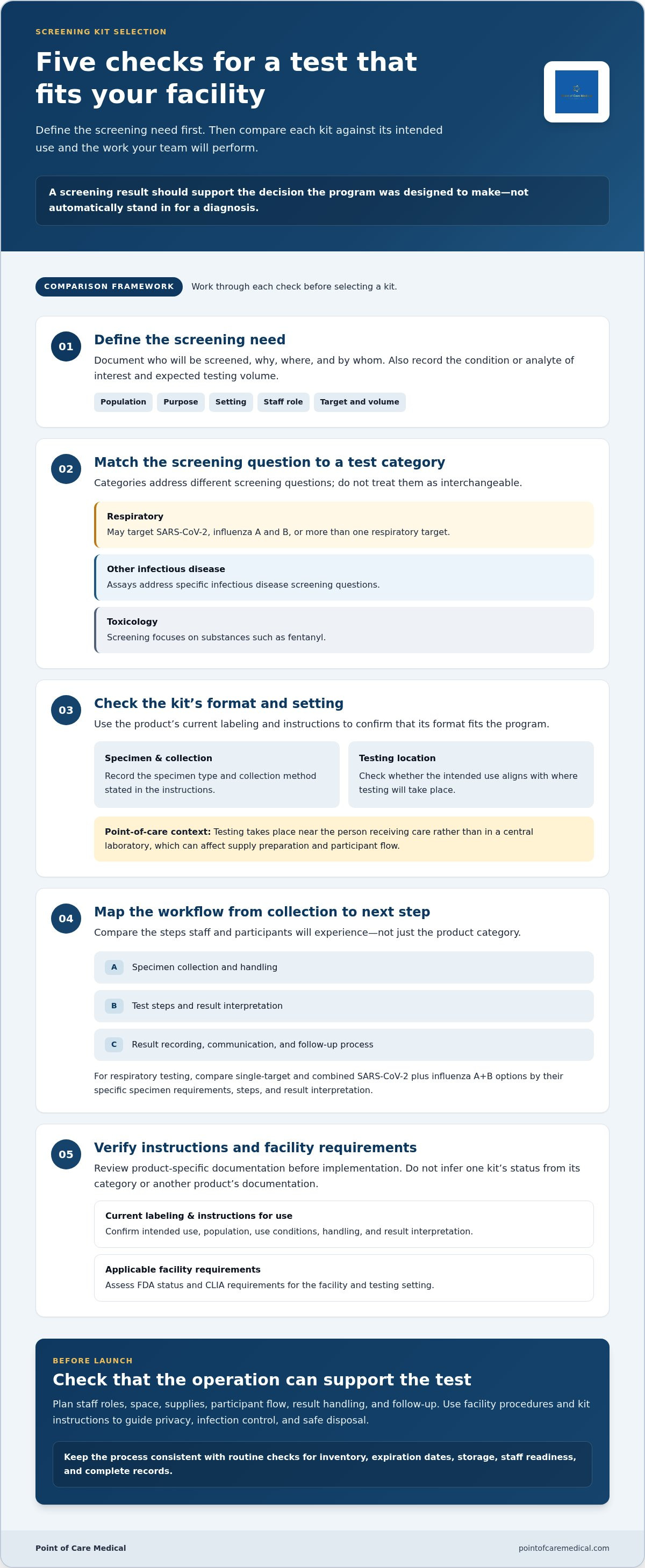
Before comparing kits, document four basics: who will be screened, why, where, and by whom. Also note the condition or analyte of interest and expected testing volume. Together, these details define the use case before product format or supply planning narrows the options.
Screening and diagnosis serve different purposes. Screening identifies people who may need further assessment or another defined response. A diagnostic decision evaluates an individual’s health status in a clinical context. A screening result should support the decision the program was designed to make, not automatically stand in for a diagnosis. Screening is an intended-use-specific process that matches a test, population, setting, and next step, not a one-kit-fits-all solution.
Define the population, setting, and screening objective
Start by recording the program context. Patient-care screening, community outreach, workplace programs, and other facility settings can differ in participant needs, staff roles, privacy expectations, and result handling. Don’t assume one protocol will fit every setting or population. Clarify who is eligible, who will administer or oversee testing, and whether participants may need help understanding the process.
Next, state what a result is intended to support, such as a referral, a follow-up conversation, or a program-level response. Record expected testing volume and where testing will happen, such as a clinical room or designated community space. These details help the team judge whether staffing and the setting can support the test steps consistently.
Match the question to a test category
Choose a category that addresses the screening question. Respiratory tests target conditions such as SARS-CoV-2 or influenza. Infectious disease assays address other specific conditions, while toxicology screening focuses on substances such as fentanyl. These categories aren’t interchangeable. A facility may have distinct objectives and workflows for each, even when testing takes place in the same location.
Review the test’s current labeling and instructions for its intended use, population, specimen requirements, setting, and result interpretation. Use those instructions to decide whether a kit fits the program. For respiratory planning, point-of-care testing describes testing performed near the person receiving care rather than in a central laboratory. That can affect where staff prepare supplies and manage participant flow.
For facilities considering a combined respiratory screening question, the SARS-CoV-2 Flu Rapid Antigen Test: How Combo Testing Works article explains the general role of combo testing. The specific kit’s intended use and instructions still determine whether it fits.
Before selecting diagnostic test kits for screening facilities, record the target, population, setting, volume, staff role, and decision supported by the result. This gives the team a practical basis for comparing options and planning the workflow.
Check Test Type, Intended Use, and Workflow Fit Before Choosing Kits
Once the screening question is defined, compare candidate kits against the work staff will perform. A familiar format or broad product category doesn’t prove that a test fits the facility’s population, setting, or intended use. Evaluate practical requirements separately from claims about accuracy or clinical performance.
Use this comparison framework:
- Screening target: Identify the condition or analyte the program needs to address.
- Format: Record the specimen type and collection method stated in the product instructions.
- Setting: Note where testing will take place and whether the kit’s intended use aligns with that setting.
- Workflow needs: Map staff steps, participant flow, result recording, and any follow-up process.
- Instruction review: Check current labeling and instructions for use, including handling and result interpretation.
Compare screening categories without treating them as interchangeable
Respiratory tests may target SARS-CoV-2, influenza A and B, or more than one respiratory target. A combined test and a single-target test can have different instructions and steps, so don’t assume their workflows are identical. Infectious disease assays address other specific screening questions, while toxicology tests focus on substances such as fentanyl. Review each category against its own intended use and workflow.
When comparing respiratory tests, identify whether the program needs a single target or a combined SARS-CoV-2 and influenza A+B test. Then compare the specific specimen requirements, test steps, and result interpretation in each kit’s current instructions. This makes the comparison relevant to the facility’s actual screening question.
Review labeling, instructions, and facility requirements
Intended use and current product instructions should guide every kit comparison, because they define the test’s purpose, use conditions, and result interpretation. Review product-specific labeling before implementation. Assess the applicable FDA status and CLIA requirements for the facility and testing setting. Don’t infer a kit’s regulatory status from its category or from another product’s documentation.
Then check whether the documented process fits staff capacity and participant flow. Account for specimen collection, handling, timing, result recording, and how staff will communicate next steps under facility procedures. The CDC Guidance for Rapid Testing in Point-of-Care Settings provides relevant guidance for point-of-care testing considerations.
Keep operational fit separate from clinical-performance claims. A format that appears convenient doesn’t establish suitability or performance. Use product-specific labeling and applicable requirements for those judgments. This comparison helps facilities select diagnostic test kits for screening facilities based on the actual screening question and the steps staff can carry out consistently. Point of Care Medical’s rapid diagnostic test kit options include respiratory, infectious disease, and toxicology categories for distinct screening needs.
Assess Staff, Space, Supplies, and Result Handling Before Launch
A screening process needs more than a selected kit. Before launch, map each task from participant arrival through result documentation and follow-up. This makes handoffs visible and helps staff find gaps before participant flow increases. Keep the process aligned with facility policy and the kit’s current instructions.
Before screening begins, assign responsibility for staffing, the testing area, supplies, participant flow, result review, documentation, communication, and escalation. Use the sequence below to turn those responsibilities into a working plan.
- Assign staff roles. Name who prepares the area, checks supplies, explains the process, performs each testing step, documents results, and communicates next steps. Identify who reviews results and who serves as the escalation contact under established facility protocols. Make handoffs clear, including coverage when the usual staff member is unavailable.
- Prepare the space. Choose an area that supports the activity and the facility’s privacy and infection-control procedures. Plan where participants will wait, receive instructions, complete test steps, and leave without disrupting other operations. Where appropriate under facility policy, set aside a clearly identified space for supplies and documentation.
- Stage supplies and instructions. Before a session, compare available kits and related supplies with planned testing volume. Keep current product instructions accessible to staff performing the steps. Assign someone to check that supplies are organized and that storage, handling, and disposal follow facility policy and kit instructions. Don’t rely on memory for product-specific steps.
- Map participant flow. Write down the path from check-in to completion. Decide who gives instructions, how staff protect participant privacy, and how the testing area will be reset between participants under facility infection-control procedures. A simple flow map can expose bottlenecks, unclear handoffs, or points where conversations may be overheard.
- Define result handling. Specify who records and reviews each result, where documentation belongs, and how results are communicated under approved facility procedures. Document the escalation route for results or situations that require follow-up. Interpret results within the test’s intended use and applicable clinical protocols. A screening result alone shouldn’t be treated as a diagnosis or treatment decision.
Confirm the process before participants arrive
Walk through the sequence with the staff who will carry it out. Use the kit instructions to review the testing steps, and confirm that each person knows their role, where supplies are kept, and how to route questions or results. A brief practice run can reveal practical issues, such as missing documentation materials or unclear transitions between testing and result communication.
Keep the assigned workflow available to staff in the testing area. If facility procedures or kit instructions change, update the process and brief affected team members before testing resumes. This gives staff a consistent operating reference without replacing product instructions or established clinical protocols. Clear roles and handoffs help facilities use diagnostic test kits for screening facilities in a controlled, repeatable process.
Use This Ongoing Checklist to Keep Screening Operations Consistent
A launch checklist helps establish a process. Recurring reviews help keep it workable as inventory changes, staff rotate, and screening needs shift. Assign an owner for each review and record the date, findings, and corrective actions. Set the review cadence based on usage and operational needs rather than adopting a schedule that may not fit the facility.
Maintain kit readiness and supply visibility
Keep a current view of stock on hand, expiration dates, storage conditions, and lot documentation. Assign responsibility for checking each item and flagging supplies that need attention. Follow the storage and handling instructions for each product. Requirements can vary between kits, so don’t apply one product’s instructions to another.
- Inventory: Compare on-hand quantities with recent use and upcoming screening plans.
- Expiration and lot records: Review dates and maintain the documentation required by facility procedures.
- Storage: Check that products are stored according to their current instructions.
- Instructions: Confirm that staff can access current product instructions and any facility-approved guidance.
- Supply interruptions: Identify who monitors supply levels, who reports a potential shortfall, and how the facility will adjust or pause screening under its procedures.
Use purchasing records and usage patterns to inform replenishment planning. For a broader procurement framework, the Bulk Medical Test Kits B2B: A Practical Buying Guide for 2026 can help facilities connect purchasing decisions with screening requirements. Tie supply planning to the categories in use, such as respiratory, infectious disease, or toxicology tests, rather than treating all kits as interchangeable.
Review consistency and update the screening process
Review completed records and reported workflow issues at the facility-defined interval. Look for recurring gaps, such as missing documentation, unclear handoffs, or steps staff find difficult to follow. Participant feedback can also reveal avoidable confusion in instructions or movement through the screening area. Record observations consistently so the team can distinguish a one-time issue from a pattern that calls for a process update.
- Confirm staff readiness and whether required guidance remains accessible.
- Record workflow deviations and the corrective action taken.
- Check documentation for completeness under facility procedures.
- Review participant feedback for recurring process barriers.
- Update staff guidance when product instructions, facility policies, or screening objectives change.
Maintain a version-controlled checklist with an owner, review date, and clear indication of the current approved version. Remove outdated copies from routine use to reduce uncertainty. These controls help teams keep diagnostic test kits for screening facilities organized and support consistent operations as program needs evolve.
For screening supplies that support distinct facility needs, review Point of Care Medical’s diagnostic test kit options.
Choose a Diagnostic Test Kit Program That Fits Your Facility
A screening program is ready to proceed when its purpose, kit, staff, workflow, and review process align. Use a final go/no-go check before implementation. A gap in any one area can leave staff uncertain about how to carry out the process or what to do with a result.
- Goal defined: The facility has documented the screening objective, population, setting, and decision the result is intended to support.
- Kit matched: The selected test’s intended use and current instructions align with the screening question and setting.
- Staff prepared: Team members know their roles, the testing steps, and the established route for result review and escalation.
- Workflow ready: The facility has planned participant flow, supplies, documentation, privacy, and handling procedures.
- Ongoing checks assigned: A designated owner will review inventory, instructions, records, and process consistency on a facility-defined cadence.
If an item remains unresolved, address it before proceeding. A defined screening goal without a workable staffing plan, for example, may not support a consistent process. A kit category alone also doesn’t establish that a specific product fits the facility. Review its intended use and instructions alongside facility procedures.
Map facility needs to relevant test categories
Match the product category to the question the program is designed to address. Respiratory testing examples include the GenBody COVID-19 Rapid Antigen Test and ViraDx™ SARS-CoV-2/Flu A+B Rapid Antigen Test. For an infectious disease screening program, the SURE CHECK HIV 1/2 Assay is a relevant example. Toxicology programs may consider the Rapid Test Cup “RTC” + Fentanyl and oral fluid tests. Review each product’s instructions and intended use before implementation.
These categories address distinct screening needs. Don’t treat a respiratory test, an infectious disease assay, and a toxicology test as substitutes, or assume they share the same steps. Use the product’s labeling and instructions to confirm its intended use, then align the facility’s process with approved procedures.
Turn the checklist into a practical next step
Document the screening objective, intended setting, operational requirements, and responsibilities in one program record. Keep current product instructions accessible to the staff who perform testing, and review applicable facility procedures before use. This record gives staff and administrators a shared reference as the program begins and makes future reviews more straightforward.
Point of Care Medical distributes rapid diagnostic test kits and screening supplies for healthcare and screening facilities, including respiratory, infectious disease, and toxicology categories. Explore diagnostic test kits for your facility’s screening needs as you plan a program that fits your intended use and workflow.
Make Your Screening Plan Ready for the Next Step
Turn your checklist into a working document your team can use and maintain. Record who owns each part of the program, where staff can find current instructions, and how the facility will review changes in screening needs. A clear reference helps new and existing team members follow the same approved process.
As your plans develop, match the supply strategy to the screening categories your facility intends to support. Point of Care Medical distributes diagnostic test kits and screening supplies to healthcare and screening organizations nationwide, with options across respiratory, infectious disease, and toxicology testing. Explore diagnostic test kits for screening facilities to identify options relevant to your program.
Preparedness is an ongoing operational practice, not a one-time purchasing decision. Keep your plan current as staffing, participant flow, and screening priorities change. With a defined process and suitable supply plan, your facility can move forward with greater confidence.
Frequently Asked Questions
Are diagnostic screening tests the same as diagnostic tests?
No. A screening test identifies people who may need further evaluation, while a diagnostic test is used to assess a suspected condition in a clinical context. The distinction affects how staff explain a result and what action follows. For example, a screening program might refer a participant for additional assessment rather than treat a screening result as a final clinical determination. Follow the test’s intended use and facility protocols.
Can one rapid test kit screen for several conditions?
Yes, some kits are designed to detect more than one target, but use them only for the targets and purposes specified in their current instructions. A respiratory combo test may address SARS-CoV-2 and influenza A+B, for example. That doesn’t mean every multi-target kit uses the same specimen process, interpretation, or workflow. Review product labeling and plan staff training around the specific kit.
Can a screening test result confirm a diagnosis?
Not by itself in every screening context. Interpret a result according to the test’s intended use and the facility’s clinical protocols. If a result requires additional assessment or follow-up, route it through the facility’s established process. Staff should avoid describing a screening result as a diagnosis unless that use is supported by the product instructions and applicable clinical procedures.
How should facilities handle an invalid rapid test result?
Follow the product instructions for an invalid result, since the response can vary by test. Don’t report an invalid result as positive or negative. Record the outcome according to facility procedures, then follow the specified steps for repeat testing or other follow-up. If the instructions don’t resolve the situation, route it to the designated supervisor or clinical lead before communicating a final result.
Can the same test kit be used in every facility setting?
No. A kit’s intended use, instructions, and applicable requirements determine whether it fits a particular setting. A process suitable for a staffed clinical area may not translate directly to a workplace or community screening site. Before implementation, check that the setting, personnel, specimen handling, and result process align with the specific product instructions and facility procedures. Don’t assume a kit’s use in one program authorizes the same use elsewhere.
What should a facility do with expired diagnostic test kits?
Don’t use an expired kit unless current product instructions or applicable guidance explicitly support its use. Separate expired stock from supplies approved for screening so staff can’t select it by mistake. Record the affected product and lot as required by facility procedures, then follow those procedures and the manufacturer’s instructions for disposal or other disposition. Review inventory controls to identify why the kit remained in active stock.
What records should a screening facility maintain?
Maintain records required by applicable procedures and facility policy. A useful operational record may capture the test name, lot and expiration details, date of use, operator, result, and any invalid result or workflow deviation. Document follow-up or escalation as appropriate, while protecting participant information under facility privacy practices. Keep inventory checks, staff training records, and current procedure versions organized so the program can be reviewed and maintained consistently.


