

Could one rapid test help identify which respiratory viruses may be causing symptoms without settling the diagnosis on its own? A SARS-CoV-2 flu rapid antigen test is designed to detect antigens from SARS-CoV-2 and influenza A and B. This combined view can support timely screening, but results still need to be interpreted in clinical context.
For healthcare and screening teams, a clear answer can help guide next steps when symptoms overlap. A negative antigen result doesn’t always exclude infection, and a positive result doesn’t replace clinical judgment. This article explains what combo testing can detect, how to interpret positive, negative, and invalid results, and how to apply product instructions and facility protocols consistently.
It also covers where rapid antigen testing can fit into a workflow, including when follow-up testing may be appropriate. Point of Care Medical supplies the ViraDx™ SARS-CoV-2/Flu A+B Rapid Antigen Test. Use its current labeling for test-specific details, and treat results as one part of the broader assessment.
Key Takeaways
- A SARS-CoV-2 flu rapid antigen test is designed to detect the viral antigens named in its labeling. The exact targets and intended use are product-specific.
- Follow the test’s instructions for specimen collection, handling, and result timing. Standardized steps help staff use the test consistently.
- Compare combined testing with separate or additional tests based on the testing question and facility workflow. Each approach has interpretation limits.
- Interpret positive, negative, and invalid results according to target-specific instructions and clinical protocols. A rapid result is not a diagnosis on its own.
- Build testing into a clear facility process that covers staff training, storage, quality procedures, documentation, and communication.
What Does a SARS-CoV-2 Flu Rapid Antigen Test Detect?
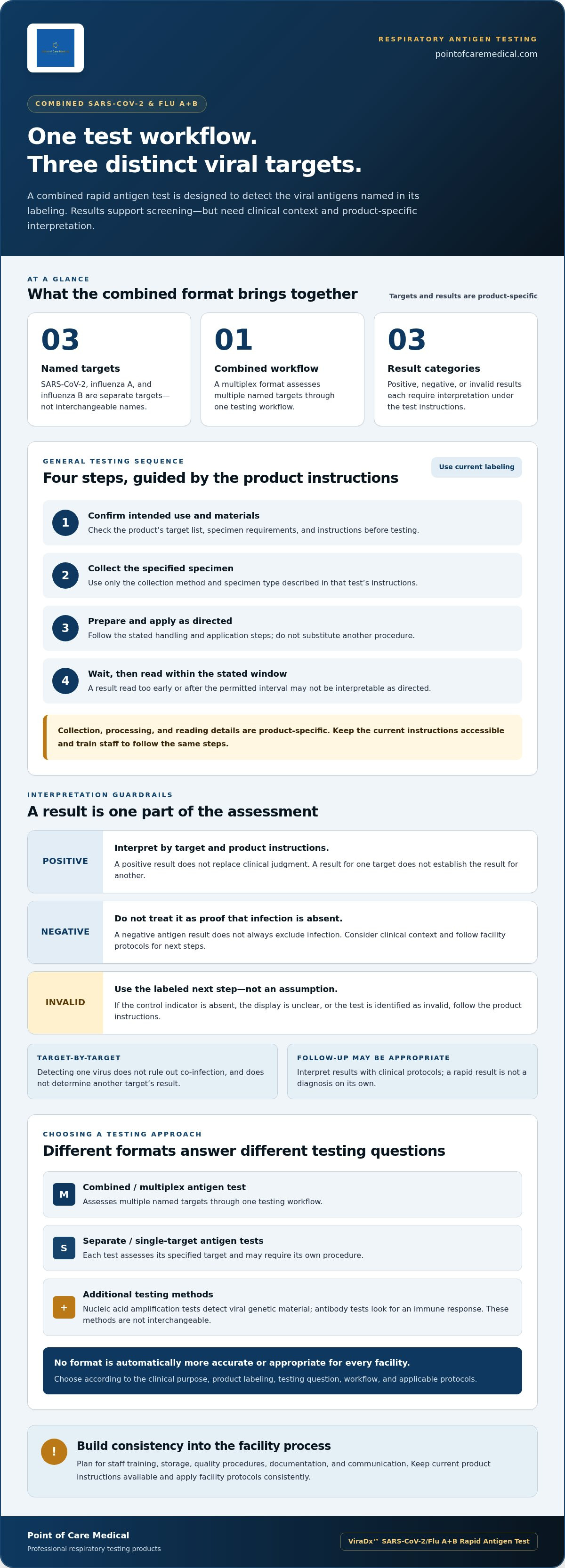
A SARS-CoV-2 flu rapid antigen test is designed to detect specific viral antigens in a collected specimen. Antigens are components of a virus that the test is designed to recognize. In a combined assay, the named targets may include SARS-CoV-2, influenza A, and influenza B. The specific targets, intended use, and result interpretation depend on the product’s current instructions for use.
Concise definition: A combined SARS-CoV-2 and influenza A/B rapid antigen test detects the viral antigens specified in its labeling. Its intended use is product-specific.
What do SARS-CoV-2, influenza A, and influenza B mean on a test label?
SARS-CoV-2 is the virus that causes COVID-19. Influenza A and influenza B are separate types of influenza virus that cause seasonal flu. These are distinct targets, not interchangeable names for one infection. For an overview of the antigen-testing approach for SARS-CoV-2, see COVID-19 rapid antigen tests.
A combined assay reports results for the targets named in its instructions. Depending on the product, it may report separate results for SARS-CoV-2, flu A, and flu B. A result for one target doesn’t establish the result for another, and detecting one virus doesn’t rule out a co-infection. Before using a test, confirm its target list, specimen requirements, and interpretation directions in the product labeling.
How is a combined antigen test different from a single-target test?
A multiplex format assesses multiple named targets through one test workflow. A single-target test is designed to assess one specified target. A combined format can provide information about several targets in one testing episode, while separate tests may require their own procedures. Neither format is automatically more accurate or appropriate for every facility. Choose based on the clinical purpose, workflow, product labeling, and applicable protocols.
Antigen tests look for viral components. Other testing approaches assess different analytes. For example, nucleic acid amplification tests detect viral genetic material, while antibody tests look for an immune response. These methods answer different testing questions and shouldn’t be treated as interchangeable. The assay type and intended use determine what a result can support.
For healthcare and screening facilities, check the target names and intended-use statements before adding a test to a protocol. Point of Care Medical supplies the ViraDx™ SARS-CoV-2/Flu A+B Rapid Antigen Test as one professional-use product example. Use its current labeling for test-specific details.
How Does a Combined COVID-19 and Flu Antigen Test Work?
A combined antigen test follows a product-specific process, but the general sequence is straightforward: collect a specimen, prepare and apply it as directed, allow the test to run, then read the target results within the stated time window. The test is designed to detect specified viral antigens. The exact procedure and interpretation depend on the product’s current instructions for use.
Quotable distinction: Antigen tests share a general mechanism of detecting specified viral components, but collection, processing, and result-reading steps are specific to each product.
What happens during collection and testing?
Start by confirming the test’s intended use and gathering the required materials. Collect the specimen using the method described in the instructions, then handle and apply it as directed. Don’t substitute a different specimen type or collection approach. For a SARS-CoV-2 flu rapid antigen test, the product labeling determines which targets are assessed and how to perform the test.
Collection and handling matter because the assay is evaluated for use with specified specimens and procedures. A collection error, incorrect preparation, or departure from the instructions can affect whether the test produces a valid, interpretable result. Keep the instructions accessible at the testing station, and train staff to follow the same steps. Don’t infer specimen type or processing details from another test, even if its format appears similar.
Why do timing and instructions matter when reading results?
After preparing the test, follow the product’s stated wait and read times. Read results only within the specified window. A result viewed too early or after the permitted interval may not be interpretable as directed. CDC resources describe different influenza testing approaches. Review CDC guidance on flu testing alongside the product instructions and facility protocols.
Some tests include a control indicator to help show whether the procedure worked as intended. Treat it as a validity check only as described in that test’s labeling. If an expected control indicator is absent, a result is unclear, or the test is identified as invalid, follow the instructions for the required next step. Don’t interpret an unclear display by assumption.
For a consistent facility workflow, document the product and procedure used, and make sure staff can access the current instructions for use. Point of Care Medical supplies professional respiratory testing products, including the ViraDx™ SARS-CoV-2/Flu A+B Rapid Antigen Test. Product information is available with Point of Care Medical respiratory testing products.
Combined Antigen Testing vs. Separate or Additional Tests
A combined antigen test assesses several named targets in one testing workflow. Separate antigen tests assess their specified targets through individual tests, while additional testing may use a different method, such as a molecular assay. The right approach depends on the testing question, facility workflow, product instructions, and clinical protocols. A SARS-CoV-2 flu rapid antigen test can provide a shared workflow for its labeled targets, but it isn’t automatically the best fit for every situation.
| Approach | Targets and workflow | Interpretation limits |
|---|---|---|
| Combined antigen test | Assesses multiple named targets through one product-specific workflow. | Results apply only to the targets and intended use in the current labeling. A negative result doesn’t always rule out infection. |
| Separate antigen tests | Uses individual tests for one or more specified targets, with separate procedures as directed. | Each result must be interpreted under that test’s own instructions. A result for one target doesn’t answer another target’s question. |
| Additional testing | May use another testing method to assess a target, based on the clinical question and applicable protocols. | Methods assess different analytes and have their own intended uses and limitations. Follow current guidance and qualified clinical judgment. |
When can a combined test support an efficient workflow?
A combined format may be operationally useful when SARS-CoV-2 and influenza A and B are all relevant to the testing question. It can provide target-specific results through one product workflow rather than requiring staff to manage separate antigen test procedures. That can simplify workflow design, but it doesn’t by itself establish faster care, better outcomes, or lower costs. Confirm that the product’s instructions fit the facility’s use case. The FDA’s Interpreting Combo Test Results document illustrates why procedures and result interpretation must follow a specific test’s instructions.
When might additional testing be considered?
A rapid negative result isn’t a universal rule-out. Symptoms, exposure history, timing, patient circumstances, and the reason for testing can all affect what a result means and whether another test is appropriate. Qualified clinical decision-makers should make that decision using current guidance and the test’s labeling. Don’t assume every negative result requires confirmation, or that a positive result for one virus excludes another.
Interpret every result in context and under current clinical guidance. A test result informs assessment; it doesn’t replace it. Facilities should define how staff escalate questions about discordant findings, ongoing symptoms, or a result that doesn’t fit the clinical picture.
How to Interpret Positive, Negative, and Invalid Results
Read each result according to the test’s current instructions for use. A result describes what the assay detected for a particular target under its labeled conditions. It isn’t a diagnosis on its own, and it doesn’t establish illness severity, infectiousness, or treatment needs. For a SARS-CoV-2 flu rapid antigen test, keep the SARS-CoV-2, influenza A, and influenza B results distinct when the product reports them separately.
What does a positive result mean for each target?
A positive result indicates detection of the specified target according to that assay’s labeling. For example, a positive influenza A result refers to the influenza A target, not automatically to SARS-CoV-2 or influenza B. Record each reported target separately, using the product’s terms and the facility’s documentation process. If the result display or instructions are unclear, don’t infer a result. Follow the product-specific directions and facility procedure.
Clinical professionals consider test findings alongside symptoms, history, and other relevant information. Staff should communicate what the test reports without extending that finding into a conclusion about cause, severity, or next steps. Those decisions belong to qualified clinical decision-makers using current guidance and applicable protocols.
What should staff understand about negative or invalid results?
A negative result means the assay did not detect the target under the conditions of that test. It may not exclude infection in every circumstance. Interpret the result in light of the testing question, timing, and the assay’s labeled use. A negative result for one target also doesn’t establish a negative result for other targets unless the test reports those results individually.
An invalid result means the test did not produce an interpretable result according to its instructions. Follow the specific product directions for the required action. Don’t record an invalid result as negative, and don’t rely on a missing or unclear indicator. If the instructions call for a new test, follow the stated procedure and facility protocol.
For follow-up decisions, use current FDA and CDC guidance alongside the test’s labeling. Facility protocols should identify who reviews results that are inconsistent with the clinical picture and how staff communicate that uncertainty. This keeps reporting consistent while leaving diagnosis and care decisions with qualified clinical professionals.
Facilities evaluating a combined respiratory antigen test can review the ViraDx™ SARS-CoV-2/Flu A+B Rapid Antigen Test and its current instructions for use.
Using a SARS-CoV-2/Flu A+B Test in a Clinical Workflow
A reliable testing workflow starts before specimen collection. Define the facility’s testing purpose, assign responsibility for each step, and match the test’s labeled targets and intended use to that purpose. Incorporate a SARS-CoV-2 flu rapid antigen test according to its current product instructions and applicable facility requirements, not assumptions based on a different assay.
What should a facility standardize before testing?
Train staff on the current instructions for use and establish a consistent process for handling specimens, performing the test, recording results, and communicating findings. Include a clear procedure for unclear or invalid results, so staff know when to pause and what action the product instructions specify. Keep documentation aligned with facility protocols.
Before use, review the product documentation for storage conditions, expiration dates, intended use, and current regulatory status. Follow stated storage requirements and quality procedures. Keep the relevant instructions accessible at the testing location, and update staff procedures when product documentation changes.
- Before testing: Confirm the test is appropriate for the facility’s purpose and check storage and expiration information.
- During testing: Follow the current instructions consistently, including the specified collection, handling, and reading procedures.
- After testing: Record target-specific results and follow the facility’s process for communicating findings and addressing invalid results.
How can facilities evaluate a combined test for their workflow?
Assess whether the test’s labeled targets match the questions staff need to address. Then consider practical factors such as staff training, how results will be documented and communicated, storage procedures, and supply continuity. These steps help facilities evaluate operational fit without assuming a combined format suits every testing situation.
Point of Care Medical supplies rapid diagnostic tests to healthcare and screening facilities, including the ViraDx™ SARS-CoV-2/Flu A+B Rapid Antigen Test. Review its current product documentation to assess its intended use, procedures, and fit within facility protocols. Apply the same review process used for any test: align the product’s labeling with the facility’s needs, and ensure staff have access to current instructions.
For facilities reviewing respiratory testing options, review respiratory rapid testing supplies.
Put Combo Testing Into a Clear Clinical Workflow
A SARS-CoV-2 flu rapid antigen test can assess the viral targets named in its labeling through a combined workflow. Its results still require careful interpretation: a negative result doesn’t always exclude infection, and positive, negative, or invalid findings should be handled according to current instructions and facility protocols.
For consistent use, match the test’s intended use to the facility’s needs, train staff on product-specific procedures, and standardize documentation and result communication. These steps help teams use rapid testing as one part of a broader clinical assessment, not as a stand-alone diagnosis.
Point of Care Medical distributes respiratory rapid diagnostic tests to healthcare and screening facilities, including the ViraDx™ SARS-CoV-2/Flu A+B Rapid Antigen Test. The respiratory rapid testing supplies page provides product information. Clear procedures and current product instructions help teams incorporate combo testing into their workflow.
Frequently Asked Questions
Can one rapid antigen test detect COVID-19 and flu at the same time?
Yes. A combined antigen test is designed to assess multiple specified targets using one product-specific testing workflow. A COVID-19 and flu combo assay may include targets for SARS-CoV-2, influenza A, and influenza B. Check the current product labeling to confirm which targets it reports and how to interpret each result. A combined format doesn’t mean the viruses are interchangeable or that every product tests for the same targets.
How accurate are combined COVID-19 and flu antigen tests?
Accuracy depends on the specific test and its labeled use. Performance can vary with the target, specimen, collection and handling, and timing of testing. Don’t apply one product’s performance claims to another or treat a general accuracy figure as universal. Review the current instructions and supporting product documentation. Clinical professionals should interpret results with relevant patient information and current guidance, particularly when a result doesn’t fit the clinical picture.
What does a negative SARS-CoV-2 and flu antigen test mean?
A negative result means the assay didn’t detect the specified target under the test’s conditions. It doesn’t always exclude infection. Interpretation may depend on factors such as symptoms, exposure, testing timing, and proper specimen collection. Read each target’s result separately when the product reports them individually. If clinical concerns remain, qualified clinical decision-makers should consider current guidance and the product’s instructions when determining appropriate next steps.
What should staff do if a combined rapid antigen test is invalid?
Staff should follow the specific product instructions for an invalid result. Don’t record it as negative or infer a result from an unclear display. Check the instructions for the required next step, which may include repeating the procedure with a new test. Document the invalid outcome according to facility protocol and use the established process for communicating it. Staff training should cover how to recognize and handle invalid results before testing begins.
Is a rapid antigen test the same as a PCR test?
No. Rapid antigen tests detect specified viral components, while PCR is a type of nucleic acid amplification test that detects viral genetic material. These methods assess different analytes and have different procedures and limitations. They aren’t automatically interchangeable. The appropriate method depends on the testing purpose, product labeling, clinical context, and applicable protocols. Follow current guidance and qualified clinical judgment when deciding whether additional testing is appropriate.
Can a positive result identify whether someone has COVID-19 or flu?
A positive result can indicate which target the assay detected when the test reports SARS-CoV-2, influenza A, and influenza B separately. Read and document each target-specific result according to the current instructions. A positive finding alone doesn’t establish illness severity, infectiousness, or treatment needs. It also doesn’t rule out detection of another virus. Clinical professionals interpret results alongside patient information and relevant guidance.
For respiratory rapid testing supplies, explore Point of Care Medical’s product options for healthcare and screening facilities.


