

The largest test-kit order isn’t always the most reliable one. For organizations sourcing bulk medical test kits B2B, start with intended use and testing workflow, not unit volume. A respiratory screening program, an HIV testing service, and a toxicology program each have different product and documentation considerations.
Price and quantity matter, especially when several programs share a purchasing process. But ordering before aligning test category, staff workflow, storage needs, and product-specific documentation can lead to mismatched supplies or difficult replenishment. A clear buying framework helps procurement teams plan consistently.
This guide explains how to match rapid test categories to organizational use cases, estimate quantities across programs, and build a repeatable ordering and replenishment process. It also covers what to review in product labeling, intended use, regulatory status, and supporting documentation. Point of Care Medical distributes rapid diagnostic testing supplies nationally, including respiratory, infectious disease, and toxicology categories. Use this framework to organize your requirements and source relevant supplies through a practical B2B purchasing process.
Key Takeaways
- Set the testing program’s purpose and workflow before deciding how many kits to order.
- Match each assay and specimen type to its current product labeling and intended use.
- Keep respiratory, infectious disease, and toxicology requirements distinct when comparing categories.
- Assign inventory ownership and document reorder triggers to make replenishment more consistent.
- Build a practical bulk medical test kits B2B plan around your organization’s needs.
Bulk medical test kits B2B: Start with the facility’s testing needs
A large order can still be the wrong order. Buying in bulk doesn’t establish whether a kit fits the testing purpose, setting, specimen collection process, or staff workflow. First define the program the supplies will support, then match the product and order plan to that program.
For a B2B buyer, bulk medical test-kit procurement means planning and purchasing supplies in quantities that support an organization’s programs and replenishment cycle. Keep these planning inputs distinct:
- Purpose: Clinical care, screening, treatment services, or workplace programs.
- Location: Where samples are collected and tests are performed.
- Expected volume: Anticipated use by program, site, and ordering period.
- Workflow: Who administers tests, handles results, and determines next steps.
Clarify whether testing happens at or near the patient. The overview of Point-of-care testing (POCT) explains this setting and helps distinguish point-of-care workflows from other testing arrangements.
Which testing program will the kits support?
Define the category before comparing products. Respiratory testing, such as COVID-19 or combined SARS-CoV-2 and influenza testing, serves a different purpose from infectious disease testing such as HIV assays, or toxicology screening. These categories are not interchangeable. Point of Care Medical distributes products in these areas, including respiratory tests, the SURE CHECK HIV 1/2 Assay, and toxicology supplies.
For each program, document who administers the test, where it will be used, and how results inform care, screening, or program decisions. These details shape the workflow and help procurement teams avoid ordering by category name alone.
How should a facility estimate demand?
Estimate demand separately for each program and location. Review planned testing activity and the ordering period, then account for predictable changes such as respiratory seasons or scheduled workplace screening. Avoid applying one facility-wide quantity to programs with different schedules or usage patterns.
Use actual consumption to refine the estimate. Record what each site receives and uses, note changes in program activity, and compare those records with remaining stock during regular inventory reviews. This gives the procurement team a practical basis for adjusting orders without relying on unsupported fixed benchmarks.
How to evaluate bulk medical test kits before placing an order
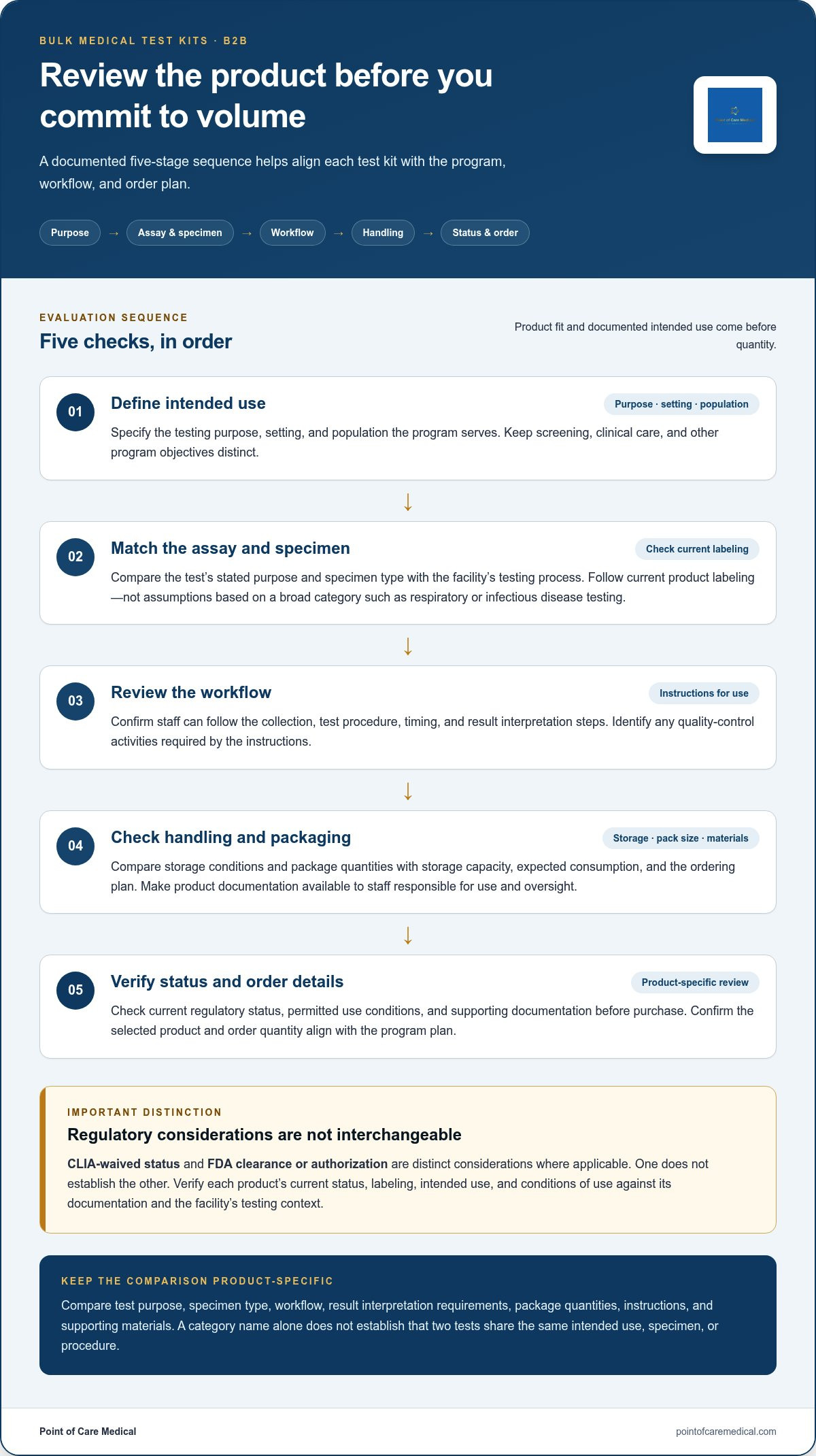
Use a documented evaluation sequence before committing to volume. Bulk purchasing should follow product fit and documented intended use, not the assumption that a larger order makes a kit appropriate. For bulk medical test kits B2B, assess each product against the facility’s actual program and workflow.
- Define intended use. Specify the testing purpose, setting, and population the program serves. Keep screening, clinical care, and other program objectives distinct.
- Match the assay and specimen. Compare the test’s stated purpose and specimen type with the facility’s testing process. Follow current product labeling rather than assumptions based on a broad category, such as respiratory or infectious disease testing.
- Review the workflow. Read the current instructions for use. Confirm that staff can follow the collection, test procedure, timing, and result interpretation steps, and identify any quality-control activities the instructions require.
- Check handling and packaging. Compare storage conditions and package quantities with the facility’s storage capacity, expected consumption, and ordering plan. Make product documentation available to staff responsible for use and oversight.
- Verify status and order details. Check current, product-specific regulatory status, permitted use conditions, and supporting documentation before purchase. Confirm that the selected product and order quantity align with the program plan.
Which product details should buyers compare?
Compare test purpose, specimen type, workflow, and result interpretation requirements side by side. Review package quantities, instructions, and supporting materials relevant to the facility. Use current manufacturer documentation for each assay. A product category alone does not establish that two tests share the same intended use, specimen, or procedure.
How do compliance and intended use affect selection?
CLIA-waived status and FDA clearance or authorization are distinct regulatory considerations where applicable. One does not establish the other. Verify each product’s current status, labeling, intended use, and conditions of use against its documentation and the facility’s testing context. The World Health Organization’s overview of essential in vitro diagnostics provides broader context on the role of diagnostics in healthcare systems. For a U.S. procurement perspective, see this clinical regulatory compliance guide.
Apply the same review to every test category instead of carrying assumptions from one program to another. Point of Care Medical distributes rapid diagnostic testing supplies across respiratory, infectious disease, and toxicology categories. Reviewing its rapid diagnostic testing supplies can help procurement teams relate product categories to documented program requirements.
Compare bulk test-kit categories by application and workflow
Category is a useful starting point, not a substitute for assay-specific review. For bulk medical test kits B2B, compare each option by program context, who performs the test, and how results are used. The table provides a planning framework, not a determination of a product’s intended use. Consult current labeling for assay-specific details before selecting or ordering.
| Category | Typical setting | Workflow focus | Procurement consideration |
|---|---|---|---|
| Respiratory rapid tests | Respiratory testing programs in clinical or screening settings | Check collection steps, test procedure, and result interpretation in the current instructions. | Confirm the assay and intended use fit the program. Distinguish single-target and combination assay requirements. |
| Infectious disease tests | Programs addressing a specific infectious disease testing need | Plan for the people administering tests and the process for handling results. | Verify assay-specific labeling, specimen type, and applicable use conditions. |
| Toxicology tests | Programs that include toxicology screening | Review the product’s collection and use instructions, plus how results are interpreted within the program. | Match the specific product and specimen type to documented program needs. |
Respiratory and infectious disease rapid tests
Point of Care Medical’s respiratory offerings include the GenBody COVID-19 Rapid Antigen Test and the ViraDx SARS-CoV-2/Flu A+B Rapid Antigen Test, a combination assay. Their names identify different test targets, not interchangeable workflows. Compare current labeling and instructions before assigning quantities. For focused purchasing considerations, see the COVID-19 rapid test wholesale procurement guide.
Infectious disease testing also requires product-specific review. Keep the SURE CHECK HIV 1/2 Assay in a separate procurement line from respiratory tests. Use its current documentation to establish applicable specimen, intended use, and workflow details instead of inferring them from the category.
Toxicology and other screening tests
The Rapid Test Cup “RTC” + Fentanyl is a toxicology offering. Oral fluid tests are another category to evaluate according to their own labeling and workflow. Keep both distinct from infectious disease assays, including the SURE CHECK HIV 1/2 Assay. For category-specific purchasing context, read the rapid test cup with fentanyl buyer’s guide.
For U.S. facilities, the CDC explains CLIA test complexity categories. Review the applicable status and requirements for each product and setting. Point of Care Medical’s rapid testing supplies provide a starting point for organizing category needs across programs.
Plan ordering, inventory, and replenishment for bulk test kits
A repeatable inventory process helps facilities align orders with testing activity and product requirements. For bulk medical test kits B2B, document each program separately, assign an inventory owner, and use actual consumption to guide replenishment rather than relying on a single facility-wide estimate.
What belongs in a bulk procurement plan?
Maintain a record for each product and testing program. Include the intended use, site, planned quantity, storage needs, responsible team, and relevant product documentation. Separate recurring demand from seasonal or one-time programs so temporary activity doesn’t become the default order quantity.
Set a review cadence that fits facility usage and product requirements. At each review, reconcile stock on hand with orders, usage, and planned testing activity. Track expiration dates, storage conditions, lot information, and current product documentation so staff can identify available supplies and handle them appropriately.
How can organizations reduce stock disruption?
Use the same sequence for each ordering cycle. Assign an owner for every program or site, and document reorder triggers based on observed consumption and facility needs. A trigger should prompt a review, not an automatic order. First check remaining stock, expiration dates, and planned demand.
- Forecast: Estimate upcoming use by site and program. Distinguish routine activity from seasonal or one-time demand.
- Order: Match the quantity and product to the program’s documented requirements and current product information.
- Receive: Record the products and quantities received, along with lot details and expiration dates. Capture storage and documentation requirements for staff.
- Review: Compare actual consumption with the forecast, assess approaching expirations, and update reorder triggers as program activity changes.
Consistent purchasing records make it easier to identify shifts in demand between locations or testing programs. They also support deliberate order adjustments instead of repeating a previous quantity without review.
As you organize product needs across programs, review Point of Care Medical’s rapid testing supplies.
Source bulk medical test kits through Point of Care Medical
A defensible purchasing decision connects a program’s intended use to the assay, required documentation, and ordering workflow. For bulk medical test kits B2B, select products by documented fit, then plan quantities and replenishment around how each program operates. Responsible bulk purchasing starts with product fit and ends with workflow readiness.
Point of Care Medical distributes rapid diagnostic testing supplies nationally across the United States for medical professionals and organizations. Its categories include respiratory, infectious disease, and toxicology testing supplies. Review each category against your facility’s program requirements rather than treating a broad product grouping as a substitute for product-specific review.
Which Point of Care Medical offerings fit this procurement scope?
- Respiratory: GenBody COVID-19 Rapid Antigen Test and ViraDx™ SARS-CoV-2/Flu A+B Rapid Antigen Test.
- Infectious disease: SURE CHECK HIV 1/2 Assay.
- Toxicology: Rapid Test Cup "RTC" + Fentanyl.
- Additional category: Oral Fluid tests. Review their current product documentation to determine fit for the specific program.
These offerings address distinct procurement needs. A respiratory assay should not be substituted for an infectious disease or toxicology test based on bulk availability or a shared point-of-care setting. For each product, current labeling and manufacturer documentation govern intended use and use conditions. Review those materials alongside facility procedures before assigning products to a program or planning an order.
What is the next step for a B2B buyer?
Bring your program requirements into the catalog review. Identify the testing category, intended use, testing site, staff workflow, and documentation your team needs to assess. Then align those requirements with the appropriate product category and build the order and replenishment plan around actual program activity. This keeps product selection connected to day-to-day operations.
A clear procurement record also supports consistent decisions across sites and ordering cycles. Record why each product was selected, which program it supports, and which product documentation informs its use. Review those records as program needs change, and keep assay-specific requirements distinct across respiratory, infectious disease, and toxicology supplies.
Review bulk rapid diagnostic test options to identify relevant categories for your organization’s testing programs.
Build a More Reliable Testing Supply Plan
A dependable bulk medical test kits B2B plan starts with the facility’s testing purpose, then matches each assay to its intended use, workflow, and product documentation. Separate respiratory, infectious disease, and toxicology needs, and use consumption records and clear reorder triggers to guide replenishment.
Point of Care Medical distributes targeted rapid diagnostic testing supplies nationally across the United States. Its catalog includes respiratory, infectious disease, and toxicology categories for organizations managing distinct testing programs.
Review the relevant categories and align product options with your documented program requirements. Review bulk rapid diagnostic test options and take the next step toward a more organized purchasing process. Clear criteria and consistent inventory practices help keep purchasing aligned with operational needs.
Frequently Asked Questions
How do I choose bulk medical test kits for a healthcare facility?
Choose kits by matching each product’s current intended-use labeling to the facility’s testing program and workflow. Define the purpose, location, specimen type, administrator, and how results will be used. Then review instructions, storage conditions, documentation, and applicable regulatory status. A respiratory assay and an HIV assay serve different testing needs, so assess them separately rather than treating them as substitutes.
What should a B2B buyer verify before ordering rapid test kits in bulk?
Confirm that the assay, specimen type, intended use, and current product labeling fit the program. Review the instructions for use, result interpretation, storage conditions, quality-control directions, package quantity, and supporting documentation. Verify product-specific regulatory status and use conditions rather than relying on a general category description. Compare the proposed order with consumption and stock on hand, including expiration dates and lot records.
Are bulk rapid tests CLIA-waived or FDA-cleared?
Status depends on the specific test and its intended use. CLIA-waived status and FDA clearance or authorization are distinct considerations, so one should not be assumed from the other. Check current product labeling and relevant FDA and CLIA information for the exact assay and use conditions. Facilities should also ensure their testing processes align with the product’s applicable requirements and the facility’s testing setting.
How many medical test kits should a facility order in bulk?
Base quantities on expected use by site, program, and ordering period. Review actual consumption and account for changes such as seasonal respiratory activity or scheduled screening programs. Check usable stock, expiration dates, storage capacity, and product-specific requirements before setting an order quantity. Track use over time and document reorder triggers for each program. This creates a facility-specific forecast without relying on generic volume benchmarks.
What types of rapid diagnostic test kits can organizations buy in bulk?
Organizations can source respiratory, infectious disease, and toxicology testing supplies, along with oral fluid tests. Point of Care Medical’s offerings include the GenBody COVID-19 Rapid Antigen Test, ViraDx™ SARS-CoV-2/Flu A+B Rapid Antigen Test, SURE CHECK HIV 1/2 Assay, Rapid Test Cup "RTC" + Fentanyl, and Oral Fluid tests. Each product has its own labeling and intended use, so review those details before selecting it for a program.
How should facilities manage expiration dates and storage for bulk test kits?
Follow each product’s current labeling for storage conditions and handling. Record lot information and expiration dates when supplies are received, then review them during regular inventory checks. Organize stock so staff can identify products approaching expiration and apply the facility’s established stock rotation procedures. Keep product documentation accessible to the responsible team, and consider storage capacity and remaining shelf life when planning order quantities.
Can one distributor supply different types of rapid test kits?
Yes. Point of Care Medical distributes rapid diagnostic testing supplies nationally across the United States, with categories that include respiratory, infectious disease, and toxicology tests. Its offerings include COVID-19 and combination respiratory tests, an HIV assay, a fentanyl test cup, and oral fluid tests. A single distributor can support purchasing across these categories while each product’s intended use and requirements remain distinct.


