

Could a rapid test that detects the right condition still be the wrong fit for your facility? Yes. A test’s name or regulatory label doesn’t establish that it matches your testing purpose, setting, operators, or specimen type. FDA status and CLIA categorization also address different requirements. That’s why how to choose compliant rapid test kits starts with intended use, not the product shelf.
A test described as rapid or compliant isn’t automatically ready for your workflow. Its labeling, your facility’s CLIA requirements, and the way staff collect specimens and perform testing all need to align.
This guide offers a practical framework for evaluating that fit before you buy. You’ll learn how to compare a test’s intended use with your facility’s purpose, review regulatory and operational requirements, and organize the documentation and procedures that support consistent use. The same process can help your team assess options for respiratory, infectious disease, and toxicology screening.
Key Takeaways
- Start with the clinical or screening question your facility needs the test to answer.
- Learn how to choose compliant rapid test kits by checking the specific test’s current FDA status and labeling alongside your facility’s CLIA requirements.
- Compare options only when their intended purpose, specimen, and testing setting align.
- Use a structured review process to assess evidence, workflow, documentation, and internal approvals.
- Record the basis for your decision so clinical, laboratory, compliance, and procurement teams can support consistent use.
Start with the testing purpose before choosing a compliant rapid test kit
Compliance starts with the exact test, its intended use, and the setting where staff will use it. A kit designed for one population, specimen, or testing purpose may not fit another, even if it detects a related condition. Before comparing brands or regulatory terms, define the question your facility needs the test to answer.
Intended use is the specific purpose, population, specimen, and setting described for a test. It sets the boundaries for appropriate selection and use. Keep those boundaries visible throughout procurement. A screening test may help identify people who need further evaluation, while a test used to support diagnosis serves a different role. Don’t assume either purpose from a product category or a rapid result alone. A general overview of Rapid Diagnostic Test (RDT) types can provide context, but the specific kit’s labeling must guide facility decisions.
Define the population, setting, and testing purpose
Write a short use statement before reviewing products. Identify who will be tested, where testing will occur, and who will collect the specimen and perform the test. Specify the condition or analyte, specimen type, and point in the care or screening process. For example, assessing respiratory symptoms and conducting toxicology screening are different use cases. Products in these categories are not interchangeable, and products within a category may have different labeled uses.
Distinguish facility-based testing from over-the-counter or home use. A test intended for self-testing may have different user directions and setting assumptions from one intended for use by facility staff. Don’t infer that a kit is appropriate for professional use simply because it provides a rapid result. Match the use statement to the intended operator and environment.
Map the current workflow before reviewing products
Document what happens from specimen collection through follow-up. Note who collects and handles the specimen, where testing takes place, how results are recorded, and what steps follow a positive, negative, or invalid result. Include an escalation pathway for situations where the result alone doesn’t resolve the clinical or screening question.
Then assess the practical conditions that shape daily use: staffing, expected testing volume, operating hours, and available space. Identify when a rapid result supports a decision and when additional evaluation is needed. This workflow map can reveal mismatches early, such as a collection process that doesn’t fit the setting or a result pathway with no clear owner.
- Population: Who will be tested, and what user group does the test’s labeling describe?
- Purpose: Is the test for screening, diagnostic support, or another defined use?
- Specimen and operator: What specimen is collected, and who performs each step?
- Setting and follow-up: Where does testing occur, and how are results documented and acted on?
This needs-first record gives the team a consistent basis for how to choose compliant rapid test kits. It also prevents a familiar brand name or broad regulatory label from substituting for a fit assessment. Once the purpose and workflow are clear, evaluate a specific test’s current status and labeling against your documented needs.
Understand FDA status, CLIA categorization, and the test's labeled use
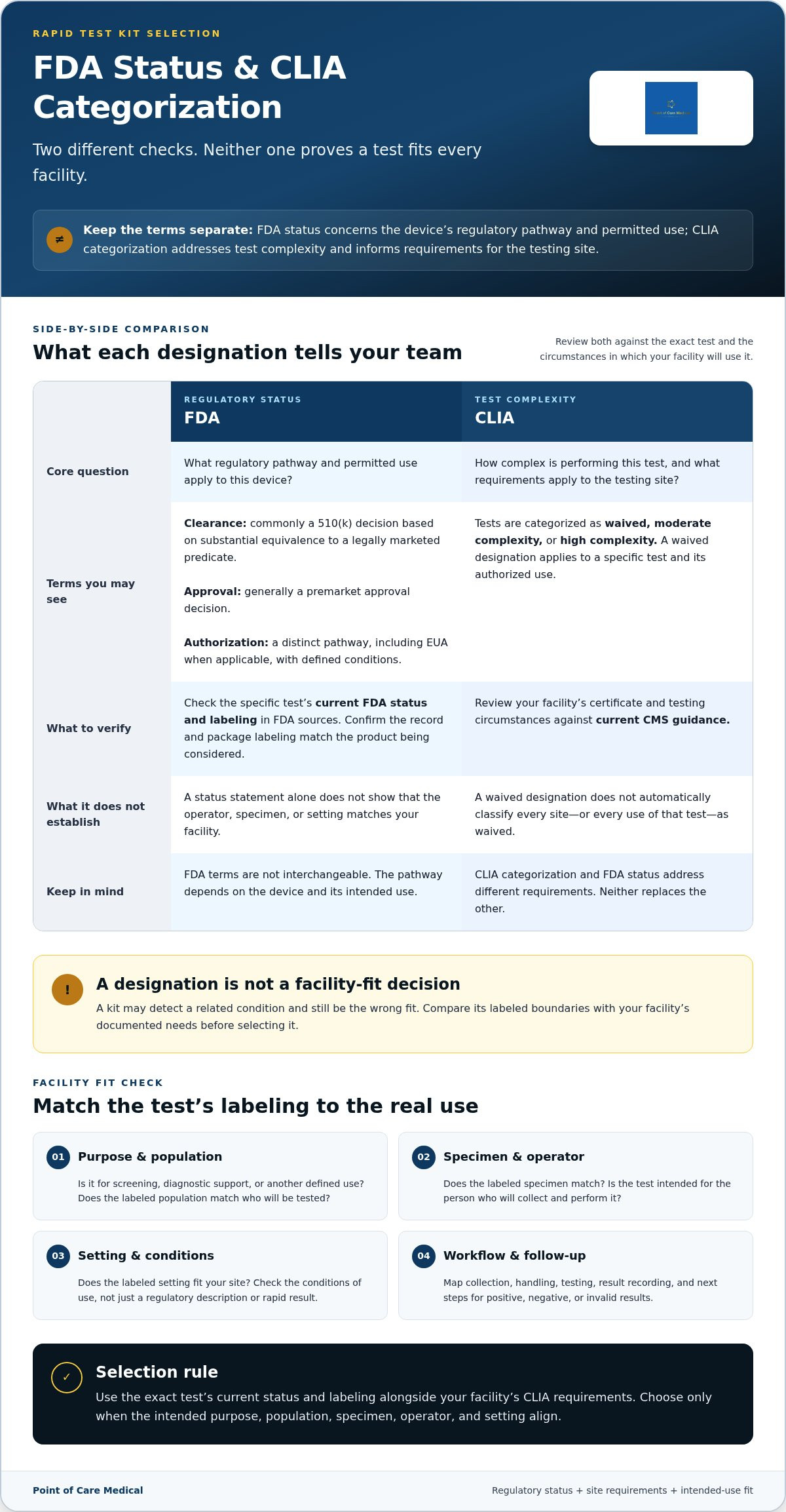
FDA status and CLIA categorization answer separate questions. FDA review concerns a device’s regulatory pathway and permitted use. CLIA categorization addresses the complexity of performing a test and informs the requirements that apply to the testing site. Neither label replaces the other, and neither establishes that a kit fits every facility workflow.
For each candidate, review the exact test name, manufacturer, current FDA record, and labeling. Compare the intended population, specimen, setting, operator, and purpose with your facility’s documented needs. A similar product name or a general claim such as “FDA compliant” isn’t enough to establish a match. This distinction is central to how to choose compliant rapid test kits for an operating site.
What FDA clearance, approval, or authorization tells a buyer
FDA terms are not interchangeable. Clearance commonly refers to a 510(k) decision that a device is substantially equivalent to a legally marketed predicate. Approval generally refers to a premarket approval decision. Authorization, including an Emergency Use Authorization when applicable, is a distinct pathway with defined conditions. The pathway depends on the device and its intended use. Verify the specific test’s current status and labeling in FDA sources before relying on a regulatory description.
Check that the record and package labeling describe the product under consideration, not a related test or a different version. Read the conditions of use closely. A status statement alone doesn’t show that the intended operator, specimen, or setting aligns with your facility. When comparing FDA-cleared and CLIA-waived language, keep the terms separate. The guide CLIA-waived versus FDA-cleared rapid tests is a useful reference point.
How CLIA categorization affects a testing site
CLIA categorizes tests as waived, moderate complexity, or high complexity. A waived designation applies to a specific test and its authorized use. It doesn’t automatically classify every site or every use of that test as waived. Facilities need to review their certificate and testing circumstances against current CMS guidance. The FDA’s overview of FDA and CLIA categorization explains the relationship between device review and complexity categorization.
Waived status also doesn’t remove the need to follow the test’s labeling and instructions, train staff appropriately, and maintain the procedures required for the facility’s testing program. Confirm the applicable certificate requirements and site responsibilities before implementation. Point of Care Medical supplies respiratory, infectious disease, and toxicology rapid testing options, including the GenBody COVID-19 Rapid Antigen Test, ViraDx™ SARS-CoV-2/Flu A+B Rapid Antigen Test, SURE CHECK HIV 1/2 Assay, and toxicology screening products. Evaluate each against its specific intended use and your facility’s requirements.
Record the evidence reviewed, the applicable FDA language, the test’s CLIA categorization, and the facility-specific requirements identified. That record gives clinical, laboratory, and compliance reviewers a shared basis for deciding whether the kit is suitable for the documented purpose and operating setting.
Compare rapid test kits by performance evidence and operational fit
After reviewing a test’s intended use and regulatory information, compare candidates against the same facility requirements. Build a matrix that keeps regulatory status, performance evidence, workflow, and supply considerations in separate columns. This prevents a positive in one area, such as convenient handling, from obscuring a mismatch in another.
Compare products only when they serve the same purpose, use the same specimen type, and are intended for a comparable testing setting. A respiratory screening test and a toxicology screening test answer different questions. Even within one category, labeled populations and specimen requirements can differ. Read performance claims in context and according to the product’s labeling. Don’t generalize them to another test or use.
Review performance information and instructions for use
For each candidate, record the labeled specimen, target population, intended setting, result interpretation, and stated limitations. Review the performance information for that specific test and note the population and conditions it applies to. Don’t treat a reported performance measure as a guarantee for every patient group or operating environment. Confirm that operators can follow the instructions as written and that result interpretation fits facility procedures.
Assess usability, capacity, and supply continuity
Map the kit’s hands-on steps, timing, equipment needs, storage conditions, and result documentation requirements against your team’s workflow. Estimate testing volume and assess whether the kit’s configuration and process fit that demand. Before standardizing a product, assign responsibility for checking lot information, expiration dates, storage, and replenishment. For point-of-care programs, CDC guidance on point-of-care testing can help teams identify relevant operational considerations.
Use a comparison table to make gaps visible. Record evidence rather than relying on impressions or marketing language.
| Criteria | Evidence to record | Facility-specific questions |
|---|---|---|
| Regulatory status and labeled use | Current FDA record, labeling, intended use, and applicable conditions | Does the documented use match this facility’s purpose, setting, operators, and specimen? |
| Performance evidence | Test-specific performance information, study population, interpretation, and limitations | Does the evidence apply to the population and circumstances in which staff will test? |
| Workflow and usability | Collection and test steps, timing, equipment, storage, and documentation needs | Can assigned staff complete and record each step within the existing process? |
| Supply factors | Kit configuration, lot and expiration tracking, storage requirements, and replenishment process | Can procurement and site teams manage supplies for expected testing volume? |
For example, a facility evaluating respiratory, infectious disease, or toxicology kits should create separate comparisons for each testing purpose. Don’t rank products across those categories as if they were substitutes. Use the matrix to identify evidence that still needs review and workflow requirements that need resolution. This gives the selection team a repeatable basis for how to choose compliant rapid test kits without letting convenience or a single performance claim dominate the decision.
Build a facility review process for compliant rapid test kit use
A repeatable review turns test selection into a controlled facility decision. Define who reviews each part, what evidence they examine, and where the final decision is recorded. Assign clinical, laboratory, compliance, and procurement reviewers according to your facility’s governance. The approval structure can vary by site, but each responsibility should have a clear owner.
Document the review in a consistent order:
- Verify the purpose. Match the proposed test’s labeled use to the facility’s intended clinical or screening purpose.
- Review status and labeling. Record the current FDA information, CLIA categorization, instructions, and applicable limitations.
- Confirm site requirements. Have the appropriate reviewer assess certificate and testing-site requirements under current guidance.
- Assess workflow. Confirm staff, specimen handling, result recording, escalation, and follow-up steps are workable.
- Prepare documentation. Align procedures, training records, and quality processes with the product instructions and facility policies.
- Approve and retain the decision. Record reviewer roles, the rationale, and the evidence used before routine implementation.
Before adopting a test, document its intended use, current status, site requirements, workflow fit, supporting procedures, and the reviewers who approved the decision. This provides a practical reference for implementation and future review. It also gives the team a clear basis for how to choose compliant rapid test kits across different testing programs.
Prepare procedures, training, and quality documentation
Write or update procedures for the specific product. Keep them consistent with the instructions for use and facility policies. Document how operators are trained, how results are recorded, and how the facility handles quality processes and result escalation. Assign responsibility for controlling procedure versions. When the product, labeling, facility process, or relevant guidance changes, route updates through the facility’s established review and approval process.
Review the kit before routine use and during ongoing operations
On receipt, confirm that the product identity and labeling match the approved selection. Record lot information and expiration details, and verify storage against the product instructions. During use, track issues, deviations from procedure, and supply changes through the facility’s existing processes. Set a review trigger when the intended use, testing site, staffing, workflow, or applicable guidance changes. Reassess the selection rather than assuming the original decision remains suitable indefinitely.
Point of Care Medical supplies rapid screening products for facility programs. Use your documented review process to evaluate each product category against its specific purpose and operating requirements.
Turn compliant test selection into a reliable procurement decision
A procurement decision should explain why a specific test fits the facility’s purpose and how the team plans to support its use. Convert the evaluation into a decision record before placing a routine order. Include the intended purpose, testing setting, current regulatory status and labeling reviewed, relevant performance evidence, workflow assessment, and assigned reviewers. Record unresolved items too, so the team can address them before adoption.
Match purchasing criteria to the test category
Apply category-specific criteria without treating rapid screening products as substitutes. For respiratory testing, compare the specific target, specimen, and labeled use. For infectious disease screening, confirm that the assay and operating process align with the facility’s stated purpose. For toxicology screening, define panel needs and how results will be handled under facility policy. Across all categories, verify that the proposed use matches the product’s current labeling and the site’s requirements.
These distinctions matter during sourcing. A respiratory test and a toxicology test serve different screening needs, while tests within one category may also differ in intended use or specimen. Use separate evaluation records whenever the clinical or screening purpose changes. For respiratory purchasing, use the appropriate COVID-19 wholesale guide alongside the facility’s test-specific review. A purchasing resource doesn’t replace regulatory verification.
Move from evaluation to a documented purchasing decision
Once reviewers reach a decision, preserve the rationale with the purchasing record. Note which evidence informed selection, how the test fits the workflow, and which clinical, laboratory, compliance, and procurement roles reviewed it. This makes the decision easier to explain during internal review and gives staff a reference when evaluating a change in product, site, or testing process.
Align purchasing quantities and replenishment plans with expected testing operations. Use anticipated volume, storage capacity, lot and expiration tracking, and supply oversight responsibilities to guide planning. Keep procurement aligned with the approved use. A change in intended purpose or setting should prompt a review rather than automatic continuation of the same ordering pattern.
A consistent record makes how to choose compliant rapid test kits a repeatable procurement method, not a one-time comparison. It connects test purpose and evidence to purchasing decisions while keeping category-specific requirements visible.
Point of Care Medical supplies respiratory, infectious disease, and toxicology screening products to healthcare and screening facilities. Review the available categories as you apply your facility’s documented criteria to each test under consideration.
Make your next purchasing decision easier to defend
A strong selection process can support more than one purchase. It gives teams a consistent standard for evaluating future testing needs, clarifies who owns each decision, and reduces uncertainty when operational requirements change. Keep the decision record accessible to the people responsible for testing and procurement, and use it as a reference when planning the next review.
Applying how to choose compliant rapid test kits as a repeatable process connects purchasing choices to the facility’s real operating needs. The goal isn’t to add complexity. It’s to make each selection clear, reviewable, and manageable for the people who support it.
Point of Care Medical distributes rapid screening supplies to healthcare and screening facilities across the United States, with categories spanning respiratory, infectious disease, and toxicology testing. Explore Point of Care Medical’s rapid diagnostic test categories as you plan your facility’s next sourcing decision.
Use the documented review process to evaluate your next order, then explore Point of Care Medical’s rapid diagnostic test categories for respiratory, infectious disease, and toxicology screening supplies.
Frequently Asked Questions
Is a CLIA-waived test automatically FDA-cleared?
No. CLIA waiver and FDA clearance describe different regulatory determinations, so one shouldn’t be inferred from the other. A test’s specific FDA status may be clearance, approval, authorization, or another status, depending on its regulatory pathway. Check the exact product’s current FDA information and labeling, then verify its CLIA categorization separately. Avoid relying on a seller’s shorthand or a similar product’s status when documenting a facility’s decision.
Can a rapid test be used outside the setting stated in its instructions?
Don’t assume that a test’s instructions cover a different setting or user group. For example, directions for home self-testing may not describe use by staff in a clinic, and facility procedures may not establish that use is appropriate. Compare the proposed use with the current labeling. If they don’t align, pause routine adoption and have the appropriate clinical and compliance reviewers assess the proposed use under applicable requirements.
How do I verify a rapid test kit's FDA status?
Start with the FDA’s current records and the manufacturer’s labeling. Match the exact product name, manufacturer, and device or submission details where available. Then read the record for the specific pathway and conditions of use, and compare these with the package instructions for the kit being considered. Don’t use a search result, product category, or status listed for a related assay as proof of the candidate kit’s status.
What should a facility document before adopting a rapid test kit?
Record the intended purpose and setting, exact product identity, current FDA status and labeling reviewed, CLIA categorization, and facility-specific testing requirements. Add the evidence supporting selection, workflow considerations, responsible reviewers, and the approval date. Include references to the procedure and training records used for implementation. Another authorized staff member should be able to understand from the file why the test was selected and what use the facility approved.
Does a rapid test result replace confirmatory testing?
Not necessarily. Whether additional testing is appropriate depends on the specific test, its labeling, the reason for testing, and the facility’s clinical or screening protocol. A screening result may guide next steps rather than establish a final diagnosis. Before use, define how staff should handle results that require further evaluation, including who makes that decision and how follow-up is documented. Don’t apply one test’s result pathway to another assay.
Can one rapid test kit be used for different specimens or testing settings?
Only if the specific test’s labeling supports the specimen and setting in question. A kit’s use with one specimen type doesn’t establish that another specimen is acceptable. Likewise, instructions for one operator group or environment shouldn’t be extended to another without review. For each proposed variation, compare the exact labeling and applicable site requirements, and document the facility’s decision before changing routine practice.
How often should a facility review its rapid test kit selection?
Set a review schedule through facility policy, and reassess sooner when a change could affect the original decision. Examples include revised product labeling, a change in test purpose or location, different operators, workflow changes, supply substitutions, or updated regulatory guidance. Keep a record of the review and its outcome, even if the facility retains the same kit. This helps teams identify when procedures, training, or procurement plans need attention.


