

A larger drug panel isn’t automatically a better fit. The right drug test cups for treatment centers match the substances a facility intends to screen, the specimen its workflow can support, and the steps staff need to complete and document each test.
Choosing a test involves more than comparing panel counts. Centers also need to understand how urine cups and oral fluid tests fit their collection procedures, whether fentanyl detection is part of the screening requirements, and how staff will handle presumptive non-negative results. This guide compares the two specimen formats, outlines practical criteria for defining facility needs, and explains the difference between screening and confirmatory testing. It also identifies the Rapid Test Cup “RTC” + Fentanyl as an option to assess against those requirements, without assuming it fits every program.
Use the comparison to build a procurement plan that connects product selection with staff procedures, documentation, result interpretation, and follow-up. Before purchasing, verify each candidate’s current instructions for use, panel composition, intended setting, and regulatory status. A clear process helps staff apply screening procedures consistently and supports a predictable workflow.
Key Takeaways
- Choose drug test cups for treatment centers by matching panel needs and specimen type to your facility’s testing workflow.
- Compare urine cups and oral fluid tests against collection procedures, staff readiness, and documented protocols rather than assuming the formats are interchangeable.
- Verify each product’s intended use, instructions, storage requirements, shelf life, and regulatory status before procurement.
- Set procedures for interpreting screening results, documenting them, and determining appropriate follow-up.
- Evaluate the Rapid Test Cup “RTC” + Fentanyl and oral fluid tests against your facility’s requirements, and confirm product details before purchasing.
What Treatment Centers Need from Drug Test Cups
An onsite drug test cup is a point-of-care tool used to screen a specimen for selected substances. It can support a facility’s testing process, but it does not provide a diagnosis or replace a broader clinical assessment. Interpret results according to the product’s instructions and facility policy, alongside other relevant information available to the care team. For foundational context on specimen types and testing methods, see this overview of the technical analysis of a biological specimen.
Connect procurement decisions to the work each test needs to support. Define which substances the program will screen for, where collection and testing fit into center-approved protocols, who handles each step, and how results are recorded. A panel that doesn’t match program requirements, or a procedure staff can’t follow consistently, can create workflow and documentation gaps. Set these requirements before comparing products.
Presumptive screening provides an initial result, while confirmatory testing uses a separate method to further evaluate a result when facility protocols call for it. Whether additional evaluation or laboratory confirmation is appropriate depends on the program’s approved procedures and the circumstances of the test.
How point-of-care drug screening fits treatment workflows
Centers may include screening in intake, ongoing monitoring, or another center-defined protocol. These are operational examples, not clinical recommendations. Map the steps from collection through result review and documentation. Identify who performs each task, where records are entered, and how staff communicate results to the appropriate team member.
Have qualified clinical leadership approve the protocol and define how screening fits into care processes. Staff should follow the product instructions for use and the facility’s procedures. Keep those instructions accessible where testing takes place, and ensure documentation reflects the process the center has approved.
What a screening result can and cannot establish
A screening result is one piece of information, not a complete clinical assessment. It reflects the test’s stated scope and must be interpreted according to its instructions and facility policy. Don’t treat a result as a stand-alone conclusion about a person’s health or care needs.
Facility protocols may call for additional evaluation or laboratory confirmation in some situations, including when a presumptive result needs further review. Define who is responsible for that decision, how the outcome is documented, and what follow-up process applies. Don’t infer performance characteristics from the format alone. Consult the assay-specific instructions and qualified clinical leadership.
Use these requirements to assess drug test cups for treatment centers in context. A clear protocol links panel selection, staff responsibilities, result handling, and records before purchasing begins.
How to Compare Drug Test Cups for Treatment Centers
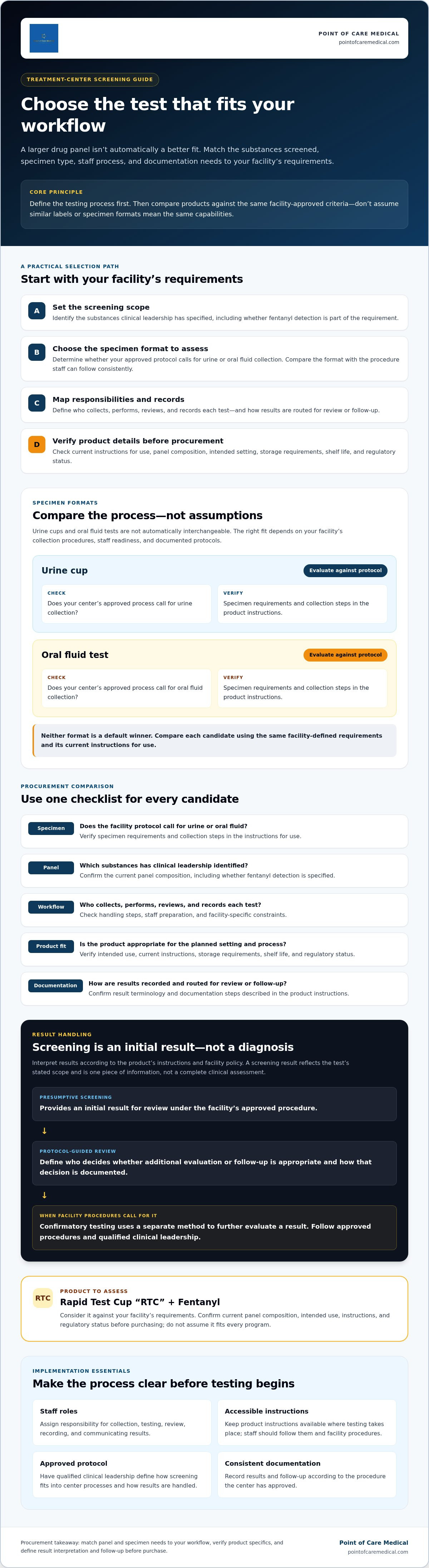
Compare each candidate against the same facility-defined criteria. Panel size alone doesn’t establish fit. Review the specimen format, substances screened, collection steps, staff responsibilities, product instructions, and documentation process. Use this framework to assess drug test cups for treatment centers without assuming that products with similar labels have the same capabilities.
| Comparison area | Questions for procurement and clinical teams | What to verify |
|---|---|---|
| Specimen type | Does the facility’s protocol call for urine or oral fluid collection? | Specimen requirements and collection steps in the instructions for use. |
| Panel requirements | Which substances has clinical leadership identified for screening? | Panel composition, including whether fentanyl detection is specified. |
| Workflow | Who collects, performs, reviews, and records each test? | Handling steps, staff preparation, and any facility-specific constraints. |
| Instructions and intended use | Is the product appropriate for the center’s planned setting and process? | Current instructions, intended use, storage requirements, and regulatory status. |
| Documentation | How will staff record results and route them for review or follow-up? | Result terminology and any documentation steps described by the product instructions. |
Mark specifications as “verify” rather than filling gaps with assumptions. For more context on the product category, consult this fentanyl test cup buyer’s guide. SAMHSA publishes scientific and technical guidelines for federal workplace drug testing programs. Treatment centers should confirm which requirements apply to their own testing program rather than treating workplace guidance as automatically applicable.
Urine cups versus oral fluid drug screens
Urine cups and oral fluid tests are distinct specimen-format options. Compare their collection procedures with the center’s privacy needs, available space, staffing, and documentation process. Check how each format fits the actual sequence of tasks, from collection through result recording. Neither format is universally preferable. The appropriate choice depends on facility requirements and the specific product’s instructions.
Panel selection and fentanyl screening
Start with the substances and screening objectives established by qualified clinical leadership. Don’t assume fentanyl is included in every cup. The Rapid Test Cup “RTC” + Fentanyl is one product to evaluate if fentanyl screening is part of the facility’s requirements. Verify its current panel composition, intended use, and instructions before procurement. Point of Care Medical supplies this cup and oral fluid tests. Review available screening supplies against your documented criteria.
Which Screening Format Fits Your Center’s Workflow?
Urine cups and oral fluid tests are different specimen options, not interchangeable products. Choose between them by reviewing the facility’s documented protocol, collection process, staff readiness, and each assay’s intended use. A format that seems simpler operationally isn’t automatically the right clinical choice. Guidance from the National Institute on Drug Abuse on drug testing offers broader context on the role of testing in substance use disorder treatment. Facility protocols and product instructions should guide local implementation.
Before selecting a format, map the work from collection to documentation. Consider where collection takes place, who supports the process, how staff record results, and how questions or unexpected results are routed for review. Ask clinical leadership to approve the protocol and confirm that it fits the center’s population and screening objectives.
When an onsite urine cup may fit
Evaluate whether the facility can support its planned urine collection steps, including appropriate space, staff responsibilities, and a consistent process for handling the specimen and recording the result. Then confirm that the cup’s documented panel matches the center’s defined screening needs. Before implementation, prepare staff to follow the product instructions and facility protocol, including how to route results for review.
For example, a center can assess whether collection fits an existing intake or monitoring workflow without creating gaps in privacy, staffing, or records. This is an operational assessment, not a recommendation to use urine testing for a particular clinical purpose.
When to evaluate an oral fluid option
Oral fluid tests offer a distinct specimen-format option. Assess the collection process, intended use, and product-specific instructions against the center’s requirements. Confirm who will administer the test, what staff preparation is needed, and where results will be documented. Point of Care Medical supplies oral fluid tests, but verify product details before selection.
Don’t assume this format suits every population or objective. Compare the practical steps and documented requirements for the specific product with those for any urine cup under consideration. Avoid choosing based only on perceived convenience or assuming the formats have equivalent performance.
Select the specimen format that matches the facility’s documented workflow and the product’s intended use. Once clinical leadership approves the protocol, procurement teams can use it to evaluate product instructions, staff procedures, and documentation before implementation.
How to Evaluate, Procure, and Implement a Drug Testing Workflow
A procurement plan works best when it starts with the facility’s protocol, not a product’s panel count. Use a documented review to connect screening objectives, product requirements, staff responsibilities, and result handling. This makes it easier to compare drug test cups for treatment centers against operational needs and identify details that still require verification.
- Define the program’s requirements. Document intended use, specimen format, panel needs, expected testing volume, and workflow owners. Have qualified clinical leadership approve the screening objectives and protocol.
- Evaluate products against those requirements. Compare confirmed attributes. Request current instructions for use and verify the product’s intended setting, panel composition, storage requirements, shelf life, and regulatory status before purchase. Check uncertain details with the supplier and current authoritative sources.
- Review implementation needs. Involve clinical, laboratory, compliance, and procurement stakeholders as appropriate. Identify who will collect specimens, perform and read tests, document results, and coordinate follow-up under facility policy.
- Prepare staff before use. Train users on the current instructions for the exact assay selected. Make the approved procedure and documentation steps available where testing occurs.
- Review the workflow after implementation. Check whether staff can follow the process consistently and whether required records are complete. Route procedure questions and review findings through facility leadership.
Create a facility-specific evaluation checklist
Keep the checklist specific to the proposed product and use case. Record the required specimen, panel, workflow owners, and product documentation. Confirm current regulatory information through relevant authoritative sources. Don’t infer status from a product category or supplier listing. Include the teams responsible for clinical approval, laboratory processes, compliance review, and purchasing so unresolved questions have a clear owner before procurement proceeds.
Prepare staff and procedures before use
Assign responsibility for collection, test handling, result reading, documentation, and follow-up. Train each user with the current instructions for the selected assay, then align the steps with the center’s approved procedures. Define how staff should handle invalid, unexpected, or disputed results, including who reviews them and whether the protocol calls for additional evaluation or laboratory confirmation. Document decisions consistently.
Before placing an order, confirm product details and facility-specific purchasing requirements. Point of Care Medical distributes toxicology screening supplies, including the Rapid Test Cup “RTC” + Fentanyl and oral fluid tests. Review screening supplies for your facility against your completed requirements, and verify current product information before procurement.
Source Treatment-Center Drug Test Cups with Clear Product Requirements
Before sourcing, turn the facility’s approved protocol into a concise set of product requirements. Confirm the specimen format, screening objectives, required panel, intended use, staff workflow, and documentation process. These criteria give procurement teams a consistent basis for review and help prevent a product change from quietly altering an established procedure.
What to confirm with a supplier before ordering
Request current documentation for each product under consideration. Check the instructions for use, panel details, intended setting, and applicable regulatory information. Verify storage requirements and shelf life from the product documentation. Confirm packaging, ordering minimums, lead times, and current availability directly with the supplier. Don’t assume these details from a prior order or general product description.
Use a written verification record to keep purchasing and clinical review aligned. For each candidate, note:
- Product name and specimen format
- Confirmed panel composition and intended use
- Current instructions and applicable regulatory information
- Storage, shelf-life, and packaging details
- Availability and any facility-specific purchasing requirements
If a proposed product would replace one already in use, document an equivalence review before changing the facility protocol. Have the appropriate clinical, laboratory, and compliance stakeholders assess whether the product’s verified attributes support the intended workflow. A similar category name or panel description alone doesn’t establish equivalence.
How Point of Care Medical fits the sourcing process
Point of Care Medical distributes toxicology screening supplies to healthcare organizations nationwide. Its catalog includes the Rapid Test Cup “RTC” + Fentanyl and oral fluid tests. These are separate options to evaluate against facility-defined requirements, not interchangeable formats. Confirm product-specific panel composition, intended use, regulatory status, and availability using current documentation before placing an order.
For teams comparing drug test cups for treatment centers, share documented requirements with the supplier and request the information procurement and clinical reviewers need to complete their assessment. Keep final protocol decisions with qualified facility leadership. A distributor can support product sourcing but doesn’t replace clinical or regulatory review.
Review the catalog against your facility’s requirements, then verify product details and purchasing conditions directly. Review Point of Care Medical’s testing solutions.
Build a Procurement Plan Your Team Can Use
Choosing drug test cups for treatment centers starts with the facility’s defined screening needs, not the broadest panel or a preferred specimen format. Match product requirements to collection workflows, staff procedures, and documentation practices. Then verify each product’s current instructions, panel details, intended use, and regulatory status before purchasing.
Keep result interpretation and follow-up within approved facility protocols. A screening result may require further review or confirmation, so clarify staff responsibilities before implementation. These steps help procurement and clinical teams make a decision that fits the center’s operational requirements.
Point of Care Medical distributes toxicology screening supplies to healthcare and screening facilities nationwide. Its catalog includes the Rapid Test Cup “RTC” + Fentanyl and oral fluid tests. Evaluate these as distinct options against your documented requirements, and confirm current product details and availability directly.
Review Point of Care Medical’s testing solutions as you finalize your sourcing plan. With clear requirements and a defined workflow, your team can make a more informed procurement decision.
Frequently Asked Questions
How do treatment centers choose drug test cups?
Choose a cup by matching its confirmed panel, specimen requirements, and intended use to the facility’s approved screening protocol. Compare collection and testing steps with staff capacity, documentation processes, and follow-up procedures. Before ordering drug test cups for treatment centers, review the current instructions for use and confirm product-specific details with the supplier. Clinical leadership should approve how testing fits the center’s workflow.
Do drug test cups for treatment centers detect fentanyl?
Some products are specifically identified as including fentanyl, but don’t assume every drug test cup tests for it. Point of Care Medical’s catalog includes the Rapid Test Cup “RTC” + Fentanyl. Before selecting it, verify its current instructions for use, panel composition, intended setting, and regulatory status. Confirm those details meet the facility’s screening requirements and that the protocol explains how staff handle and document results.
Are rapid drug test cup results definitive?
Not necessarily. A rapid cup provides a screening result, which should be interpreted under the product instructions and facility policy. It isn’t, by itself, a complete clinical assessment. The facility’s protocol may call for additional evaluation or laboratory confirmation, depending on the result and intended use. Establish who reviews results and determines follow-up before implementation. Don’t treat a presumptive result as equivalent to a confirmatory test.
Should a treatment center use urine cups or oral fluid tests?
The appropriate format depends on the center’s requirements, collection workflow, staff readiness, and the specific product’s intended use. Compare the collection steps, privacy and space needs, and documentation process for each option. Urine cups and oral fluid tests are distinct specimen formats, so don’t assume they’re interchangeable or that one is universally better. Have clinical leadership approve the protocol before choosing a format.
What should a treatment center check before ordering drug test cups?
Confirm the product’s panel composition, specimen requirements, intended use, and current instructions for use. Review applicable regulatory information, storage conditions, shelf life, packaging, ordering minimums, lead times, and availability directly with the supplier. Check that the product fits the facility’s approved workflow and documentation process. If replacing an existing test, document the facility’s review before changing the established protocol.
Can a treatment center use a drug test cup without laboratory confirmation?
That depends on the facility’s approved protocol, the test’s intended use, and the circumstances surrounding the result. A cup can provide an initial screening result, but screening and confirmation are different processes. The facility should define when a result requires further evaluation or laboratory confirmation, who makes that determination, and how follow-up is documented. Consult qualified clinical leadership when establishing or revising these procedures.
How can treatment centers compare drug test cup suppliers?
Compare suppliers by requesting current product documentation and checking whether they can confirm panel details, intended use, regulatory information, storage requirements, shelf life, packaging, ordering minimums, lead times, and availability. Evaluate each product against facility-defined requirements rather than relying on broad descriptions. Point of Care Medical distributes toxicology screening supplies nationwide, including the Rapid Test Cup “RTC” + Fentanyl and oral fluid tests.


