

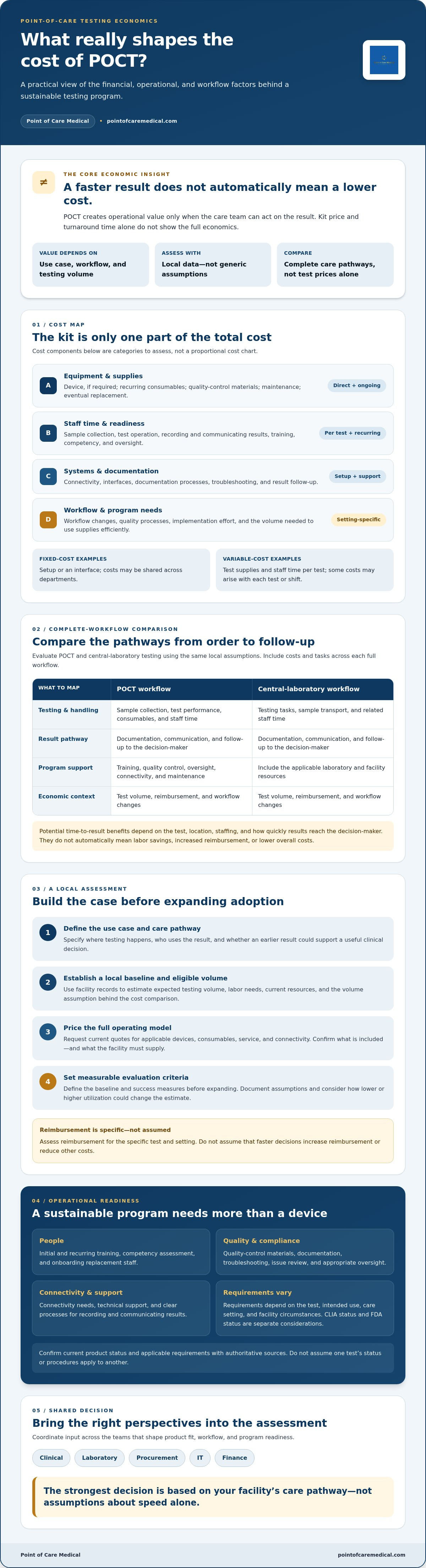
A faster result can make a testing workflow more expensive, not less. The point of care testing economic barriers often sit beyond the test kit: staffing, quality control, training, connectivity, and the volume needed to use supplies efficiently all affect the total cost. A result creates operational value only when the care team can act on it.
That makes the decision more complex than comparing a POCT price with a central-laboratory charge. Facilities also need to account for reimbursement, workflow changes, and whether faster decisions reduce other costs in their specific setting. Those questions are difficult to answer without local data, but a structured assessment can bring them into focus.
This guide explains the direct and indirect cost drivers, operational and compliance requirements, and reimbursement factors that shape POCT economics. It also shows how to estimate test volume and ongoing support needs, compare POCT with central-laboratory workflows, and build an adoption plan with measurable evaluation criteria. The goal is a practical decision based on your facility’s care pathway, not assumptions about speed alone.
Key Takeaways
- Assess point of care testing economic barriers across financial, workforce, infrastructure, reimbursement, and implementation needs.
- Map staff competency, quality control, documentation, connectivity, and result follow-up requirements for the specific test and setting.
- Compare complete POCT and central-laboratory workflows, including labor, consumables, transport, and follow-up.
- Define the use case, baseline, eligible test volume, and success measures before expanding adoption.
- Coordinate clinical, laboratory, procurement, IT, and finance input to evaluate product fit and program readiness.
What Are the Point of Care Testing Economic Barriers?
Point-of-care testing (POCT) is diagnostic testing performed near the patient, rather than relying solely on a central laboratory. It can take place in settings such as a clinic or at the bedside, with the specific test and workflow shaped by the intended use. For a foundational overview of the methods and common applications, see Point-of-care testing (POCT).
The point of care testing economic barriers are the financial, workforce, infrastructure, reimbursement, and implementation constraints that affect whether a facility can operate POCT sustainably. The purchase price is only one part of the decision. Total ownership costs extend from setup through routine operation, oversight, and eventual replacement. A test may appear affordable per kit but require staff time, quality processes, or technical support that changes the overall cost.
Which costs are visible, and which are easy to overlook?
Visible expenses can include a testing device, if required, and recurring consumables. Less visible costs often determine whether the workflow is practical. Include training and competency activities, quality-control materials, maintenance, connectivity, documentation processes, and staff time for collecting samples, running tests, recording and communicating results, and providing oversight.
Some costs may be shared across departments, while others arise with each test or shift. Estimate them using local data rather than a generic per-test comparison. Request current vendor quotes for applicable devices, consumables, service, and connectivity needs. Then review facility records for expected testing volume, labor requirements, and existing laboratory or IT resources. Confirm what is included in each quote and what the facility must supply.
To make the estimate easier to review, separate fixed costs, such as setup or an interface, from variable costs, such as test supplies and staff time per test. Divide the costs included in the comparison by the expected number of completed tests, and document the volume assumption. This makes it easier to see how lower or higher utilization could change the result.
Why do facilities consider point-of-care testing despite these barriers?
Facilities may consider POCT when results closer to the patient could support a more direct workflow or inform a timely clinical decision. Potential time-to-result benefits depend on the test, location, staffing, and how quickly results reach the decision-maker. They do not automatically translate into labor savings, increased reimbursement, or lower overall costs.
Clinical value may come from acting on a result sooner, but only when that result changes care in a useful way. Compare the full pathway: how testing is ordered, performed, documented, communicated, and followed up. Also consider whether the expected volume supports the required staff readiness and ongoing quality processes. Assess reimbursement for the specific test and setting rather than assuming it.
POCT value depends on the use case, workflow, and testing volume, not the kit price or turnaround time alone. This principle helps facilities frame the economic assessment before comparing POCT with central-laboratory workflows.
How Do Operational and Compliance Requirements Shape POCT Economics?
POCT shifts more than the test location. It also distributes testing tasks across staff and care areas, creating ongoing needs for training, quality oversight, documentation, and result management. These responsibilities can affect the business case even when the testing device is straightforward to use. A review of the practical and economic challenges of POCT also highlights the importance of laboratory support for quality assurance and compliance.
Requirements depend on the specific test, its intended use, the care setting, and the facility’s circumstances. CLIA status and FDA status are separate considerations. Confirm the applicable requirements and current status of each product with authoritative sources before selecting a test or building a workflow. Do not assume that one test’s status or procedures apply to another.
How do staffing and quality responsibilities affect the business case?
Build an operational estimate that includes both direct testing tasks and the oversight needed to support dependable results. Account for initial and recurring staff training, competency assessment, and the time needed to onboard replacement staff. Include quality-control materials and the labor required for documentation, troubleshooting, issue review, and supervisory oversight.
Multiple testing locations can add coordination work. Facilities may need consistent procedures, clear escalation paths, and a way to confirm that required activities are completed at each site. Map who performs each task and who is accountable for oversight. This makes staffing assumptions visible before a pilot or broader rollout.
- Staffing: Training, competency, test performance, and coverage for turnover.
- Quality: Control materials, documentation, troubleshooting, and review.
- Governance: Procedures, supervisory time, and coordination across locations.
- Results: Routing, communication, and follow-up when results require action.
Why can connectivity and reimbursement complicate adoption?
Connectivity affects both cost and workflow. Assess whether results can move into the facility’s information systems, reach the appropriate care team, and support reliable documentation. Confirm interface requirements, compatibility, implementation responsibilities, and ongoing technical support with relevant vendors and internal IT staff. A disconnected process may require manual entry or extra checks, adding work and creating opportunities for delays.
Reimbursement is specific to the payer, test, and setting. Verify current coverage, coding, and payment policies for the intended use rather than treating reimbursement as a fixed offset. Separate the potential operational benefit from the financial case, then model each using local assumptions.
Operational value may support a POCT decision, but it does not guarantee reimbursement or savings. Once clinical, regulatory, and workflow requirements are clear, facilities can consider supply options, including rapid diagnostic test categories, as one part of program planning.
How Can Facilities Compare POCT With Central-Laboratory Testing?
A fair comparison follows each testing pathway from order to action. Comparing a POCT kit price with a central-laboratory charge, or comparing turnaround time alone, leaves out important work and resource needs. To understand point of care testing economic barriers, use actual facility volume and workflow data, and label estimates and assumptions clearly.
Which inputs belong in a fair cost comparison?
Build a like-for-like view for the same test population and period. Include equipment and consumables, staff time, quality activities, transport, connectivity, and result follow-up. Use local records for test volume, unused or expired supplies, repeats, staffing time, and service utilization where available. If a figure is estimated, state its source and assumption rather than presenting it as a measured cost.
For central-laboratory testing, account for collection, specimen handling and transport, laboratory processing, reporting, and the steps required to deliver results to the care team. Compare those steps with the POCT workflow, including local staffing and oversight. Keep financial inputs separate from potential clinical or access benefits. Faster access may matter if it changes a decision, but assess that benefit independently instead of assigning unverified savings.
Check that each cost is counted once. For example, if a service charge already includes a particular laboratory process, do not add that same process again as a separate expense. Use the same time period and test population on both sides of the comparison.
| Cost area | POCT workflow | Central-laboratory workflow |
|---|---|---|
| Equipment | Device purchase, setup, and replacement needs, if applicable. | Facility costs or service charges associated with laboratory capacity. |
| Consumables | Test supplies, controls, wastage, and repeats. | Collection and specimen supplies, plus applicable testing charges. |
| Labor | Collection, testing, recording, and result communication. | Collection, handling, processing, and reporting. |
| Quality | Control activities, documentation, troubleshooting, and oversight. | Applicable laboratory quality processes and related charges. |
| Transport | Include any movement needed within the facility. | Specimen pickup, transport, and handling. |
| Connectivity | Interfaces, result routing, and technical support. | Reporting interfaces and result routing. |
| Follow-up | Review, communication, and next steps after results. | Review, communication, and next steps after results. |
When might each testing model fit better?
Distance, operating hours, testing volume, and clinical urgency can change the comparison. POCT may fit a workflow where a timely result informs a decision and the facility can support testing locally. A central laboratory may fit consolidated testing or a workflow with established capacity and transport processes. Neither model is universally cheaper, faster, or clinically preferable. Compare the local pathway, then weigh financial findings alongside separately assessed access and clinical considerations.
How Can a Facility Evaluate POCT Adoption Before Scaling?
A staged evaluation helps leaders test whether POCT fits a defined clinical need and local workflow before committing to broader implementation. Start by specifying the use case, patient group, testing location, and decision the result is expected to inform. Establish the current workflow as a baseline, then estimate eligible test volume using facility data rather than a broad demand assumption.
Set the pilot scope with clinical leadership, laboratory oversight, procurement, IT, and finance. Assign responsibilities for testing, quality oversight, result routing, supply planning, and evaluation. Before launch, agree on success criteria across clinical, operational, compliance, and financial goals. This makes the evaluation more useful and prevents the team from changing the definition of success after results are in.
What should a POCT pilot measure?
Record pilot activity and implementation effort, not just the number of tests performed. Compare baseline and pilot-period conditions, using the same definitions and collection methods for both wherever possible. Track:
- Utilization: Eligible patients, tests performed, consumable use, unused supplies, and repeat or invalid tests.
- Staff workload: Time spent on training, collection, testing, documentation, quality activities, troubleshooting, and result communication.
- Workflow: Relevant intervals from order to result and from result to action, using a method defined before the pilot.
- Quality and implementation: Quality events, connectivity issues, supply interruptions, and time required to establish and support the process.
- Clinical relevance: Whether results informed or changed decisions, assessed against the use case and documented consistently.
Note contextual changes that could affect comparisons, such as changes in staffing, demand, or workflow. Separate measured costs from clinical or access outcomes that require their own assessment.
How should leaders decide whether to expand, revise, or stop?
Compare pilot findings with the thresholds set in advance. Expand only if the results support the intended clinical use and the facility can sustain the operating, quality, and supply processes. If results fall short, investigate training, workflow, connectivity, and utilization before concluding that test cost is the cause. Revise the process and reassess when appropriate. Stop if essential requirements or predefined goals are not met.
Supply planning should reflect the pilot’s expected demand and product requirements, not substitute for clinical and operational readiness. Facilities evaluating respiratory-test procurement can consult this COVID-19 rapid test wholesale procurement guide. Once requirements are established, review rapid-test supply options as one part of the adoption plan.
How Can Procurement Support a Sustainable Point-of-Care Testing Program?
Procurement supports a POCT program, but purchasing alone does not resolve the point of care testing economic barriers. A sustainable decision also depends on clinical governance, staffing, quality processes, connectivity, and a clear use case. Procurement can help translate those requirements into product and supply criteria, then confirm that proposed options fit the facility’s intended workflow.
Start with the test’s purpose and the setting where it will be used. Before comparing suppliers, document the required test format, expected demand, storage capacity, ordering process, and roles for receiving and inventory management. This helps teams assess the full operating model rather than choosing on purchase price alone.
What should procurement confirm with a diagnostic supplier?
Ask for current, product-specific information and review it with the appropriate clinical and laboratory leads. Confirm intended use, applicable FDA status, CLIA status, storage conditions, and current instructions for use. Verify each detail for the exact test under consideration. Do not infer regulatory status, handling requirements, or suitability from a general product category.
Also review product documentation, ordering procedures, supply planning, and any support arrangements. Clarify how the facility will monitor inventory and respond to changes in demand or supply. These checks help procurement identify practical dependencies early, while clinical and laboratory oversight determine whether the test meets the program’s requirements.
- Product fit: Does the test match the intended use, setting, and workflow?
- Documentation: Are current instructions and product-specific status information available for review?
- Operations: Can the facility meet stated storage and handling conditions?
- Supply planning: Do ordering and inventory processes fit projected use and the facility’s continuity needs?
How can Point of Care Medical fit into supply planning?
After the facility defines its clinical, regulatory, and operational requirements, Point of Care Medical may be a procurement resource for rapid-test categories in respiratory, infectious-disease, and toxicology screening. Its catalog includes the GenBody COVID-19 Rapid Antigen Test, ViraDx SARS-CoV-2/Flu A+B Rapid Antigen Test, SURE CHECK HIV 1/2 Assay, and toxicology screening products, including Rapid Test Cups with Fentanyl and oral fluid tests. Verify product availability and applicable FDA and CLIA status before selection.
Use supplier discussions to check category fit and current product details against the facility’s documented needs. Then coordinate the purchasing plan with the teams responsible for governance, implementation, and evaluation. Facilities that have established those requirements can review available rapid-test categories as one step in building a sustainable program.
Make Your POCT Decision With Local Evidence
Point-of-care testing economics depend on the full care pathway, not the test price alone. A sound assessment includes staffing, quality oversight, connectivity, reimbursement, and the work required to communicate and act on results. These point of care testing economic barriers are best evaluated with facility-specific volume and workflow data.
Before scaling, define the use case, establish baseline measures, and set clinical, operational, compliance, and financial criteria for a pilot. Compare results against those criteria, then address implementation issues before deciding whether to expand, revise, or stop. Procurement can support the plan, but product selection should follow clinical and operational requirements.
Once those needs are clear, Point of Care Medical can be a supply resource for healthcare and screening organizations across the United States. Its rapid-testing categories include respiratory, infectious-disease, and toxicology tests. Review options and verify current product details as part of your evaluation.
Review Point of Care Medical’s rapid testing categories and take the next step with a practical, evidence-based plan for your facility.
Frequently Asked Questions
What are the main economic barriers to point-of-care testing?
The main barriers include test supplies and equipment, staff preparation, quality oversight, connectivity, documentation, and ongoing program management. Reimbursement uncertainty and variable test volume can also affect the business case. The relative impact depends on the test, setting, workflow, and use case. To assess point of care testing economic barriers, build estimates from facility-specific volumes, labor, supply needs, and vendor information rather than relying on general cost claims.
Is point-of-care testing more expensive than central-laboratory testing?
Not necessarily. The comparison depends on the complete workflow, including supplies, staff time, quality activities, transport, connectivity, and how results influence care. Comparing only the test-kit price can miss substantial costs in either model. Use actual local volumes and operating inputs, and assess clinical or access benefits separately from direct financial costs. Neither POCT nor central-laboratory testing is universally less expensive across all settings.
How much does point-of-care testing cost a healthcare facility?
There is no single reliable cost figure for every facility. Expenses vary by test, equipment needs, volume, staffing model, quality program, system interfaces, and applicable requirements. Request current product-specific information and estimate both startup and ongoing expenses, including training, controls, and oversight. Use facility data to document assumptions and calculate a local estimate. Avoid applying an industry-wide average that may not reflect your test or workflow.
Can point-of-care testing reduce overall healthcare costs?
It may support a more direct workflow or timely clinical decisions, but lower total costs are not guaranteed. The outcome depends on whether results change care, how staff use the test, and which costs are added or displaced. Define the intended use, compare a pilot with a documented baseline, and track operating costs alongside relevant workflow measures. Treat operational improvements as financial savings only when the analysis supports that conclusion.
What happens if a facility adopts POCT without accounting for quality and training?
A facility may encounter inconsistent processes, documentation gaps, workflow problems, or unplanned oversight demands. Applicable requirements depend on the test, setting, and facility, so confirm them before implementation. Plan for staff preparation, competency, quality-control procedures, and accountable oversight. Involve qualified laboratory leadership and consult relevant regulatory guidance for product- and facility-specific decisions. These steps help identify operational needs before they disrupt routine testing.
How can a facility calculate the cost-effectiveness of point-of-care testing?
Start by defining the clinical use case and the workflow you will compare it with. Collect local data for test volume, supplies, staff time, quality activities, connectivity, transport, and follow-up. Track relevant turnaround and workflow measures using methods set in advance. Document assumptions, then compare pilot results with a baseline. Keep clinical and access benefits distinct from financial outcomes unless the analysis shows a clear relationship between them.
Does CLIA-waived status mean a rapid test has no implementation costs?
No. CLIA-waived status does not eliminate purchasing, staff preparation, storage, documentation, quality processes, or workflow requirements. Verify the status and intended use for the specific test, then assess the applicable requirements for your facility. Review current instructions and product details with the appropriate clinical and laboratory leads. Do not assume that a status or operating process for one test applies to other products in the same category.


