

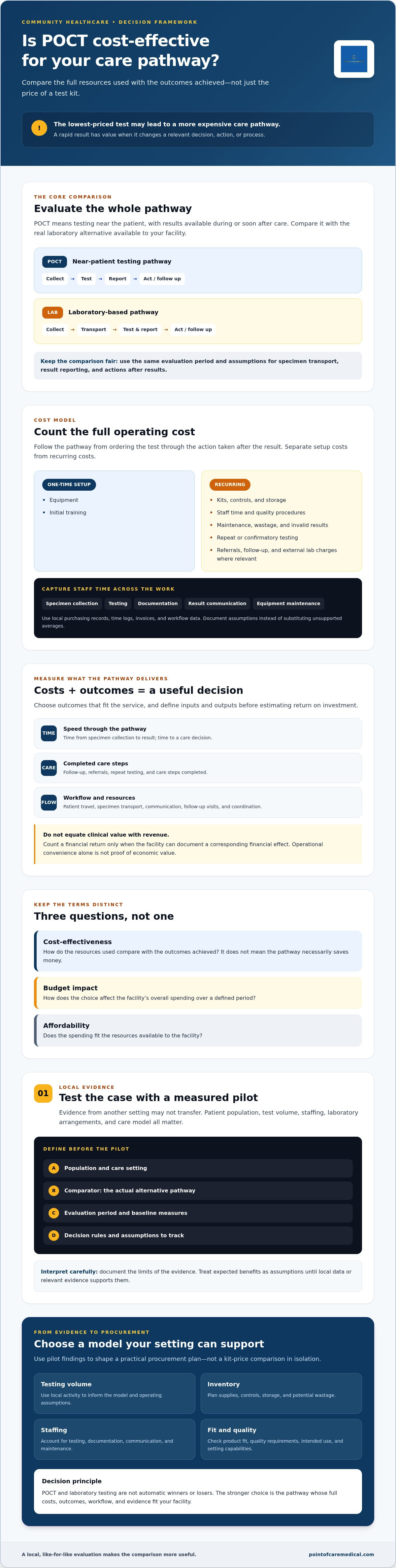
The lowest-priced test can lead to a more expensive care pathway. The cost-effectiveness of POCT in community healthcare depends on more than the kit price. It depends on whether faster results change decisions, reduce follow-up steps, or help staff use resources more efficiently. A fair comparison accounts for the full operating cost and the outcomes each pathway can support.
It’s reasonable to ask whether point-of-care testing costs less than sending samples to a laboratory. The answer depends on the test, patient population, testing volume, and care model, so evidence from another setting may not apply directly. This guide explains how to compare POCT with laboratory-based testing using consistent assumptions. You’ll identify the costs, outcomes, and operational measures to track, then document the limits of the evidence behind your decision. The result is a practical framework for assessing whether POCT fits your setting before procurement.
Key Takeaways
- Assess the cost-effectiveness of POCT in community healthcare by weighing full pathway costs against outcomes, not by comparing test-kit prices alone.
- Build a cost model that captures supplies, equipment, staff time, quality procedures, and downstream follow-up.
- Compare POCT and laboratory pathways using the same assumptions, including specimen transport, result reporting, and actions after results.
- Use a measured pilot with a defined population, comparator, evaluation period, baseline measures, and decision rules.
- Turn pilot findings into a procurement plan that addresses testing volume, inventory, staffing, product fit, and quality requirements.
What Cost-Effectiveness of POCT Means in Community Healthcare
Point-of-care testing (POCT) is testing performed near the patient, with results available during or soon after care. The Point-of-care testing (POCT) overview provides background on the approach and its applications. For a community clinic, the key question is how testing fits into the full care pathway, not just how much a test kit costs.
Cost-effectiveness compares the resources a testing pathway uses with the outcomes it achieves; it does not mean that the pathway necessarily saves money. A POCT model could cost more to operate yet support a worthwhile outcome, or cost less without improving care. Budget impact asks how a choice affects the facility’s overall spending over a defined period. Affordability asks whether that spending fits available resources. Operational convenience, such as fewer handoffs, may matter too, but it isn’t proof of economic value on its own.
Why community healthcare evaluates more than the test price
Consider the steps around testing: patient travel, specimen transport, result communication, follow-up visits, referrals, and care coordination. Some effects can be measured locally, such as time from collection to result or the number of repeat visits. Other benefits, such as avoided travel or faster treatment decisions, need evidence from the facility’s own workflow. A rapid result has value only if it changes a relevant decision, action, or process.
Which community settings and testing pathways are in scope?
Community clinics and health centers can serve as useful examples, but staffing, patient access, test volumes, and laboratory arrangements differ from one facility to another. Compare POCT with the actual alternative available to your facility, including how specimens are collected and transported, how results return, and who acts on them. A generic comparison may overlook important steps in your own workflow.
The cost-effectiveness of POCT in community healthcare therefore depends on the test, population, comparator, workflow, and assumptions used in the analysis. Keep the clinical purpose and test-specific regulatory requirements in scope when evaluating a pathway. Confirm that the test’s intended use and procedures align with the setting and its capabilities. Treat expected benefits as assumptions until local data or relevant evidence supports them. This gives decision-makers a clearer basis for comparing models without presuming that POCT or laboratory testing is always the better choice.
Build a Full Cost and Outcome Model for Community Clinic Rapid Testing
Start with the complete pathway, from test ordering through the action taken after a result. Separate one-time setup costs, such as equipment and initial training, from recurring costs, such as kits, controls, staff time, storage, and quality procedures. Set an evaluation period that reflects the service’s testing volume and operating cycle, then use the same period for the POCT and laboratory-based options.
Which costs belong in a POCT evaluation?
Count staff time for specimen collection, testing, documentation, result communication, and equipment maintenance. Include wastage, invalid results, repeat tests, confirmatory testing, referrals, follow-up, and external laboratory charges where relevant. Use purchasing records, time logs, invoices, and workflow data from your facility. Avoid substituting unsupported industry averages for local inputs.
A published economic evaluation of POCT in remote primary care illustrates how an analysis can account for potential costs avoided when testing informs decisions about medical evacuation. Review its setting and assumptions before applying its findings elsewhere.
Which outcomes can support a point of care testing ROI estimate?
Define the inputs and outputs before calculating ROI. Depending on the service, measurable outcomes may include time from specimen collection to result, time to a care decision, completed follow-up, referrals, repeat testing, and completed care steps. Don’t treat clinical value as revenue automatically. Count a financial return only when the facility can document a corresponding financial effect.
A POCT ROI estimate is only as transferable as its local testing volume and workflow assumptions. A clinic with different staffing, specimen transport, or follow-up patterns may reach a different result, even when evaluating the same test.
Use a working table to record each input, its source, and the assumptions behind it:
| Category | Data source | Unit | Assumption to document |
|---|---|---|---|
| Kits, controls, and wastage | Purchasing and inventory records | Per test or evaluation period | Expected volume and unusable tests |
| Equipment, storage, and setup | Invoices and facility records | One-time or recurring | Evaluation period and allocation method |
| Staffing and quality procedures | Time logs and workflow records | Minutes or hours | Tasks included and staff roles |
| Follow-up and external testing | Referral, laboratory, and follow-up records | Per patient or event | Repeat, confirmatory, and downstream steps |
| Operational outcomes | Result and care records | Time or completed steps | Baseline, definitions, and period measured |
For procurement planning, facilities can also review rapid diagnostic test options alongside documented volume, workflow, and product requirements.
Compare POCT with Laboratory Testing Without Assuming One Model Wins
Compare the pathways your facility can actually operate. A POCT workflow may involve testing near the patient and acting on a result during the visit. A laboratory pathway may involve specimen preparation, transport, external processing, result reporting, and later communication with the patient. Include every step that affects staff time, access, and follow-up, rather than comparing turnaround or test costs in isolation.
Use a consistent evaluation period and record local data for each pathway. The table below provides a starting framework. Add measures that reflect the test’s clinical purpose and your facility’s workflow.
| Comparison area | POCT pathway | Laboratory pathway | Local measure to check |
|---|---|---|---|
| Total costs | Test supplies, equipment, staffing, and quality procedures | Laboratory charges, collection, transport, and result handling | Cost per completed testing episode, including repeat or follow-up steps |
| Turnaround | Time from collection to result at the care site | Time from collection through transport, processing, and reporting | Elapsed time to a result and to a care decision |
| Staffing | Staff time for testing, documentation, and quality tasks | Staff time for collection, dispatch, tracking, and communication | Roles and time spent at each workflow step |
| Access | Testing available at the point of care, subject to local capacity | Access depends on collection arrangements and laboratory services | Missed or delayed testing and documented access barriers |
| Follow-up | Result may inform action during the visit if appropriate | Result may require later review and patient contact | Completed follow-up, referrals, and additional testing |
When can POCT fit a community care pathway?
POCT may fit when a result available during the visit changes an appropriate next step, such as the timing of further assessment or follow-up. Test whether that change occurs in practice. Measure relevant access barriers and follow-up constraints rather than assuming they exist or that POCT resolves them. Confirm that the selected test is appropriate for its intended population and use.
When may laboratory testing remain the better comparator?
If the existing laboratory pathway meets required turnaround and quality needs, moving testing on-site may add staff and quality tasks without changing care. Consider local testing volume and frequency, staff capacity, distance to laboratory services, and any need for confirmatory testing. Lower or irregular volume may affect how setup and recurring work are distributed. Don’t assume results from another test, population, or setting will transfer directly.
The cost-effectiveness of POCT in community healthcare depends on the complete comparison. Faster results aren’t an automatic clinical or economic advantage; they matter when they lead to a meaningful, measurable change in the facility’s workflow or care pathway.
Evaluate POCT Economics with a Measured Pilot and Clear Decision Rules
A measured pilot can test whether the assumptions in your cost model match actual clinic operations. Define the clinical use, test, patient population, laboratory comparator, evaluation period, and accountable lead before rollout. Set baseline measures first so you can distinguish changes associated with the pilot from differences that were already present.
How should a community clinic design a POCT pilot?
Keep the pilot focused on a defined test and workflow the facility can monitor. Document who performs each step, including staff training, quality procedures, result entry and communication, and escalation when a result requires additional action. Set review criteria in advance. Base them on the facility’s objectives and requirements rather than applying universal thresholds for success.
Record data sources, exclusions, and assumptions in a short evaluation plan. Note which patients or tests are included, how missing information is handled, and any differences between the POCT and laboratory pathways. Before purchasing, review test-specific intended use and regulatory status. The CLIA-waived and FDA-cleared rapid test guide can be part of that review. Confirm current product documentation and requirements for the specific test.
Which measures should decision-makers review after launch?
Review spending and workflow measures together. Compare actual kit use, wastage, staff time, repeat testing, and follow-up activity with the baseline. Track result timing and relevant care-process measures, such as whether planned next steps were completed. Use the same definitions and data sources across review periods to make comparisons meaningful.
Schedule reviews at planned intervals and assign responsibility for checking the data. If actual test volume differs from the forecast, staff time increases, or follow-up patterns change, record the change and assess how it affects interpretation. Adjust the pathway or revise the assumptions where needed. A result that appears favorable under one set of operating conditions may not hold when volume or staffing changes.
This local evidence helps decision-makers assess the cost-effectiveness of POCT in community healthcare without assuming that a faster result automatically improves care or reduces spending. Preserve the pilot plan, data definitions, results, and decision rationale so the procurement decision can be reviewed later.
Once you’ve defined the test requirements and expected volume, review rapid test options for procurement as one part of the evaluation.
Apply the Economics to Procurement and Choose a Supportable POCT Model
Use pilot findings to shape a procurement plan that reflects how the facility will operate the service. Document expected testing volume, ordering frequency, inventory levels, staff responsibilities, and quality procedures. Include the assumptions behind each decision. If actual volume was uneven during the pilot, account for that when planning routine stock and staffing rather than treating a short-term average as a guarantee of future demand.
What should procurement verify before selecting rapid tests?
Review each candidate test against the facility’s defined clinical need and workflow. Verify its intended use, current regulatory status, instructions for use, storage requirements, and any facility-specific requirements with current product documentation. Then check ordering units and product information against projected use, including how inventory will be monitored and managed. Don’t assume a product is available or suitable without confirming those details.
Bring clinical, compliance, operational, and procurement stakeholders into the review. They can assess whether the test’s use, procedures, staffing needs, and documentation fit the planned service. For background on evaluating product-specific compliance, consult the CLIA-waived and FDA-cleared rapid test guide, then verify current requirements for the specific test and intended use.
How can Point of Care Medical fit into sourcing discussions?
Point of Care Medical is a U.S. distributor of specialized rapid diagnostic test kits, not a clinical service or POCT implementation provider. Its catalog includes respiratory and infectious disease assays, such as GenBody COVID-19 Rapid Antigen Tests, ViraDx™ SARS-CoV-2/Flu A+B tests, and SURE CHECK HIV 1/2 assays, as well as toxicology options, including Rapid Test Cups with Fentanyl and oral fluid drug screens. Treat these products as options to assess against your documented need, not as evidence of savings or suitability. Confirm current product specifications and availability as part of procurement review.
If toxicology testing is within scope, the rapid test cup with fentanyl buyer’s guide may help inform product questions. Keep the evaluation tied to the facility’s intended use, workflow, and requirements.
A supportable decision connects the pilot evidence to an operating plan: forecast volume, inventory controls, assigned staff tasks, and quality processes. Record why the selected model fits, what evidence informed the choice, and which assumptions should be reviewed as use changes. This makes the cost-effectiveness of POCT in community healthcare a documented procurement question rather than a claim based on unit price alone.
To compare available test categories with your documented facility needs, review Point of Care Medical’s rapid test options as one part of your sourcing process.
Make Your Next POCT Decision Evidence-Based
The cost-effectiveness of POCT in community healthcare depends on the full pathway, not the kit price alone. Compare POCT with the laboratory option your facility actually uses, and account for staffing, quality procedures, follow-up, and outcomes that matter to your service. A measured pilot can test those assumptions and show whether the model fits your local volume, workflow, and requirements.
Use the evidence to create a practical procurement plan for inventory, staffing, and quality processes. Confirm each test’s intended use, current documentation, and fit with facility requirements before purchasing. A decision based on local data is easier to explain, review, and update as needs change.
Point of Care Medical distributes specialized rapid diagnostic testing supplies nationally, with respiratory, infectious disease, and toxicology test categories. Review options against your documented needs, then verify product details as part of your procurement process. Review rapid testing options for your facility and take the next step with a clear, evidence-aware plan.
Frequently Asked Questions
Is POCT cost-effective in community healthcare?
It can be, but the result depends on the test, population, comparator, and local workflow. Assess the cost-effectiveness of POCT in community healthcare by comparing total operating costs with relevant outcomes and follow-up, not kit price or turnaround time alone. A faster result matters only if it supports a meaningful care or operational step. Before applying published findings, review the study’s setting, methods, comparator, and limitations.
How do you calculate the cost-effectiveness of point-of-care testing?
First define the population, testing pathway, comparator, evaluation period, costs, and outcomes. Include relevant supplies, staff time, training, quality procedures, repeat testing, and downstream care. Use facility records to compare the pathways, and document data sources and assumptions. Keep ROI estimates distinct from cost-effectiveness analysis: an estimated financial return does not, by itself, demonstrate clinical benefit or show that patient outcomes improved.
Can rapid testing reduce costs for a community clinic?
It may change costs, but lower overall spending isn’t guaranteed. A rapid result could alter workflow or follow-up in a particular setting, while staffing, repeat tests, equipment, and quality procedures can add operating costs. Compare the complete local pathway with the facility’s existing alternative. Measure actual spending and workflow changes before making a savings claim, and account for any downstream testing, referrals, or follow-up.
What costs should a community clinic include when evaluating POCT?
Include test kits, controls, equipment, storage, training, staff time, quality procedures, and documentation. Where relevant, also record invalid or repeated tests, confirmatory testing, referrals, and follow-up. Separate one-time setup expenses from recurring costs, and use an evaluation period that fits the service being assessed. Local purchasing records, staff time logs, and workflow data provide a more useful estimate than unsupported industry averages.
How does POCT compare with laboratory testing in community healthcare?
The comparison depends on the test and the facility’s actual care pathway. Assess total costs, turnaround, specimen handling and transport, staffing, result reporting, and follow-up for both options. Laboratory testing may already meet the clinic’s turnaround and quality needs. POCT may fit where local workflow and intended use support it. Compare the same population, evaluation period, and outcome definitions to avoid favoring either model.
What outcomes should be included in a point-of-care testing ROI analysis?
Select outcomes that relate to the defined service and can be measured reliably. Examples include time to result, completed follow-up, referrals, repeat testing, and documented workflow changes. Set clear definitions and data sources before analysis. Don’t treat operational measures as proof of clinical benefit, or assume clinical value automatically creates revenue. Any ROI calculation should identify its financial inputs, outputs, and assumptions, separately from cost-effectiveness findings.


