

Urine testing is typically the most common pre-employment drug test option, but the familiar choice isn’t automatically the right fit for every workplace. Knowing how to choose workplace drug tests starts with matching the method to your hiring purpose, safety requirements, and the time window you need to assess.
What other employers commonly use can be a useful starting point. A sound policy also considers which substances to screen for, how recent use should be detected, and how to protect specimen integrity. The right balance depends on the role and reason for testing.
This article compares urine, oral fluid, and hair testing, explains how detection windows and collection methods differ, and outlines key specimen-integrity considerations. It also covers when federal testing requirements affect your options, helping you make a practical, informed choice for your workplace.
Key Takeaways
- Urine testing is a common pre-employment option, but the best fit depends on the role, testing purpose, and applicable requirements.
- Compare urine, oral fluid, and hair tests by what each method can detect and the time window that matters for your policy.
- Protect sample integrity with clear collection procedures and documented handling from collection through testing.
- Match the test panel and collection method to workplace goals, including whether you need to assess recent use or a longer history.
- Understand how each method’s limits affect result interpretation before setting expectations for your testing program.
What Is the Most Common Pre-Employment Drug Test Option?
Urine is commonly used for pre-employment drug testing. Employers use it to screen applicants before hiring, and it is required for regulated tests such as those conducted by the Department of Transportation (DOT). The Substance Abuse and Mental Health Services Administration says federal agency drug tests include five drug categories. These features make urine a practical baseline for many employment testing programs.
Pre-employment testing helps employers apply a consistent screening policy and assess whether applicants meet role-specific requirements. Purpose matters: testing for a safety-sensitive position may need to follow federal rules, while a private employer’s program may reflect its own workplace goals. Set the policy before testing applicants. Specify who is covered, when testing occurs, and which substances the panel screens for.
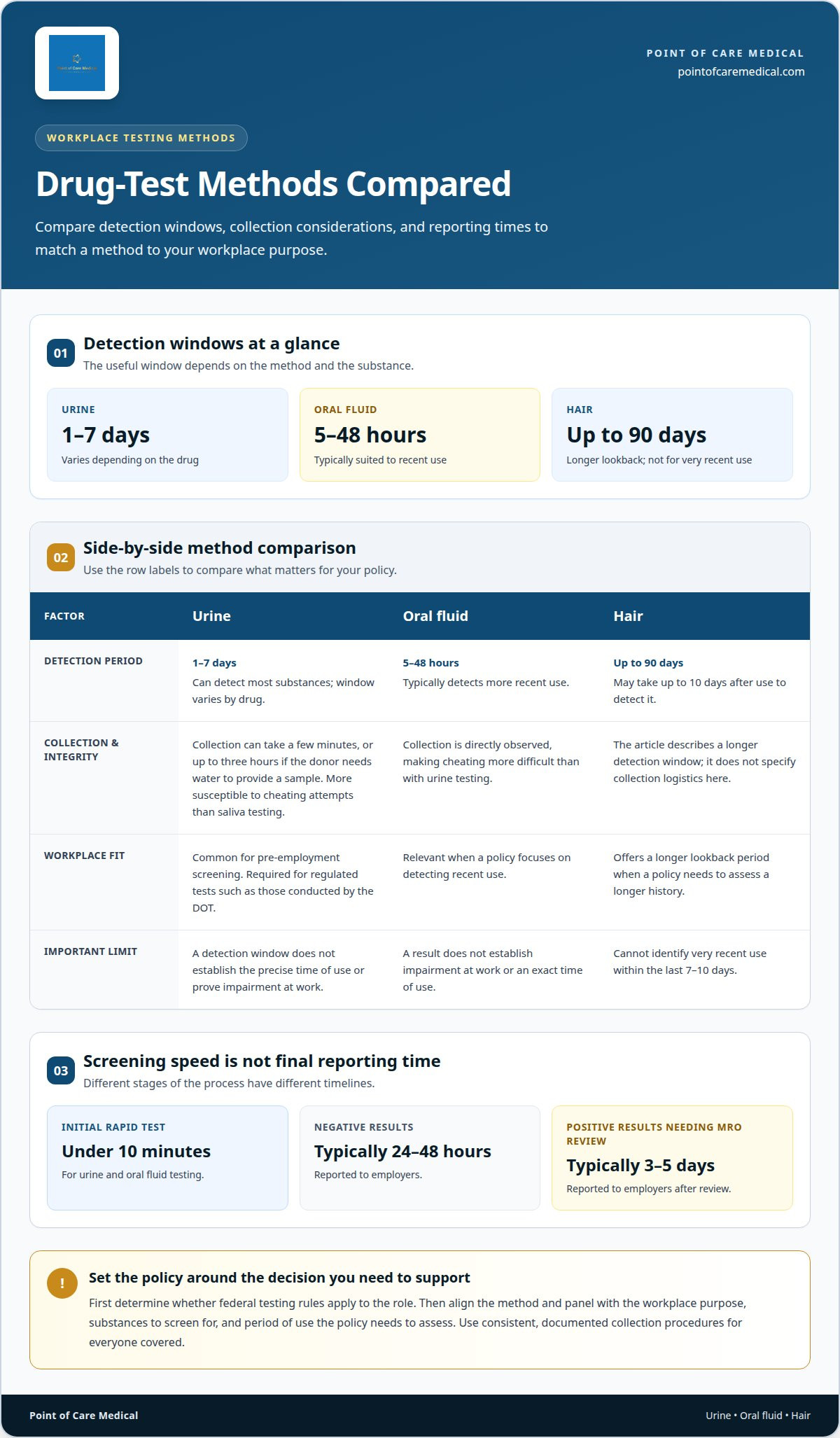
Urine testing can detect most substances for 1-7 days, depending on the drug. That window can support pre-employment screening, but it does not establish the precise time of use or prove impairment at work. Hair testing offers a longer view, detecting drug use for up to 90 days. It cannot identify recent use within the last 7-10 days, so it may not fit a policy focused on very recent use.
Breath alcohol testing serves a different purpose from drug testing. It measures alcohol concentration in breath, rather than screening a urine specimen for drugs. According to the U.S. Department of Transportation, a breath alcohol concentration result of 0.02 or higher requires a confirmation breath alcohol test within 15-30 minutes. In U.S. DOT alcohol testing, results between 0.02 and 0.039 require removing an employee from safety-sensitive positions for a period set by the relevant DOT administration. These thresholds apply to DOT alcohol testing, not general drug-test panels.
Blood testing is a distinct method. Drugs in blood may remain detectable for only minutes to hours after use. That short window makes blood testing more relevant to questions about recent exposure than to a broad pre-employment history. Compare the detection period with the decision your testing program needs to support.
For a typical pre-employment screen, first determine whether DOT rules apply to the position. Then choose a method and panel that fit the role, policy, and period of use you need to assess. Urine is a common starting point; hair offers a longer detection window, while breath testing measures alcohol. A clear purpose helps keep test selection reasonable and consistent.
Workforce QA Drug Testing Methods: a Comparison - How to choose?
Choose a collection method that fits the workplace purpose, detection period, and applicable regulations. Compare collection logistics and result timing before selecting a testing program.
Selecting Methods for Workplace Use Cases
A collection method determines which specimen is tested and which use cases it can support. Urine is common in employment drug testing, while oral fluid is suited to detecting more recent use. Hair testing offers a longer lookback period, up to 90 days. Match the method to whether the policy addresses recent use, a longer history, or a regulated testing requirement.
For a role covered by federal workplace testing rules, method choice must follow those requirements. For other roles, weigh the purpose of testing alongside collection practicality. Oral fluid tests typically detect recent use within 5-48 hours, making that method relevant when a shorter detection period matters. No method answers every workplace question.
Collection Procedures and Cheating Considerations
Collection procedures determine how a specimen is obtained and handled. Urine collection can take a few minutes, but may take up to three hours if the donor needs water to provide a sample. Allow for that possibility when scheduling. Oral fluid collection is directly observed, which makes cheating more difficult than with urine testing.
Urine testing is more susceptible to attempts to cheat than saliva testing. Use a consistent, documented collection process for everyone covered by the policy. Specimen type also affects logistics: direct observation can support sample integrity, while urine collection may take additional time. Align the procedure with your testing purpose and workplace policy.
Rapid Results and Lab Processing
A rapid test can provide an initial result in under 10 minutes for urine and oral fluid testing. That speed can help with on-site screening decisions, but it is distinct from the time needed to report a final result. Negative drug-test results are typically reported to employers within 24-48 hours.
Laboratory processing and review add time, especially when a result requires further evaluation. Positive results requiring Medical Review Officer review are typically reported to employers within 3-5 days. Set expectations around the result type, not just the collection method. A quick screening result and a reviewed report serve different stages of the testing process.
Detection Windows and Test Limitations
A detection window is the period during which a test may identify a substance or its metabolites. Oral fluid testing typically detects recent use within 5-48 hours, while hair testing can detect repeated use for up to 90 days. Hair testing may take up to 10 days after use to detect it, so it cannot address very recent use.
Every method has limits. Detection depends on the substance and the time between use and collection. A result does not establish impairment at work or provide an exact time of use. Compare the method’s window with the decision your policy supports. For teams considering oral-fluid screening, review oral fluid test options as one collection method.
Chain of custody and sample integrity
A chain of custody is the documented record of a specimen’s handling from collection through testing. It shows which sample was collected, who handled it, and when transfers occurred. Consistent records support reliable review and help identify gaps, such as an unclear handoff or mismatched identifier.
Start with the collection record. Document the employee’s identity, specimen type, collection date and time, and the collector responsible. Give the sample a unique identifier and use it on accompanying records. Before transfer, confirm the container is closed and its identifying information matches the paperwork. These steps help prevent specimen mix-ups.
Make every handoff traceable. Record when the specimen leaves the collection site, who receives it, and when the laboratory accepts it. For example, if a urine sample’s label differs from its custody form, pause processing and document the discrepancy instead of silently changing either record. Apply the same tracking discipline to oral fluid specimens, following the collection procedure for that specimen type.
Federal drug-testing specimens are tested by an HHS-certified laboratory and interpreted by a Medical Review Officer (MRO); both are required. An MRO is a licensed physician with knowledge of drug testing, substance use disorders, and federal drug-testing regulations. The MRO reviews results in context rather than treating a laboratory finding as the only relevant information.
Keep the laboratory report, chain-of-custody record, and MRO determination linked to the same specimen identifier. If an employee provides prescription information during review, route it through the established MRO process rather than placing sensitive medical details in general personnel files. Limit access to authorized staff and retain records according to your organization’s policy and applicable requirements.
Build these controls into the program before the first collection. Train collectors to verify identity, label the container immediately, document transfers, and report collection irregularities. Record exceptions such as a missing signature, unclear seal, or unexplained delay. Consistent documentation helps distinguish procedural issues from test findings and supports a fair, repeatable review.
Sample integrity also depends on clear procedures for incomplete collections and record errors. Preserve the original entry, add a dated correction, and identify who made it. Never obscure an alteration or create a replacement record that hides the original. A transparent correction history helps reviewers maintain confidence in the testing program.
Choosing tests based on workplace goals
A testing program works best when each test supports a defined workplace decision. Separate hiring screening, transportation compliance, post-accident review, and concerns about current impairment. These goals ask different questions. A pre-employment screen assesses an applicant under the organization’s policy, while a reasonable-suspicion test responds to specific observed circumstances. Identify the decision first, then choose the method, panel, and collection process that fit.
For transportation employees covered by DOT rules, testing includes pre-employment, random, post-accident, reasonable-suspicion, and return-to-duty tests. A private employer’s policy cannot replace those requirements. For other positions, document which roles are covered and when testing applies. State and local regulations vary, including rules about cannabis, permitted test types, and safety-sensitive positions. Review the applicable rules before adopting one policy across multiple worksites.
Choose a panel according to the substances relevant to the policy. A 5-panel test screens for marijuana, cocaine, amphetamines, opioids, and PCP. A 10-panel test adds barbiturates, benzodiazepines, methaqualone, methadone, and propoxyphene. Some employers add fentanyl. The broader panel is not automatically the better choice: define what the screening is meant to cover, then align panel contents with that purpose and applicable regulations.
Timing also shapes the goal. Oral fluid testing detects recent use, while hair testing can identify a longer history. Match the detection window to the question being asked. A test for recent exposure does not answer the same question as one intended to review a longer period. Separate drug testing from alcohol testing, too, because each requires a method suited to the substance and decision.
Set procedures for specific events. After an accident, the recommended approach is to test individuals who may have contributed, rather than treating every employee as equally involved. For reasonable-suspicion decisions, train managers to recognize and handle concerns, then document the details. For random testing, use a computer-based, documented, unbiased selection process with unpredictable testing throughout the year.
Finally, define how results inform decisions. A positive result that requires MRO review follows a different process from a negative result. Establish who receives results, how they are reviewed, and which policy applies to each role. The practical takeaway is simple: set the workplace goal first, then match the test panel, detection window, and procedure to it.
How accurate are urine, saliva, hair, and blood drug tests?
Accuracy depends on what the test is designed to detect and when the specimen is collected. Results can be affected by the substance, assay cutoff, specimen quality, and collection timing. Sensitivity describes a test’s ability to identify a substance when present; specificity describes its ability to exclude substances it does not target. These measures vary by test and panel, so no method is universally the most accurate.
Urine testing is widely used, but results reflect a specimen collected within a particular detection period. That period depends on the substance and individual factors, so a negative result cannot rule out use outside the test’s window. A positive screening result also needs careful interpretation. Distinguish an initial screen from a reviewed result, and apply the same documented process to each employee.
Oral fluid testing can help assess more recent use. Its detection window is typically 5-48 hours, and collection is directly observed, which can reduce opportunities to tamper with the specimen. That does not make oral fluid a universal substitute for urine. The employer still needs to match the test panel to the substance of concern and follow the collection and review procedures established for the program.
Hair testing can detect repeated drug use for up to 90 days, but it may take up to 10 days after use to detect it. That makes it less useful for identifying very recent exposure. Blood testing often detects substances for only minutes to hours after use. Its short window may fit questions about recent exposure, but not a broader history. For both methods, specimen timing shapes what a result can reasonably establish.
For defensible interpretation, document the collection, specimen type, test panel, and timing before reviewing results. Treat a test result as evidence within those limits, not a complete account of an employee’s behavior. If a result is unexpected, use the program’s established confirmation and review process before making an employment decision. This separates screening from final interpretation and reduces the risk of acting on an incomplete picture. Teams evaluating observed collection can explore oral fluid testing options as part of a method comparison.
Point of Care Medical: GenBody COVID-19 Rapid Antigen Test
Point of Care Medical offers the GenBody COVID-19 Rapid Antigen Test for respiratory screening, a separate workplace need from drug testing. For toxicology screening, its Rapid Test Cup "RTC" + Fentanyl is relevant when a workplace panel includes fentanyl. Choose each test according to the substance or condition the screening program addresses.
Other available tests include the ViraDx™ SARS-CoV-2/Flu A+B Rapid Antigen Test and SURE CHECK HIV 1/2 Assay. These serve distinct screening purposes and should not be treated as substitutes for a workplace drug-testing method. Align the test with the question your organization needs to answer, then establish collection and result-review procedures that fit that purpose.
Contact Point of Care Medical to discuss the available testing options, or visit Point of Care Medical.
Turn Your Testing Policy Into a Practical Plan
Turn method selection into a written policy managers can apply consistently. Define the roles covered, what events trigger testing, who handles specimen records, and how results are reviewed. Then map each decision to a clear procedure. For example, separate applicant screening from post-incident response so employees and supervisors understand what happens in each situation.
Document how to choose workplace drug tests for each role and testing purpose. Keep the policy aligned with applicable regulations, and schedule reviews so changes in job duties or workplace needs prompt a fresh assessment. Assign responsibility for collections, records, and result handling before testing begins.
For related workplace testing needs, Point of Care Medical offers the GenBody COVID-19 Rapid Antigen Test, Rapid Test Cup "RTC" + Fentanyl, and ViraDx™ SARS-CoV-2/Flu A+B Rapid Antigen Test. Visit Point of Care Medical to explore its testing options and take the next step in planning your program.
Frequently Asked Questions
How long does it take to receive a result?
Negative results are typically reported within 24-48 hours, while results requiring Medical Review Officer review usually take 3-5 days. Timing affects hiring schedules, so build the expected review period into applicant communications and start dates. For example, an employer filling a role urgently can schedule collection early in the hiring process rather than waiting until the final day before onboarding.
What Test is Most Effective?
No single test is most effective for every workplace goal. To choose workplace drug tests, start with the decision the test must support. Urine is commonly used for pre-employment screening, oral fluid focuses on recent use, and hair can show a longer history. Transportation employers subject to DOT requirements have different needs from employers assessing recent use after an incident.
What is the cost?
Workplace testing costs depend on the method, panel, collection arrangements, and whether laboratory processing or review is involved. Point of Care Medical provides personalized pricing for its products after a request. For budgeting, specify the test format and panel your program needs, and account separately for any collection or laboratory charges associated with your process.
What is the detection window?
The detection window varies by specimen and substance. Urine testing can detect most substances for 1-7 days; oral fluid testing typically covers 5-48 hours. Hair testing can detect use for up to 90 days, but may not identify use within the last 7-10 days. Blood testing often detects substances for only minutes to hours. Match that period to the workplace question.
What types of workplace drug tests are available, and how do they compare?
Common methods include urine, oral fluid, hair, and blood testing. To choose workplace drug tests, compare collection procedures, detection windows, and screening purposes. Urine is widely used for workplace screening; oral fluid suits recent-use detection; hair offers a longer lookback; blood has a short detection period. Breath testing measures alcohol, not drugs. Applicable regulations also shape method selection.
What drugs and substances do workplace drug test panels screen for?
A 5-panel test screens for marijuana, cocaine, amphetamines, opioids, and PCP. A 10-panel test adds barbiturates, benzodiazepines, methaqualone, methadone, and propoxyphene. Some employers add fentanyl to their panels. Panel contents should follow the employer’s screening purpose and applicable requirements. Check the specific panel configuration because the panel name alone may not describe every substance included.
How much do workplace drug tests cost, including lab confirmation and collection fees?
There is no single total cost for every workplace program. The overall amount depends on the test, panel, collection setup, and whether laboratory confirmation or review is included. Point of Care Medical provides personalized quotes for its products. For a full program budget, separate product pricing from collection and laboratory charges, then compare costs using the same test configuration and services.
What federal laws govern workplace drug testing in the United States?
Federal requirements depend on the employer and role. A 1988 federal law requires companies employed in some way by the federal government to maintain a drug-free workplace. DOT-regulated transportation employees follow federal testing rules, including specified testing circumstances and urine testing. Federal agency testing covers five drug categories, according to the Substance Abuse and Mental Health Services Administration. State and local rules may also apply.


