

In an FDA-reviewed study, a combo test correctly identified 99% of negative and 92% of positive SARS-CoV-2 samples. Clinics evaluating wholesale COVID flu combo rapid tests should also compare flu results: the study reported 99.9% correct identification of negative influenza A and B samples, 92.5% of positive influenza A samples, and 90.5% of positive influenza B samples. Accuracy depends on the pathogen and whether the sample is positive or negative.
For clinics, choosing wholesale covid flu combo rapid tests means weighing test performance against supply needs. Product-specific order minimums affect how much to buy, while bulk and repeat orders shape inventory planning.
This guide explains how to interpret combo-test accuracy, what listed minimum quantities look like, and which practical details matter when comparing bulk purchasing and repeat orders. It also outlines how to match a clinic’s testing needs with available options, so procurement decisions stay grounded in clinical workflow and supply planning.
Key Takeaways
- Compare accuracy by pathogen and result type, and treat a negative antigen result in the context of symptoms and clinical workflow.
- Order minimums vary by product; plan quantities around expected use and the storage and inventory practices of your clinic.
- Use bulk purchasing and recurring orders to align replenishment with demand, avoiding a one-size-fits-all ordering schedule.
- Understand how a combination test detects COVID-19 and influenza and what its result can, and cannot, tell you.
- Match the test category to your clinic’s respiratory testing needs when selecting a supply option.
How accurate are combo flu/COVID-19 tests?
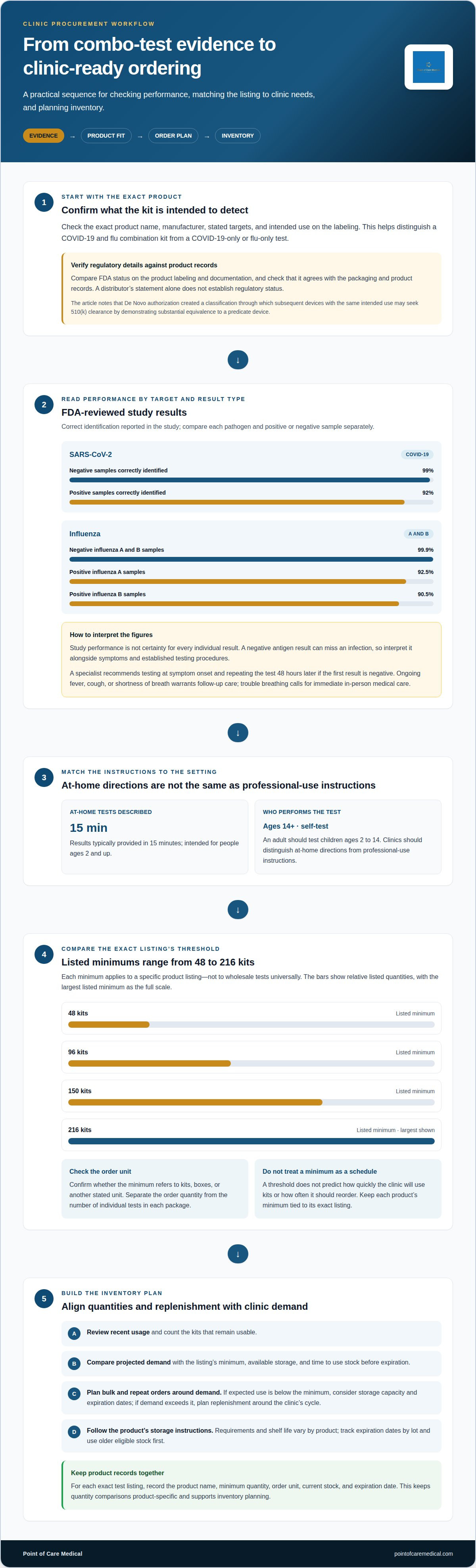
Combo antigen accuracy differs by pathogen and by whether the sample is positive or negative. In an FDA-reviewed study, the test correctly identified 99% of negative SARS-CoV-2 samples and 92% of positive samples. For influenza A and B, it correctly identified 99.9% of negative samples. It identified 92.5% of positive influenza A samples and 90.5% of positive influenza B samples.
When comparing wholesale covid flu combo rapid tests, review performance for each target separately. Study results describe performance in the study, not certainty for every individual result. A negative result can miss an infection, so interpret it alongside symptoms and established testing procedures.
For flu and COVID-19, a specialist recommends testing at symptom onset and repeating the test 48 hours later if the first result is negative. People who continue to have fever, cough, or shortness of breath should seek follow-up care from a health care provider. People having trouble breathing should seek immediate in-person medical care.
In the United States, the relevant regulatory pathway depends on the specific test and intended use. According to the U.S. Food and Drug Administration, De Novo authorization created a classification that allows subsequent devices with the same intended use to seek 510(k) clearance by demonstrating substantial equivalence to a predicate device. State requirements can also depend on the activity and jurisdiction.
To assess a test’s regulatory status and authenticity, compare the exact product name, manufacturer, intended use, and FDA status on its labeling and documentation. Check that these details agree across the packaging and product records. A distributor’s statement alone does not establish regulatory status.
Wholesale prices and bulk discounts depend on product and order terms. Minimum quantities vary by kit, with listed COVID-19 and flu test minimums of 48, 96, 150, or 216 kits. Compare the product’s stated order unit and package contents before evaluating quantities. Retail availability includes pharmacies and online sellers, while listed prices vary by product and pack size.
Manufacturers and medical-test distributors may offer combo kits for bulk purchase. Identify the manufacturer and product from the labeling, then assess the stated targets and intended use. This helps distinguish a combination kit from a COVID-19-only test or a flu-only test when planning procurement.
Storage requirements and shelf life vary by product. Follow the manufacturer’s labeled storage instructions and track expiration dates by lot when receiving bulk shipments. For example, record expiration dates in inventory logs and use older eligible stock first. Don’t assume different kits have the same storage requirements.
At-home COVID-19 and flu tests typically provide results in 15 minutes and are intended for people ages 2 and up. Users ages 14 and older can test themselves; an adult should test children ages 2 to 14. Clinics planning wholesale covid flu combo rapid tests should distinguish at-home directions from professional-use instructions.
Minimum order requirements
Minimum order quantities differ by combo-test listing, so one clinic’s order threshold may not fit another product. Listed COVID-19 and flu test kits have minimums of 48, 96, 150, or 216 kits. Treat each number as specific to its listing, not as a universal wholesale standard. Before building a purchase plan, identify the exact kit and its minimum quantity.
A minimum order sets the lowest quantity accepted for that product. It doesn’t indicate how quickly a clinic will use the kits or how often it should reorder. Compare the threshold with expected patient demand, available storage, and the time needed to use inventory before expiration. A 48-kit minimum, for example, may suit a different purchasing plan than a 216-kit minimum.
- 48 kits: A listed minimum for one COVID-19 and flu test kit.
- 96 kits: A separate listing’s minimum quantity.
- 150 kits: Another product listing’s minimum quantity.
- 216 kits: A higher listed minimum for a different kit.
Order minimums offer a useful basis for comparison, but they don’t establish a standard case size or reorder schedule. Read the sales unit carefully: determine whether the minimum refers to kits, boxes, or another stated unit, and distinguish it from the number of individual tests in each package. This helps procurement teams compare equivalent quantities.
To estimate an order quantity, review recent usage records and count the kits that remain usable. Compare projected demand with the product’s minimum. If demand is below the threshold, consider storage capacity and expiration dates before ordering. If demand exceeds it, plan the order around the clinic’s replenishment cycle rather than relying on the minimum alone.
Keep product thresholds separate in procurement records. A spreadsheet can give each combo test its own line for product name, minimum quantity, order unit, current stock, and expiration date. For example, record a 96-kit threshold beside the exact listing it applies to. Don’t transfer that minimum to another brand or test format. This reduces quantity errors when staff reorder several respiratory products.
Minimums are only one part of the purchase decision. Compare the exact product, its stated order unit, and the clinic’s inventory plan before placing an order. For clinics reviewing respiratory rapid test options, keeping these details together makes quantity comparisons more useful.
The listed minimums are 48, 96, 150, or 216 kits, depending on the product. The section provides no basis for stating wholesale prices or bulk discounts.
Bulk and recurring orders
Shipping, handling, and any cold-chain requirements depend on the kit. Follow the manufacturer’s labeled transport and storage conditions during receipt and storage. The product labeling indicates whether temperature controls apply.
Plan bulk purchases around clinic usage, usable stock, and the time needed to use the inventory. For example, compare recent order records with current stock before setting the next quantity. This ties purchasing to actual demand rather than an arbitrary buffer.
A recurring order schedule should adapt to changes in testing activity. After each purchasing cycle, review usage records and adjust the next order to fit the clinic’s current workflow. If respiratory testing demand fluctuates, revise the planned quantity instead of automatically repeating the same order.
- Review usage: Compare completed tests and remaining kits before placing a new order.
- Check inventory: Separate usable stock from kits that have reached their expiration date.
- Set a reorder point: Use the clinic’s purchasing process to identify when remaining stock should trigger replenishment.
- Record order details: Track the product name, quantity, order date, and receipt date.
Bulk purchasing can simplify procurement by combining quantities into fewer orders, but it also means staff must receive, store, and track more stock. Compare volume-based terms with the quantity the clinic can use within the product’s labeled shelf life. A lower unit cost does not help if kits expire unused.
Build a review into every recurring order cycle. Before reordering, compare the previous quantity with actual consumption and remaining inventory. If testing volume changes, adjust the quantity or timing. Keep the product and sales unit consistent so changes in packaging don’t distort the comparison.
When a shipment arrives, compare it with the purchasing record. Log the product, delivered quantity, lot information, and expiration dates, then store the stock according to the manufacturer’s instructions. Keeping expiration details in inventory records helps staff use eligible kits in the right order.
For wholesale COVID-19 and flu combo rapid tests, organize bulk and repeat purchasing as one inventory process. Tie forecasting, order review, receipt, storage, and expiration tracking together. This gives procurement and clinical teams a shared view of what they have, what they use, and what the next order needs to cover.
Follow the kit’s labeled transport and storage conditions throughout handling. Apply temperature controls when the product labeling requires them.
Storage conditions and temperature requirements vary by product, so follow the manufacturer’s labeling. Plan quantities around each kit’s labeled shelf life, and track expiration dates to use stock before it expires.
COVID-19 and influenza combo tests
A combination antigen test screens for SARS-CoV-2 and influenza in one testing process. For clinics, that can provide results for two respiratory pathogens from a single test workflow. The result still identifies only the targets included in that specific test. Check the product’s intended use and labeling before incorporating it into a clinic protocol.
FDA status depends on the specific test and its intended use. The FDA granted emergency use authorizations for a number of at-home combined flu and COVID-19 tests last winter. Separately, according to the U.S. Food and Drug Administration, its De Novo authorization created a classification that lets later devices with the same intended use seek 510(k) clearance by demonstrating substantial equivalence to a predicate device. Authorization for one test does not establish authorization for every product or use setting.
U.S. wholesale purchasing options include COVID-19 and influenza combo kits offered for clinic screening. Product names, intended users, and authorization pathways differ across listings. Compare those details for each kit rather than treating “combo test” as a complete description. For example, a listing intended for at-home use may not describe the same workflow as a test intended for professional use.
- Targets: Confirm that the product covers SARS-CoV-2 and influenza A and B, if all are needed.
- Intended use: Match the labeled setting and user to the clinic’s testing workflow.
- FDA status: Review the specific product’s authorization and labeling, not just a general category description.
- Order format: Compare the kit’s package unit and minimum quantity with purchasing needs.
At-home combined tests are a distinct option. Results typically take 15 minutes, and these kits are intended for people ages 2 and up. Users ages 14 and older can test themselves; an adult should test children ages 2 to 14. These age directions apply to the at-home tests described, not automatically to professional-use products.
When comparing wholesale COVID-19 and flu combo rapid tests, start with the clinic’s intended use. Then check the exact targets, labeled users, and authorization status. Confirm that the product’s instructions fit the clinic’s testing process, and align its package format with procurement records. Those steps help distinguish a true combination kit from a COVID-19-only or flu-only test.
How combination antigen tests work
A combination antigen test uses a respiratory specimen to check for proteins linked to its listed pathogens. Test reagents interact with those targets, and the device displays target-specific indicators. For example, a kit may have separate result areas for SARS-CoV-2, influenza A, and influenza B. The exact targets depend on the product labeling.
Each test has its own procedure. Follow the product instructions for collection, sample preparation, timing, and interpretation. A brief training checklist can help staff apply the steps consistently, for example, by prompting them to confirm the specimen type and read results within the stated time window.
Read each result area separately. A positive indicator for one target does not establish a result for another target. If a device reports SARS-CoV-2, influenza A, and influenza B individually, document each finding in its corresponding field. Follow the product instructions for invalid or unclear readings instead of recording them as negative.
Compared with separate COVID-19 and influenza tests, a combo test assesses multiple listed targets within one test workflow. Separate tests use distinct test procedures for their respective targets. Clinics purchasing wholesale covid flu combo rapid tests can compare workflow needs, target coverage, and documentation practices before choosing a format. Neither format should be presumed more accurate without product-specific performance information.
Use this sequence to assess how a test fits the clinic’s workflow:
- Match targets: Confirm the kit includes the pathogens the clinic needs to assess.
- Review instructions: Note the specimen, preparation, timing, and result-reading steps.
- Prepare staff: Use the product instructions to guide staff training and reference materials.
- Record findings: Keep each target’s result distinct in the clinic record.
Control indicators and unreadable results need attention, too. The product instructions explain how to interpret the control and respond if it fails the stated criteria. Include that response in staff procedures before routine use, so an invalid reading isn’t treated as a positive or negative finding.
A combo test only assesses the targets named in its labeling. For example, a test for SARS-CoV-2 and influenza does not report findings for other causes of respiratory symptoms. Clinics should consider that scope when deciding how results fit into their broader assessment process.
When evaluating wholesale covid flu combo rapid tests, compare the labeled targets with the clinic’s intended workflow and documentation needs. Review combination rapid test options as part of that product comparison.
Point of Care Medical: GenBody COVID-19 Rapid Antigen Test
Point of Care Medical offers the GenBody COVID-19 Rapid Antigen Test for clinics sourcing a COVID-19 antigen option. For clinics that need a combination test for SARS-CoV-2 and influenza A and B, Point of Care Medical also offers the ViraDx™ SARS-CoV-2/Flu A+B Rapid Antigen Test. These options serve different testing needs, so match the product to the pathogens your clinic intends to assess.
Use the accuracy, intended-use, and inventory considerations above to guide product selection. Review each test’s labeling and instructions as part of the clinic’s purchasing and workflow decisions.
Contact Point of Care Medical or visit pointofcaremedical.com to discuss its rapid test offerings.
Make your next purchasing cycle more predictable
Turn these considerations into a written procurement process before the next respiratory testing cycle. Assign responsibility for reviewing demand, receiving shipments, updating inventory records, and initiating replenishment. Clear handoffs help clinical and purchasing teams work from the same inventory information.
A procurement plan for wholesale COVID-19 and flu combo rapid tests should also define how staff compare products against clinic workflow. Record the product selected, the reason it fits the intended use, and the internal steps for reviewing future orders. This creates a consistent basis for purchasing decisions as clinic needs change.
Point of Care Medical offers diagnostic test options for clinics planning or refining their supplies. Review the product information to identify options relevant to your testing needs, then align your selection with the clinic’s established procedures.
Review testing options at Point of Care Medical as you prepare your next procurement cycle. A practical process gives your team a clear starting point for dependable planning.
Frequently Asked Questions
How does a combo flu/COVID-19 test work?
A combo test uses one respiratory specimen to look for antigens associated with its listed targets. Test reagents produce target-specific result indicators, which staff interpret using that kit’s instructions. For example, a device may display separate indicators for SARS-CoV-2 and influenza. Record each indicated result separately, and follow the product instructions for invalid readings or control indicators.
What are the sensitivity, specificity, and turnaround time of leading COVID-flu combo rapid tests?
Performance depends on the specific test and its labeling. In an FDA-reviewed study, reported sensitivity was 92% for positive SARS-CoV-2 samples, 92.5% for positive influenza A samples, and 90.5% for positive influenza B samples. Reported specificity was 99% for negative SARS-CoV-2 samples and 99.9% for negative influenza A and B samples. At-home combo tests typically return results in 15 minutes.
What are the risks of false negative results and when should users seek confirmatory testing?
A false negative can occur even when infection is present, so symptoms remain relevant to next steps. If the first test is negative, repeat testing after 48 hours is recommended for flu and COVID-19. People with continuing fever, cough, or shortness of breath should seek follow-up care from a health care provider. Trouble breathing calls for immediate in-person medical care.
Which U.S. wholesale suppliers offer the fastest shipping and availability for combo rapid tests?
Point of Care Medical distributes respiratory tests in the United States, including the ViraDx™ SARS-CoV-2/Flu A+B Rapid Antigen Test. Shipping speed and product availability depend on the specific order and configuration, so compare the stated fulfillment timing for the product you need. Match the test’s targets and intended use to your clinic’s workflow before placing a bulk order.
What storage conditions, shelf life, and expiration dates apply to wholesale combo test kits?
Storage requirements and shelf life vary by product, so follow each kit’s labeled instructions. Track expiration dates by lot and use older eligible stock first.
What are the wholesale prices, minimum order quantities, and bulk discounts for combo rapid tests?
Minimum order quantities are 48, 96, 150, or 216 kits, depending on the product. Bulk discounts depend on the product and order terms.


