

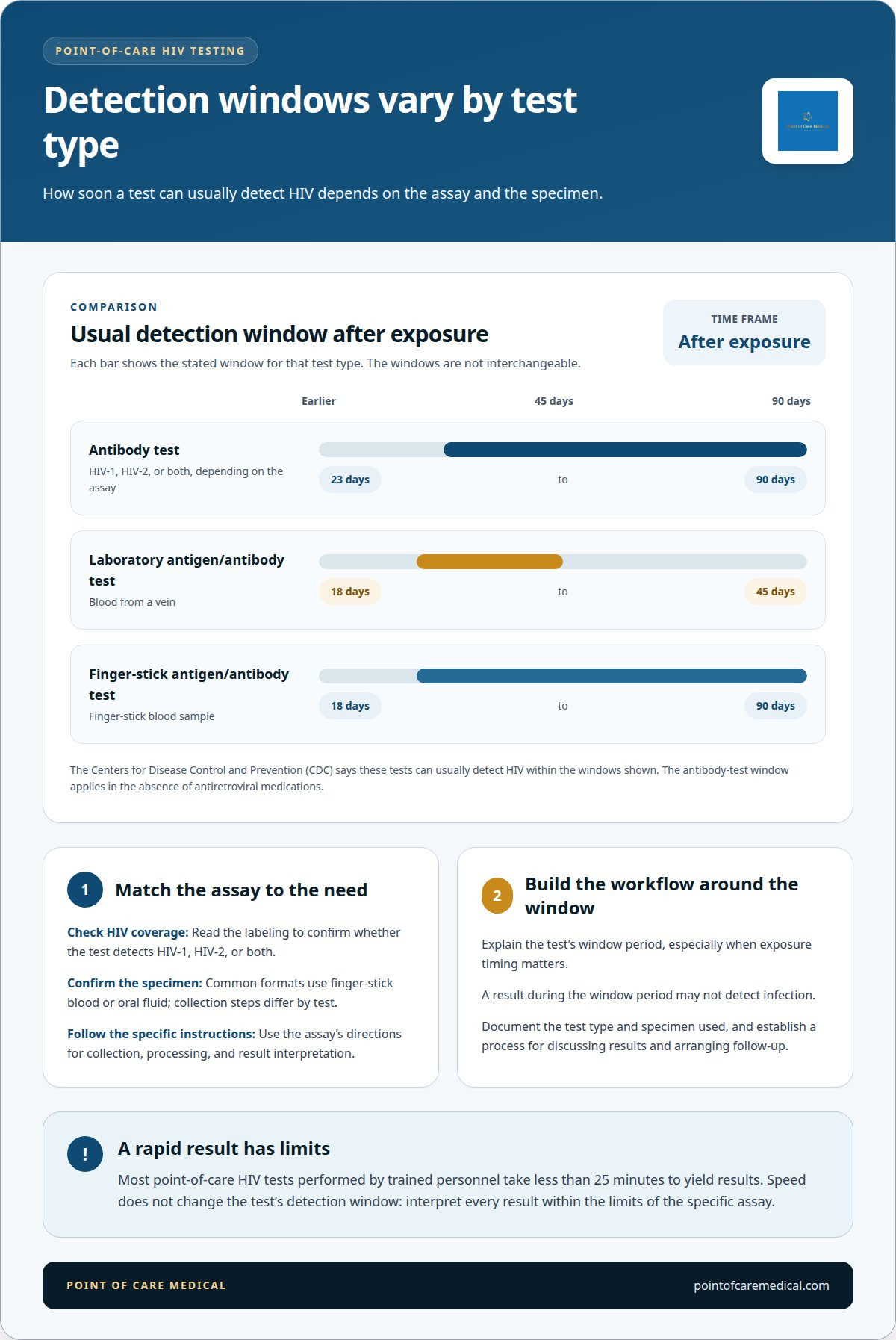
CLIA waived HIV rapid tests can screen for HIV-1 and HIV-2 antibodies, but timing matters: according to the Centers for Disease Control and Prevention, an antibody test can usually detect HIV infection 23 to 90 days after exposure in the absence of antiretroviral medications. Most point-of-care HIV tests performed by trained personnel take less than 25 minutes to yield results.
That speed can support practical testing workflows, but understanding what the result can tell you depends on the test type and its detection window. This guide explains rapid HIV-1 and HIV-2 antibody tests, quality-control supplies, and the requirements, application process, and renewal steps for a CLIA waiver. You’ll also see how these considerations fit into planning a reliable point-of-care testing program.
Key Takeaways
- The Centers for Disease Control and Prevention advises that people ages 13 through 64 be tested for HIV at least once as part of routine health care.
- Learn how rapid HIV-1 and HIV-2 antibody tests fit into point-of-care workflows and what to consider when selecting quality-control supplies.
- Understand the steps involved in applying for a CLIA Certificate of Waiver and renewing it before it expires.
- See why a reactive rapid result calls for follow-up testing and how to plan appropriate next steps.
- Review test limitations, false-positive considerations, and safety practices that support responsible testing.
Rapid HIV-1 and HIV-2 antibody tests
Rapid antibody tests look for the body’s response to HIV. The assay detects antibodies associated with HIV-1, HIV-2, or both. Read the test’s labeling to identify its intended HIV coverage. Selecting CLIA waived HIV rapid tests starts with matching that coverage to the facility’s screening needs. A test that detects both types supports broader screening within one workflow. The selected assay must also match the facility’s specimen collection process. Common formats use a finger-stick blood sample or oral fluid. Follow the specific test instructions for collection, processing, and result interpretation. Do not assume different test formats use identical steps.
Timing affects how an antibody result should be understood. In the absence of antiretroviral medications, an antibody test can usually detect HIV infection 23 to 90 days after exposure, according to the Centers for Disease Control and Prevention. This interval is the test’s window period. A test performed during that period may not detect infection. For comparison, a laboratory antigen/antibody test using blood from a vein can usually detect HIV infection 18 to 45 days after exposure, according to the Centers for Disease Control and Prevention. A finger-stick antigen/antibody test can usually detect HIV infection 18 to 90 days after exposure, according to the Centers for Disease Control and Prevention. These are different test types, so their windows should not be treated as interchangeable.
Testing access also supports routine care. The Centers for Disease Control and Prevention advises that people ages 13 through 64 be tested for HIV at least once as part of routine health care. Facilities can use this recommendation to plan screening access and staff workflows. Before choosing an assay, identify the intended population, specimen type, and testing location. Then compare the device’s HIV-1 and HIV-2 coverage with the facility’s screening needs. Confirm that staff can perform each step as written.
Prepare before a patient arrives. Review the package instructions, specimen requirements, storage conditions, and result-reading criteria. Set up a clean work area with the materials needed for the chosen test. Assign trained personnel to collect specimens, perform the assay, and record results according to facility procedures. Keep the instructions accessible during testing. Use quality-control materials when required by the test instructions and facility procedures. Record control results and resolve any out-of-range control before testing patient specimens. Include these steps in staff training when preparing to use CLIA waived HIV rapid tests.
Interpret each result within the limits of the specific assay. A rapid antibody result indicates antibody detection; it does not establish that every recent exposure will be detected. Document the test type and specimen used. Explain the window period to patients, especially when the timing of exposure matters. Establish procedures for discussing results and arranging follow-up. Matching the assay, workflow, and counseling process helps make point-of-care screening more consistent.
Applying for and renewing a waiver certificate
Plan the certificate process before introducing waived testing at a facility. Agencies applying for a CLIA Certificate of Waiver can obtain application form CMS-116 from the CMS website or their state health department. Start by identifying the facility responsible for testing and the state agency handling its application. Keep the form, supporting records, and correspondence together in one administrative file. This creates a clear reference point for submission and later renewal work.
Use a consistent preparation process. First, obtain the current CMS-116 form through one of the stated channels. Next, review each field and assemble the facility details requested by the form. Assign a staff member to coordinate completion and retain the final submitted copy. Record the submission date and the state agency contact or correspondence. These are practical recordkeeping steps, not additional certificate requirements. They help the facility track its paperwork and respond consistently to application-related requests.
For an orderly application workflow, prepare these items:
- Form access: Obtain CMS-116 from the CMS website or the state health department.
- Form review: Read the application fields and collect the information they request.
- Submission record: Keep a copy of the completed form and note when it was sent.
- Renewal calendar: Record the certificate expiration date and schedule advance preparation.
A CLIA Certificate of Waiver is valid for two years. A renewal application must be sent to the state agency not less than 9 months before expiration. Treat that timing as a fixed planning point. Do not wait until the expiration date is near to begin assembling renewal materials. Instead, add the deadline to the facility’s compliance calendar when the certificate is issued. Set an internal reminder early enough to review the form and prepare the submission before the required window.
When preparing for renewal, gather the current certificate, prior application records, and relevant agency correspondence. Confirm that the facility’s administrative details are accurate, then complete the renewal application using the applicable form. Keep a dated copy of the submitted materials. Track the renewal through the state agency’s process and file the renewed certificate with the original records. Assigning a staff owner can prevent missed handoffs when personnel or responsibilities change.
Keep certificate administration separate from test procurement, but coordinate both in the facility’s operating plan. For the supply side of point-of-care testing, Point of Care Medical is a relevant resource for healthcare facilities.
CLIA Certificate of Waiver requirements
In the United States, facilities that examine human specimens to diagnose, prevent, or treat disease, or assess health, must register with the Centers for Medicare & Medicaid Services and obtain CLIA certification. A facility planning rapid HIV screening should address certification before testing begins. Certification is the responsibility of the facility conducting the testing, not simply the person ordering supplies. Identify each testing location and its administrative owner early.
A Certificate of Waiver applies to testing conducted under the applicable waiver pathway. Build the operating plan around the selected assay and its instructions. Check how specimens are collected, how results are read, and which quality-control steps the instructions require. Assign staff to perform the test and maintain records. These measures help align daily operations with the facility’s certification responsibilities, but they do not replace the required application.
Before submitting paperwork, create a controlled document file containing the facility’s certificate records, application materials, and relevant state-agency correspondence. Keep test instructions and written procedures accessible to staff. For example, a clinic using finger-stick specimens can document who collects samples, who performs testing, and where results are recorded. This makes responsibilities clear during routine work and staff transitions. Review the workflow when the facility changes locations, personnel, or testing procedures.
State requirements can change the administrative process. Washington is exempt from CLIA regulations and has its own requirements that meet or exceed CLIA requirements. New York is exempt from CLIA except for physicians’ office laboratories, which must have a CLIA certificate; the state has its own requirements that meet or exceed CLIA requirements. Facilities in either state should plan around the applicable state framework rather than assume that procedures used elsewhere apply unchanged.
Use a structured readiness review before launching testing:
- Facility scope: Identify the location and testing activity covered by the plan.
- Certificate records: Maintain application documents and agency correspondence together.
- Assay procedures: Keep the selected test’s instructions available to testing personnel.
- Staff workflow: Assign specimen handling, testing, result recording, and quality-control responsibilities.
- State pathway: Account for the relevant state requirements, including Washington or New York provisions.
Connect procurement decisions to the approved testing workflow. The test’s intended use and instructions should fit the facility’s planned procedures. Keep purchasing records distinct from certification documents, while retaining both in the facility’s record system. This helps administrators manage supplies without confusing product selection with certification. Review the process whenever the facility updates its test menu or written procedures.
What confirmatory testing and follow-up are needed after a reactive rapid HIV result?
A reactive rapid result should trigger the facility’s follow-up protocol. Treat it as a screening outcome that requires additional clinical steps, not as a complete patient-care workflow. The protocol should specify who communicates the result, who arranges further testing, and how each step is documented. Clarify these roles before testing begins. For example, a clinic might assign result communication to the testing clinician and follow-up coordination to a designated care team member.
Follow the facility’s established clinical pathway for confirmatory testing. Under that pathway, the responsible clinical team should select the test method and specimen collection. Do not choose a supplemental test solely for convenience or because it matches the initial rapid-test format. Staff should know where to place the follow-up order, how the specimen is routed, and who reviews the report. A written workflow supports continuity if the original tester is unavailable.
Use an ordered process after a reactive result:
- Record the screening result: Document the assay, specimen, date, and result in the appropriate record.
- Explain the next step: Tell the patient that additional clinical testing is part of the follow-up process.
- Arrange further testing: Follow the facility’s clinical pathway for ordering and collecting the next specimen.
- Assign result review: Identify the person responsible for receiving and acting on the report.
- Close the loop: Record patient communication and the completed follow-up actions.
Use clear, neutral language. Do not present a reactive screening result as a final diagnosis. Explain what happens next, who will coordinate it, and how the patient will receive follow-up information. Staff should use approved scripts or counseling procedures where available. If a patient leaves before the next step is arranged, document the contact plan and assign responsibility for outreach.
Protect confidentiality throughout testing and follow-up. Discuss results only in appropriate care settings and with authorized personnel. Follow the facility’s identity-check procedures before sharing results. Secure paper records and keep electronic records within the authorized system. Avoid leaving detailed messages that disclose sensitive health information. These practices support a controlled handoff between the testing area and the team arranging follow-up.
Review the reactive-result workflow with staff before putting it into practice. A brief scenario can confirm that personnel know whom to notify, where to document the result, and how to arrange further testing. Update the procedure when roles or systems change. Track unresolved follow-up steps through the facility’s usual patient-care process. This review helps ensure a reactive result is not recorded without a clear next action.
Follow-up planning can also include ongoing testing guidance. The Centers for Disease Control and Prevention says sexually active gay and bisexual men may benefit from HIV testing every 3 to 6 months. Timing can matter when a recent exposure is possible: in the absence of antiretroviral medications, a nucleic acid test can usually detect HIV infection 10 to 33 days after exposure, according to the Centers for Disease Control and Prevention.
The Clinical Laboratory Improvement Amendments were established in 1988 to set quality standards for laboratory testing, supporting reliable processes for handling and reviewing specimens.
What are the limitations, false-positive risks, and safety precautions for rapid HIV tests?
A rapid HIV test provides a screening result within its intended use, but it cannot answer every question about exposure timing or diagnosis on its own. An antibody test may not detect infection during its window period. The Centers for Disease Control and Prevention explains that detection depends on test type and time since exposure. Interpret results alongside the test instructions and the patient’s testing timeline.
The possibility of a false-positive result is another reason to plan the full workflow. A reactive screening result requires follow-up testing before it is treated as a confirmed diagnosis. Define who communicates the result, arranges additional testing, and tracks completion. For example, document the screening result, explain the next step, and assign a staff member to coordinate follow-up. Clear responsibilities help prevent a reactive result from being mistaken for a final finding.
Correct execution matters. Collecting a specimen incorrectly, omitting a step, or reading a result outside the instructed timeframe can compromise the process. Follow the test’s directions for specimen type, timing, and result interpretation. Do not apply one assay’s procedure to another. Train staff on the specific device and keep its instructions where testing takes place. Follow the quality-control procedures required by the test directions and facility policy.
Follow routine specimen-handling precautions throughout testing. Before collection, prepare the work area and gather the materials listed in the instructions. Use the protective equipment and handling practices required by facility procedures. Keep patient specimens separate from clean supplies. Dispose of used materials through the facility’s established process. After testing, clean the work surface according to local procedures and document any process issues. These steps support consistent handling without changing the assay procedure.
Facilities can use this pre-test checklist:
- Confirm the assay: Match the test instructions to the specimen and intended use.
- Check the setup: Gather required materials and prepare the testing area.
- Follow the procedure: Observe each collection, processing, and reading step.
- Record the outcome: Document the test and follow the facility’s result pathway.
- Escalate concerns: Route reactive results and process problems through established procedures.
Do not use a rapid screen as a substitute for the facility’s follow-up pathway. A nonreactive result also needs context when exposure timing falls within the assay’s detection window. Staff should explain the test’s limits using approved patient communication procedures. Review the workflow with personnel and revise it when device instructions or facility procedures change. For operational planning, review point-of-care testing supplies alongside your facility’s testing workflow.
Point of Care Medical: GenBody COVID-19 Rapid Antigen Test
Point of Care Medical offers the GenBody COVID-19 Rapid Antigen Test for facilities managing respiratory testing alongside HIV screening. It addresses a separate testing need, so it should not replace an HIV assay or confirmatory follow-up. Keep each test aligned with its intended use and the facility’s procedures.
For facilities coordinating multiple point-of-care testing workflows, GenBody tests may be considered as part of respiratory testing procurement. Maintain separate procedures, supplies, and result documentation for each assay. This keeps workflows clear across screening programs without conflating their purposes.
To discuss the GenBody COVID-19 Rapid Antigen Test, contact Point of Care Medical.
Make your testing plan operational
Make testing policy part of a repeatable procurement process. A sourcing plan for CLIA waived HIV rapid tests should connect assay selection with the facility’s patient workflow, documentation process, and supply responsibilities. Assign an owner to review these elements together. This keeps purchasing aligned with clinical operations as staffing or testing priorities change. Keep product selection separate from decisions about testing procedures and result follow-up.
For related rapid-test procurement, Point of Care Medical offers the GenBody COVID-19 Rapid Antigen Test, Rapid Test Cup "RTC" + Fentanyl, and ViraDx™ SARS-CoV-2/Flu A+B Rapid Antigen Test. These offerings address different testing needs, so map each to its intended role in your facility’s program. A clear procurement plan can help teams manage product categories without confusing their purposes or workflows.
Explore the available offerings and take the next step toward an organized testing plan at Point of Care Medical. A practical, well-coordinated process gives your team a clear foundation for ongoing procurement.
Frequently Asked Questions
What CLIA certificate or waiver is required to perform rapid HIV testing?
Facilities that test human specimens to assess health or diagnose, prevent, or treat disease need CLIA certification. Facilities using tests categorized as waived need a CLIA Certificate of Waiver. For example, a clinic adding waived HIV screening should include the testing location in its certification planning and confirm the assay’s waiver status before incorporating it into the workflow.


