

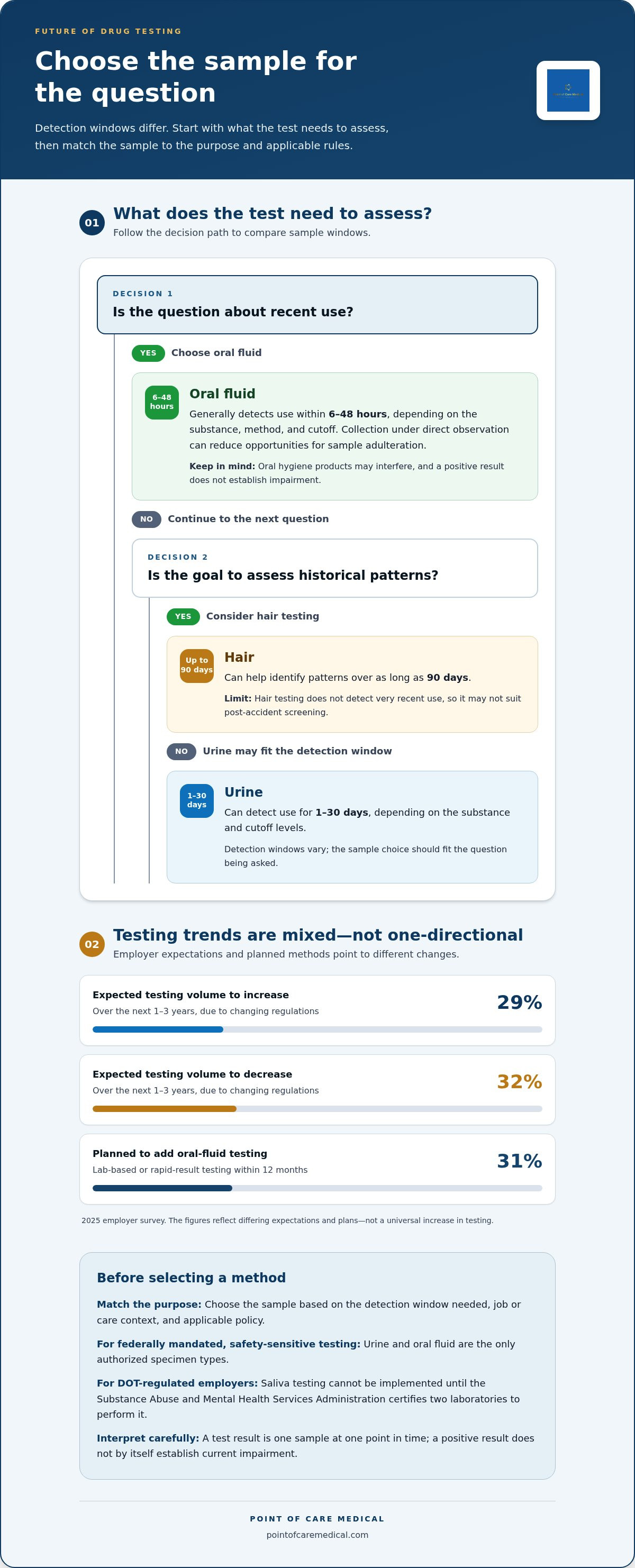
The future of drug testing may bring more screening in some settings, but not a universal increase. In a 2025 employer survey, 29% of respondents expected changing regulations to increase testing volumes over the next 1-3 years, while 32% expected them to decrease. The direction is mixed, and at-home screening could reshape how people access tests without replacing workplace or clinical programs.
That uncertainty matters to employers and care teams balancing safety, changing policies, and practical testing needs. New approaches may make screening faster or more accessible, but the method still needs to fit its purpose.
This article explores the future of drug testing, including whether testing is likely to increase and what may drive that change. It looks at rapid testing, mobile and digital tools, and at-home options, and explains where each may fit in workplaces and care settings. Convenience alone does not determine whether a screening method is appropriate.
Key Takeaways
- Expect drug-testing trends to vary by employer and setting, rather than move uniformly upward. Use role, risk, and applicable rules to shape screening policies.
- Compare oral-fluid, urine, and hair testing by the time period each can help assess, not just by convenience.
- Rapid screens can support timely decisions, while confirmation procedures remain important for interpreting results.
- Mobile and digital tools may simplify scheduling and result management, but they don’t replace sound testing protocols.
- At-home screening may expand access; understand its limits and how results fit the decision you need to make.
Potential workplace, hospital, and treatment-center uses
Workplace drug testing has been standard practice in many industries for decades, especially where impairment could create safety risks. Programs may use pre-employment, random, post-accident, or reasonable-suspicion testing, based on job duties and applicable rules. The Future of Drug Testing will likely involve more targeted choices, not one universal panel. High-risk industries are adopting expanded 10-panel and 11-panel tests, while hospitals may explore rapid methods to support decisions during overdose emergencies.
Cannabis laws complicate workplace policies. Forty states and Washington, D.C., have legalized medical marijuana, while twenty-four states and Washington, D.C., allow recreational use. Yet federal and state rules remain misaligned. Some states restrict discipline for off-duty legal use, limit pre-employment testing before a conditional offer, or prohibit random testing except in defined circumstances. Employers should align each program with job-related risks, state law, and industry requirements. A cannabis result also does not establish current impairment.
What new drug testing standards and regulations are expected in the United States? Federal workplace panels added fentanyl effective July 7, 2025, and the U.S. Department of Health and Human Services revised guidelines to include fentanyl and norfentanyl. For DOT-regulated employers, saliva testing cannot be implemented until the Substance Abuse and Mental Health Services Administration certifies two laboratories to perform it.
What are the costs of new drug testing technologies? Costs depend on the testing method, sample collection process, panel scope, and whether laboratory confirmation is needed. Digital scheduling and result workflows may also affect program costs through setup and administration.
Fentanyl is an increasing consideration in workplace panels, while ketamine may be relevant when an employer’s policy and role-specific risks call for targeted screening. Expanded panels can cover selected substances, but no single panel detects every drug. For synthetic drugs and new psychoactive substances, targeted assay development is key: programs need tests designed for the substances they intend to identify. Fingerprint testing using paper-spray mass spectrometry is also being studied, including for emergency substance identification and routine monitoring, but it is not a universal replacement for established methods.
What privacy, bias, and consent risks come with advanced drug testing? Digital records and new sample methods can expose sensitive health or employment information if access, retention, and use are poorly controlled. Apply written policies consistently, limit data access to relevant personnel, and explain the purpose and process before collecting samples. These steps can also help reduce inconsistent treatment across workers.
Hospitals and treatment centers may use screening to inform care rather than workplace discipline. Fingerprint testing has been proposed for overdose emergencies and routine monitoring in doctors’ offices. A single result represents one sample at one point in time, so clinical teams need to interpret it alongside the immediate situation and the person’s care needs.
Will drug testing increase in the future?
U.S. employers expect different directions, not a single rise in testing. In a 2025 employer survey, 29% expected changing regulations to increase volumes over the next 1-3 years, while 32% expected a decrease. Method choice may change alongside volume. In the same survey, 31% planned to add lab-based or rapid-result oral-fluid testing within 12 months. For decision-makers, the useful question is which sample fits the purpose, policy, and industry requirements.
Urine, hair, and oral fluid each capture a different detection window. Urine testing can detect use for 1-30 days, depending on the substance and cutoff levels. Hair testing can identify patterns over as long as 90 days, which can help assess historical use. It does not detect very recent use, so it may not suit post-accident screening. Oral fluid testing generally detects use within 6-48 hours, depending on the substance, method, and cutoff. A random test aimed at recent exposure may therefore call for a different sample than a review of longer-term patterns.
Oral fluid can be collected under direct observation, which can reduce opportunities for sample adulteration. Its shorter detection window also makes it more relevant to recent use than historical patterns. There are limits: oral hygiene products may interfere with results, and a positive result does not establish impairment. Federal workplace guidelines recognize oral-fluid testing, but implementation is still evolving as of 2026. DOT-regulated employers cannot implement saliva testing until the Substance Abuse and Mental Health Services Administration certifies two laboratories to perform it.
Blood testing may have a different role. Lab-on-a-chip devices may analyze small blood, saliva, or urine samples for multiple substances and provide results in minutes. That speed could support time-sensitive assessment in care settings. It does not make blood interchangeable with workplace samples: the decision, collection process, and applicable program standards determine whether a method fits.
For federally mandated, safety-sensitive testing, urine and oral fluid are the only authorized specimen types. Hair testing may complement other methods when a program needs historical information, while oral fluid may suit a recent-use question. Employers should match each panel and protocol to job risk, industry rules, and state requirements. In practice, document the purpose of each test before selecting the sample type, then apply the policy consistently across comparable roles.
For programs considering oral-fluid screening, review how oral fluid testing options fit the intended screening purpose and workflow.
Rapid drug-test screening and confirmation
Rapid drug tests can produce qualitative screening results in minutes. Across complete testing workflows, screening results may take 4 hours on average. In a 2025 employer survey, 40% of respondents named timely results as a major challenge. Another 23% were likely or very likely to shift from lab-based testing to instant or rapid-result methods within 1-2 years. Faster screening can shorten initial decision times, but a preliminary result and a confirmed result serve different purposes.
Confirmation helps organizations assess non-negative screening results through established laboratory methods. Confirmatory results are typically available in 2 to 3 days. A sound program maintains chain of custody, applies established cutoffs, and follows a consistent review process. These steps matter because a screening result alone should not carry the full weight of an employment or care decision. Record the result, preserve the sample process, and follow the organization’s protocol before taking action.
Workforce positivity figures offer context, not an individual verdict. The combined U.S. workforce urine positivity rate was 4.3% in 2025. Marijuana positivity in urine testing among the general workforce was 4.4% that year. Those figures describe tested populations. They do not establish whether a particular worker was impaired during a specific situation. Drug tests cannot measure marijuana impairment, so organizations should separate a test result from any separate assessment of fitness for duty.
CBD reports also require careful handling under a written policy. If a worker reports CBD use, document that information separately and apply the same panel, cutoff, and review process used for comparable cases. A marijuana-positive drug test does not show whether a person is impaired. Employers should not treat the result as a complete account of conduct or job performance. The role, applicable policy, and testing purpose remain relevant to interpreting the finding.
Machine learning may help laboratories recognize patterns across drug-test results, with the aim of reducing false positives and improving reliability. It can support review, but it does not replace validated testing methods or established cutoffs. A model’s output depends on the data and rules used to train it. Human review remains important when a result could affect employment or care, especially when screening and confirmation produce different findings.
Use results according to the decision each test was designed to inform. For example, a negative result may be reported within 24 hours, while a non-negative screen may need confirmation. Keep screening, confirmation, and final review distinct in program records. This structure helps HR teams, clinicians, and safety managers apply results consistently without confusing a preliminary flag with a confirmed finding.
Mobile and instant digital screening
Mobile screening tools can connect appointment scheduling, collection instructions, and result delivery in one workflow. In a 2025 employer survey, 35% of respondents were interested in mobile apps for scheduling and results. That interest points to an administrative opportunity: employees can receive clear instructions, while program staff can track each testing step. Digital convenience does not change what a specimen can detect or how a result should be interpreted.
For a workplace program, map the process from selection through review. Identify who schedules the test, records collection status, and receives results. A mobile workflow can make missed steps visible, such as an incomplete appointment after a post-accident test. Limit access to relevant personnel and document how results move through screening and confirmation. A digital record supports consistency only when the underlying protocol is clear.
Remote-proctored drug screening may use video or digital instructions to guide someone through collection away from a central site. Before using this model, define identity checks, sample handling, and secure result transfer. These controls matter because remote collection changes how staff observe the process. For a safety-sensitive role, the method must also fit the applicable testing program and its specimen requirements.
Rapid screens can deliver an initial result quickly, while laboratory confirmation follows a separate process. Digital systems can label these stages distinctly, so a preliminary screen is not mistaken for a final determination. After a non-negative screen, follow the established confirmation and review steps. This separation improves record clarity, especially when an employee’s result follows an accident or another time-sensitive event.
How are rapid, at-home, and wearable drug tests developing? Rapid tests provide qualitative screening results in minutes, and at-home kits bring sample collection closer to the individual. Companies have also developed wristbands and patches intended to detect drugs or alcohol in sweat, but these wearables need further research and testing.
Wearable screening raises a distinct accuracy question: what substance is detected, over what window, and under which conditions? A sweat-based signal may support ongoing observation, but it should not be treated as equivalent to a validated drug test without evidence for that use. Before adopting a new device, define its purpose, determine how results will be reviewed, and explain the process to employees. Digital tools can streamline administration, but a clear protocol remains the basis for dependable decisions.
At-home drug testing
At-home drug tests offer private collection and an initial screening result without a workplace collection site. That convenience changes access, not what a sample can show. A home urine test provides a point-in-time screen. The result reflects the test’s panel, cutoff, sample quality, and collection process. It cannot establish a person’s complete history or current impairment. Match the test to the question before interpreting the result.
Detection windows vary by specimen and substance. Most drugs are typically detectable in urine for about 1 to 4 days, with longer detection possible for frequent cannabis use. Oral-fluid tests generally focus on recent exposure, while hair testing can assess longer-term patterns. These methods answer different questions. Someone checking for recent use needs a different window than someone assessing a broader history. A test’s instructions and stated detection purpose should guide how its result is understood.
Collection quality matters at home. Follow the kit instructions in sequence, use the correct sample type, and record the collection time. For urine screening, handling and storage can affect whether a sample is suitable for testing. For saliva collection, oral hygiene products may interfere with results. Do not treat a screening result as final when the decision has employment, treatment, or other serious consequences. A non-negative screen calls for an appropriate confirmation process.
At-home screening can help someone decide whether to seek further assessment or discuss a concern with a care professional. It is not interchangeable with a regulated workplace program. Workplace testing may require defined collection procedures, chain of custody, and documented review. A home kit also cannot determine impairment. For example, a positive marijuana result does not show whether someone is impaired at the time of testing. Use the result only within the limits of the method and its detection window.
Before choosing among drug tests, identify the purpose: recent exposure, historical pattern, or an initial personal screen. Then compare specimen type, substances included, instructions, and how results are interpreted. Keep the kit’s stated use distinct from any employment or clinical decision. This sequence helps prevent a convenient home result from being treated as broader evidence than it is.
For organizations considering oral-fluid screening in their testing workflows, explore oral fluid testing supplies suited to institutional use.
Point of Care Medical: GenBody COVID-19 Rapid Antigen Test
Point of Care Medical supplies the GenBody COVID-19 Rapid Antigen Test for respiratory screening needs. Its offerings also include the Rapid Test Cup "RTC" + Fentanyl for toxicology screening, ViraDx™ SARS-CoV-2/Flu A+B Rapid Antigen Test, and SURE CHECK HIV 1/2 Assay. These products address distinct screening purposes, so select the test that matches the substance or infection being assessed and follow its instructions.
For organizations reviewing testing workflows, these options connect emerging technology with practical screening supplies. Drug tests support screening, not a standalone assessment of impairment. Use the appropriate protocols for the decision at hand.
Visit pointofcaremedical.com to explore Point of Care Medical’s testing offerings.
Build a testing program ready to adapt
The future of drug testing will depend not only on new devices, but also on how well organizations connect testing choices to clear decisions. Treat each method as part of a broader workflow: define the purpose, set consistent review steps, and make sure staff understand how results inform action. This approach gives new tools a practical place without letting convenience replace sound judgment.
For your next program review, identify one point where the current process creates delay or uncertainty. Then assess whether a different screening format or clearer result-handling steps could address it. Keep intended use, privacy protections, and follow-up in view as the program evolves.
Point of Care Medical offers testing supplies for organizations assessing screening needs across infectious disease and toxicology. Explore the available options and take a practical next step for your workflow.
Visit Point of Care Medical to learn more. A deliberate review today can help your program adapt with clarity.
Frequently Asked Questions
Current Drug Testing Technologies: What Exists Today?
Current programs use urine, oral fluid, and hair samples, with rapid screens and laboratory testing serving different roles. Urine and oral fluid are authorized specimens for federally mandated safety-sensitive testing. Blood testing and fingerprint analysis are additional approaches under development or specialized evaluation. Wearables designed to detect substances through sweat are also being studied, but they are not interchangeable with established workplace testing methods.
How Does it Work?
A drug test analyzes a collected sample for specified substances or their markers. A screening method compares detected signals with established cutoff levels and reports an initial result. A non-negative screen can proceed to laboratory confirmation under the program’s review protocol. The panel, specimen, cutoff, collection controls, and confirmation process all shape what the result means. For example, an oral-fluid screen addresses a different exposure period than a hair sample.
What Are the Advantages?
Testing can help organizations apply written screening policies consistently and identify results that require further review. Rapid formats can support quicker initial decisions, while laboratory confirmation adds a separate review step for non-negative screens. Different specimen types also let a program align collection with its purpose, such as assessing recent exposure or longer-term patterns. These benefits depend on selecting an appropriate panel and applying the same process to comparable situations.
What new technologies are shaping the future of drug testing?
Several developments focus on speed, collection, and data handling. Lab-on-a-chip devices can analyze small blood, saliva, or urine samples and may return results in minutes. Fingerprint analysis using paper-spray mass spectrometry is being explored for substance detection. Mobile applications can support scheduling and result management, while sweat-sensing wristbands and patches are under development. Each approach raises practical questions about validation, sample handling, and how results should inform decisions.
How accurate are emerging drug testing methods compared with current tests?
Accuracy depends on the method, specimen, target substance, cutoff, and validation process, so emerging tools cannot be ranked as one group. Rapid screens provide an initial result, while confirmation testing adds an analytical step. Machine learning is being studied to recognize patterns and support reliability, but it does not replace validated laboratory procedures. For any method, assess how it performs for the specific substances and samples in its intended use.
How will hair, saliva, urine, blood, and sweat testing compare in the future?
These specimens serve different assessment windows and collection needs. Hair can support review of longer-term patterns, while urine and oral fluid can identify exposure within shorter, substance-dependent windows. Blood-based lab-on-a-chip devices are being developed for rapid analysis. Sweat-sensing wearables remain under research and testing. A practical comparison considers the decision being made, whether the method detects the target substance, and how results will be confirmed and reviewed.
How will cannabis legalization and changing workplace policies affect drug testing?
Policy decisions will continue to vary with state law, job duties, and federal requirements. Current Consulting Group’s 2026 survey found that 64% of respondents cited marijuana legalization-related reasons for employers stopping drug testing. Employers can respond by defining which roles require screening, what a test result triggers, and how policies distinguish a positive result from evidence of impairment. Clear written procedures help teams apply rules consistently across similar cases.
How are AI and data analytics being used in drug testing?
AI and data analytics can identify patterns across testing data and support program-level review. Machine learning is being studied to recognize result patterns, with the goal of improving reliability and reducing false positives. Predictive analytics may also flag trends for further assessment. These tools should support, not replace, established cutoffs, confirmation protocols, and human review. Organizations should control access to sensitive records and define how analytical outputs can influence decisions.


