

Near-patient decisions depend on more than a test device. Point of care testing supplies include rapid diagnostic tests and the materials needed to perform testing close to the patient, where results can inform timely clinical decisions. Applications range from infectious disease screening to immunoassay and biochemistry testing.
Fast results are valuable when they fit a reliable workflow. Test selection, staff procedures, and quality assurance all affect how testing is performed and results are used. Understanding these factors helps healthcare and screening facilities match supplies to their needs and maintain consistent processes.
This article explains how point-of-care testing works in near-patient settings, which supplies support different applications, and how quality control fits into the process. It also covers test-selection considerations and Point of Care Medical’s rapid diagnostic tests for respiratory, HIV, and toxicology screening.
Key Takeaways
- Match the test category to the clinical question, patient setting, and intended workflow.
- Use the FDA complexity designation to understand the level of testing oversight associated with a test.
- Build quality control and quality assurance into routine procedures across testing locations.
- Prepare the right collection materials, test components, and documentation before testing begins.
- Explore rapid diagnostic tests for respiratory, HIV, and toxicology screening when they fit your facility’s needs.
POCT device categories and clinical applications
Point-of-care testing devices bring diagnostics closer to the patient, but each serves a specific clinical purpose. A rapid test may support infectious disease screening, while an instrument may measure glucose, electrolytes, or coagulation markers. Match the test format to the analyte, specimen, care setting, and decision the result will inform. This helps facilities select point of care testing supplies suited to their actual work.
Common categories include lateral-flow tests, cartridge-based analyzers, and compact chemistry instruments. Lateral-flow formats support rapid screening, including respiratory antigen testing. Cartridge systems process specimens in a dedicated analyzer, while chemistry instruments measure selected blood components near the care setting. Each format has specific collection steps, operating procedures, and result-interpretation requirements. Map these steps before adopting a device.
- Rapid tests: Use the test’s intended specimen and read results within its stated procedure.
- Analyzer-based tests: Match cartridges or test panels to the instrument and clinical application.
- Specialty testing: Select assays around the service line, such as emergency care or infectious disease screening.
CLIA complexity affects how a facility organizes testing responsibilities. Under the FDA scorecard described for CLIA test complexity, a score of 12 or less yields a moderate-complexity designation, according to the U.S. Food and Drug Administration. The designation helps determine the testing category and associated operational requirements. CLIA requires waived-testing sites to notify their State Agency of specified changes within 30 days, according to the Centers for Medicare & Medicaid Services. Facilities should include those reporting steps in administrative workflows.
Clinical trial testing may involve systems such as i-STAT and Piccolo when a protocol calls for near-patient measurements. Study teams should define eligible tests, specimen handling, operator responsibilities, and documentation in the protocol. They should also specify how results relate to the study’s laboratory methods. This planning supports consistent collection across trial sites without assuming every device or assay suits every research question.
How do supplies compare in accuracy, turnaround time, and ease of use? Performance depends on the specific test, specimen, operator steps, and instrument. Turnaround and usability depend on the workflow and test format. Compare each candidate’s intended-use information and operating procedure.
How should facilities choose supplies for specialty and patient volume? Start with the clinical service, required analytes, specimen types, staff workflow, and expected testing demand. How much do supplies cost? Costs vary by test type, instrument needs, consumables, order volume, and replenishment terms. Point of Care Medical provides personalized pricing based on product selections, quantities, and configuration notes. Submit a quote request to receive pricing.
Where can U.S. healthcare providers buy these supplies? They can purchase through medical diagnostics distributors or authorized manufacturer sales channels. How should used supplies be disposed of? Separate sharps from other used test materials, then follow the facility’s established waste-handling procedures for each category.
Consider ISO 13485:2016 compliance and FDA clearance for the United States when evaluating devices. As of 2021, 537 million adults aged 20-79 worldwide were living with diabetes; the global in-vitro diagnostics market is valued at over $85 billion USD.
Quality control and quality assurance
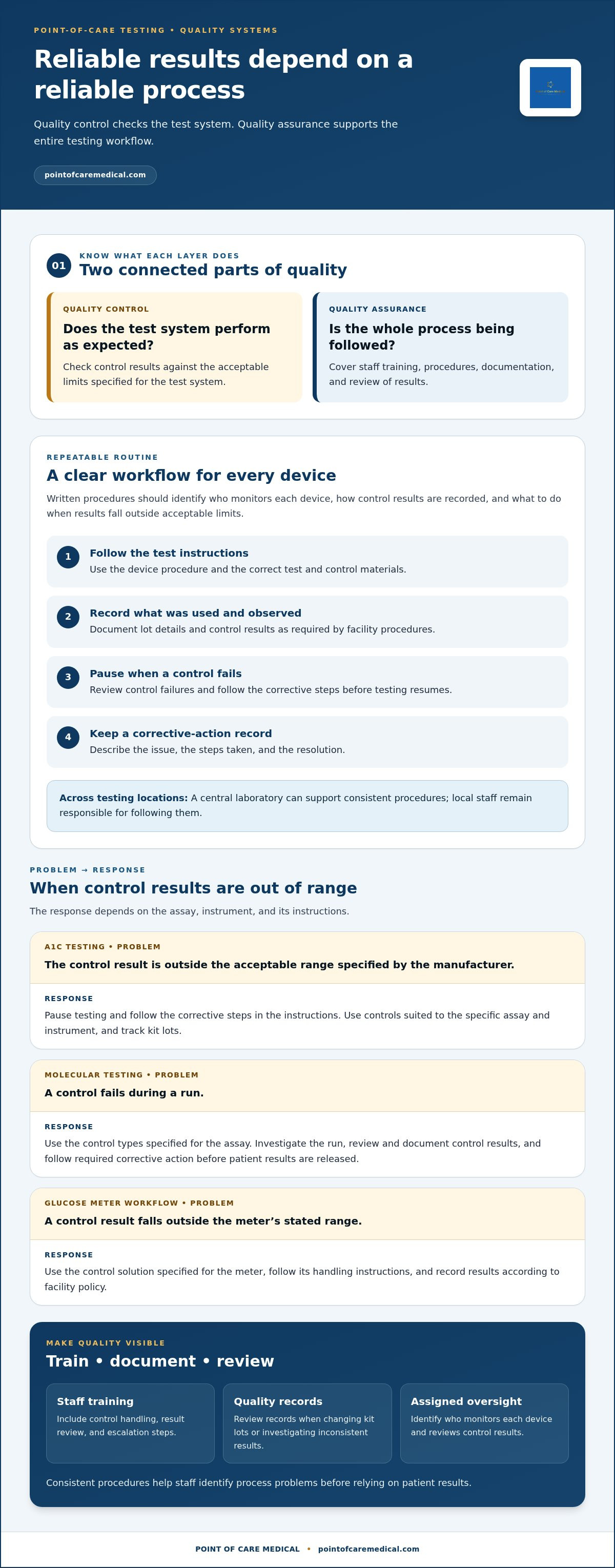
Quality control checks whether a point-of-care test system performs as expected. Quality assurance covers the broader process, including staff training, procedures, documentation, and result review. A written hospital or clinic plan should identify who monitors each device, how control results are recorded, and what to do when a result falls outside acceptable limits. These steps help staff identify process problems before relying on patient results.
Build a repeatable workflow around each instrument. Staff should follow the test instructions, confirm the correct test and control materials, record lot details, and document results as required by facility procedures. Review control failures before testing resumes. Keep corrective-action records that describe the issue, steps taken, and resolution. A central laboratory can support consistent procedures across near-patient locations, while local staff remain responsible for following them.
A1C testing kits need controls suited to the specific assay and instrument. Use the control materials identified in the kit instructions, and record control results alongside the test system’s required documentation. If control results fall outside the acceptable range specified by the manufacturer, pause testing and follow the corrective steps in the instructions. Staff should also track kit lots and review quality records when changing lots or investigating inconsistent results.
Molecular quality controls help assess whether a molecular testing process is working as intended. The relevant control types depend on the assay and its instructions. Assign staff to review control results and document any required corrective action. For example, a failed control should trigger the procedure for investigating the run before patient results are released. Include control handling, result review, and escalation steps in staff training.
Glucose control solutions support routine monitoring of glucose meters and related testing workflows. Use the solution specified for the meter, follow its handling instructions, and record results according to facility policy. If a control result falls outside the meter’s stated range, stop and troubleshoot using the device instructions. Before returning the device to use, check that the control, test strips, meter, and technique match the procedure.
What CLIA requirements apply to point-of-care test supplies and kits? CLIA regulations apply to point-of-care testing programs wherever testing occurs. Medical laboratory professionals should lead or oversee these programs as qualified technical consultants, including quality control and quality assurance across testing sites.
How should test supplies be stored and handled? Follow the kit and control instructions for storage, preparation, and use. Keep materials in their specified conditions, check expiration dates before use, and document handling or storage issues that could affect test performance.
Immunoassay and biochemistry testing
Immunoassays and biochemistry tests answer different clinical questions. An immunoassay uses antibody binding to detect or measure a target, such as an infectious disease marker. A biochemistry test measures chemical substances in a specimen, such as glucose or electrolytes. Match the assay type to the clinical question, specimen, and care setting. Otherwise, the result may not provide the information needed for the next decision.
An immunoassay device may use a test strip, cassette, cartridge, or analyzer. Each format has specific specimen procedures and result-reading methods. Staff should follow the assay instructions in order, including sample preparation and result timing. A rapid test can support near-patient screening, while the clinical team interprets the result in the patient’s care context. The instrument and consumables must be compatible with the selected assay.
Biochemistry testing uses different methods to measure selected components in blood or other specimens. For example, a glucose meter produces a result from a compatible test strip and specimen. Other point-of-care instruments measure selected analytes using dedicated cartridges. Before testing, staff should confirm that the instrument, test format, specimen type, and intended measurement align. This matching step connects the result to the healthcare decision being considered.
The urinary albumin-creatinine ratio is described as the best way to detect kidney disease early. This example shows why test selection should follow the clinical purpose, not just the available device. A facility planning kidney-related testing should identify the intended marker and specimen, then select a method designed to measure them. The workflow should also specify how staff record and communicate the result.
- Define the question: Identify the marker or substance the clinician needs to assess.
- Match the method: Choose an immunoassay or biochemistry format suited to that target.
- Set the workflow: Align specimen collection, instrument use, and result handling.
Point-of-care instruments can make selected measurements more accessible near the patient. Their value depends on a clear connection between the assay, workflow, and care decision. For example, a glucose measurement has a defined analyte, specimen, and compatible meter. An immunoassay for an infectious disease target follows its own test procedure. Both require interpretation in the appropriate clinical context.
Before introducing a new assay, map every step from specimen collection through result reporting. Identify the responsible staff, required instrument, compatible test materials, and procedure for documenting results. Incorporate the assay into staff training and routine quality oversight. This helps the facility maintain a consistent workflow and connect the chosen method to its intended clinical use.
Point-of-care testing in near-patient settings
Near-patient testing places diagnostics close to the patient rather than relying solely on a central laboratory. This can provide immediate, actionable results where care decisions are made. Settings include hospital departments, physician offices, and pharmacies. Each location needs a defined workflow for specimen collection, testing, result review, and follow-up. Choose the appropriate platform based on the clinical purpose and the staff responsible for each step.
U.S. testing locations extend well beyond hospitals. As of January 2022, 96% of U.S. facilities licensed to perform testing were located outside a hospital setting. Pharmacies held 25,709 CLIA licenses in the United States as of January 2022. These figures illustrate why near-patient procedures must work across different settings. Facilities should map where testing occurs, who performs it, and how results reach the clinician responsible for patient care.
Proximity can matter when a result informs a time-sensitive decision. HIV patients tested with a point-of-care device received antiretroviral therapy 130 days faster than patients diagnosed with the help of a traditional lab. Heart failure patients who received a point-of-care test were discharged from the hospital 3 days sooner than those without point-of-care testing. These comparisons show how testing location and result availability can connect diagnostics with the next care step.
Plan the workflow around the patient journey, not just the device. For each site, document the testing location, specimen route, operator, result recipient, and action after review. In a pharmacy, for example, staff need a clear process for handling the test and directing results into the appropriate care pathway. In a hospital department, teams should define how results reach the clinician managing the patient.
- Set the use case: Identify the clinical decision the result will inform.
- Assign responsibilities: Define who collects, tests, reviews, and communicates results.
- Plan replenishment: Align point-of-care testing supplies with testing locations and expected workflow demand.
Near-patient platforms also require coordination with facility quality procedures. CLIA regulations apply to point-of-care testing programs wherever testing is performed. Medical laboratory professionals should lead or oversee programs as qualified technical consultants, including quality control and quality assurance across testing sites. In a hospital network with testing in multiple departments, this oversight can support consistent procedures at each location.
Before adding a near-patient service, connect the test’s intended use with staff training, result documentation, and follow-up responsibilities. Confirm that each testing location can perform the required steps within its patient-care workflow. This planning helps facilities use rapid results appropriately and maintain consistent processes across clinics, hospitals, and pharmacies.
What supplies are needed for point-of-care testing?
A testing workflow needs more than an assay. The point of care testing supplies required depend on the test method, specimen, instrument, and care setting. A lateral-flow rapid test has different components from an analyzer-based chemistry test. Before ordering, map each testing step and identify the materials staff need to complete it.
Use a supply checklist organized by function. Components vary by test system, so match each item to its instructions and intended use.
- Test and instrument: List the assay, compatible analyzer or reader, and any required cartridge, strip, or cassette.
- Specimen collection: Identify the collection device, transfer materials, and specimen container required for the procedure.
- Controls: Include compatible quality-control materials when the test system’s instructions or facility procedure calls for them.
- Protective and cleaning materials: Stock the items staff use to handle specimens and maintain the testing area under facility procedures.
- Records and waste supplies: Prepare result documentation and the appropriate containers for used materials.
Compatibility matters. A test strip designed for one glucose meter may not work with another instrument. An assay may also require a specific swab or transfer device. Record each approved pairing in the local procedure and use that list when ordering. This reduces substitutions that disrupt staff workflows or prevent testing.
Storage and handling requirements also shape the supply plan. Follow the manufacturer’s instructions for each test, control, and collection material. When receiving supplies, compare delivered items with the order, inspect packaging, record lot details, and organize stock by expiration date. Keep materials under their specified storage conditions, and separate expired or damaged supplies from usable inventory according to facility procedures.
Freight planning starts with a clear view of demand. Track consumption by testing location and review stock before placing routine orders. Set replenishment triggers based on expected use, supplier lead times, storage limits, and expiration dates. A central inventory list can help clinics and hospitals identify shortages early, while local staff should promptly report unusual demand or damaged deliveries.
Keep the checklist current when a facility adds an assay, changes an instrument, or adjusts its testing workflow. Confirm that collection materials, controls, and compatible consumables remain available together. Grouping orders around the complete test process can make receiving and stock checks more straightforward. For respiratory screening workflows, facilities can review the GenBody COVID-19 Rapid Antigen Test and ViraDx™ SARS-CoV-2/Flu A+B Rapid Antigen Test as specific examples of rapid-test offerings.
Point of Care Medical: GenBody COVID-19 Rapid Antigen Test
Point of Care Medical supplies rapid diagnostic tests for healthcare and screening facilities. For respiratory testing, its offerings include the GenBody COVID-19 Rapid Antigen Test and ViraDx™ SARS-CoV-2/Flu A+B Rapid Antigen Test. The catalog also includes the SURE CHECK HIV 1/2 Assay and Rapid Test Cup "RTC" + Fentanyl.
Point of Care Medical supplies diagnostic tests for respiratory, HIV, and toxicology screening. Match each test to the clinical application, intended workflow, and facility procedures before ordering. For teams managing recurring diagnostic needs, organizing selections by testing program can help align procurement with use.
Contact Point of Care Medical to discuss its rapid diagnostic testing supplies.
Put a practical testing plan into motion
Start with a focused review of your facility’s testing priorities. Identify which clinical workflows need near-patient diagnostics, then align purchasing with the tests, staff procedures, and replenishment processes that support those workflows. This makes procurement a deliberate part of care delivery rather than a response to an unexpected stock gap.
Point of Care Medical offers the GenBody COVID-19 Rapid Antigen Test, ViraDx™ SARS-CoV-2/Flu A+B Rapid Antigen Test, and Rapid Test Cup "RTC" + Fentanyl. These options support facilities sourcing rapid tests for respiratory and toxicology screening. Consider how the available point of care testing supplies fit your intended applications and purchasing needs.
To discuss these testing supplies and your facility’s requirements, contact Point of Care Medical. A clear plan is a practical starting point for a more organized testing workflow.
Frequently Asked Questions
What types of point-of-care test kits and analyzers are available?
Available options include rapid diagnostic kits and analyzer-based systems for selected clinical tests. When comparing point of care testing supplies, distinguish single-use components from reusable instruments and confirm compatibility. Supplies should also match the specimen type and testing purpose. Point of Care Medical offers professional screening products, including respiratory and toxicology tests. Product availability and regulatory classification can vary by configuration.
What FDA-cleared point-of-care tests and supplies are available?
FDA clearance applies to specific products and intended uses, so review the labeling for each test rather than assuming all products share the same status. Point of Care Medical offers the GenBody COVID-19 Rapid Antigen Test and ViraDx™ SARS-CoV-2/Flu A+B Rapid Antigen Test. Check each product’s stated intended use and regulatory classification when selecting a test for a clinical program.
What PPE and quality-control supplies are needed for point-of-care testing?
Choose PPE according to the specimen-handling procedure and facility policy. Quality-control supplies depend on the assay and its instructions. Identify compatible control materials, document control results, and establish a process for addressing results outside the stated range. Keep controls clearly associated with the relevant test system, and include their storage and handling requirements in facility inventory procedures.


