

Storage conditions can affect whether a rapid test gives a reliable result. Follow the rapid diagnostic test storage guidelines on the product packaging and instructions for use, including the specified temperature range. Check the expiration date, and don’t use an expired kit.
Keeping tests organized and stored properly is part of routine testing. Because storage needs vary by test, one temperature or method won’t suit every kit. Follow the requirements in each product’s instructions.
This guide explains where to find expiration dates and storage directions, how temperature, moisture, light, and handling can affect test kits, and what can happen when storage requirements aren’t followed. It also covers inventory practices that help staff identify the right kit and use stock in a timely way. Apply these principles consistently, while following each test’s instructions for use.
Key Takeaways
- Check the expiration date on the kit packaging and review the instructions or information insert before use.
- Follow each test’s specified storage temperature and protect kits from moisture, light, contamination, and physical damage.
- Keep the manufacturer’s instructions accessible so staff can follow the correct handling and testing requirements.
- Use an organized inventory system, such as first-in, first-out, to help manage stock and reduce the risk of expired kits.
- For COVID-19 antigen testing supplies, Point of Care Medical offers the GenBody COVID-19 Rapid Antigen Test.
Expiration dates and test reliability
Check each rapid test’s expiration date and storage requirements before use. These rapid diagnostic test storage guidelines help teams identify kits that remain within their labeled shelf life and have been kept under the specified conditions.
Reading Package Storage and Expiration Details
Rapid test packaging and instructions for use identify the storage conditions and expiration date. Check the outer box first, then review the instructions or information insert if either detail isn’t visible. To find the conditions and expiration date, look for the test name, date, and storage directions on the package label and insert. Use these details to determine whether the kit is suitable for testing.
Shelf life is the period during which the manufacturer indicates a kit may be used, provided it’s stored as directed. The exact expiration date applies to the individual kit, not to rapid tests as a category. For example, two antigen tests may have different printed dates or storage requirements. Don’t estimate shelf life from the purchase date or apply one kit’s date to another.
Expiration-Date Controls
Expiration-date checks identify kits that are past their labeled use period. They matter because expired diagnostic test kits shouldn’t be used: results may be inaccurate. Before testing, match the test name and expiration date on the kit with the product instructions. If the date has passed, remove the kit from usable stock.
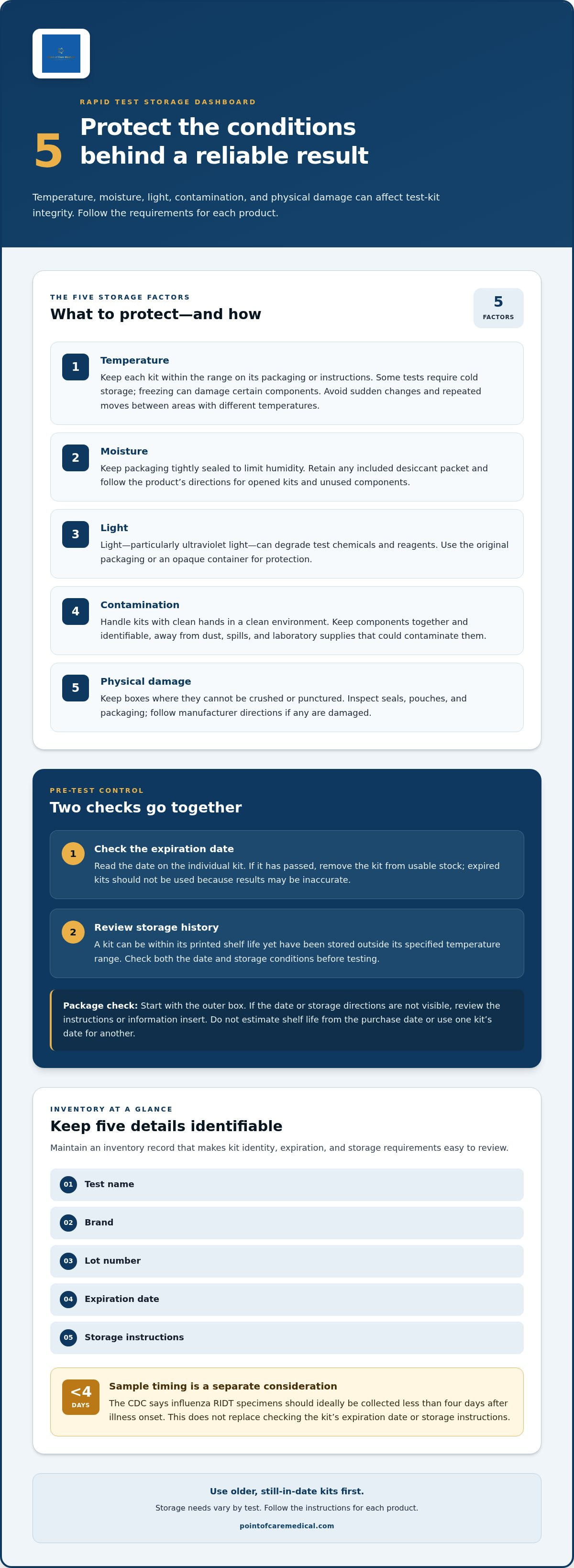
Keep an inventory record that makes expiration dates easy to review. Include the test name, expiration date, and storage instructions, and record the brand and lot number for reference. Organize stock so staff use older, still-in-date kits first. A recent delivery doesn’t mean every kit is within its labeled shelf life.
- Read the expiration date on each kit’s packaging.
- Use the instructions or information insert to resolve where the date or storage directions appear.
- Keep the test name, lot number, and expiration date identifiable in inventory records.
Storage and expiration checks go hand in hand. A kit may still be within its printed shelf life but be affected by storage outside the temperature range on its packaging. Some tests require cold storage, while freezing can damage certain components. Review both the expiration date and storage history before testing.
For respiratory testing, specimen timing also matters to interpretation. The Centers for Disease Control and Prevention says influenza RIDT specimens should ideally be collected less than four days after illness onset. This timing doesn’t replace checking the kit’s expiration date or instructions. It shows why reliable diagnostic testing depends on following the relevant requirements for both the test kit and the sample.
Protection from contamination, moisture, light, temperature changes, and physical damage
Store each kit within the temperature range printed on its packaging, and avoid sudden changes. For opened kits and unused components, follow the manufacturer’s instructions, including directions on packaging and storage.
Temperature Control and Storage Ranges
Temperature control means keeping a rapid test within the storage range stated on its label or in its instructions. Storage outside that range can affect test performance. Some tests require cold storage, but freezing can damage certain components. Follow the range for the specific test rather than assuming all kits have the same requirements.
Choose a consistent storage location and limit moves between areas with different temperatures. A refrigerator is suitable only when a kit’s instructions require cold storage. Temperature fluctuations may affect the test even if the kit later returns to its original range. Keep package directions accessible so staff can apply the correct controls.
Protecting Kits from Storage Hazards
Protective storage limits exposure to contamination, moisture, light, and physical damage. Keep kit packaging tightly sealed to reduce exposure to humidity, and retain any included desiccant packet. Light, particularly ultraviolet light, can degrade test chemicals and reagents, so use the original packaging or an opaque container for protection.
Handle kits with clean hands in a clean environment. Keep boxes away from spills, dust, direct light, and places where they could be crushed or punctured. Medical packaging helps shield diagnostic products from physical damage and environmental exposure. These precautions support kit integrity but don’t replace correct sample collection or interpretation.
Storing Opened Kits and Unused Components
For an opened kit, check the instructions for how to store remaining components and whether they can be retained. Keep unused items in their original packaging when directed, and maintain the specified temperature and moisture controls. Don’t assume opening the outer box changes the storage requirements or extends the usable period of individual components.
After opening, keep components together and identifiable with the test name and instructions. Avoid placing loose items near laboratory supplies that could contaminate or damage them. If a seal, pouch, or component package is damaged, follow the manufacturer’s directions to determine whether the kit remains suitable for testing. Proper storage helps protect test results and supports decisions about treatment.
Make storage checks part of routine collection and testing workflows. Staff can record temperature concerns, inspect packaging during stock handling, and separate damaged kits from usable inventory. Facilities reviewing their supply options can browse rapid testing supplies while applying the storage directions for each test.
Following manufacturer instructions
A test’s instructions for use connect storage, sample handling, and result interpretation. Follow the directions for the specific kit rather than habits carried over from another assay.
Using Manufacturer Storage Instructions
Manufacturer instructions define how to store and handle a particular test. Following them matters because temperature, component handling, and testing steps vary between kits. Read the package and instructions for use together. For example, one test’s cold-storage requirement doesn’t establish the correct range for another.
Use the instructions as an operational reference, not just for troubleshooting. Make them accessible where staff receive, store, and use kits. Include the test name and lot number in records so staff can connect the correct instructions to the stock in use. A standard operating procedure can direct staff to review these details before testing.
Instructions also guide sample collection and result interpretation. Specimen quality and user technique can affect rapid diagnostic test performance. Read a patient’s positive or negative result according to the stated timing and criteria, not an informal estimate. If the control line doesn’t appear, the test is invalid and should be repeated according to its instructions.
Training helps staff apply these steps consistently. Use the manufacturer’s directions when training staff in sample collection, test procedures, and interpretation. Standard operating procedures can document the workflow, while quality monitoring and competency assessment can identify where technique needs correction. These measures support consistent testing without replacing product-specific directions.
FDA Storage Guidance in the United States
In the United States, there’s no single storage temperature for every rapid diagnostic test. Use the storage range printed on the specific kit’s packaging or instructions; requirements vary by product. This product-specific approach helps staff avoid applying one assay’s conditions to another.
For an FDA-related storage question, use the directions supplied with the test rather than assuming a universal temperature rule. Check the kit label and instructions for its required conditions, including whether it needs cold storage. Some tests can be damaged by freezing, so don’t substitute a freezer for a refrigerator or infer an acceptable range from another product.
Build the instructions into routine receiving and storage procedures. Staff can record the product name, lot number, and storage directions, then keep the relevant instructions available where testing takes place. If a storage excursion occurs, record the affected test and lot, separate that stock from routine use, and follow the written procedure to determine its disposition.
Storage is one factor in reliable diagnostic testing, alongside specimen quality and proper technique. Following test-specific instructions helps staff handle an infection screening workflow consistently and interpret results using the manufacturer’s stated criteria.
Consequences of improper test kit storage
Improper storage can make rapid diagnostic test results inaccurate. Temperature excursions, moisture, light, or damaged packaging may affect test performance, making results less reliable for detecting the target. In influenza testing, improper storage or prolonged storage before testing can increase false-positive or false-negative results.
If a rapid test was stored outside its recommended temperature range, separate it from usable stock, identify its product and lot, and follow the manufacturer’s instructions for assessing or discarding it. Don’t use it for patient testing until its status has been determined according to those instructions.
Storage damage isn’t always visible. A sealed box can look intact after exposure to temperatures outside its labeled range, while test components may still be affected. Returning a kit to the recommended range doesn’t establish that its performance has recovered. Record the event and affected stock so staff can make consistent decisions.
Test performance depends on more than storage. Sample quality, collection technique, timing, and correct interpretation also matter. An invalid control line means the result can’t be interpreted, and the test should be repeated according to its instructions. In some circumstances, a negative result may also require follow-up testing, based on the test instructions and clinical context.
Consider a respiratory antigen test exposed to excessive heat. Its result may not reflect the patient’s infection status as expected. A false negative could delay further assessment, while a false positive could lead to unnecessary follow-up. Similar concerns apply to any test whose assay components are affected by storage conditions.
A pregnancy test is another example of why product-specific instructions matter. Don’t assume storage directions for one diagnostic test apply to another. Different tests can use different components and have distinct storage limits. Follow the instructions for the exact kit rather than applying a familiar range from another product.
During an emergency, quick access to test kits matters, but speed shouldn’t replace a storage review. Check the affected kit’s label and storage record before releasing it for testing. If the record shows a storage excursion, keep the kit separate and follow the manufacturer’s instructions to determine the next step. This helps protect result interpretation during urgent workflows.
Document the product name, lot number, observed storage issue, and action taken. These records help teams identify affected stock, support quality monitoring, and prevent kits from mistakenly returning to routine use. A clear process also helps staff distinguish storage concerns from issues involving sample collection or test technique.
Emergency test kit storage
Emergency stock is useful only when test kits are properly stored and easy to locate. Healthcare facilities can combine temperature controls, inventory records, and first-in, first-out rotation to support screening readiness and limit avoidable waste.
Cold-chain logistics help maintain required conditions for tests that need cold storage. Keep each kit within its manufacturer’s stated range and use a consistent storage location. Freezing can damage some components, so cold storage doesn’t mean placing every kit in a freezer. A facility’s emergency plan should account for the storage needs of each test format.
Plan how staff will protect kits during a disruption. Identify the designated storage area and make its requirements clear to staff handling supplies. If kits must be moved, keep their packaging and instructions together, then place them in an appropriate storage location. Avoid uncontrolled temperature changes during relocation, since fluctuations can affect test performance and accuracy.
Inventory control supports quick access while keeping dates and product types clear. Use a first-in, first-out system so older kits still within their labeled shelf life are used before newer stock. Record the product name, lot number, expiration date, and storage instructions. These details help staff locate suitable test kits during an emergency.
Separate products by name and storage requirement. For example, don’t treat respiratory antigen kits and other screening tests as interchangeable just because they share a storage area. Each product’s instructions determine its appropriate conditions. Clear labeling reduces the chance that staff will select a similar-looking kit with different handling requirements.
During routine checks, review storage conditions and stock organization together. Confirm that packages remain protected and staff can identify the correct test and its instructions. Record storage concerns and affected lots, then follow the manufacturer’s directions for those kits. This creates a traceable process for deciding which supplies remain suitable for use.
Emergency readiness also depends on staff knowing where records and instructions are kept. Include storage details in the facility’s standard operating procedures, and train relevant staff to apply them during screening workflows. A consistent process helps preserve kit integrity without relying on memory or assumptions under pressure.
Review your rapid testing inventory and storage workflow to support organized access to supplies. Explore rapid testing supplies for healthcare and screening needs.
Point of Care Medical: GenBody COVID-19 Rapid Antigen Test
Point of Care Medical offers the GenBody COVID-19 Rapid Antigen Test for facilities seeking COVID-19 antigen testing supplies. Select the test that fits your screening program, then apply its own storage instructions, expiration-date checks, and handling procedures. These practices remain essential after procurement because reliable use depends on keeping each kit within its stated conditions.
For other testing needs, Point of Care Medical also offers the ViraDx™ SARS-CoV-2/Flu A+B Rapid Antigen Test, Rapid Test Cup "RTC" + Fentanyl, and SURE CHECK HIV 1/2 Assay. Each product should be managed according to its specific instructions for use.
Contact Point of Care Medical to discuss its rapid testing supplies for your facility.
Make Storage Practices Part of Your Routine
Make rapid diagnostic test storage guidelines a consistent part of your facility’s operating routine. Assign responsibility for inventory review, keep storage procedures accessible, and include staff training in your workflow. A clear process helps teams manage supplies consistently as screening needs change.
Use your next inventory review to assess whether storage procedures are easy to follow during receiving, stock rotation, and testing. Note where staff need clearer instructions or a more practical recordkeeping process. These improvements can support reliable testing without adding unnecessary complexity.
For healthcare facilities sourcing rapid testing supplies, Point of Care Medical offers options for respiratory and other screening needs. Align supply planning with your facility’s testing workflow, then contact Point of Care Medical to discuss its offerings. A well-managed process gives your team a practical foundation for the work ahead.
Frequently Asked Questions
What temperature range should rapid diagnostic tests be stored at?
Store each rapid diagnostic test within the temperature range stated on its packaging or instructions for use. No single range applies to every product. For example, a clinic managing different test formats should record each product’s storage requirement separately, rather than apply one general rule to the supply area. This helps staff match each kit to its labeled conditions during receiving, storage, and testing.
Can rapid diagnostic tests be refrigerated or frozen?
Refrigerate a rapid test only when its instructions specify cold storage. Don’t assume refrigeration suits every kit, and don’t freeze a test unless its instructions direct you to do so. Freezing can damage some test components. For a mixed inventory, distinguish products requiring cold storage from those with different conditions, and keep each product’s directions with its stock. This prevents one kit’s handling procedure from being applied to another.
How should rapid diagnostic tests be protected from humidity, light, and heat?
Keep test kits sealed in their packaging, away from moisture, direct light, and heat sources. Retain any desiccant packet supplied with the kit, and use an opaque container if additional light protection is needed. For example, avoid storing kits beside a sunny window or heat-producing equipment. Handle packages with clean hands, and keep them away from spills or damage that could compromise the contents.
Do storage requirements differ by test type or manufacturer?
Yes. Storage requirements can differ by test type and manufacturer, so follow the instructions for the exact product. Don’t assume an antigen test and another diagnostic format share the same temperature or handling requirements. Keep product names and instructions identifiable in storage, especially when several assays occupy one supply area. Staff can then follow the relevant directions rather than rely on memory or a neighboring kit’s label.
How long can rapid diagnostic tests remain at room temperature during shipping or use?
The permitted time depends on the specific test’s instructions, so there’s no room-temperature duration that applies to all kits. Check whether the product directions describe shipping, temporary handling, or use conditions, and follow each separately. Don’t infer an allowance from another test or from the journey’s apparent conditions. If a shipment or kit was outside its stated range, isolate the affected stock and use the product instructions to determine its disposition.
Can rapid diagnostic tests be used after their expiration date?
No. Don’t use an expired rapid diagnostic test because its result may be inaccurate. Remove expired kits from usable inventory so they aren’t selected during routine testing or urgent screening. Check dates during stock rotation and record the product name and lot number in inventory records. If an expired kit has already been used, don’t treat its result as reliable; follow the appropriate testing procedure for the situation.


