

The largest order is not always the easiest to manage. A search for “CLIA waived fentanyl test cups bulk” is only a starting point: the specific product’s regulatory status, intended use, and configuration must fit your facility’s needs. A mismatch can leave your team with supplies that do not support its screening workflow.
Bulk purchasing can simplify replenishment, but it is worth checking product details before ordering. This guide explains how to review product-specific documentation, compare panel configurations with your screening process, and assess pack size and replenishment needs. Point of Care Medical distributes the Rapid Test Cup (RTC) + Fentanyl. Verify its current documentation and product details before deciding whether it suits your setting.
Use this guide to build a practical sourcing checklist. You will learn what to verify about CLIA categorization and intended use, how specimen type and panel fit can affect workflow, and which packaging, storage, expiration, and ordering details to confirm. The goal is an order that meets your facility’s requirements, not simply a larger quantity.
Key Takeaways
- For CLIA waived fentanyl test cups bulk, verify the specific test’s waiver status and authorized intended use in current product documentation.
- Compare the documented specimen type, panel configuration, and instructions with your facility’s screening workflow before selecting a cup.
- Reduce inventory risk by forecasting facility demand, checking shelf life and storage requirements, and setting practical reorder points.
- Use a checklist to review compliance, product fit, supplier details, and receiving controls before placing an order.
- Consider Point of Care Medical’s Rapid Test Cup (RTC) + Fentanyl, and confirm its current documentation, configuration, pack size, and availability before ordering.
Buying CLIA-waived fentanyl test cups in bulk: verify the claim first
Before comparing case quantities, confirm that the exact fentanyl test cup has the regulatory status your facility needs. CLIA-waived status applies to a specific test for its authorized intended use. A seller’s name, a “CLIA-waived” category page, or wording in a product title is not enough to verify the claim.
This distinction matters when sourcing CLIA waived fentanyl test cups bulk. A product’s status and your facility’s testing obligations are related, but they are not interchangeable. The Clinical Laboratory Improvement Amendments (CLIA) provide background on the federal framework. Confirm which requirements apply to your setting and testing activity with your compliance lead or the appropriate authority before ordering.
What does CLIA-waived mean for a fentanyl test cup?
A waiver claim should match the exact test and its authorized use, not just the broad category of rapid urine drug screens. Do not assume every rapid cup is waived, or that a claim for one configuration covers another. Match the product name and manufacturer to current labeling and supporting documentation, then confirm that the intended use aligns with how your facility plans to use the test.
Even when a product has a waiver, that status alone does not establish that every facility or testing circumstance meets applicable requirements. Verify your setting’s obligations separately, including any required certificate or oversight. If the intended use or setting is unclear, resolve that question before procurement.
Which documents should buyers verify before ordering?
Request and review current product labeling, instructions for use, intended-use information, and applicable regulatory documentation. Check that each document identifies the same test and configuration you are considering. A panel variant or product listing with a similar name may have different claims or instructions.
Use this verification sequence:
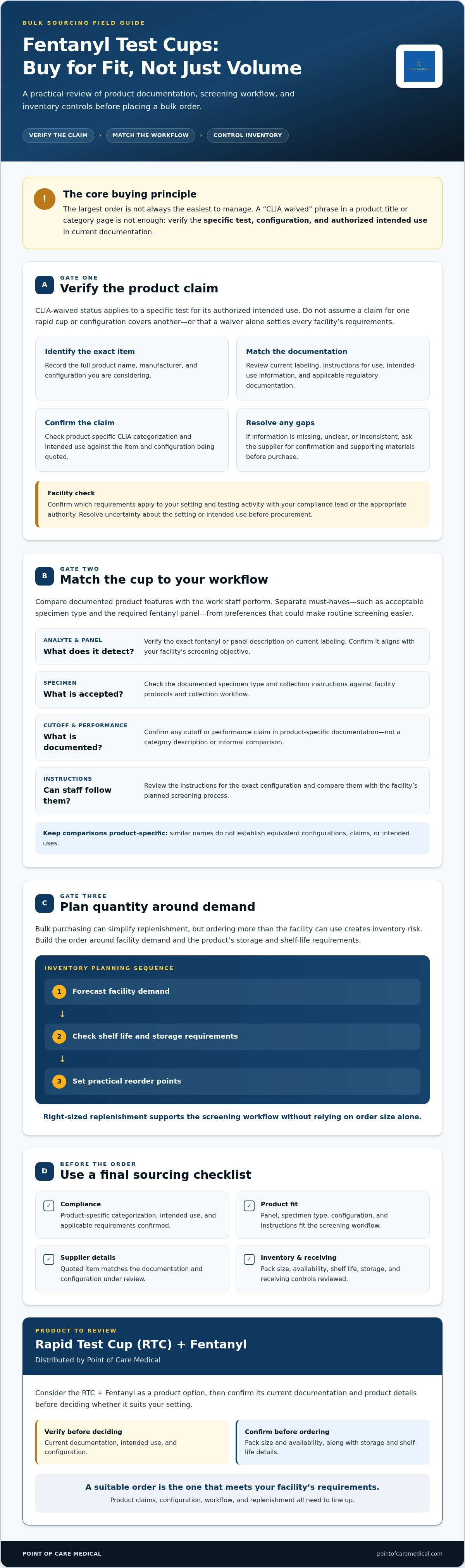
- Identify the test: Record the full product name, manufacturer, and configuration.
- Match the documents: Compare the labeling and instructions with the item being quoted, including specimen type and panel details where listed.
- Confirm the claim: Check the product-specific CLIA categorization and intended use against current documentation.
- Resolve gaps: If a document is missing, unclear, or inconsistent, ask the supplier to confirm the claim and provide supporting materials before purchase.
Apply the same review to Point of Care Medical’s Rapid Test Cup (RTC) + Fentanyl. Its availability as a product option does not, by itself, establish CLIA status. Confirm its current product documentation, configuration, and intended use before deciding whether it fits your facility.
Compare fentanyl test cup features against your facility workflow
Once you have identified products that may meet your compliance needs, compare their documented features with the work your staff performs. Separate must-haves, such as an acceptable specimen type and the required fentanyl panel, from preferences that could make routine screening easier. Similar product names do not establish equivalent configurations or intended uses.
Which panel and specimen details should you compare?
Use current manufacturer labeling and instructions to verify what the test detects and which specimen it accepts. Confirm any cutoff or performance claim in product-specific documentation rather than relying on a category description or informal comparison. For federally regulated workplace programs, the federal workplace drug testing guidelines offer a relevant program reference, but do not assume they apply to every clinical setting.
| Comparison point | What to verify | Why it matters |
|---|---|---|
| Analyte and panel | Exact fentanyl or panel description on current labeling | Confirms the product aligns with the facility’s screening objective |
| Specimen | Documented specimen type and collection instructions | Checks compatibility with facility protocols and collection workflow |
| Cutoff and performance | Product-specific claims and supporting documentation | Prevents assumptions based on another test or a similar product name |
| Instructions | Handling, timing, result interpretation, and quality-control steps | Helps staff follow a consistent documented procedure |
How do test instructions affect day-to-day operations?
Review the full procedure before choosing a cup. Consider whether staff can reliably follow the collection, handling, timing, interpretation, and quality-control instructions within the facility’s process. A preference for a simpler workflow should never override required instructions. For additional operational considerations, see this point-of-care drug screening workflow guide.
Compare documented requirements first, then assess workflow preferences. This makes evaluations of CLIA waived fentanyl test cups bulk more consistent and helps procurement teams explain why a configuration fits their needs or should be ruled out.
Point of Care Medical offers the Rapid Test Cup (RTC) + Fentanyl. If you are considering it, review its current product documentation and confirm the specific configuration and ordering details before purchase. Review Point of Care Medical’s testing supplies as part of your product comparison.
Plan bulk fentanyl test cup procurement without creating inventory risk
Bulk purchasing works best when the order quantity reflects actual facility use and product constraints. A large order can create waste if stock approaches its expiration date or storage requirements cannot be maintained. Base your replenishment plan on documented demand, verified packaging details, and the facility’s capacity to receive and store supplies.
How can a facility estimate a useful order quantity?
Start with recent screening volume and note any planned program changes that could affect demand. Compare projected use with the product’s confirmed pack size and expiration information. Include reserve stock only at a level your facility has approved and can reasonably rotate. Avoid relying on a universal quantity or assuming current demand will remain constant.
Use this sequence to set an order quantity and reorder point:
- Estimate use: Review facility records and planned changes to the screening program.
- Confirm shelf life: Ask for current expiration details for the product being ordered, then assess whether expected use can consume the quantity in time.
- Check storage: Verify product instructions and confirm the facility can maintain the specified storage conditions.
- Set a reorder point: Choose an inventory trigger that gives procurement time to review requirements and place the next order, based on your facility’s usage and purchasing process.
What should procurement teams confirm before placing a bulk order?
Confirm the exact product identity and configuration, pack size, current availability, expiration details, and storage instructions with the supplier. Make sure the information relates to the item being quoted, not a similar listing. Request a current quote for your facility rather than relying on an old quote or assuming a bulk discount.
Plan receiving controls before the order arrives. Assign responsibility for checking the delivered product against the order, recording lot and expiration details where applicable, and rotating stock so older usable inventory is issued first. These steps help staff identify discrepancies and maintain consistent inventory records.
For additional selection considerations in a treatment-center context, consult this drug test cup selection guide for treatment centers. Facilities evaluating CLIA waived fentanyl test cups bulk can use the same planning discipline: confirm the product details, then order quantities that align with use, storage capacity, and replenishment procedures. Point of Care Medical distributes the Rapid Test Cup (RTC) + Fentanyl. Contact the supplier through Point of Care Medical to confirm current product, pack-size, and availability details before ordering.
Use a compliance and supplier checklist before selecting a fentanyl cup
A written checklist gives clinical, compliance, and procurement teams a shared basis for evaluating options. Use it to compare equivalent configurations, record unanswered questions, and prevent a product title or supplier claim from standing in for current product-specific evidence. When sourcing CLIA waived fentanyl test cups bulk, record a waiver claim only after verifying the exact test and intended use.
What belongs on a fentanyl test cup purchasing checklist?
Complete the compliance and product-fit items before comparing quotes. Keep the supporting documents with the purchasing record so reviewers can trace each decision to the specific product under consideration.
- Compliance: ☐ Record the exact product name and manufacturer. ☐ Confirm the intended use and product configuration. ☐ Document CLIA status only after checking current, product-specific supporting materials.
- Product fit: ☐ Match the documented analyte or panel, specimen type, and instructions to facility protocols. ☐ Verify any cutoff or performance claims against current documentation. ☐ Confirm the staff workflow can follow the stated handling, timing, and interpretation steps.
- Storage and receiving: ☐ Record storage instructions, expiration details, lot identification, and packaging information. ☐ Define who will inspect the order, record relevant lot and expiration details, and rotate inventory.
How should facilities evaluate supplier and operational fit?
Confirm current availability and fulfillment terms directly with the supplier before committing. Compare products using the same fields, not just similar names. If a detail is missing, mark it unresolved and request clarification rather than assuming two configurations are interchangeable.
| Review area | Record for each option | Decision status |
|---|---|---|
| Documentation | Current labeling, instructions, intended use, and applicable regulatory information | Verified / unresolved |
| Configuration | Exact product identity, panel details, specimen type, and pack size | Fits / does not fit / unresolved |
| Operations | Storage, expiration, availability, fulfillment terms, and staff procedure fit | Confirmed / follow up |
Use an outstanding-questions column to assign follow-up before approval. This creates a clear record of why an option was selected and what still needs confirmation. Point of Care Medical offers the Rapid Test Cup (RTC) + Fentanyl. Check its CLIA status and product details against current documentation rather than inferring them from the name.
Review the Rapid Test Cup (RTC) + Fentanyl and confirm its documentation, configuration, pack details, and current availability as part of your evaluation.
Order Rapid Test Cup (RTC) + Fentanyl with product details confirmed
Point of Care Medical offers the Rapid Test Cup (RTC) + Fentanyl as part of its toxicology testing supplies. This gives facilities a product to include in their comparisons, but the name alone does not confirm specifications, intended use, or CLIA status. Review current product-specific information before deciding whether it fits your facility’s requirements.
What should buyers confirm about RTC + Fentanyl?
Request current product documentation and match it to the exact configuration being considered. Verify the intended-use information and applicable CLIA categorization in those materials. Also confirm any details your evaluation depends on, such as panel configuration, specimen type, instructions, cutoff information, packaging, storage, and expiration. If the documentation does not answer a question, ask the supplier to clarify it before ordering.
Use the same evidence-based comparison process for every option. A product description or similar name is not a substitute for labeling and instructions tied to the specific test. For broader selection context, see the rapid test cup with fentanyl buyer’s guide.
What are the next steps for a facility purchase?
Finalize the evaluation checklist and assign a procurement contact to coordinate open questions. Before approval, confirm these details directly with Point of Care Medical:
- Product fit: Confirm the exact product configuration and applicable documentation.
- Ordering details: Verify pack size, current availability, and fulfillment terms.
- Facility readiness: Check that the documented instructions and storage requirements fit your procedures.
Keep the confirmed product information with the purchasing record. This gives clinical and procurement teams a consistent reference when the order is received and added to the facility’s workflow. If a detail remains unresolved, hold the order decision until the supplier provides clarification.
Facilities sourcing CLIA waived fentanyl test cups bulk should base their selection on verified documentation and operational fit, not assumptions about a product category. Review the Rapid Test Cup (RTC) + Fentanyl alongside your requirements, then contact the supplier with procurement questions. Review Point of Care Medical toxicology testing supplies.
Make your next bulk order with confidence
Strong procurement decisions start with product-specific evidence, not a category label or a larger order quantity. Confirm the test’s documentation and intended use, compare its configuration and instructions with your facility workflow, then plan quantities around documented demand, expiration details, and storage capacity.
These steps help facilities sourcing CLIA waived fentanyl test cups bulk identify questions before committing. Confirm its CLIA status and other specifications in current product documentation before purchase. Point of Care Medical serves professional customers nationally across the United States.
When your checklist is ready, review Point of Care Medical toxicology testing supplies and confirm product configuration, pack size, availability, and applicable documentation directly with the supplier. A careful review can support a clearer, more practical purchasing process for your facility.
Frequently Asked Questions
Is every fentanyl test cup labeled CLIA-waived appropriate for every facility?
No. CLIA categorization and intended use must be verified for the specific test, and each facility must assess applicable requirements for its setting. Review current product labeling and supporting documentation rather than relying on a supplier description or broad category label. If the waiver status or its relevance to your workflow is unclear, ask the supplier for clarification and consult your compliance personnel before adding the test to your procedures.
Can a facility order CLIA-waived fentanyl test cups in bulk?
Bulk procurement may be an option, but confirm the exact product, current availability, pack size, documentation, and expiration information before ordering. Facilities sourcing CLIA waived fentanyl test cups bulk should estimate quantities from expected use and storage capacity, not an assumed standard order size. Minimum quantities and fulfillment schedules can vary, so verify them directly with the supplier before submitting a purchase order.
What should buyers check before purchasing fentanyl test cups?
Verify the product name, manufacturer, configuration, intended use, specimen type, panel description, and instructions. Check product-specific regulatory information, packaging, storage conditions, expiration details, and available quantities. Compare those documented features with your facility’s workflow. Similar product names do not necessarily indicate identical configurations or intended uses. If a listing and its documentation appear inconsistent, ask the supplier to resolve the discrepancy before placing an order.
How much should a clinic order when buying fentanyl test cups in bulk?
There is no single appropriate quantity for every facility. Start with recent screening volume and planned program needs, then compare your forecast with verified pack sizes, storage requirements, and expiration information. Include reserve stock only if it fits your facility’s inventory plan. Set a reorder point that matches your purchasing process, and confirm packaging and current availability with the supplier before ordering more than your facility can manage.
What is the difference between a fentanyl test cup and a confirmatory test?
A rapid screening cup is used according to its labeling and instructions to produce a screening result. It should not automatically be treated as a definitive diagnosis or as confirmatory testing. Confirmatory testing is a separate step, and facilities should follow their policies and applicable requirements to determine appropriate follow-up. Review the specific product’s current intended-use and performance documentation, and make sure staff understand how to interpret and handle results.
Does Point of Care Medical sell fentanyl test cups in bulk?
Current bulk availability, pack size, minimum order, and fulfillment terms are not confirmed here, so contact the supplier to verify them before purchasing. Request current product-specific documentation as well, including applicable CLIA information, intended use, and configuration details. Do not assume the product is CLIA-waived without verifying its status in the supporting documentation.


