

A positive urine drug screen doesn’t always identify the substance that triggered it. Rapid urine drug screen cross-reactivity can occur when a medication or other substance reacts with an immunoassay’s antibodies, and the result can vary by test. Diphenhydramine and methadone have been reported in connection with this type of cross-reactivity.
It’s reasonable to question an unexpected result, especially when a person’s medication history doesn’t seem to match the screen. The test’s result is presumptive, not a definitive identification: positive urine immunoassay screens should be confirmed with GC-MS to help rule out false positives. The older concern that ibuprofen commonly caused false-positive cannabinoid screens also needs context, since that issue was corrected over 20 years ago.
This article explains how medications and other substances can interfere with a rapid urine drug screen, why immunoassays may produce different results, and what confirmation testing can clarify. It also distinguishes cross-reactivity from other possible causes of an unexpected result, helping you interpret the finding more precisely.
Key Takeaways
- False-positive screens can involve medications and other substances, but the likely cause depends on the assay and the substance being tested.
- Different immunoassays can respond differently to the same substance, so a result should be interpreted in the context of the specific test.
- Diphenhydramine has been reported in connection with methadone-screen cross-reactivity, making medication context useful when reviewing an unexpected result.
- For workplace testing, the U.S. Department of Health and Human Services (HHS) initial immunoassay cutoff for PCP is 25 ng/mL.
- Methylphenidate and amphetamine screens involve distinct testing considerations; learn what can affect interpretation and when confirmation testing matters.
What Medications Cause False-Positive Drug Tests?
Medication-related interference depends on the substance and the immunoassay used. Reviewing the test type, medication history, and collection details helps distinguish a presumptive screen from a confirmed finding.
Medication-Related False Positives
A medication-related false positive occurs when a drug or its metabolites trigger a screen for a different drug class. Diphenhydramine has been reported in connection with methadone-screen cross-reactivity, making medication history relevant when a result is unexpected.
Ibuprofen requires context: the cannabinoid immunoassay issue linked to false positives was corrected over 20 years ago. In 1998, the U.S. DHHS increased the workplace opiate cutoff from 300 ng/mL to 2000 ng/mL to reduce false positives from poppy seed ingestion and routine prescription drug use. These examples show why the assay and cutoff matter.
Immunoassay Cross-Reactivity
Immunoassay cross-reactivity occurs when an assay’s antibodies respond to a substance other than the target drug. Marketed tests use proprietary antibody technology, so the same medication may affect one product differently from another.
A positive immunoassay is presumptive, not definitive. False negatives are also possible when a target drug or metabolite falls below the assay’s cutoff, is outside its detection window, or is not recognized by the test’s antibodies. A negative result therefore does not rule out every drug or exposure.
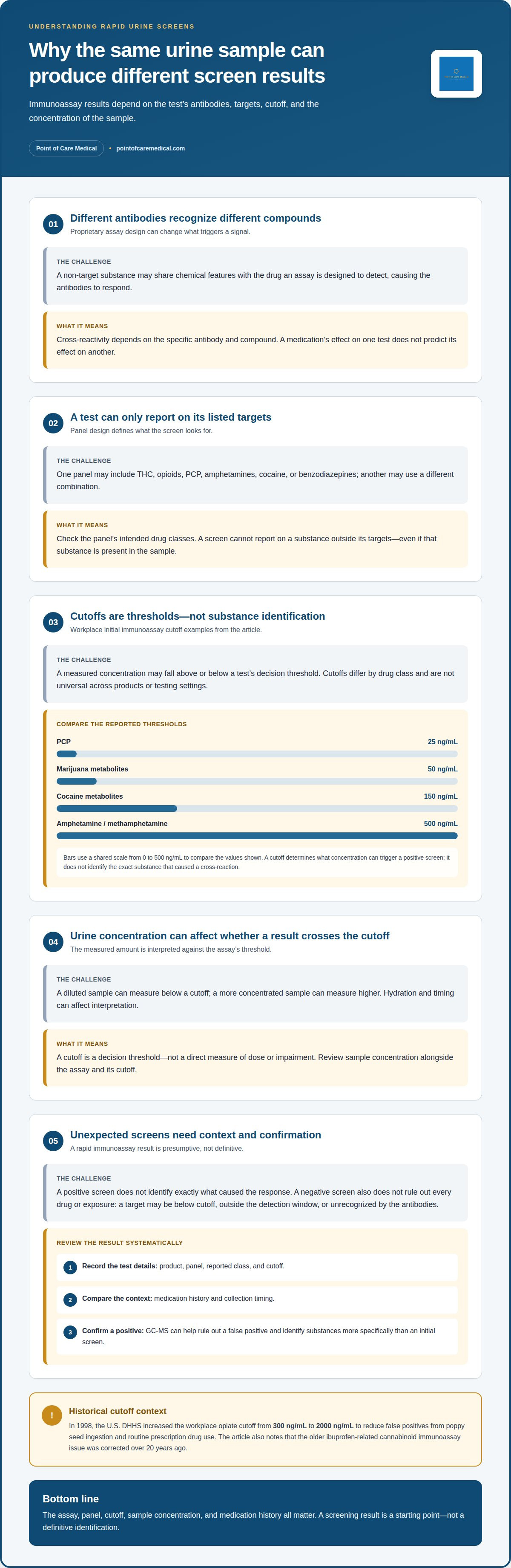
For workplace testing, the U.S. Department of Health and Human Services (HHS) sets the initial immunoassay cutoff for PCP at 25 ng/mL. A cutoff determines what concentration can trigger a positive screen; it does not identify the exact substance that caused a cross-reaction.
Rapid Screen Detection and Limitations
Rapid urine screens use antibodies to detect selected drugs or metabolites in a sample. FDA clearance is specific to the test product and its intended use; a rapid format alone does not establish clearance. Each assay also has defined targets and cutoffs, which limit what its result can show.
Detection time varies by substance and use pattern. Amphetamine can generally be detected in urine for 48 hours. Marijuana can generally remain detectable for 3 days after single use, 5 to 7 days after moderate use four times per week, 10 to 15 days after daily use, and over 30 days after long-term heavy use.
After an unexpected positive, document relevant medications and request confirmation with GC-MS to help rule out a false positive. Collection conditions matter too: the U.S. Department of Transportation says urine temperature should be between 90 and 100 degrees Fahrenheit when measured within 4 minutes of collection. Laboratory errors can also cause false positives, though medications are more often the cause.
Differences among immunoassay products
Two urine screens can produce different results from the same sample. Each marketed immunoassay uses proprietary antibody technology, and antibodies differ in the compounds they recognize and the signals they produce. Accuracy also depends on cutoff levels and urine concentration. A concentrated or diluted sample can affect whether a measured amount crosses the test’s threshold.
Panel design is another key difference. One screen may test for THC, opioids, PCP, amphetamines, cocaine, or benzodiazepines, while another may use a different combination of targets. Check the panel’s intended drug classes when interpreting a result. A test cannot report on substances outside its targets, even if they are present in the sample.
Workplace initial immunoassay cutoffs illustrate how thresholds vary by drug class. The U.S. DHHS cutoff is 50 ng/mL for marijuana metabolites and 150 ng/mL for cocaine metabolites. For amphetamine/methamphetamine, it is 500 ng/mL. These values show why concentrations can be classified differently across target classes. They don’t establish a universal cutoff for every product or testing setting.
Urine concentration affects the amount an assay measures. If a sample is diluted, a target may fall below the cutoff; a more concentrated sample may produce a higher measured concentration. Hydration and timing can therefore affect interpretation alongside the substance and assay. A cutoff is a decision threshold, not a direct measure of dose or impairment.
Antibody design also affects cross-reactivity. A non-target compound may share chemical features with an assay’s target and trigger a response. The reaction depends on the specific antibody and compound. As a result, rapid urine drug screen cross reactivity can differ between products, even when both screens report the same drug class. A medication’s effect on one assay does not predict its effect on another.
For an unexpected finding, record the product, panel, reported class, and cutoff. Compare those details with the medication history and collection timing. Do not assume one immunoassay’s result predicts another’s. If a decision depends on the finding, confirmation testing can identify substances more specifically than an initial screen.
Keep the test’s purpose in view. A screen designed for HIV, for example, does not evaluate urine drug targets. Matching the assay to the clinical or program decision prevents unrelated results from being treated as interchangeable. Understanding rapid urine drug screen cross reactivity starts with knowing which targets the product tested and what its thresholds mean.
Diphenhydramine and methadone cross-reactivity
Diphenhydramine can trigger an unexpected methadone result on some rapid urine screens. The reported cross-reaction matters because the screen may respond to a medication rather than methadone itself. It does not mean every diphenhydramine user will test positive or that every methadone assay responds the same way. The specific immunoassay determines the result.
How the unexpected result can occur
A methadone immunoassay uses antibodies designed to detect methadone or related target compounds. Diphenhydramine may interact with some assay antibodies, producing a signal interpreted as a presumptive positive. The test detects an antibody response, not a definitive identification of the substance responsible. That distinction matters when medication history and screening results appear inconsistent.
Product differences matter. Marketed immunoassays use proprietary antibody technology, so one product may react differently from another. A result from one test cannot establish how another would respond to diphenhydramine. The assay’s target, antibody design, and cutoff all influence whether a sample produces a positive screen.
What the result does and does not show
A positive methadone screen indicates that the sample triggered the assay’s threshold. It does not, by itself, prove methadone exposure. Diphenhydramine is one possible explanation for an unexpected result, but the screen alone cannot identify the cause. A medication record provides relevant context, while confirmation testing can distinguish the target drug from a cross-reacting substance.
For example, if a person reports diphenhydramine use and receives a positive methadone immunoassay, consider both facts when interpreting the result. The medication history does not automatically invalidate it. Instead, it raises the possibility of cross-reactivity, which requires a more specific test to assess. A negative result on a different immunoassay would not necessarily settle the question because assay responses differ.
How to interpret and follow up
Clearly label the initial result as a screen. Record the assay or panel used, the reported drug class, and relevant medication information. Then use confirmation testing, such as GC-MS, to assess whether methadone is present and help rule out a false positive. This step is especially important when the result affects a consequential clinical or workplace decision.
Interpret the finding in context, not as an isolated statement about a person. A diphenhydramine-associated cross-reaction is a testing limitation, not proof of methadone use or misuse. Conversely, a reported medication does not establish that cross-reactivity caused the result. The assay’s response and confirmatory analysis provide the relevant evidence.
For testing programs, clearly recording the assay and follow-up process supports consistent review. Staff should distinguish presumptive immunoassay findings from confirmed results. If an unexpected methadone screen occurs, document diphenhydramine use and preserve the sample for appropriate confirmation. This approach addresses the specific result without treating every assay as interchangeable.
Medications and other substances that can interfere with screens
Medication interference occurs when a urine immunoassay responds to a non-target compound. The result depends on the assay’s antibody and the substance’s chemical properties. Medication history provides useful context but does not identify the cause on its own. Laboratory errors can also produce false positives, although medications are more often responsible.
During result review, separate three possible explanations: genuine target detection, cross-reactivity, and process error. For example, an unexpected positive alongside a reported medication raises a cross-reactivity question. A collection or processing problem raises a different one. These explanations require different evidence, so treating every unexpected result as medication interference can lead to an incorrect conclusion.
Other substances can interfere when an assay’s antibodies respond to them. This effect is product-specific, not a universal property of every urine screen. A substance that affects one immunoassay may not affect another. Since examples vary by product, do not treat a general list as proof that a particular substance caused a particular result.
Review collection and laboratory processes separately. A handling or analytical error can create an incorrect result without any cross-reacting medication. Record the sample’s collection and processing details, then compare them with the test result. This helps distinguish an assay response from an error introduced during testing.
Interpret concentration in relation to the assay cutoff. A result near the threshold can be sensitive to small differences in measured concentration. Urine concentration and the amount of a target or interfering compound affect the assay signal. The screen reports only whether its response meets the decision threshold, not which compound produced that response.
For an unexpected positive, document reported medications and the test’s target class. Keep screening and confirmation distinct: a positive immunoassay is presumptive, while GC-MS confirmation helps assess whether the target drug is present. This is more informative than attributing the result to a medication based only on timing or a general interference list.
Review the complete pattern, not just one detail. Compare the reported medication, assay, target class, collection record, and confirmation result. If confirmation does not support the initial screen, do not treat the presumptive result as a confirmed identification. If a process error is suspected, document that concern separately from possible cross-reactivity.
These steps keep medication effects, other substances, and laboratory errors distinct. A specific medication name matters only when the assay and evidence support the connection. For example, an unexpected result alongside a medication history is a reason to investigate, not proof of interference. Confirmation testing provides a more specific basis for interpretation.
Methylphenidate and amphetamine screens
Methylphenidate treatment and a positive amphetamine screen are separate facts. The screen reports an immunoassay response, not a medication review or definitive identification. Interpreting the result requires considering the assay’s target, its cutoff, and appropriate follow-up. A medication name alone cannot establish why a urine screen reacted.
Start by identifying the reported drug class. An amphetamine immunoassay is designed to detect its specified target or related compounds. Methylphenidate is a medication name, while “amphetamine” on a result is the assay’s reported category. Do not treat those labels as interchangeable. The result alone does not show whether methylphenidate caused a reaction or whether the target drug is present.
Cutoff level affects the screening decision. The U.S. DHHS workplace initial immunoassay cutoff for amphetamine/methamphetamine is 500 ng/mL. That value applies to the stated workplace initial screen; it isn’t a universal threshold for every product or testing setting. A screen’s cutoff determines when its signal meets the positive threshold. It doesn’t identify the compound that produced the signal.
Immunoassay products can respond differently because each marketed test uses proprietary antibody technology. For an unexpected amphetamine result, consider the product alongside the reported class and cutoff. A result from one assay cannot establish how another product would respond to the same sample. This matters when reviewing a medication such as methylphenidate alongside a result naming amphetamine.
Document the medication information and exact screening result. Include the reported class, the assay used, and the stated cutoff if it is available in the testing record. Keep the result classified as presumptive until confirmation. This record helps reviewers evaluate whether the finding reflects a target compound, a cross-reaction, or another testing issue.
Confirmation testing provides a more specific assessment than an initial immunoassay. GC-MS can help determine whether the target drug is present and rule out a false-positive screen. For example, when a person reports methylphenidate and receives an amphetamine-positive result, confirmation is more informative than inferring the cause from the medication name alone.
Also distinguish a negative screen from proof that no relevant substance is present. An immunoassay evaluates its defined targets and cutoff; it cannot answer questions beyond that design. A result below the cutoff may not trigger a positive report. The assay’s target range and the sample’s measured concentration shape what the screen can detect.
For clinical or workplace review, do not turn an initial amphetamine result into a conclusion about methylphenidate use. Record the facts, preserve the presumptive status, and use confirmation when the decision depends on identifying a substance. This keeps medication history relevant without treating it as proof of interference or exposure.
Point of Care Medical
Point of Care Medical supplies rapid testing products for defined screening needs. Its offerings include the Rapid Test Cup "RTC" + Fentanyl, alongside respiratory tests and the SURE CHECK HIV 1/2 Assay. Each test serves its stated purpose; these products don’t confirm or resolve an unexpected urine drug screen result. For a presumptive positive, use the appropriate confirmation process described above.
For organizations selecting rapid tests, match the test type to the screening need. Point of Care Medical’s catalog includes the GenBody COVID-19 Rapid Antigen Test and ViraDx™ SARS-CoV-2/Flu A+B Rapid Antigen Test, as well as its other listed assays. Contact Point of Care Medical to discuss its rapid testing offerings.
Build a consistent follow-up process
Turn an unexpected screen into a defined review pathway. Specify who records assay details, how medication information is considered, and when confirmatory analysis is requested. A consistent process for rapid urine drug screen cross-reactivity helps teams review results methodically and keeps screening findings distinct from final decisions.
Review the pathway with staff responsible for testing and result interpretation. Clear roles can reduce confusion about what an initial screen establishes and what requires additional analysis. Keep the process aligned with the testing program’s purpose, whether it supports clinical workflows or workplace screening.
For organizations managing rapid testing needs, Point of Care Medical offers testing products across several categories. Contact Point of Care Medical to discuss its offerings and identify options relevant to your program.
A clear process supports careful decisions and dependable operations.
Frequently Asked Questions
What drugs are likely to interfere with urine drug screens?
Interference depends on the assay, so no single list applies to every screen. Diphenhydramine has been reported in connection with methadone-screen cross-reactivity. Poppy seed ingestion has also been associated with opiate-screen concerns. Treat these as examples for interpreting a specific result, not proof that a substance caused it. The assay’s target and follow-up findings matter to the assessment.
Debunked: Does methylphenidate cause a false positive for amphetamines?
Methylphenidate use alone does not establish why an amphetamine screen is positive. The result reflects the response of a particular assay, and products can differ in antibody design and cutoff. Record the medication and test details, then use confirmatory analysis if the result affects a decision. This distinguishes a screening signal from evidence identifying the substance responsible.
What does a urine drug test look for?
A urine drug screen looks for selected drug classes or their metabolites, according to the panel used. Common targets include THC, opioids, PCP, amphetamines, cocaine, and benzodiazepines. A panel reports only on its designated targets. For example, a result for one class does not establish whether another is present. The test’s purpose and panel determine what its findings can address.
Which medications and substances can cause false-positive results on rapid urine drug screens?
Diphenhydramine is one medication reported in connection with methadone-screen cross-reactivity. Poppy seed ingestion has been linked with opiate-screen concerns. These examples do not predict how every product will respond. For an unexpected result, note the specific test and relevant substance history. Confirmation testing can help determine whether the screen identified its intended target or produced a presumptive result.
What is the cross-reactivity profile of common urine drug screen immunoassays?
There is no shared profile for all immunoassays. Each marketed product uses its own antibody technology, so a non-target substance may affect one test differently from another. A useful profile must connect a specific substance to a specific assay and target. General lists can guide questions during review, but they cannot establish the cause of an individual positive result.
How do cross-reactivity rates differ by drug class and test manufacturer?
Rates vary with the assay’s antibodies, target drug, and cutoff. The available information does not support a universal percentage comparison across manufacturers or drug classes. In practice, compare the product and panel used, then interpret the result within that assay’s design. A positive from one manufacturer should not be treated as a prediction of another product’s response to the same sample.
Can cold medicines, antidepressants, pain medications, or supplements trigger false positives?
Some substances may react with particular immunoassays, but broad categories such as cold medicines or supplements do not predict a result on their own. Diphenhydramine is a specific medication reported in connection with methadone-screen cross-reactivity. Review the named ingredients and the test involved rather than assuming every product in a category has the same effect. Confirmation can help resolve an unexpected screen.
How are positive rapid urine drug screen results confirmed by GC-MS or LC-MS/MS?
A positive immunoassay is a presumptive finding. GC-MS confirmation provides a more specific follow-up to help determine whether the target drug is present and rule out a false positive. The sample is analyzed using a method designed for confirmation, rather than relying only on the initial antibody response. Keep screening and confirmation results distinct in records and decisions.


