

A point-of-care testing program needs clear expectations before teams can assess its activity and resource use. When implementing a point of care testing program, define its purpose, the outcomes to track, and the resources needed to support the work.
A useful program plan covers more than test selection. Teams also need shared expectations about the program’s purpose and a practical way to review whether its activity aligns with them. Without that structure, operational data can be difficult to interpret.
This article explains how to define program expectations and outcomes, track testing activity and resources, and use those measures for ongoing review. It also covers how clear roles, consistent documentation, and a defined review process connect program goals with day-to-day operations.
Key Takeaways
- Set clear program assertions and expected outcomes so activity and resource use can be assessed consistently.
- Connect test selection to clinical needs, intended use, workflow, and the decisions results must support.
- Understand how CLIA requirements relate to the tests and testing activities in your program.
- Account for applicable accreditation and regulatory standards when defining oversight and quality processes.
- Evaluate devices, vendors, and laboratory information system integration as parts of one operational workflow.
Assertions and expected outcomes
A point-of-care testing program needs a clear statement of what it is designed to support. Start with the clinical or operational need, the setting, and the decision informed by a test result. For example, a clinic might expect point-of-care testing to support timely decisions during a defined visit workflow. Treat this as a program hypothesis, not a promised result. Record the context so later reviews can compare performance with the original purpose.
Separate the program’s rationale from its expected outcomes. The rationale explains why the program should work in its intended context. Outcomes describe what the team will observe to assess that expectation. In the clinic example, the rationale might focus on access to a result during a visit. Outcomes could include tests completed, invalid results, repeat testing, result documentation, and whether the result was available for the relevant decision. Define each measure before reviewing performance.
Choose measures that answer operational questions. A test count shows activity, but not whether testing met the intended need. Pair volume with measures that explain the workflow, such as the proportion of results documented in the patient record or the frequency of repeat tests. Define the numerator, denominator, reporting period, and data source for each measure. Use consistent definitions across locations, or comparisons may reflect different counting methods rather than different performance.
When implementing a point of care testing program, assign an owner to each expectation and outcome. The owner maintains definitions, reviews the relevant data, and records decisions based on the findings. A structured review can distinguish issues involving test use, staff workflow, supplies, or documentation. It can also reveal when the original rationale no longer fits the clinical context. Record why a change was made and when it takes effect in the program’s review cycle.
Make expected outcomes specific enough to verify, without implying a guaranteed result. State what evidence would support, challenge, or prompt revision of an expectation. For example, if the intended outcome is that results are available for a defined clinical decision, review timestamps and documentation alongside test activity. Software can organize these data, while a developer may help configure fields or calculations. The program team must still define what each field means and how exceptions are handled.
Keep the method practical. Document each expectation, its context, related measures, data source, review owner, and resulting action. Use the findings to decide whether the program should continue as designed, adjust its workflow, or reassess its purpose. This creates a traceable link between the program’s intended function and the evidence used to evaluate it.
How do you assess clinical needs and select point-of-care tests?
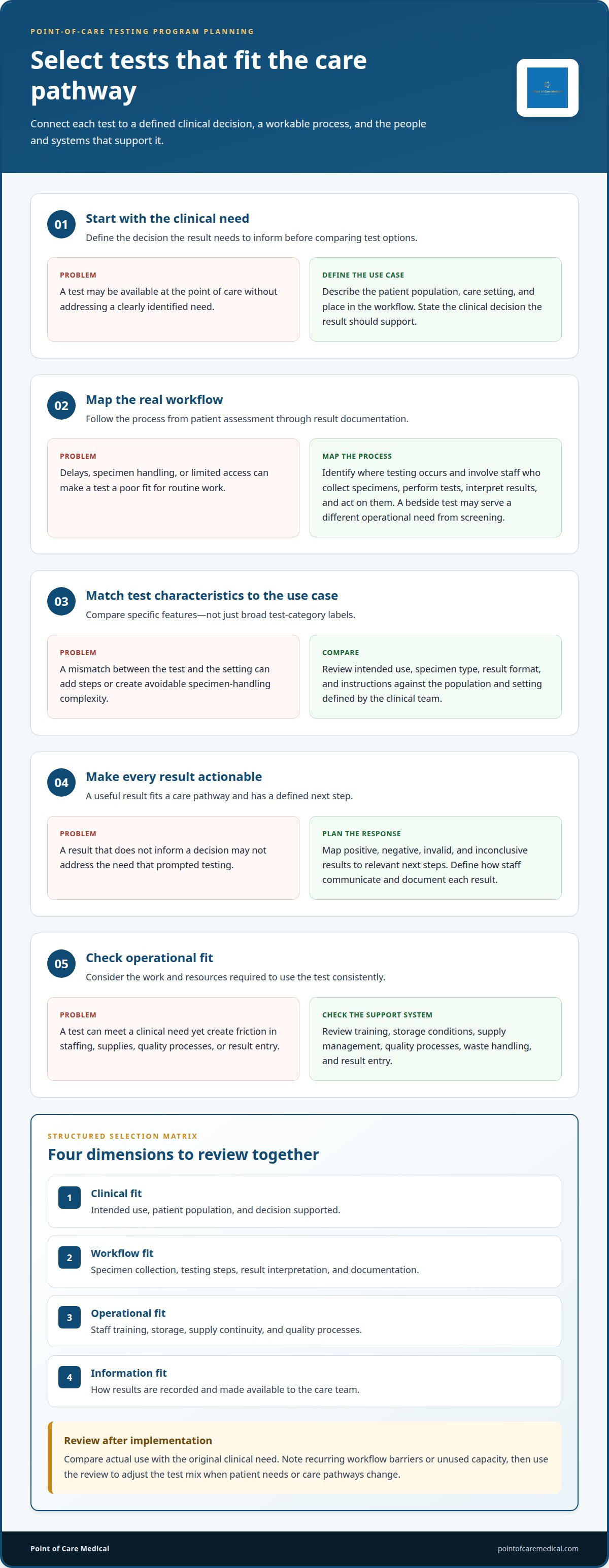
Begin with the clinical decision the test needs to inform. A test is useful when its result fits a defined care pathway. For example, a clinic may need a result during a visit to guide the next step. Describe the patient population, care setting, and point in the workflow where testing occurs. These details establish the use case before reviewing test options.
Next, map the current process from patient assessment through result documentation. Identify where delays, specimen handling, or access to testing affect the workflow. A test performed at the bedside may serve a different operational need from one used for screening. Include the staff who collect specimens, perform testing, interpret results, and act on them. Their input can reveal practical constraints that a purchasing review alone may miss.
Compare each candidate test with the use case, not just a broad category label. Review the test’s intended use, specimen type, result format, and instructions. Check whether these features match the population and setting defined by the clinical team. A mismatch between specimen collection and routine workflow can add steps or create avoidable handling complexity.
Assess how the result will affect care. If it does not inform a decision, the test may not address the identified need. Map positive, negative, invalid, and inconclusive results to the relevant next steps. Consider how staff communicate and document results. This helps distinguish a clinically useful result from one that is simply available at the point of care.
Then evaluate operational fit. Consider training needs, storage conditions, supply management, quality processes, waste handling, and result entry. These factors affect whether the test can be used consistently across shifts or locations. A compact review matrix can keep comparisons structured:
- Clinical fit: intended use, patient population, and decision supported.
- Workflow fit: specimen collection, steps, result interpretation, and documentation.
- Operational fit: staff training, storage, supply continuity, and quality processes.
- Information fit: how results are recorded and made available to the care team.
Use the matrix to document the reason for selecting a test and the needs it serves. If teams are considering oral fluid tests, assess whether that specimen type and testing purpose suit the intended screening workflow. Review point-of-care testing supplies as one part of matching test options to a defined clinical need.
Finally, define how you will review the selection after implementation. Compare actual use with the original clinical need, and note recurring workflow barriers or unused capacity. A clear review process helps the program adjust its test mix when patient needs or care pathways change.
What are the CLIA requirements for point-of-care testing in the United States?
For a U.S. point-of-care program, make CLIA review specific to each test during launch planning. Identify each assay, its intended use, and the setting where staff will perform it. A rapid format or simple workflow does not replace a review of the test’s CLIA status. Keep the test name and supporting documentation together in the program record.
Review each test under consideration separately. Record the assay’s classification, the applicable certificate pathway, and the facility’s status for performing that testing. Then document how the facility will meet the conditions associated with the test and certificate. This prevents the assumption that one test’s classification automatically applies to another assay in the same department.
Before implementation, appoint an accountable program lead to coordinate the review. That person can organize test documentation, facility information, the intended workflow, and unresolved decisions. Involve the laboratory director or other responsible laboratory leadership in deciding how testing will be governed. Connect the test’s classification to the location and personnel involved, rather than treating procurement as the only approval step.
Translate the review into operational controls. Define who may perform each test, what training and competency records the facility will maintain, how testing procedures are controlled, and how results and exceptions are documented. Include quality activities, equipment or kit records, and processes for addressing errors or changes. Align these controls with the test’s applicable CLIA conditions and facility policies. Do not assume a procedure written for one assay covers another test.
Before a test goes live, complete a documented readiness review. Check that the facility’s CLIA status covers the planned activity, the test’s classification and instructions are on file, and staff responsibilities are clear. Confirm the workflow for routine results and exceptions, such as an invalid result or a test that cannot be completed. Record approvals and the rationale for the decision so later reviews can follow the same logic.
Review the CLIA file whenever the program changes. A new test, testing location, workflow, or responsible role can require reassessment of the facility’s documentation and controls. Maintain a current inventory linking each assay to its classification, location, procedure, and accountable lead. This gives program managers a practical view of covered activities and areas needing further review. It also makes CLIA considerations part of routine oversight, not a one-time purchasing task.
Separately, the study's test cases contained about 16,612 statements; its approach identified Arrange, Act, and Assert statements with recall up to 74%.
What accreditation and regulatory standards apply to point-of-care testing programs?
Requirements depend on the test, facility, location, and organization’s accreditation status. Start with a standards inventory for each testing site. Record the assay, its intended use, the department performing it, and the governing policies. This helps identify which requirements apply to each activity. If a program operates across clinics, map each location separately rather than assuming one site’s review covers every workflow.
Separate regulatory obligations from accreditation expectations. Regulatory requirements establish the conditions that apply to testing. Accreditation standards assess whether an organization follows defined quality and operational practices. The two may overlap in areas such as procedures, staff records, quality management, and result documentation, but they are not interchangeable. Record the source of each requirement and whether it applies to the organization, the test, or both.
Build a standards matrix before launch. Use a row for each assay and location, then connect each relevant requirement with its process owner and evidence. For example, the matrix can show which controlled procedure governs specimen handling, where staff training records are kept, and how quality events are documented. This structure helps program leaders identify gaps without treating every test as subject to identical controls.
Accreditation reviews often examine whether written processes match actual practice. Prepare evidence staff can follow, such as current procedures, training records, quality documentation, and corrective-action records. If a point-of-care result enters a patient record, include the documentation workflow in the review. A procedure that describes one process while staff follow another reveals an operational discrepancy.
Assign an owner to monitor changes in standards and internal policies. The owner should assess whether a revised procedure affects a specific assay, department, or testing location. For example, changing who is responsible for a testing step may require updates to role documentation and training records. Record the change, its approval, and the affected workflows. This creates traceability for internal reviews and external assessments.
Use a pre-launch review to connect the matrix with readiness evidence. Confirm that each test has an approved procedure, assigned responsibilities, documented training, and defined quality records. Then check that the process works at the actual testing location. A clinic workflow may differ from a central laboratory workflow, even when both use the same assay. Document applicable requirements and evidence together to show how each standard translates into daily practice.
Revisit the inventory whenever the program adds a test, location, or workflow. This review can identify accreditation expectations and regulatory conditions that need reassessment. It also prevents outdated procedures from staying in circulation after operational changes.
How do you evaluate point-of-care testing devices, vendors, and laboratory information system integration
Evaluate the device against the clinical workflow and the test’s intended use. Review specimen requirements, collection steps, result format, and instructions for handling exceptions. A device may fit the clinical need but still create workflow friction if staff must move specimens between locations or enter results separately. Map the process from patient identification through result review before comparing options.
Evaluate the complete testing process, not just the instrument. Consider how staff prepare the test, recognize an invalid result, document completion, and manage supplies. For example, a clinic workflow should account for where the specimen is collected, where testing occurs, and how the result reaches the care team. Apply the same workflow questions to each device under consideration for consistent comparisons.
Evaluate suppliers based on the operational support they provide for the selected test. Review product documentation, ordering processes, supply continuity, and how product or documentation questions are handled. Confirm that the information provided supports facility procedures and staff training. Record responsibilities clearly, including which tasks remain with the facility and which relate to product supply. This reduces uncertainty when routine processes change.
Plan laboratory information system integration around the result’s full path. Define how the patient and test are identified, which result fields must transfer, and where staff review the result. Include invalid, corrected, or incomplete results in the design. A result that reaches the wrong record or lacks necessary context can disrupt clinical interpretation. Map how device output moves into the laboratory information system and patient record, then assign an owner to each handoff.
Test the proposed workflow before routine use. Use representative cases to confirm that identifiers, result values, units, timestamps, and status information display as intended. Include an exception case, such as an invalid result, to check whether staff can recognize and resolve it. Document observed issues, decisions, and required workflow changes. Retest after changes so the final process matches the approved procedure.
Use a practical comparison record to support selection and oversight:
- Device: intended use, specimen workflow, result format, and exception handling.
- Vendor: documentation, ordering process, supply coordination, and support responsibilities.
- Integration: identifiers, transmitted results, record destination, and exception workflow.
- Readiness: staff workflow, training materials, test records, and issue resolution.
For facilities sourcing rapid testing supplies, explore point-of-care testing supplies as part of the device and vendor review. Match each supply choice to the intended test, workflow, and information requirements before finalizing the program design.
Integration: record the identifiers, transferred result fields, exception behavior, and owner for each handoff, then retain the test cases and outcomes with the comparison. The study evaluated its approach on 449 test cases and across 4 Apache open source projects. A network access control standard, 802.1X, uses RADIUS to authenticate devices and users connecting to wireless access points or network switches. The example Calculator class implements addition by returning the sum of its two integer inputs.
Point of Care Medical
Point of Care Medical supplies targeted rapid diagnostic tests for healthcare and screening facilities. Once your program’s clinical needs and testing workflows are defined, its offerings can support relevant respiratory, infectious disease, and toxicology testing needs. Options include GenBody COVID-19 Rapid Antigen Test, ViraDx™ SARS-CoV-2/Flu A+B Rapid Antigen Test, SURE CHECK HIV 1/2 Assay, and Rapid Test Cup "RTC" + Fentanyl.
Use the program’s intended test, population, and workflow to guide supply decisions. These products address specific testing categories, so match an offering to the clinical purpose established for your program. For information about these testing supplies, contact Point of Care Medical.
Move from planning to a managed rollout
As you move toward implementation, treat the program plan as a working management tool. Assign responsibility for maintaining procedures, reviewing operational information, and recording decisions when workflows change. This keeps the original purpose connected to daily practice as teams begin using point-of-care testing.
For leaders implementing a point of care testing program, the next step is to turn the agreed design into a rollout plan. Specify the locations and workflows included, who owns each activity, and how staff will raise issues. Use early operational feedback to identify process changes and document the rationale. Clear ownership helps teams adapt while keeping the program’s intended role in view.
When your testing needs align with available rapid diagnostic supplies, contact Point of Care Medical to discuss its offerings. A defined plan gives your team a practical foundation for moving forward with clarity.
Frequently Asked Questions
What are the key steps to implement a point-of-care testing program?
Start by appointing a program lead and a clinical stakeholder group. Define the care decisions testing should support, set the program’s scope, and identify participating locations. Then establish governance, documentation, and staff responsibilities before preparing the testing workflow. A limited rollout can reveal practical issues, such as unclear handoffs or result-entry delays. Use those findings to refine procedures before extending the program to additional teams.
How much does it cost to implement and operate a point-of-care testing program?
Costs depend on the testing model, selected devices, expected test volume, and local workflow. Build a budget that accounts for test supplies, equipment where needed, staff training, quality activities, information-system work, and ongoing oversight. For example, a site with several testing locations may need to account for separate workflows and support needs. Review recurring expenses alongside startup requirements, then update estimates as actual usage and operational needs become clearer. Product pricing from Point of Care Medical is personalized based on the requested products, quantities, and configurations.
How do you measure the performance and clinical impact of a point-of-care testing program?
Measure operational performance and clinical impact separately, then interpret them together. Track completed tests, invalid results, repeat testing, and the time from collection to result availability. For clinical impact, examine whether results informed the intended care decision and what action followed. For example, compare documented actions before and after testing becomes part of the workflow. Review results by location or use case to identify process differences and where adjustments may help.
What staff training and competency assessment are required for point-of-care testing?
Define who may perform each test and maintain training and competency records for them. Align these controls with the test’s applicable CLIA conditions and facility policies.


