

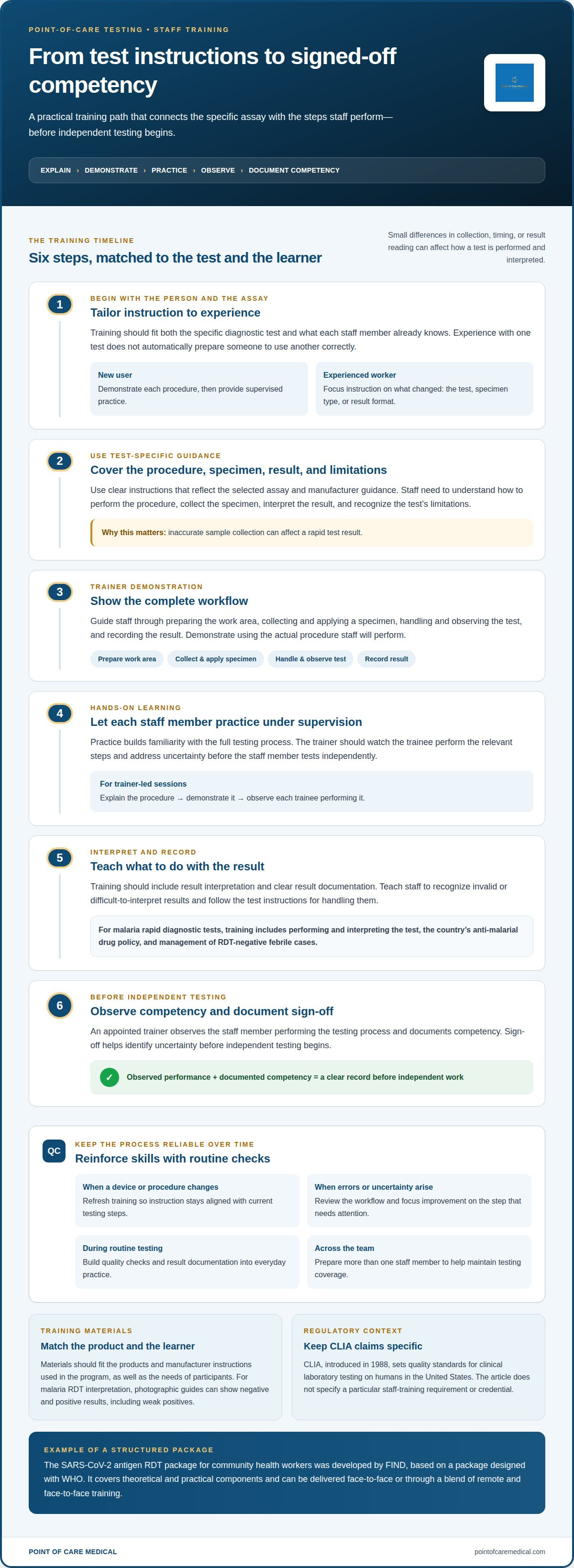
A rapid test’s short turnaround doesn’t remove the need for careful training. Effective staff training for rapid diagnostic tests should match the specific assay and each staff member’s experience, combining clear instruction with hands-on practice and observed competency. Staff need to understand the procedure, specimen collection, result interpretation, and the test’s limitations.
A straightforward test may seem easy to learn, but small differences in collection technique, timing, or result reading can affect how it is performed and interpreted. Clear, product-specific instructions and routine quality checks help make testing more consistent across a team.
This article explains how to prepare staff with varied diagnostic experience, adapt training materials to the test and workplace, and reinforce skills over time. You’ll also learn how competency sign-off, result documentation, and quality-control practices can help reduce avoidable errors. The goal is a practical training approach that supports reliable point-of-care testing without assuming every staff member starts with the same knowledge.
Key Takeaways
- Match instruction and hands-on practice to each test’s procedure, limitations, and staff experience.
- Use clear, accessible training materials that reflect the applicable guidelines and the needs of the participants.
- Refresh training when devices or procedures change, and maintain coverage by preparing more than one staff member.
- Observe staff performing the testing process and document competency before they work independently.
- Build quality checks, result documentation, and a suitable testing environment into routine practice to help prevent errors.
Staff comfort and training for point-of-care tests
Point-of-care testing brings medical tests closer to patients, including in decentralized settings outside a central laboratory. Effective staff training for rapid diagnostic tests connects each test’s instructions with the practical steps staff perform.
A rapid test can support timely decisions near the patient, but the result depends on more than speed. Staff need to understand specimen collection, test handling, result interpretation, and the assay’s limitations. For example, inaccurate sample collection can affect a rapid test result, so training should include a demonstration and observed practice using the actual procedure.
Confidence develops through familiarity with the whole testing process. A practical training session can guide staff through preparing the work area, collecting and applying a specimen, observing the test, and recording the result. An appointed trainer can then observe competency and sign it off, identifying uncertainty before independent testing begins.
CLIA Requirements and Staff Training
The Clinical Laboratory Improvement Amendments (CLIA) is a U.S. federal law introduced in 1988 that sets quality standards for clinical laboratory testing on humans, according to U.S. Congress. For rapid testing programs, this establishes an important quality framework; the fact does not specify a particular staff-training requirement or credential.
To address U.S. regulations responsibly, distinguish CLIA’s quality standards from the practical training plan. Build instruction around the selected test’s procedure, specimen collection, result interpretation, and known limitations. A trainer should observe the staff member performing the test and document competency. These steps support consistent practice without assuming a single training rule applies to every rapid test.
Training Costs
There is no single training cost for every rapid diagnostic testing program. The resources required depend on factors such as staff time, test complexity, and whether training uses instructor-led practice or reference materials.
For planning, identify the tasks staff must learn and the time needed for demonstration, practice, and competency observation. A simple procedure may need a different training approach from a test with more interpretation steps. Include time to document competency and refresh skills when procedures change. This gives administrators a clearer basis for estimating resource needs without relying on an unsupported price.
The benefits of point-of-care testing depend on integrating it into routine medical work. In a decentralized clinic, staff can collect and test a specimen near the patient rather than send it through a separate testing workflow. This can support faster access to a result, while clear recording procedures help the team use it in care decisions.
Use quality checks to reinforce training. Teach staff to recognize invalid or difficult-to-interpret results and follow the test’s instructions for handling them. Review the workflow when errors or uncertainty arise. These steps help teams maintain consistent testing and focus improvement efforts on the specific step that needs attention.
Training for healthcare workers with varied diagnostic experience
Training should build on each worker’s experience and the specific diagnostic test they will perform. For rapid tests, practical competency includes both correct procedure and sound result interpretation.
Training for Different Experience Levels
Training for different experience levels adjusts instruction and practice to what each healthcare worker already knows. This matters because experience with one diagnostic test doesn’t automatically prepare someone to use another correctly.
For a new user, demonstrate each procedure and allow supervised practice. An experienced worker may need focused instruction on a changed test, specimen type, or result format. In both cases, observe the full process and document competency. For malaria rapid diagnostic tests, users need instruction in performing and interpreting the test, as well as the country’s anti-malarial drug policy and management of RDT-negative febrile cases.
Training Trainers and Community Health Workers
Training trainers prepares designated staff to demonstrate procedures, support practice, and assess competency. This approach helps build capacity across community health worker teams and supports consistent communication about test steps.
Trainers should explain the procedure, demonstrate it, and then observe each trainee performing it. For malaria RDT interpretation, photographic guides showing negative and positive results, especially weak positives, can make real result patterns easier to recognize than line drawings. Training should also address what follows a negative result, including the applicable management of febrile cases.
Community Healthcare Worker Training Packages
A community healthcare worker training package organizes instruction around safe, accurate use of a specific rapid diagnostic test. It matters because a structured package can connect classroom learning with practical testing tasks.
The SARS-CoV-2 antigen rapid diagnostic test package for community health workers was developed by FIND, based on a package designed with WHO. It covers theoretical and practical components and can be delivered face-to-face or through a blend of remote and face-to-face training. The malaria RDT resource is designed to train health workers in safe and accurate use. Training materials should match the products and manufacturer instructions used in the program.
Qualifications for Performing Rapid Tests
For rapid diagnostic testing, practical competency means demonstrating the procedure and interpretation under observation. This matters because gaps in formal training and sample collection can affect testing accuracy.
A single qualification does not apply universally to every test or U.S. setting. A useful training plan teaches the specific procedure, specimen handling, result interpretation, and limitations; an appointed trainer then observes competency and signs it off. This clarifies what workers need to demonstrate without assuming the same credential applies to every diagnostic test.
To perform and interpret a rapid test, follow its instructions, collect and handle the specimen as directed, complete the procedure, and interpret the result using the test guidance. For a malaria RDT, training also covers anti-malarial policy and management of RDT-negative febrile cases.
U.S. healthcare staff can use structured resources such as the FIND and WHO-based SARS-CoV-2 antigen training package and the malaria RDT training resource. The former supports face-to-face or blended delivery, while materials should be adapted to the test and applicable national guidance.
Adapting materials to national guidelines and participants
Training materials work best when they reflect national guidance and the people who will use them. Adapt examples and practice activities without obscuring the specific test procedure.
Start with a content review. Identify which instructions apply to the particular disease, test, and clinical setting. Then align the training language with national guidelines and the relevant care pathway. For malaria, for example, learning materials should address how workers handle RDT-negative febrile cases alongside test use. Keep the test’s own instructions visible so local adaptation doesn’t change the procedure staff must perform.
Next, tailor delivery to participants’ roles and starting knowledge. A laboratory professional may need practice documenting results in a decentralized workflow, while a community health worker may need clearer examples of specimen handling and when to communicate a result for follow-up. Use a short scenario for each role. Ask participants to explain the next action in their own words, then address gaps during practice.
Language and format affect whether staff can use training materials during real testing. Malaria RDT users should receive instructions in a language and format they readily understand, along with the equipment needed to perform tests. A written guide, demonstration, or visual aid can support different learning needs. Choose materials that match participants’ working context rather than assuming one format suits every group.
Review examples for local relevance before training begins. Replace a generic patient scenario with one that reflects the disease being tested and the decisions staff actually face. Keep the assessment tied to observable tasks: following the procedure, interpreting the result, and explaining the next step. This gives trainers a practical way to identify where further instruction is needed.
Adaptation should also preserve accuracy. For malaria training materials, compare the content with the products and manufacturer instructions used in the program. If a procedure differs, update the training example and demonstrate the correct workflow. Avoid combining instructions from different tests in one guide. Clear separation helps staff connect each test with its own steps.
Before delivery, review the relevant guideline, selected product instructions, and participants’ roles. A trainer can then check whether the terminology is understandable, examples fit the setting, and assessment tasks reflect actual practice. Record the material version used for each session so future updates can be compared with the right reference.
Finally, use participant feedback as an assessment tool. If several trainees misunderstand the same instruction, revise the explanation and test it in the next session. Keep the core procedure consistent while improving language, examples, and teaching format. This makes materials more useful across clinical and community settings without weakening test-specific accuracy.
Keeping staff training current as devices and procedures change
A revised device, test procedure, or sample type can change what staff must do at the point of care. Keep training aligned with current manufacturer instructions, then identify which tasks require updated practice before implementing the change.
Begin with a change review whenever a test kit, device, or procedure is replaced. Compare the current instructions with the materials staff use. Mark differences in sample collection, timing, result interpretation, and documentation. For example, a change to a specimen collection step calls for focused practice on that step, not simply distributing a revised document.
Make version control visible. Keep the current test instructions and training materials together, and remove obsolete copies from work areas. A staff member using an earlier procedure may collect a patient sample incorrectly or apply outdated interpretation guidance. Record which version supports each training session so supervisors can trace the material used.
Update examples when result formats or interpretation guidance change. A training exercise should show how to read negative, positive, and invalid results using the current test materials. Ask staff to explain what they see before discussing the next action. This helps identify confusion about a faint line or another result that may be difficult to interpret.
Changes to specimen collection deserve direct observation. Have staff demonstrate the revised collection and handling steps with the relevant supplies. Compare performance with the current instructions, then document any coaching needed. Sample collection can affect accuracy, so a written update alone may not show whether each person can perform the revised technique.
Use a risk-based approach to decide who needs retraining. If a change affects only result entry, focus practice on recording and reporting. If it affects the device, specimen, or interpretation, include those tasks in an observed competency assessment. An appointed trainer can document the outcome and identify staff who need additional practice before using the changed procedure independently.
Communication supports consistent implementation across shifts. Share the change with every team member who performs or supports testing, including staff responsible for documenting results. For example, if an electronic system changes, explain the current process for recording results when connectivity is unavailable. Keep escalation instructions available for IT issues that interrupt testing workflows.
Review whether the update works in the actual testing environment. Temperature fluctuations can affect rapid test accuracy, so include storage and handling considerations when they change. Supervisors can also review quality-control records and staff questions for signs that a procedure remains unclear. Use those findings to revise examples, demonstrations, or follow-up training.
Close the update cycle by confirming that the revised procedure is in use. The supervisor can check the current instruction version, observe a staff member completing the changed step, and record the assessment. This creates a clear link between a device or procedure change and the training provided, without relying on an arbitrary retraining calendar.
Quality control, external quality assessment, and error prevention
Quality checks help identify problems with equipment, procedures, and result recording. Build them into routine diagnostic testing, not just staff orientation.
The Clinical Laboratory Improvement Amendments (CLIA) is a U.S. federal law introduced in 1988 that sets quality standards for clinical laboratory testing on humans, according to U.S. Congress.
Set up a testing area free of food and beverages, and define how staff check equipment accuracy. Include calibration where the device requires it, since failure to calibrate can affect accuracy. Staff should know where to record quality-control checks and what to do after an unexpected result. Clear internal guidelines help make these actions consistent across shifts.
External quality assessment can complement internal checks by providing another way to review testing performance. Keep the process connected to the actual rapid test, its instructions, and the staff who perform it. Document findings and use them to identify whether an issue relates to equipment, specimen handling, interpretation, or result recording.
Preventing Testing Errors
Error prevention means building checks around steps that can affect a test result. This matters because specimen collection, calibration, and result documentation can each introduce problems.
Use a practical review of the complete workflow. Confirm that staff follow the test instructions, keep the testing area suitable, and document results in the designated record. For an antigen test, include clear guidance on recognizing and recording the displayed result. If a result is difficult to interpret, staff should follow the test instructions and established internal procedure rather than guess.
Documenting Staff Competency
Competency documentation records that a staff member has demonstrated the testing process under observation. It matters because completing a training session alone doesn’t show how someone performs each technical step.
An appointed trainer should observe the staff member completing the procedure and sign off competency. Record the test or procedure assessed, the observation outcome, and any follow-up practice needed. Keep the documentation accessible to supervisors responsible for testing oversight, whether records are paper-based or electronic.
When a quality check identifies a concern, use the record to guide corrective training. For example, a documentation gap calls for a review of result entry, while an equipment issue calls for attention to the relevant device checks. Avoid treating every problem as a general training failure. A targeted response helps the team address the process step involved and assess whether the correction resolves it.
Maintain a defined route for reporting technical issues and recording results when electronic connectivity is unavailable. Review quality-control records alongside staff competency documentation to identify recurring gaps. These records make follow-up more specific and help supervisors see whether an issue relates to a person, procedure, or equipment.
For rapid testing supplies that support your testing workflow, explore rapid diagnostic test options.
Point of Care Medical: Oral Fluid tests
Point of Care Medical supplies Oral Fluid tests for facilities that need oral-fluid testing supplies as part of their screening workflow. Matching a selected test with the facility’s procedures and staff training helps keep product use aligned with established processes.
Its rapid testing offerings also include the GenBody COVID-19 Rapid Antigen Test, Rapid Test Cup "RTC" + Fentanyl, and ViraDx™ SARS-CoV-2/Flu A+B Rapid Antigen Test. These options address different testing needs, so use the product-specific instructions when preparing staff and maintaining competency. A trained team can then follow the appropriate procedure for the test in use.
For facilities reviewing oral fluid testing supplies or other rapid testing options, contact Point of Care Medical.
Make the next testing decision a coordinated one
Use your next testing workflow review to connect the procedure, the people performing it, and the supplies they will use. A staff-training plan for rapid diagnostic tests becomes more practical when tied to your facility’s specific testing needs. Identify which testing categories matter to your program, then align purchasing decisions with established workflows.
Point of Care Medical offers the GenBody COVID-19 Rapid Antigen Test, Rapid Test Cup "RTC" + Fentanyl, and ViraDx™ SARS-CoV-2/Flu A+B Rapid Antigen Test. These options support different testing applications. Consider which category fits your facility’s intended use and the procedures your team is prepared to follow.
A clear next step is to discuss the testing supplies relevant to your program. Contact Point of Care Medical to take that step and keep your planning focused on practical requirements.
Frequently Asked Questions
What topics should staff training for rapid diagnostic tests cover?
Cover the procedure, specimen handling, result interpretation, and the test’s limits. Staff should also understand imprecision, potential inaccuracies, and contraindications relevant to the test. Include a practical scenario where a patient’s result needs follow-up, so staff can explain how they would communicate it. A useful training check asks each person to describe what the test can and cannot establish, rather than focusing only on completing the steps.
How often should staff receive rapid diagnostic test training and competency assessments?
Schedule refreshers when a device, procedure, or instruction changes, or when quality reviews identify a skill gap. Include staff who perform tests infrequently, since a long gap between uses can make procedural steps less familiar. Use observed assessments to target retraining rather than repeating identical sessions for everyone. If staffing changes, cross-training supports coverage and helps maintain testing workflows when a usual operator is absent.
What are common errors and risks when staff perform rapid diagnostic tests?
Common risks include collecting a specimen incorrectly, misreading a result, and using a test outside its stated limitations. Result interpretation can be subjective, especially when a visual result is faint or difficult to distinguish. Temperature fluctuations can also affect accuracy. A practical risk review can examine one testing episode from specimen collection through documentation, then identify which step needs clearer instructions or additional staff practice.
How should staff handle quality control, test kits, and invalid results?
Follow the specific kit instructions for storage, preparation, and quality-control checks; temperature changes can affect test accuracy. Record the quality check and result using the practice’s defined process. If a result is invalid, staff should follow the test’s instructions for the next step and document the outcome rather than interpret it as positive or negative. Keep a clear route for technical issues and result recording during electronic outages.


