

POCT for decentralized diagnostics brings selected tests closer to the people and settings where results are needed. It can support testing in clinics and other care environments. Home-based approaches may involve collecting a sample outside a traditional laboratory and processing it through an appropriate testing pathway.
Moving testing closer to the point of need can make access and workflows more convenient, but convenience alone does not determine whether a program is suitable. The test, sample collection process, result quality, operating costs, regulatory requirements, and usability for staff or patients all shape adoption.
This article explains how point-of-care technologies support decentralized testing and what home collection can involve. It examines how assay formats and digital tools affect implementation, which quality considerations matter, and how organizations can assess costs without relying on a single price figure. The goal is to clarify where decentralized testing fits and what to consider before adding it to a care or screening workflow.
Key Takeaways
- Assess decentralized testing by how it fits care workflows, access needs and the decisions results must support.
- Plan home-based testing around clear collection instructions and reliable handling of samples and results.
- Evaluate the full operating model, including quality processes, staffing and technology, rather than focusing on test costs alone.
- Consider usability and clinical trial design together, since both influence whether a test performs reliably in real-world settings.
- Compare diagnostic technologies by their test format and intended use to identify options that fit your testing program.
Decentralized testing to alleviate healthcare-system pressure
Decentralized testing moves selected diagnostic steps closer to patients, rather than routing every sample through a central laboratory. In a clinic, community setting, or home-based program, a point-of-care test can provide information where care decisions begin. Diagnostics guide nearly 70% of clinical decisions, while accounting for only a fraction of total medical spending. This contrast helps explain why healthcare organizations examine testing workflows as they manage service demand.
The pressure is operational as well as clinical. Centralized pathways can involve sample transport, laboratory processing, result delivery, and follow-up, with coordination needed at each handoff. A decentralized model changes where some steps happen, but still depends on suitable tests, trained users, clear escalation routes, and result documentation. For example, a clinic may use a rapid test to inform an initial assessment, then direct cases requiring further evaluation into the appropriate care pathway.
Digital systems can connect test results with clinical records and care teams. Depending on the technology and workflow, smartphone interfaces may guide users through instructions or capture results for review. AI can support data interpretation or triage within a defined system, but it does not replace sound test design or clinical oversight. Before deployment, define who enters results, who reviews them, and what action follows an unclear or concerning result.
Access depends on more than placing a test outside a hospital. Distance, limited clinic hours, language, disability, digital access, and confidence with sample collection can all affect whether people can use a service. A self-testing pathway should include understandable instructions, accessible support, and a route to professional care when needed. For people without a suitable device or reliable internet connection, a non-digital reporting option may be necessary.
- Map the workflow: identify the user, testing location, result recipient, and follow-up step.
- Design for access: account for language, device access, and assistance with collection.
- Connect responsibly: specify how digital results reach authorized care teams.
Global demand also shapes investment in point-of-care platforms. The market is projected to reach USD $78.19 billion by 2029, with projected annual compound growth of 11.4%. Those projections indicate expanding interest, not proof that every decentralized model reduces workload. Adoption works best when the test addresses a defined service bottleneck and its results fit existing clinical decisions. This is the practical role of POCT for decentralized diagnostics: bring selected testing closer while preserving a reliable path from result to care.
Home-based testing and decentralized sample collection
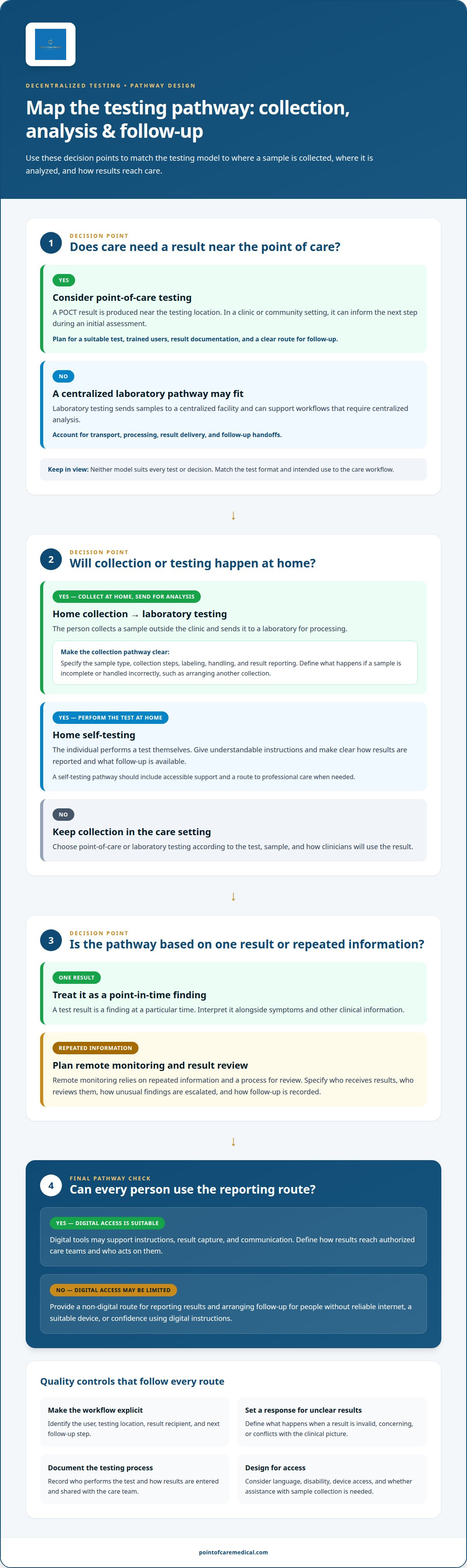
Home-based testing moves selected collection or testing steps outside clinics, while decentralized models keep results connected to care. The right approach depends on the disease, sample, and how clinicians will use the result.
POCT and Laboratory Testing
Point-of-care testing produces a result near the testing location, while conventional laboratory testing sends samples to a centralized facility. This distinction matters when a care team needs information during an appointment or must coordinate collection and processing across locations. A clinic can use a point-of-care result to guide the next step, while laboratory testing can support workflows that require centralized analysis. Neither model suits every test or decision.
For home collection, distinguish the collection step from the testing step. A person may collect a sample at home and send it to a laboratory, or perform a self-test at home. Each model needs clear instructions for sample type, collection, labeling, handling, and result reporting. If a sample is incomplete or handled incorrectly, the care pathway needs a defined response, such as arranging another collection.
Self-Testing and Remote Monitoring
Home-based self-testing lets individuals collect a sample or perform a test themselves, while remote monitoring shares results or relevant health information with a care team. The distinction matters: a test result is a point-in-time finding, whereas monitoring relies on repeated information and a process for review. A connected model should specify who receives results, how unusual findings are escalated, and how follow-up is recorded in the care record.
Digital tools can support instructions, result capture, and communication, but they cannot resolve every access barrier. A usable pathway should account for people without reliable internet, compatible devices, or confidence reading test instructions. For example, a program can offer a clear non-digital route for reporting results and arranging follow-up. Remote monitoring should also assign review responsibilities so information reaches an accountable recipient.
CLIA-waived testing is relevant when a decentralized program considers testing outside a conventional laboratory. Build the workflow around the test’s intended use, staff training, quality processes, and clear documentation. Do not treat a waived category as a substitute for operational controls. Record who performs the test, how results are documented, and what happens when a result is invalid or conflicts with the clinical picture.
Antimicrobial stewardship adds another decision point. A test result can inform an assessment, but should be interpreted alongside symptoms and other clinical information. For a suspected infection, define how testing affects decisions about further evaluation and treatment. This helps keep results within their intended role and aligns care testing with the patient’s condition.
Before adopting POCT for decentralized diagnostics, map each handoff from collection to clinical action. Identify the user, sample route, result destination, and person responsible for follow-up. These practical details help organizations choose workable models for home-based testing and connected care.
POCT costs, regulation, and quality challenges
Reliable point-of-care testing depends on trained operators, documented quality control, and connectivity that routes results to the right record. Decentralized POCT can improve access and shorten result pathways, but it also creates risks such as collection errors, missed follow-up, and results being used outside their intended purpose.
Cost assessment should cover more than the test itself. Account for instruments, consumables, controls, staff time, training, connectivity, maintenance, waste, and repeat testing. For example, a site that performs few tests may face different equipment and staffing costs from a clinic with steady testing volume. Invalid results and additional collection steps also affect the total operating model.
Build quality into routine operations. Train each operator on test instructions, sample handling, result interpretation, and escalation procedures. Document competency and refresher training according to the organization’s quality plan. Use the prescribed test controls, record results, and define what happens when a control fails. Ongoing review can identify recurring errors, such as inconsistent collection or incomplete result entry.
Connectivity supports traceability when it links the patient, test, operator, result, and follow-up action. A manual workflow can use a controlled log and assigned reviewer; a digital workflow can transfer results into a clinical record. In either case, assign responsibility for reviewing exceptions. For example, an invalid result should trigger a documented next step, not remain as an unexplained entry.
Regulatory compliance and accreditation require a clear distinction between the test and the setting in which it is used. Align procedures with the test’s intended use, regulatory status, and applicable facility requirements. Accreditation processes may also require documented training, quality records, and corrective actions. Requirements can vary by program, so build them into workflow design rather than treating accreditation as a substitute for daily quality control.
Novel point-of-care tests bring additional review needs. Their regulatory pathway depends on factors such as intended use, test claims, technology, and the population being tested. A test making a broader clinical claim may need a different evidence and review pathway from one intended for narrower use. Keep claims, validation evidence, user instructions, and quality procedures aligned throughout development and implementation.
Cost and quality decisions are linked. A low-cost test that requires frequent repeats, extensive staff support, or manual transcription may add operational burden. A connected workflow can reduce data-entry steps, but also introduces setup and maintenance needs. Compare models across the full process, from procurement and training through result review and follow-up, rather than considering purchase cost alone.
For patients, the practical measure is whether results are accurate, understandable, and connected to appropriate care. For organizations, the ongoing challenge is maintaining those conditions as testing expands across sites, staff, and populations.
Usability and clinical trial design for POC tests
Providers can set up a decentralized POCT program by defining its clinical purpose, test workflow, operator roles, result pathway, and follow-up process. They can then train users, assess usability in the intended setting, and monitor quality records and operational issues.
Usability affects whether a point-of-care test produces useful results in routine conditions. Trial design should reflect the people, locations, and workflow where the test will be used. For example, if clinic staff collect samples during appointments, evaluate the test with those staff and the intended collection process. A test that performs well under controlled conditions may still be difficult to use during a busy visit.
Study protocols should define the intended population, sample type, test procedure, and clinical question before enrollment begins. Researchers should record invalid results, repeat tests, and deviations from instructions alongside successful results. These records help show whether a test fits its intended role. A study evaluating a chronic disease marker, for example, should consider how the result informs the relevant clinical decision, not only whether the device produces a readable output.
Human factors testing can identify usability problems before broader implementation. Observe users completing the actual steps, from preparing materials to recording results. Note where instructions cause hesitation, where a sample may be applied incorrectly, or where an interface obscures the result. Revise the instructions or workflow, then assess whether the change addresses the observed problem. This approach evaluates real tasks rather than making assumptions about user familiarity.
Remote clinical review can extend follow-up beyond the testing location. A defined process should route results to an assigned clinician, show when review is complete, and record the response. For example, a care team monitoring treatment response can review results alongside symptoms, medication history, and other relevant records. Remote review supports continuity only when information reaches someone responsible for interpreting it.
Data access shapes clinical decision-making. Link each result to the correct patient, test, collection time, and operator, then present it in a format clinicians can interpret. A disconnected spreadsheet, for example, can make it harder to tell whether a result belongs to the current visit or an earlier test. Establish access controls and a documented process for correcting errors before routine use.
Clinical trial teams should test the complete data pathway, not just the assay. Confirm that result capture, transfer, review, and follow-up work across the intended sites. If the traditional workflow relies on paper records, compare it with the planned digital route. This reveals where handoffs can fail and helps teams develop a usable, traceable model.
After implementation, review performance using documented feedback, quality records, and workflow observations. Repeated questions from users may point to unclear instructions; recurring missing entries may signal a data-capture problem. These findings help program leads prioritize targeted changes while preserving the test’s intended clinical role.
Point-of-care diagnostic technologies
Major POCT platforms differ in assay format, test menu, workflow, and intended setting. Compare them based on the conditions that shape adoption: required tests, time to a usable result, sample throughput, and total operating costs.
POCT Platform Capabilities
POCT platforms use different technologies to produce diagnostic results near the patient or testing site. Their capabilities matter because assay format influences sample handling, user steps, and where testing fits into disease management. Immunological assays account for 64% of POCT research literature, while lateral flow immunoassays account for 44%. These figures describe research literature, not the share of tests used in clinics.
Other approaches address different technical needs. More than 3,000 research publications have focused on microfluidics in POCT, reflecting sustained research attention to compact testing systems. During the pandemic peak years of 2021 and 2022, about one-third of POCT publications were directly related to COVID-19. These examples show how the field spans established assay formats and developing technologies.
Test Menu and Operational Measures
A platform’s test menu identifies the assays it supports, while operational measures show how it fits a testing workflow. These differences matter when selecting technology for clinics, screening programs, or other settings. Compare menus with the conditions the program needs to assess, then review turnaround, throughput, staffing, consumables, and instrument requirements using the relevant test documentation.
No single platform leads on every measure. A focused menu may suit a program with a defined testing need; a broader menu may support multiple workflows but requires an assessment of actual demand. Turnaround depends on the assay and its procedure. Throughput depends on how tests are run and how the site operates. Total cost extends beyond equipment or test materials, so also evaluate staffing, training, quality processes, and repeat testing.
Use a structured comparison rather than treating one specification as decisive:
- Test menu: match available assays to the clinical question and intended population.
- Turnaround: assess when the result becomes actionable within the care pathway.
- Throughput: consider expected demand, staffing, and workflow capacity.
- Operating cost: account for equipment, consumables, labor, and quality activities.
Then assess whether results can be documented and reviewed within the existing care process. For example, a respiratory testing site may prioritize a relevant assay menu and clear result reporting, while a screening program may have different workflow needs. The technology should fit the service, not force the service to fit a device.
For practical testing supply options, review point-of-care testing supplies that align with your program’s intended use.
Point of Care Medical
Point of Care Medical distributes targeted rapid diagnostic testing supplies to healthcare and screening facilities. Turn to its catalog when your program needs point-of-care tests for respiratory, infectious disease, or toxicology screening. Available options include the GenBody COVID-19 Rapid Antigen Test, ViraDx™ SARS-CoV-2/Flu A+B Rapid Antigen Test, SURE CHECK HIV 1/2 Assay, and Rapid Test Cup "RTC" + Fentanyl.
Match the test category to your program’s intended use and workflow. These supplies support specific testing needs, while your organization remains responsible for its testing procedures, quality processes, and result follow-up. For supply questions related to your program, contact Point of Care Medical.
Build a Practical Path from Planning to Testing
Decentralized testing works best when the next operational decision is specific: identify the testing need, define how results enter care, and select supplies that fit the intended workflow. Use this plan to guide implementation, staff preparation, and ongoing review. A deliberate approach to POCT for decentralized diagnostics can help organizations move from broad interest to a testing model with clear roles and processes.
Point of Care Medical supplies targeted rapid diagnostic tests for healthcare and screening facilities. Its catalog includes options for respiratory, infectious disease, and toxicology testing. As a practical next step, identify your program’s testing requirements and request a quote for suitable products and configurations.
Contact Point of Care Medical to discuss testing supplies for your program. A clear plan can make your next implementation decision more straightforward.
Frequently Asked Questions
What is point-of-care testing (POCT) for decentralized diagnostics?
POCT is diagnostic testing performed near the patient or outside a centralized laboratory. In decentralized care, testing may take place in a clinic, screening facility, or another suitable setting. The result can support a local care or screening decision, while the program defines how results are recorded and acted on. For example, a screening team may collect and test a sample at its service location rather than send every sample elsewhere.
What diseases and clinical settings are POCT decentralized diagnostics used for?
POCT can support testing for conditions such as COVID-19, influenza, HIV, and substance exposure, depending on the test’s intended use. Examples include respiratory testing in clinical facilities and toxicology screening in healthcare, workplace, or treatment settings. The appropriate setting depends on the test, sample, operator, and purpose. A program should select tests that address a defined clinical or screening need, then establish how results connect to follow-up.
What POCT technologies and test types are available, such as molecular, antigen, and lateral-flow tests?
Available approaches include molecular assays, antigen tests, and lateral-flow immunoassays. These technologies differ in how they detect a target, the sample they use, and the equipment or handling their workflows require. For example, antigen tests detect target components, while molecular methods detect genetic material. Check the test’s intended use and instructions to understand its required sample, procedure, result format, and role in a specific care pathway.
How accurate are decentralized POCT tests compared with central laboratory testing?
Accuracy varies by test, target, specimen, and conditions of use, so no single comparison applies to every POCT assay. Review performance evidence for the specific test and intended population. Collection quality, correct procedure, and result interpretation also affect the usefulness of an individual result. If a result does not fit the clinical picture, the care pathway should define whether further assessment or another testing method is appropriate.
What are the typical costs and prices of POCT devices, tests, and implementation?
There is no single typical cost for all POCT programs. Budget planning should account for the device, test materials, quality controls, staff time, training, connectivity, and any repeat testing. Testing volume and workflow design also affect total operating costs. Point of Care Medical provides personalized pricing after a request based on selected products and quantities. Product availability and regulatory classification can vary by configuration.
What FDA regulations and CLIA requirements apply to POCT in the United States?
FDA status and CLIA categorization are test-specific considerations in the United States. The appropriate pathway depends on the test, its intended use, and the setting where it will be used. Review the test’s labeling and applicable facility requirements before adding it to a workflow. For example, a test intended for one setting or use should not automatically be assumed suitable for another. Document procedures, training, and quality activities for the program.


