

A test performed at the point of care isn’t automatically CLIA-waived. The difference between CLIA-waived vs non-waived testing comes down to the complexity category of the specific test system. Waived tests are simple, low-risk tests cleared for home use or specifically approved for waiver; non-waived tests are moderate- or high-complexity. Sites performing waived tests still need the appropriate CLIA certificate and must follow the manufacturer’s instructions.
That distinction matters when a facility selects a test and sets expectations for staff. Waiver status applies to a specific test system, so tests of the same type can have different classifications across brands or models. This article explains what makes a test CLIA-waived, how waived and non-waived testing differ in oversight and operating requirements, and what staff training and competency involve. It also explains why point-of-care use alone doesn’t determine a test’s CLIA status.
Key Takeaways
- Determine a test’s CLIA category by its specific system and model, not simply by where staff perform it.
- Waived testing still requires the appropriate CLIA certificate and use according to the manufacturer’s instructions.
- Plan for additional quality-system, personnel, and oversight requirements when a facility performs non-waived testing.
- Train staff on each waived test they perform, then assess and document their competency using more than one method.
- Match testing plans to the facility’s equipment, space, staffing, and quality procedures before expanding laboratory services.
What is Clinical Laboratory Improvement Amendments (CLIA)?
The Clinical Laboratory Improvement Amendments (CLIA) established standards for U.S. laboratory testing in 1988. They apply to facilities testing human specimens to assess health or diagnose, prevent, or treat disease.
CLIA Oversight of Laboratory Testing
CLIA regulates U.S. clinical laboratory testing through requirements for certificates, personnel, quality systems, and oversight. The rules are set out in 42 CFR Part 493, with definitions in 42 CFR 493.2. FDA, CMS, and CDC have distinct responsibilities within CLIA oversight. For facilities, the applicable requirements depend on the complexity of the tests performed and the certificate held.
Certificate Scope and Compliance Risks
A CLIA certificate defines which testing a laboratory is authorized to perform. Testing outside that scope creates compliance risk because the certificate does not authorize the additional work. A laboratory performing only waived tests may be randomly inspected during a compliance investigation. The certificate type, test category, and any changes to planned testing all matter when managing that risk.
Facilities performing nonwaived tests must hold a CLIA certificate, undergo inspection, and meet quality standards in 42 CFR Subparts H, J, K, and M. Moderate-complexity laboratories need a Certificate of Compliance or Certificate of Accreditation. By contrast, a Certificate of Waiver authorizes waived tests only when staff follow the manufacturer’s instructions. That distinction affects the laboratory’s procedures, personnel requirements, and oversight.
Laboratory setup should match the tests performed. Before adding testing, assess whether the facility has suitable space, equipment, and staff to support the work. Equipment must be used according to the test system’s instructions, while written procedures should cover the testing process. CLIA quality-system requirements include managing pre-analytic, analytic, and post-analytic steps. A procedure manual must meet regulation 493.1251.
Quality checks and documentation help make results consistent and traceable. Maintain written procedures and records that show how testing is performed and how quality processes are managed. Nonwaived testing also falls under proficiency-testing requirements in 42 CFR Subpart H. Those requirements make documentation part of routine laboratory operations, not an optional administrative task.
To apply for a Certificate of Waiver, a testing site can use form CMS-116, available through the CMS CLIA website or its State Agency. Contacting the State Agency is also the route for state-specific requirements and certificate changes. Submit the appropriate application and receive the updated certificate before using a new certificate type.
State rules can add licensing or registration requirements, including for waived testing. Washington and New York are identified as CLIA-exempt states. In Washington, one medical test site license covers state requirements and CLIA, so a separate CMS application is not required. California registers laboratories performing waived tests or provider-performed microscopy and licenses moderate- or high-complexity laboratories.
Staff training and competency
Staff preparation connects test instructions with the quality standards that support clinical decisions. Training and competency records should identify which personnel may perform each test and how their skills are assessed.
Correct Testing Practices
Correct testing means following the manufacturer’s instructions and established laboratory procedures every time. Waived tests are designed to be simple, but errors can occur when personnel misunderstand a test system or skip a required step. Make current instructions available where testing takes place. Staff should use the specified specimen, follow the stated procedure, and record results as required.
Good laboratory practices include keeping the testing area organized and using the correct materials for each procedure. Before testing, personnel need to understand specimen requirements and the sequence of steps. During testing, they should follow instructions without unauthorized changes. After testing, they should document results and complete required quality checks. A written procedure helps staff apply consistent criteria across shifts.
For nonwaived complexity testing, personnel requirements appear in 42 CFR Subpart M. The laboratory’s training plan should reflect the test category, assigned duties, and applicable quality standards. A person authorized for one test should not be presumed competent for another. For example, staff trained on one test system need test-specific preparation before using a different system.
Training and Competency Assessment
Training prepares personnel to perform each test they are authorized to use; competency assessment evaluates whether they can do so correctly. Hospitals must train staff on each waived test and document that training. They must assess and document competency at orientation and at least annually thereafter. These records connect staff authorization with demonstrated performance.
Competency must be assessed using more than one method. Options include observing routine work, reviewing quality-control performance, blind-specimen testing, and written testing. A supervisor might observe a staff member following the procedure, then review quality-control records for that test. Multiple methods provide evidence of both practical technique and procedural understanding.
The 2025 Joint Commission National Performance Goal for waived testing requires hospitals to maintain policies and procedures and ensure staff competency. Facilities can use those requirements to organize training records by test, employee, and assessment date. When performance shows a knowledge gap, targeted retraining can address the specific step before the employee resumes that testing duty.
Training plans should also account for changes in methods or assigned responsibilities. Document the instruction provided, the test system covered, and the competency evidence retained. Facilities evaluating test-specific workflows can review oral fluid tests as one example of a testing category requiring clear procedures and staff familiarity.
Differences between waived and moderate complexity testing
Test complexity determines the certificate, quality controls, and personnel standards a laboratory must maintain. The right category also affects whether additional testing fits the facility’s resources and patient volume.
Complexity-Based Testing Requirements
A waived test follows a simpler pathway than moderate- or high-complexity testing, which carries broader laboratory requirements. According to the Electronic Code of Federal Regulations, seven criteria determine whether a clinical laboratory test system is moderate or high complexity. Under 42 CFR 493.17, FDA uses those criteria to categorize tests that are not statutorily waived.
The category matters because nonwaived testing requires a CLIA certificate that covers the work. Moderate-complexity laboratories need a Certificate of Compliance or Certificate of Accreditation, inspections, and more stringent quality standards. Nonwaived testing also brings requirements under 42 CFR Subparts H, J, K, and M. Those areas address proficiency testing, facility administration, quality systems, and personnel.
Moderate-complexity examples include complete blood counts, clinical chemistries, thyroid function tests, and infectious disease screenings. A waived test, by comparison, is designed for simpler performance and lower risk. Its operator must still follow the manufacturer’s instructions. A test does not become waived just because it is performed in a clinic or another point-of-care setting.
Moderate-complexity testing can expand a facility’s in-house test menu, but it also requires suitable space, equipment, procedures, and qualified personnel. Evaluate patient volume and infrastructure before making the change. A broader menu is useful only when the facility can consistently support its quality and staffing requirements.
High-complexity testing has its own personnel criteria, while other quality-system standards apply to non-waived testing. A laboratory considering moderate- or high-complexity testing should account for state requirements and necessary inspections. The certificate must match the tests performed; the corresponding certificate is required before a change in testing scope takes effect.
Certificate and Compliance Costs
There is no single typical cost for CLIA certification and compliance across laboratories. Financial requirements depend on certificate type, test menu, staffing, equipment, facility needs, and whether accreditation applies. CLIA laboratories pay certain certificate fees every two years, while non-waived testing also requires resources for quality systems and proficiency testing.
Separate the certificate fee from ongoing operating requirements. A facility adding moderate-complexity testing may need additional equipment, staff preparation, written procedures, quality-control processes, and inspection readiness. Requirements depend on the selected tests and existing infrastructure. A waived-only site has a narrower testing scope, but still needs a valid certificate and must follow test instructions.
Before expanding, compare expected patient volume with setup and operating requirements. Consider whether available space supports the planned instruments and workflow, then assess staffing capacity and documentation needs. This review helps determine whether moderate-complexity testing offers enough operational value to justify its additional requirements.
Characteristics of waived tests
CLIA-waived tests are designed to be simple and low risk when users follow the test instructions. They are either cleared by the FDA for home use or specifically approved for waiver under CLIA criteria. Examples include glucose monitoring, pregnancy tests, and some urine tests. Waived tests are often used in point-of-care settings, where results can inform clinical decisions close to the patient.
Waived status does not make a test error-proof. Incorrect results can contribute to misdiagnosis, delayed treatment, or medication errors. For example, glucose results may guide diabetes medication adjustments, while an HIV antibody result may affect follow-up decisions. Personnel must follow the manufacturer’s instructions, use the correct specimen, and document testing according to facility procedures.
Specimen handling is another practical consideration. Waived tests generally use unprocessed specimens, including whole blood or oral fluid. The permitted specimen type depends on the specific test system, so staff should follow its instructions rather than assume every test accepts the same sample. Location does not determine a test’s category: performing it in a clinic or at a bedside does not automatically make it waived.
To check a test’s status, identify its exact test system, including its brand and model, then review the FDA CLIA categorization for that system. Waiver status attaches to the specific system, so products testing for the same condition can have different classifications. More than 1,400 CLIA-waived test systems exist, making precise identification important before adding a test to a laboratory’s menu.
A test’s classification depends on its status, so check the specific test system rather than relying on broad assumptions. Tests listed as waived under 42 CFR 493.15(c) are also categorized as waived. Other systems receive their categorization after FDA review of the manufacturer’s waiver application. These distinctions help facilities avoid treating a general test type as proof of a particular product’s status.
A facility performing waived tests still needs the appropriate CLIA certificate. A Certificate of Waiver permits only waived tests performed according to manufacturer instructions, and the Centers for Medicare & Medicaid Services says it is valid for two years. Some states also require separate laboratory licensing or registration, so state rules apply alongside federal CLIA regulations.
Waived tests are useful when a facility needs a test designed for straightforward performance, but the test system and certificate must align. Physicians and other clinical staff should rely on the specific test instructions, not assumptions based on similar products. This discipline preserves each test’s intended use and supports consistent laboratory procedures.
Differences between CLIA-waived and non-waived testing
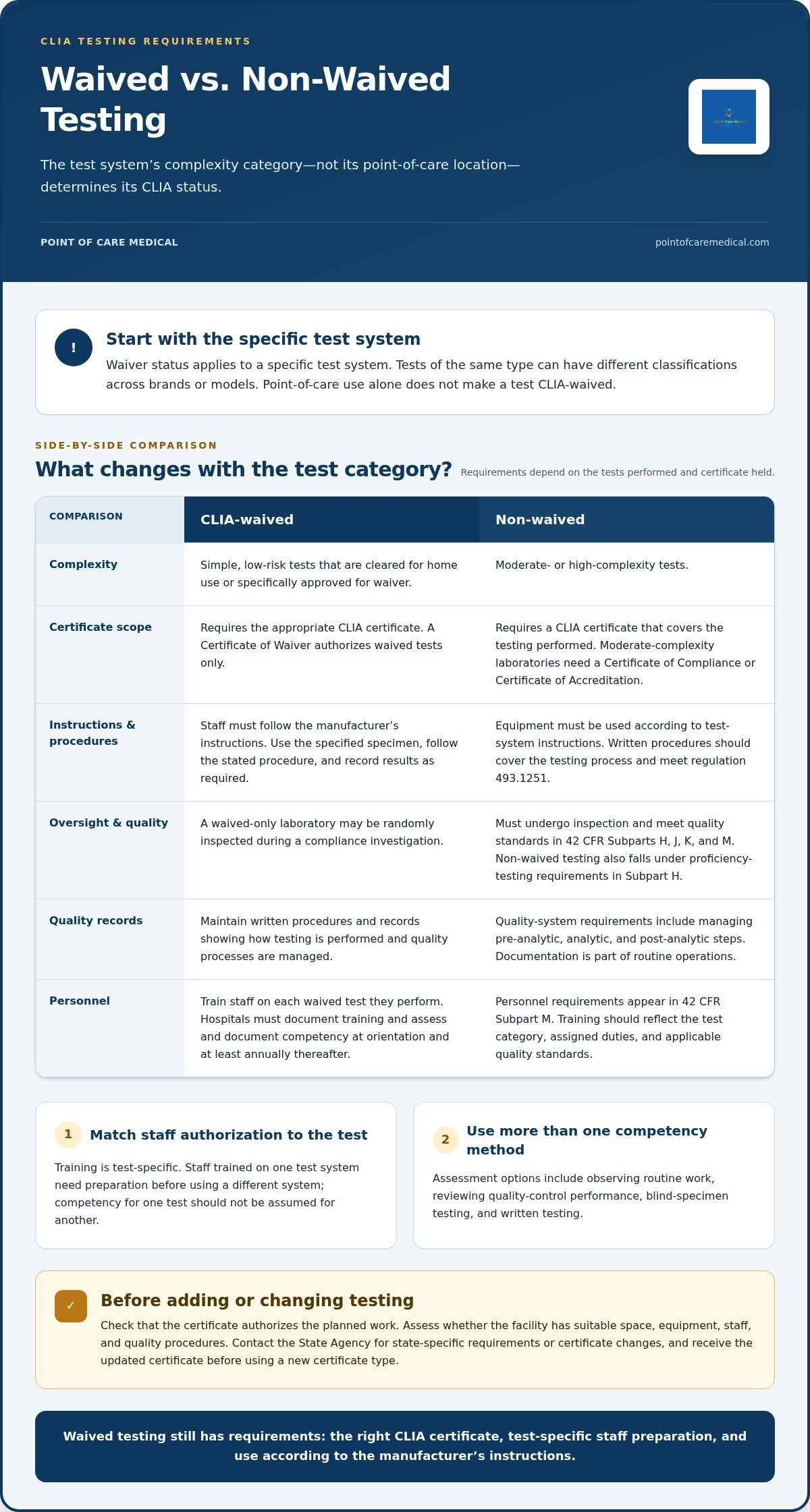
The key difference is the test system’s complexity category, which determines the certificate and oversight a laboratory needs. A point-of-care location does not make a test waived. Waiver status belongs to a specific test system, so products for the same condition can have different categories.
A site performing only waived tests needs a CLIA Certificate of Waiver. Non-waived testing requires an appropriate certificate that covers the work. The certificate must match the laboratory’s testing activities, not simply its general purpose.
According to the Centers for Medicare & Medicaid Services, a Certificate of Waiver authorizes only waived tests performed according to manufacturer instructions and is valid for two years. Waived sites are not routinely inspected, though they may be randomly inspected during a compliance investigation. Non-waived laboratories must meet quality standards and inspection requirements.
The operating requirements also differ. Non-waived testing is subject to proficiency-testing requirements under 42 CFR Subpart H, quality-system requirements under Subpart K, and personnel requirements under Subpart M. These standards affect procedures, staff qualifications, quality records, and test performance. Waived testing has fewer federal quality-system requirements, but correct use still depends on following each manufacturer’s instructions.
Changes to a test can change its classification. Under 42 CFR 493.17, laboratory-developed tests and tests modified from the approved manufacturer’s instructions default to high complexity under CLIA. A facility cannot treat a modified procedure as waived simply because the original test system had waived status. The applicable category must guide the certificate and staffing plan.
Both categories require attention to patient safety. Waived tests are designed to be simple and low risk, but errors can still affect diagnosis, treatment, or medication decisions. Non-waived testing has more extensive quality-system and personnel requirements. In either category, training, competency, documentation, and adherence to test procedures help support reliable results.
Before adding a test, identify its exact system and category, then compare that status with the facility’s certificate and staff capabilities. If the test menu includes non-waived work, plan for its additional quality and oversight obligations. Facilities assessing specimen workflows can explore oral fluid testing options as part of their operational review.
Point of Care Medical: GenBody COVID-19 Rapid Antigen Test
Point of Care Medical offers the GenBody COVID-19 Rapid Antigen Test for facilities evaluating respiratory testing options. The product fits into a broader set of rapid testing supplies that also includes the ViraDx™ SARS-CoV-2/Flu A+B Rapid Antigen Test, Rapid Test Cup "RTC" + Fentanyl, and SURE CHECK HIV 1/2 Assay.
Before selecting a test, match the exact test system to your facility’s needs and confirm its CLIA category. Waiver status is specific to the test system, not simply the condition being tested or the point-of-care setting. Follow the manufacturer’s instructions and ensure the facility’s certificate covers the testing performed.
Visit Point of Care Medical’s website to review its testing offerings.
Build a Testing Plan That Can Adapt
A practical approach to CLIA-waived vs non-waived testing starts with a clear view of the facility’s clinical priorities. As patient needs or workflows change, review whether the test menu still fits how results are used. Assign responsibility for reviewing proposed changes, including a new test system, a different specimen workflow, or expanded testing in another setting.
Use that review to connect operational decisions with staff readiness, documentation, and the facility’s testing scope. A consistent process helps teams identify implications before a change enters routine use. It also gives administrators a clearer basis for planning purchases and laboratory resources around actual clinical needs.
For rapid testing options relevant to your facility, visit Point of Care Medical. Take the next step by aligning your test selection with your operational priorities and building a process your team can maintain.
Frequently Asked Questions
What is a CLIA waived test?
A CLIA-waived test is a test system the FDA has categorized as waived because it meets applicable simplicity and low-risk criteria. The category applies to the particular system, not every product used to test for the same condition. For example, two brands of a similar test may have different CLIA categories. Identify the exact test system before adding it to a facility’s testing menu.
What are factors to consider for transitioning to moderate complexity testing?
Assess whether patient volume and clinical needs support the expanded testing scope. Then review available space, equipment, staffing, written procedures, quality systems, and inspection readiness. State requirements also matter. Map each proposed test to its complexity category and certificate requirements before changing operations. This assessment helps determine whether existing infrastructure can support the test menu without disrupting routine laboratory workflows.
What does CLIA waived testing mean?
CLIA-waived testing means a facility performs tests categorized as waived under CLIA and follows each manufacturer’s instructions. The facility still needs a valid Certificate of Waiver to conduct only waived tests. A test is not waived simply because it is used near the patient or has a particular general purpose. Check the specific system’s category and ensure the facility’s certificate covers its planned testing.
What is CLIA non-waived testing?
CLIA non-waived testing means performing moderate- or high-complexity laboratory tests on human specimens. These tests require a certificate appropriate to the work and must meet applicable CLIA quality-system and personnel standards. Examples of moderate-complexity testing include clinical chemistries and thyroid function tests. Before adding a test, account for its category, required procedures, personnel responsibilities, and applicable state requirements.
What are the main differences between CLIA-waived and non-waived tests?
The practical distinction in CLIA-waived vs non-waived testing is the test category and the compliance framework that follows. Waived testing uses a Certificate of Waiver and requires adherence to manufacturer instructions. Non-waived testing requires a certificate covering the work, with broader quality-system, personnel, and proficiency-testing requirements. The category belongs to the specific test system, so assess that system before planning staffing or operations.
Which laboratory tests are CLIA-waived in the United States?
Examples of test types that may be waived include glucose monitoring, pregnancy tests, and some urine tests. This does not mean every product in those categories is waived. Status depends on the specific test system, brand, and model. To assess a product for use, identify its exact system and FDA CLIA category, then compare that status with the laboratory’s certificate and intended workflow.
What are the personnel qualifications for non-waived testing?
Personnel requirements depend on the complexity category and the duties assigned. CLIA addresses personnel standards for non-waived testing in 42 CFR Subpart M, and moderate- and high-complexity requirements differ. Laboratories should match staff qualifications to their assigned testing responsibilities and maintain the relevant documentation. A staff member’s experience with one test does not, by itself, establish competency on a different system or method.
What quality control and proficiency testing rules apply to waived and non-waived tests?
Non-waived testing is subject to proficiency-testing requirements under 42 CFR Subpart H and quality-system standards under Subpart K. Waived testing must follow the manufacturer’s instructions and good laboratory practices, including appropriate quality checks. Facilities should retain records that show how tests are performed and how quality is monitored. Do not assume proficiency-testing requirements for non-waived work automatically apply to every waived test.


