

Rapid testing is most useful when a timely result can guide the next step in care. Healthcare facilities can order rapid diagnostic kits online by matching the test to the clinical or screening need, specimen type, and workflow. Rapid antigen tests detect viral proteins and typically provide results in minutes; rapid COVID-19 tests usually provide results in about 30 minutes.
For pharmacies and healthcare facilities, ordering rapid diagnostic kits online involves more than choosing a fast test. The test format, result type, and sample collection and processing steps all affect how well a kit fits routine operations.
This guide explains how rapid diagnostic kits are used, how qualitative and quantitative tests differ, and what to consider when choosing supplies for your setting. It also covers ordering workflows and targeted tests for respiratory infections, HIV screening, and toxicology. Use these points to match supplies to your facility’s needs and plan procurement.
Key Takeaways
- Distinguish qualitative tests, which report detected or not detected, from quantitative tests that measure a value, then match the format to the testing purpose.
- Compare specimen requirements, manufacturer data on sensitivity and specificity, and the facility’s testing workflow before selecting kits.
- Plan procurement around storage conditions, expiration-date tracking, order quantities, and shipping terms to support reliable inventory management.
- Assess the total ordering cost by considering the kit, shipping method, and order size rather than focusing on the product price alone.
- Use the article’s company and product overview to identify targeted testing supplies that align with your facility’s screening needs.
Top 10 Qualitative and Quantitative Rapid Test Kits to Buy?
Rapid tests cover infectious diseases and other conditions, but each kit answers a different clinical question. Match the test’s target, specimen, and result format to its intended use.
Use these ten test categories as a starting point for comparing rapid test options across healthcare settings.
Diseases and Conditions Detected
Rapid tests can detect viral antigens, antibodies, and other markers in patient specimens. Results may support screening or inform next steps, including treatment decisions. Before selecting a kit, check its intended use, specimen requirements, and manufacturer data on sensitivity and specificity.
- COVID-19 antigen: Detects viral proteins, often using a nasal swab.
- Combined respiratory antigen: Tests for SARS-CoV-2 and influenza A and B in one test.
- Influenza antigen: Targets influenza A or B for respiratory screening.
- RSV: Supports rapid testing for respiratory syncytial virus.
- Group A Streptococcus: Helps assess suspected strep throat.
- HIV antibody: Detects antibodies associated with HIV infection.
- Fentanyl: Drug-screening tests can detect fentanyl in a specimen.
- Oral-fluid drug screens: Provide a non-blood specimen option for toxicology screening.
- Pregnancy: Detects human chorionic gonadotropin, or hCG, in urine.
- Antibody tests: May identify antibodies associated with past infection using blood or serum.
These categories differ in their targets and specimens, so they aren’t interchangeable. Sexual health screening, for example, requires a test intended for the specific infection being assessed.
Choosing Kits by Accuracy and Intended Use
Choose a test that matches the condition, specimen, and decision its result must support. Review manufacturer data on sensitivity and specificity, then compare the stated intended use with your facility’s screening workflow and patient population.
Qualitative tests report a result such as positive or negative. Quantitative tests provide a measured value, supporting decisions that require a level rather than simple detection. Rapid antigen tests detect viral proteins and typically return results in minutes; antibody tests look for an immune response associated with past infection.
How do you verify FDA authorization or clearance? Compare the exact kit name and intended use with FDA records and the manufacturer’s authorization or clearance documentation. Make sure the product’s stated use matches the test you plan to perform.
Can insurance or HSA/FSA funds cover online purchases? Coverage depends on plan eligibility rules and the purpose of the purchase. Facility procurement follows the organization’s purchasing process, while individual buyers should review their plan’s eligible-expense criteria.
What risks come with expired, counterfeit, or improperly stored kits? Expiration, damaged packaging, or storage outside the manufacturer’s recommended temperature range can compromise test performance. Keep kits in their original packaging, follow storage instructions, and check expiration dates during inventory reviews.
Ordering testing kits for pharmacies and healthcare facilities
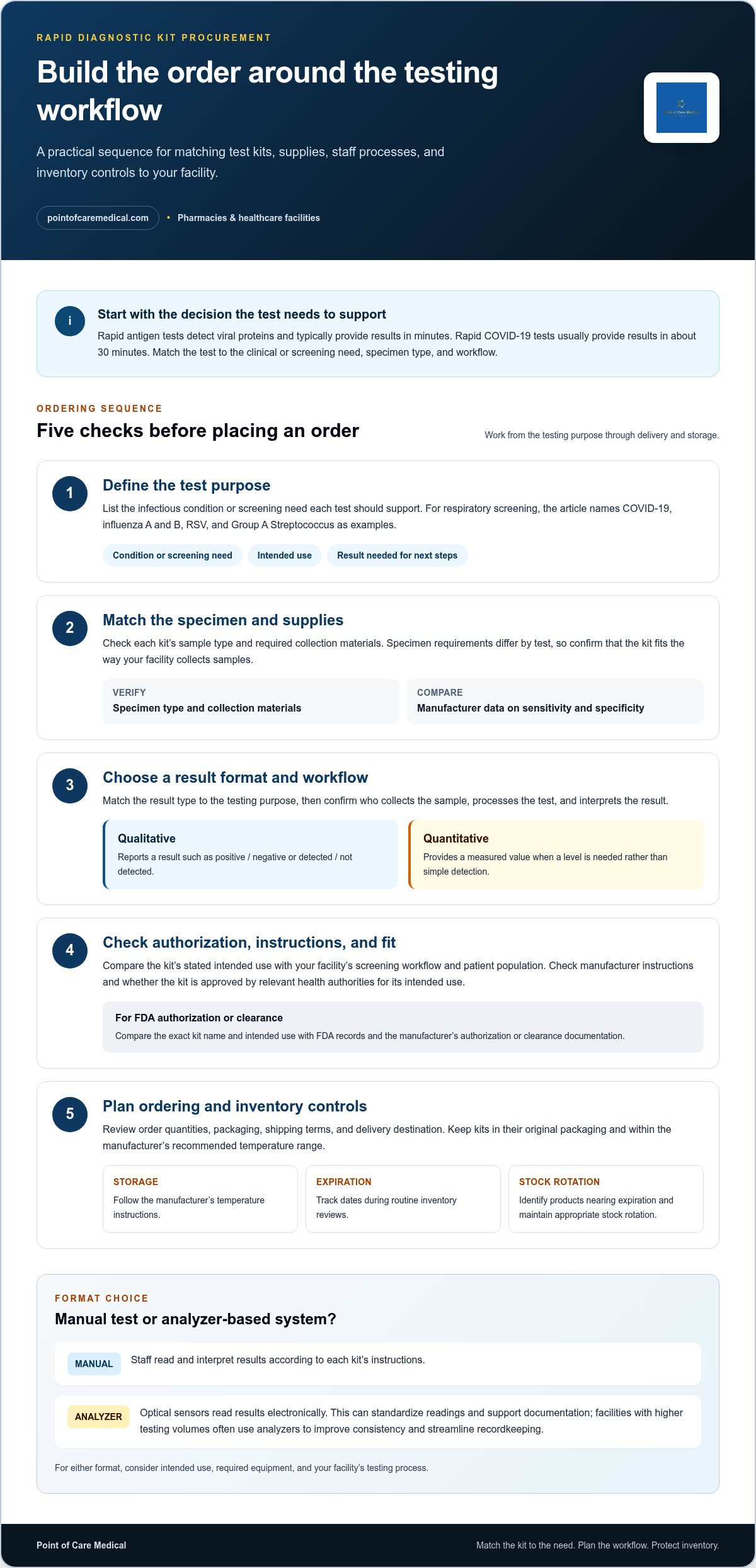
Online procurement works best when each rapid test kit fits a defined testing workflow. Pharmacies and healthcare facilities can start by identifying the condition, specimen, staff process, and result format required.
Build the order around the testing workflow
Set the intended use first. A pharmacy screening for COVID-19, influenza A and B, RSV, or Group A Streptococcus needs tests aligned with those pathogens. Then compare each kit’s specimen requirements, instructions, and manufacturer data. Check whether the kit is approved by relevant health authorities for its intended use.
Before placing an order, document the supplies and processes your site needs:
- Test purpose: List the infectious condition or screening need each test supports.
- Specimen and supplies: Match the test to its sample type and required collection materials.
- Staff workflow: Confirm who collects the sample, processes the test, and interprets results.
- Inventory controls: Plan storage within the manufacturer’s recommended temperature range and track expiration dates.
- Ordering details: Review order quantities, packaging, shipping terms, and delivery destination.
Keep kits in their original packaging until use. Routine inventory checks help staff identify products nearing expiration and maintain appropriate stock rotation.
Match equipment and test format to volume
Analyzer-based systems use optical sensors to read results electronically. This can standardize readings and support result documentation. Facilities with higher testing volumes often use analyzers to improve consistency and streamline recordkeeping. Compare this workflow with manual rapid tests, which staff read and interpret according to each kit’s instructions.
Point-of-care molecular systems that are CLIA-waived offer increased detection sensitivity and are suitable for point-of-care use. Choose a system based on its intended use, required equipment, and your facility’s testing process. A pharmacy with varied respiratory screening needs may prioritize flexible workflows; a high-volume site may value electronic reading and documentation.
Include noninfectious testing supplies
Not every point-of-care supply addresses an infectious disease. For glucose and HbA1c testing, identify the specific test and compatible supplies required by the facility’s process. Keep these orders distinct from respiratory or other infectious rapid tests to simplify inventory review and staff preparation.
Point-of-care testing resources should support proper collection, processing, and interpretation. Use the manufacturer’s instructions for each test, and consult a healthcare professional when results require clinical interpretation or further guidance. For facilities reviewing online procurement options, explore point-of-care testing supplies as part of the sourcing process.
Benefits and uses of rapid diagnostic kits
A rapid diagnostic test can move a sample from collection to an actionable result within the same care workflow. Rapid diagnostic tests usually provide results in 20 minutes or less, while many rapid tests produce results in 10-30 minutes. The time depends on the specific test and its instructions.
A shorter turnaround can help healthcare teams make timely decisions about screening, isolation, treatment, or further testing. It doesn’t replace clinical judgment or laboratory testing when confirmation is needed.
Support timely decisions at the point of care
In a pharmacy or clinic, staff can collect a sample, run the test, and interpret the result on site. A respiratory antigen test, for example, detects viral proteins and typically provides results in minutes. A combination test can detect multiple pathogens in one test, helping staff assess respiratory symptoms through a single testing workflow.
Rapid test kits also support screening outside traditional laboratory workflows. A facility can organize testing around the condition being assessed, the required sample, and the next clinical step. This can help determine whether a patient needs additional evaluation, treatment guidance, or laboratory follow-up.
Use results as part of clinical assessment
A rapid result is one input, not a complete diagnosis. Rapid tests are less sensitive than laboratory tests, particularly during the earliest stages of infection. Consider a negative result alongside symptoms, exposure history, and the timing of the sample.
Some over-the-counter COVID-19 tests recommend repeating the test after a negative result. A healthcare provider may also send a second sample to a laboratory to confirm or rule out a rapid test result. Follow the specific kit instructions and use clinical protocols to guide interpretation.
Choose the right use for each test
Rapid tests have different targets and specimen requirements. An antigen test detects viral proteins, while an antibody test detects antibodies associated with past infection. Because these tests answer different questions, choose based on whether you need to detect current infection, assess a past immune response, or support another screening purpose.
Before testing, match the kit’s intended use to the clinical question. Follow the manufacturer’s collection, processing, and interpretation steps. Store each kit within its recommended temperature range, keep it in its original packaging until use, and track expiration dates during routine inventory checks.
These steps help teams use rapid tests consistently across healthcare settings. They also clarify when an on-site result can inform care and when laboratory testing or professional interpretation should guide the next decision.
Companies active in rapid diagnostic kits
Rapid diagnostic testing involves several types of organizations. Manufacturers develop test kits for targets such as influenza, COVID-19, pregnancy, and drug screening. Diagnostic companies may focus on a particular disease, specimen, or testing method. Distributors connect healthcare facilities with products from different manufacturers. Analyzer companies supply instruments that read certain tests electronically.
These roles matter during procurement. A manufacturer’s instructions explain a kit’s intended use, sample type, and result interpretation. A distributor’s catalog helps facilities compare test categories and order supplies. Analyzer systems add equipment considerations, including compatibility between the instrument and test format. Identify which role you need before comparing purchasing options.
Company lists also need careful interpretation. Lists of top rapid diagnostic kit companies are sorted in no particular order. Placement alone does not establish product accuracy, regulatory status, or suitability for a facility. Compare the specific kit and its intended use rather than treating a company ranking as an endorsement.
Compare companies by testing focus
Start with the condition your facility screens. Respiratory testing may involve COVID-19 or influenza A and B. Sexual health testing requires a kit intended for the infection being assessed. Toxicology screening uses different targets and specimens. Pregnancy tests detect human chorionic gonadotropin, or hCG, in urine. These examples show why a broad medical catalog may include distinct product categories.
Next, review the test format. A test strip may produce a visual positive or negative result, while an analyzer-based system reads results electronically. Antigen tests detect viral proteins; antibody tests detect antibodies associated with past infection. These formats answer different questions. A company’s expertise in one category does not mean every product suits every clinical workflow.
Assess evidence at the kit level
Review manufacturer data on sensitivity and specificity for the exact test you are considering. Confirm that its stated intended use matches your patient population, specimen, and screening purpose. Check whether the kit is approved by relevant health authorities. For a negative result, follow the kit instructions and applicable clinical workflow, especially if symptoms or exposure remain relevant.
Operational details also distinguish suppliers. Compare packaging, storage requirements, expiration-date controls, and staff instructions. A facility using several test types can organize them by condition and specimen. For example, keep influenza respiratory kits separate from urine pregnancy tests and toxicology supplies. This makes stock reviews and staff preparation more straightforward.
Use company information as a starting point, then evaluate each kit’s documentation and fit with your workflow. This keeps purchasing decisions tied to the test’s purpose, not a broad company label or an unordered market list.
How much do rapid diagnostic kits cost online, including shipping?
The total cost of an online order includes the test kits and applicable shipping charges. It depends on the selected tests, quantities, packaging, shipping destination, and delivery service. When planning a healthcare facility’s testing budget, compare the complete order total rather than a per-kit price alone.
Different tests serve different workflows. A single-pathogen respiratory antigen test and a combination respiratory test have distinct purposes and packaging. Estimate the quantities needed for each test type, then review the order details for shipping terms and additional charges before completing procurement.
Build a complete order estimate
Use the same purchasing assumptions for each quote. That makes it easier to compare equivalent orders and account for operational needs.
- Test type: Separate respiratory, infectious disease, and toxicology requirements.
- Order quantity: Base quantities on planned use and inventory already on hand.
- Shipping destination: Confirm the facility address and delivery service shown at checkout.
- Packaging: Include the number of kits and any required components in the order details.
- Inventory timing: Consider storage conditions and expiration dates when deciding how much to purchase.
This process helps prevent under-ordering and excess stock. For example, a facility can estimate respiratory testing demand separately from toxicology screening, then review the combined order total and shipping terms.
Account for shipping and delivery
Shipping affects the final amount and replenishment timing. Orders within the continental United States are shipped using next-day service via Mercury or Federal Express. Delivery timing matters when facilities plan routine inventory, respond to testing demand, or coordinate incoming kits with staff workflows.
Review the shipping method, destination, and order contents together. If a facility is receiving multiple test types, confirm that the order details include every selected item. Keep the receipt and order record with procurement documents so staff can reconcile incoming stock against the purchase.
Set a practical purchasing process
When you order rapid diagnostic kits online, follow a consistent review process: identify the test purpose, confirm the quantity, inspect shipping terms, and calculate the complete order total. Apply the same process to each supplier quote. Don’t compare a product subtotal with a quote that already includes delivery.
After delivery, match the shipment to the order record. Check product names, quantities, packaging, and expiration dates before adding kits to inventory. Store each kit within the manufacturer’s recommended temperature range and retain its original packaging until use. These steps connect purchasing decisions with safe, organized stock management.
Point of Care Medical: GenBody COVID-19 Rapid Antigen Test
Point of Care Medical offers the GenBody COVID-19 Rapid Antigen Test for facilities seeking a targeted respiratory testing supply. Choose it when your testing workflow calls for a COVID-19 antigen test, and follow the kit’s manufacturer instructions for specimen collection and result interpretation.
For broader respiratory screening, the ViraDx™ SARS-CoV-2/Flu A+B Rapid Antigen Test detects multiple respiratory targets in one test. Other available testing options include Rapid Test Cup "RTC" + Fentanyl and the SURE CHECK HIV 1/2 Assay. Match each test to its intended screening purpose and your facility’s workflow.
Contact Point of Care Medical to discuss rapid testing supplies for your facility and request personalized pricing.
Make your next testing order fit your workflow
Use your next procurement cycle to align testing supplies with the questions your team needs to answer. Set priorities by screening purpose, specimen type, and how staff will use results. This gives your facility a clear basis for product selection and inventory planning. When you order rapid diagnostic kits online, keep the intended use central to your decision rather than treating every rapid test as interchangeable.
Point of Care Medical offers the GenBody COVID-19 Rapid Antigen Test, ViraDx™ SARS-CoV-2/Flu A+B Rapid Antigen Test, and Rapid Test Cup "RTC" + Fentanyl. These options address distinct respiratory and toxicology testing needs. Select the category that aligns with your facility’s workflow, then consider how it fits your broader procurement plan.
Contact Point of Care Medical to discuss testing supplies for your facility. A clear purchasing plan can help your team move forward with confidence.
Frequently Asked Questions
How are rapid diagnostic kits used?
Staff use a rapid diagnostic kit by collecting the specified sample, running the test as instructed, and interpreting its result for the intended screening purpose. For example, a clinic may use a respiratory test to guide the next step for a patient with symptoms. Assign trained staff, follow the kit’s instructions, and record results through the facility’s established workflow. A rapid result informs care, but doesn’t replace clinical assessment.
What are rapid tests?
Rapid tests are diagnostic tests designed to produce results near the point of care, without relying solely on a central laboratory workflow. Depending on the kit, detection may target an antigen, antibody, or another marker in a sample. Result formats and intended uses vary by product. Read the kit’s labeling to understand what it detects, which specimen it requires, and how staff should interpret the result.
Where can I order rapid diagnostic test kits online in the United States?
Healthcare and screening facilities can order rapid diagnostic kits online from Point of Care Medical. Its catalog includes respiratory, infectious disease, and toxicology testing supplies for professional settings. The request-based process lets you select products, quantities, and configuration details, then submit a request for review and personalized pricing. There’s no immediate online checkout. Include the exact product name and intended facility use in your request.
Which rapid diagnostic kits are available online, such as COVID-19, flu, strep, and pregnancy tests?
Online catalogs may include different tests based on the supplier and intended setting. Point of Care Medical offers the GenBody COVID-19 Rapid Antigen Test and ViraDx™ SARS-CoV-2/Flu A+B Rapid Antigen Test, plus the SURE CHECK HIV 1/2 Assay, Rapid Test Cup "RTC" + Fentanyl, and oral fluid tests. Strep and pregnancy tests are distinct categories. Match the named test to your facility’s screening need and specimen workflow.
Which online retailers and pharmacies sell FDA-authorized rapid diagnostic kits?
A retailer’s presence alone doesn’t establish that a specific rapid test is FDA-authorized or cleared. Check the exact product name and intended use against FDA records and the manufacturer’s documentation. Authorization applies to a particular product and use, not every kit sold by a retailer. For facility procurement, retain product documentation with purchasing records so staff can identify the selected test and its designated purpose.
Do I need a prescription or medical license to order rapid diagnostic kits online?
Requirements depend on the exact test, its labeling, and the purchaser’s intended setting. Professional testing supplies are intended for healthcare, screening, or workplace teams, and some tests may have use conditions tied to their authorization. Before ordering, identify the product’s intended use and the facility role responsible for testing. Follow applicable requirements and the manufacturer’s instructions for the specific kit rather than assuming one rule applies to every test.
How long does shipping take, and can rapid diagnostic kits be delivered to my state?
Orders within the continental United States are shipped using next-day service via Mercury or Federal Express. Point of Care Medical serves customers nationally, while product availability and regulatory classification can vary by configuration. Include the delivery state and requested product configuration in your procurement planning. Review the order details for the shipping method and destination, then coordinate receipt with staff responsible for checking and storing incoming testing supplies.


