

A rapid test’s result is only useful when the test run is valid. In the United States, CLIA requires laboratories to have quality control and quality assurance measures in place, according to the Centers for Disease Control and Prevention. Effective quality control procedures for rapid diagnostics help teams identify problems with reagents, equipment, or test performance before results are reported.
That process matters because a rapid test can be quick but unreliable if materials, handling, or interpretation vary. Quality assurance helps prevent errors through controlled procedures and trained operators. Quality control checks whether a test run performs as expected.
This article explains how manufacturers assess materials and finished kits, how testing teams use internal controls to spot reagent or equipment issues, and what quality control looks like for a lateral flow test. You’ll learn how checks at each stage support consistent results and what to review when a test produces an invalid result.
Key Takeaways
- Separate quality assurance, which helps prevent errors, from quality control, which checks whether products and test runs meet requirements.
- Use independent control materials to assess assay performance and help distinguish test issues from sample-related variation.
- Track internal control results over time to spot shifts that may point to reagent, equipment, or process problems.
- For lateral flow tests, consistent reagents, membrane coating, assembly, and packaging all contribute to readable, dependable results.
- When a rapid test result is invalid, follow the manufacturer’s instructions and review sample collection, reagent storage, and testing procedures.
How Do Manufacturers Ensure the Quality of Rapid Test Kits?
Manufacturers build quality into rapid test kits by controlling materials, production conditions, and finished-product checks. Independent controls and clear records help identify variation before kits reach testing teams.
Independent and Patient-Like Control Materials
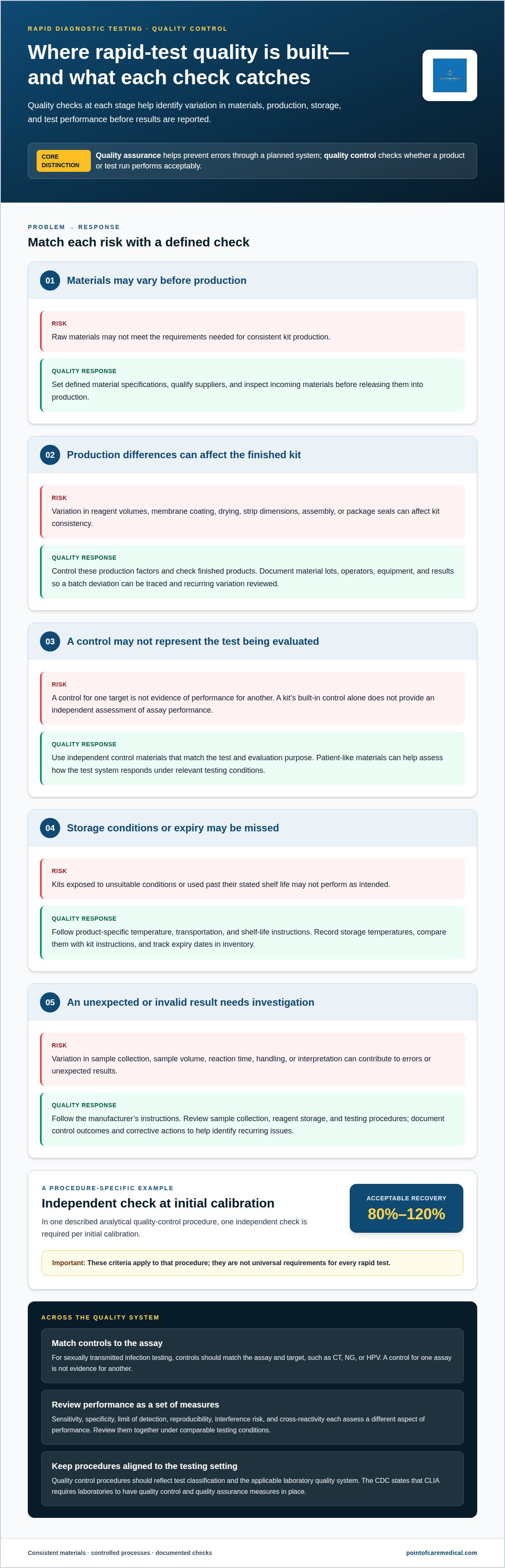
Independent control materials assess assay performance separately from the kit’s own built-in controls. Materials that resemble patient samples help laboratories evaluate how the test system responds under relevant testing conditions. This provides a check on performance beyond visual inspection of a finished kit. In one described analytical quality-control procedure, one independent check is required per initial calibration, with acceptable recovery from 80% to 120%. These criteria apply to that procedure, not universally to every rapid test.
Raw Material Selection and Supplier Qualification
Reliable kit production starts with defined raw material specifications, supplier qualification, and incoming-material inspection. Before releasing materials into production, manufacturers can assess whether they meet requirements. Production controls cover factors such as reagent volumes, membrane coating, drying, strip dimensions, assembly, and package seals. Documenting material lots, operators, equipment, and results supports traceability when a batch shows a deviation. Batch reviews can also reveal recurring variation and guide process improvements.
Quality Assurance Materials for Specific Tests
Quality assurance materials help assess whether tests for a specific target perform as intended. For lymphatic filariasis and onchocerciasis tests, evaluation materials can support checks of assay response and help teams interpret results consistently. Materials should match the test and evaluation purpose: a control for one target is not evidence of performance for another. Quality assurance and quality control materials for rapid diagnostic tests are available in English and French, supporting use across different laboratory teams.
Requirements for Waived and Non-Waived Tests
Quality control procedures should reflect the test’s classification and the applicable laboratory quality system. Since requirements differ by testing setting, teams should align documented procedures with the rules that apply to their test. The Centers for Disease Control and Prevention states that CLIA requires laboratories to have quality control and quality assurance measures in place. For either category, a controlled process should define operator training, test handling, and how to investigate unexpected results.
Storage, Temperature Monitoring, and Expiration Checks
Storage controls help preserve kit performance. Follow each product’s stated temperature, transportation, and shelf-life conditions. Laboratories can record storage temperatures and compare them with the kit instructions, while tracking expiry dates through their inventory process. These checks help teams identify kits exposed to unsuitable conditions or past their stated shelf life before use. Manufacturers also conduct stability studies to assess shelf life, temperature response, packaging protection, and reliability over time.
What Is Quality Control in Rapid Diagnostic Testing?
Quality assurance organizes activities that help tests meet their requirements, while quality control checks whether testing performs acceptably. Together, they help teams detect errors before results inform patient care.
Quality Assurance and Quality Control
Quality assurance is the planned system behind dependable testing; quality control evaluates whether a test run is valid. This distinction helps an organization prevent process failures and identify problems during testing. The Centers for Disease Control and Prevention (CDC) states that CLIA requires laboratories to have quality control and quality assurance measures in place. Operator training, sample collection, sample volume, reaction time, and result interpretation all support the system.
For sexually transmitted infection testing, controls should match the assay and target, such as CT, NG, or HPV. Quality control procedures for rapid diagnostics should account for the specific target and test method, rather than treating a control for one assay as evidence for another. Documenting control outcomes and corrective actions helps teams identify recurring issues.
Performance Testing for Accuracy
Performance testing evaluates whether a diagnostic assay detects its intended target under defined conditions. Common measures include sensitivity, specificity, limit of detection, reproducibility, interference risk, and cross-reactivity. Each measures a different aspect of performance. Sensitivity considers whether target-positive samples are detected, while specificity considers whether target-negative samples produce negative results.
Review these measures together rather than treating one result as a complete picture of accuracy. Low sensitivity can increase false-negative risk, while low specificity can increase false-positive risk. Quality control procedures for rapid diagnostics are more informative when comparisons use similar target analytes, sample types, testing conditions, and evaluation criteria. Repeated tests under similar conditions also show whether results are reproducible.
External Proficiency Testing
External proficiency testing compares a laboratory’s results with those of peer laboratories and supports review of testing processes over time. It can help identify issues involving reagents, controls, technicians, or instruments. The CDC states that CLIA requires laboratories to maintain quality control and quality assurance measures. Proficiency testing supports performance assessment, with its application depending on the laboratory’s testing context.
When results differ from those of peer laboratories, review the full testing process. Consider sample handling, control outcomes, operator technique, and equipment conditions. Document the investigation and corrective action so the laboratory can identify recurring patterns and strengthen its quality practices.
Detecting reagent and equipment issues
Internal quality control helps identify changes in results that may point to a reagent, instrument, or testing-process issue. Review control patterns alongside clinical context instead of treating each unexpected result as an isolated event.
Detection Limits and Repeatability
A limit of detection describes a test’s ability to detect low concentrations of its target under specified conditions. Repeatability describes whether repeated tests produce consistent results under the same or similar conditions. Both measures help teams evaluate what a test can detect and how consistently it performs. A change in either can affect confidence in results, especially when they are near the assay’s detection limit.
Control results can reveal a change, but they don’t establish its cause on their own. Compare the current pattern with prior control data, then review reagent lots, calibration, and the testing method. A weaker signal might reflect a reagent change, an instrument issue, or variation in how the test was performed. Considering these possibilities helps teams investigate efficiently.
QC Charts and Error Detection
Quality control charts display control results over time, making shifts and unusual patterns easier to evaluate. Levey-Jennings charts are one method laboratories can use to interpret QC data. A single result may appear acceptable while a series reveals a consistent change. Reviewing the trend helps teams investigate potential errors before they affect reported patient results.
For a useful chart, record control results consistently and note relevant changes, such as a new reagent lot or instrument calibration. When results move away from the established pattern, assess the control material, equipment, and testing procedure. A chart does not diagnose the problem. It signals when closer review is warranted and helps direct that review toward process changes.
Common Errors and Quality Risks
Common point-of-care risks include changes in reagent lots, instrument calibration, and technician technique. In lateral flow tests, variation in membrane coating thickness can change signal development and weaken the test line. This can make results harder to read and may affect accuracy. Monitoring control trends helps teams recognize changing results, even when the source needs further investigation.
Sample handling and procedural variation also matter. Differences in collection, sample volume, reaction time, or result interpretation can introduce inconsistency. If a control result falls outside the laboratory’s established criteria, follow the applicable procedure before reporting results. Review the reagents, equipment, and steps used for that run, and document the findings. A consistent investigation method helps distinguish an isolated handling error from a recurring quality issue.
For facilities reviewing testing supplies alongside their QC process, rapid diagnostic testing supplies are part of the operational picture. Keep product instructions and control procedures aligned so the materials and method used support consistent evaluation.
Internal quality control procedures
Internal quality control uses routine checks to monitor whether a testing process remains stable. Consistent documentation helps teams compare results, investigate changes, and support standardization.
Internal Standards
An internal standard is a reference included in an analytical procedure to help assess consistency across samples and calibration. It gives the laboratory a point of comparison when evaluating results. In one described analytical procedure, the internal-standard area must fall within 50%-200% of its area in the associated calibration standard. That criterion applies to the described procedure, not every rapid diagnostic test.
Internal controls also use a stable substance tested repeatedly on a detection system to assess whether results remain accurate and stable. Teams can compare findings with established standards and review shifts before patient results are delivered. Record each control result alongside the method, relevant reagent lot, and instrument information. These records help distinguish a possible process change from an isolated result and support follow-up when disease testing results appear inconsistent.
CLIA Quality Control Requirements
The Centers for Disease Control and Prevention (CDC) states that CLIA requires laboratories to have quality control and quality assurance measures in place. This is the general requirement; the specific internal process should reflect the test and the laboratory’s documented procedures. Routine checks, instrument calibration, and prompt investigation of errors help the laboratory monitor whether testing performs as intended.
For analytical procedures described in the available quality-control facts, continuing calibration standards are used before and after samples, with no more than 10 samples between calibration checks. These details illustrate a defined analytical procedure, not a universal schedule for all rapid tests. A laboratory should distinguish method-specific criteria from its broader quality assurance system and retain records that explain how staff assessed a run.
Quality Control Instructions for Use
For each rapid test, follow the product instructions for the applicable control procedure and result interpretation. The instructions provide operational details such as sample collection, sample volume, reaction time, and how to read results. Following the specified method supports correct and consistent testing across operators.
Build these directions into the laboratory’s written procedure and staff training. Based on the test instructions, the procedure should identify the required control, when to run it, how to assess its result, and what to do if the outcome is unacceptable. Record the control outcome and any investigation. If a run is invalid, follow the manufacturer’s instructions and review collection, reagent storage, and testing steps before proceeding.
Quality control example for lateral flow tests
A lateral flow test’s quality depends on consistent strip construction and clear checks for each run. A practical approach is to monitor every stage that can affect signal development, readability, or result validity.
During production, manufacturers assess reagent consistency, membrane coating, drying performance, strip dimensions, assembly accuracy, and packaging seals. Each check addresses a different potential failure. For example, uneven membrane coating can change signal development and weaken a test line. A strip with inconsistent dimensions or assembly may also behave differently from its intended design. Documenting checks by batch supports investigation when finished tests show variation.
Finished-product assessment can compare signal strength, visual line consistency, reagent performance, and selected final samples. The aim is to detect variation across a batch, not simply confirm that one strip looks acceptable. A control material can help assess whether the test system produces its expected response. Interpret results using the product’s instructions, since acceptance criteria and result-reading procedures depend on the specific test.
At the testing site, staff follow the manufacturer’s instructions for sample collection, sample volume, reaction time, and result interpretation. These steps matter because a lateral flow result depends on both the strip and how the test is performed. A control line can indicate that the run met the test’s stated validity condition. If the control response is absent or otherwise invalid, follow the instructions. Do not treat an invalid run as a negative result.
If a rapid test produces an invalid result, follow the manufacturer’s instructions for handling it. Review sample collection, reagent storage, and testing procedures to identify possible causes. A missed procedure step or storage outside stated conditions, for example, may affect test performance. Record the issue and response so recurring problems can be assessed across operators, reagent lots, or test batches. This creates a practical feedback loop between testing and quality review.
Reliable practices connect manufacturing checks with testing-site records. A modern quality process uses batch information, control outcomes, and documented deviations to identify patterns and support corrective action. If line readability changes across a batch, investigate membrane uniformity, reagent performance, and assembly records together. No single visual check explains every failure, so the full production and testing record provides a stronger basis for assessment.
For facilities aligning lateral flow testing with procurement, review rapid diagnostic testing supplies for your program.
Point of Care Medical
Point of Care Medical supplies rapid diagnostic tests for healthcare and screening facilities building or maintaining testing programs. Its offerings include respiratory tests, such as GenBody COVID-19 Rapid Antigen Test and ViraDx™ SARS-CoV-2/Flu A+B Rapid Antigen Test, alongside SURE CHECK HIV 1/2 Assay and Rapid Test Cup "RTC" + Fentanyl. These supplies support testing needs; they do not replace a laboratory’s quality assurance procedures or product-specific instructions.
Turn to Point of Care Medical when your facility is sourcing tests for its screening or diagnostic workflow. Match product selection to the intended testing scenario and your team’s procedures. Contact Point of Care Medical to discuss your rapid testing supply needs.
Put Your Quality Plan Into Practice
Strong quality systems depend on clear ownership, not just written procedures. Define who reviews quality records, escalates deviations, and documents corrective actions for each testing workflow. This structure helps teams turn quality control procedures for rapid diagnostics into repeatable daily practice, even as staffing or testing needs change.
Use your next program review to identify where test procurement and laboratory procedures meet. Confirm that selected tests fit the intended testing scenario, then keep product instructions accessible to the staff performing the tests. A practical workflow connects supply decisions with training, documentation, and routine quality review.
For support with rapid diagnostic test supply planning, contact Point of Care Medical. A clear process gives your team a steady foundation for reliable testing.
Frequently Asked Questions
Why is quality assurance important?
Quality assurance helps reduce preventable testing errors and supports decisions based on more dependable results. A clear process can reveal whether an issue relates to the test, the operator, or sample handling. This matters because inadequate laboratory quality control can contribute to misdiagnosis, treatment delays, patient-safety risks, and wasted resources. Documented procedures also help teams identify recurring issues and improve their testing workflow.
How to Determine Whether a Rapid Test Kit Meets Quality Requirements?
Assess whether the kit fits its intended testing scenario, then review its performance and quality documentation. Useful records can include technical specifications, performance validation reports, batch inspection records, and applicable quality management system certificates. Compare performance only when target analytes, sample types, testing conditions, and evaluation criteria are sufficiently similar. For example, a test evaluated with a different sample type may not provide a meaningful basis for judging your planned use.
What quality control procedures are recommended for rapid diagnostic tests?
Use the test instructions alongside the laboratory’s written quality process. Relevant procedures may cover operator training, sample handling, control testing, result interpretation, and documentation of errors or deviations. The process should also define how staff respond when results are invalid or controls fall outside stated criteria. For a lateral flow test, consistent reading conditions and adherence to the specified reaction time help reduce variation between operators and testing sessions.
How often should internal quality controls be performed for rapid diagnostic tests?
Follow the product instructions and the laboratory’s applicable quality requirements to set control frequency. Daily checks are one approach laboratories can use, but the schedule depends on the test and its documented procedure. For example, a laboratory may specify when controls are needed in relation to testing, equipment calibration, or a change in testing materials. Record the timing and outcome so staff can identify gaps or recurring patterns.
What are the steps for running and documenting quality control on rapid diagnostic tests?
Use a consistent sequence: consult the test instructions, prepare the specified control material, run it using the stated method, and assess the outcome against the stated criteria. Record the test and control identification, date, operator, result, and relevant lot or equipment details. If a result is unacceptable, document the investigation and action taken. This record helps connect a later concern with the conditions of the original test run.
What control materials and positive and negative controls are needed for rapid diagnostic tests?
Use the control materials specified for the particular test. They may include stable materials tested on the detection system or independent materials that resemble patient samples. Positive and negative controls help assess different aspects of assay response, but their required type and use depend on the product instructions. Do not assume that a control designed for one target or sample type validates a different assay or testing scenario.
What acceptance criteria and actions apply when rapid diagnostic quality control results are out of range?
Apply the acceptance criteria provided for the specific test and control material. No single range fits every rapid test. If a control outcome is unacceptable or the test is invalid, follow the manufacturer’s handling instructions before interpreting results. Review the relevant collection, storage, and testing steps, then document the finding and response. An invalid control result does not show that the test run was acceptable.


