

Rapid results can strengthen care in two practical ways: they help care teams move from testing to clinical decisions sooner and create an earlier opportunity to arrange follow-up. Improving patient outcomes with rapid results depends on connecting findings to clear next steps, not on speed alone. A result supports care when the right people can review it and act.
Timely information matters, as does clear communication about what a result means and what happens next. For healthcare and screening facilities, a dependable diagnostic workflow can support decision-making and follow-up while keeping patient needs at the center. This article explains how rapid testing can improve diagnostic processes, guide follow-up, and fit into a point-of-care workflow.
Key Takeaways
- Build a clear process for reviewing results, communicating findings, and arranging the next step in care.
- Make diagnostic workflows easier to act on by connecting test results with timely clinical review and follow-up.
- Consider how rapid test types differ in the conditions they address and the role they play in a care setting.
- Use turnaround time as one factor in treatment decisions, alongside the patient’s needs and the clinical context.
- Explore point-of-care testing options that align with your facility’s respiratory, HIV, or toxicology screening needs.
1. Effects on follow-up processes and patient outcomes
Rapid results are most useful when they trigger a defined follow-up step. A care team can assign responsibility for reviewing each result, documenting the clinical interpretation, and contacting the patient when action is needed. This process helps prevent a result from sitting unnoticed in a queue. It also gives the physician a clearer path from diagnosis to a treatment or monitoring plan.
Patients who need timely decisions may benefit most, including people with symptoms that call for prompt assessment and patients discharged while test results are still pending. People managing chronic diseases can also benefit when results inform ongoing monitoring and follow-up. In every case, the key is linking the result to an appropriate next step rather than treating speed itself as an outcome.
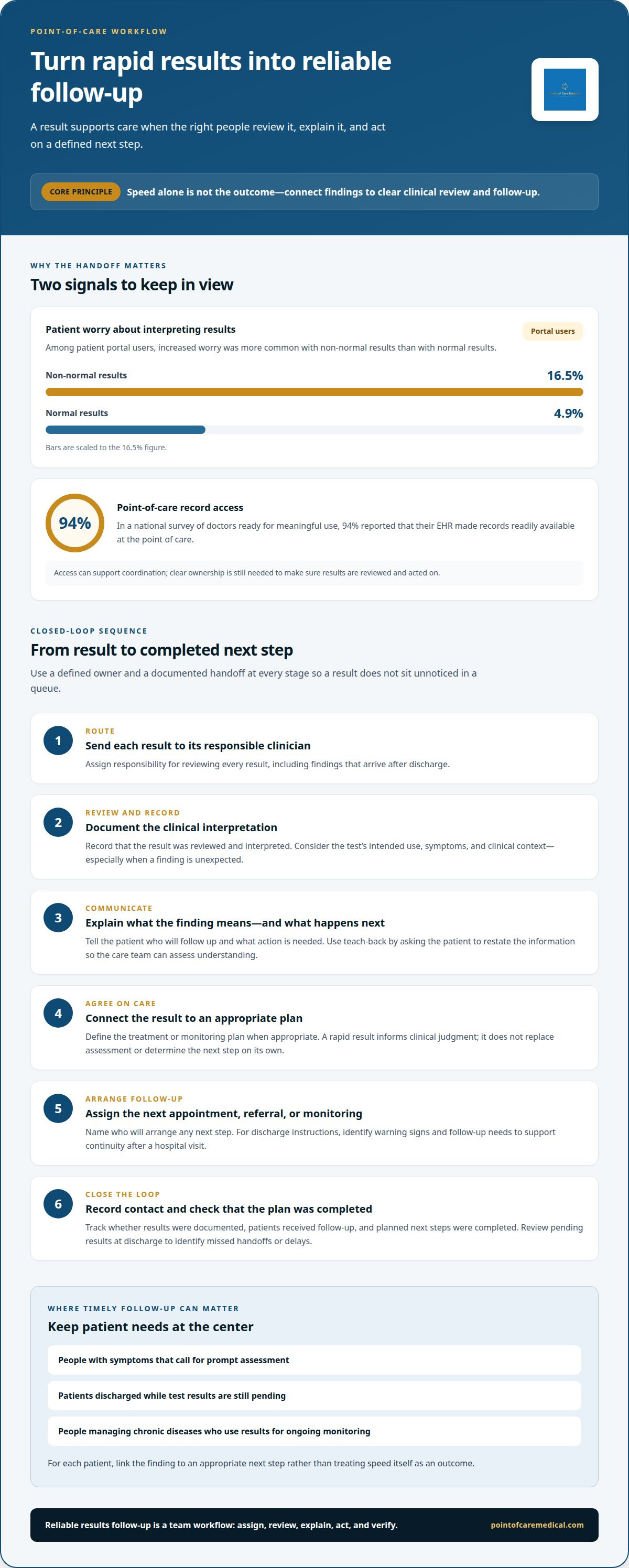
Follow-up communication matters because patients may not know how to interpret a result or what to do next. Among patient portal users, increased worry about interpreting results was more common with non-normal results than normal results: 16.5% versus 4.9%. A clear message can explain the finding, identify who will follow up, and describe the next action. Teach-back, in which a patient restates the information, can help a care team assess understanding.
Organizations can make follow-up more reliable with a closed-loop workflow. Route each result to the responsible clinician, document its review, communicate relevant information to the patient, and record the agreed next step. If another appointment, referral, or monitoring is needed, assign responsibility for arranging it. Clear discharge instructions should identify warning signs and follow-up needs to support continuity after a hospital visit.
Health information systems can support this process by making results and care plans available to the people involved. In a national survey of doctors ready for meaningful use, 94% reported that their EHR made records readily available at the point of care. This access can help care teams coordinate information, but the workflow still needs clear ownership. Teams should also track results pending at discharge, since unresolved findings can delay diagnosis and create patient-safety risks.
Measure the process as well as clinical outcomes. Review whether results were documented, patients received follow-up, and planned next steps were completed. These measures can reveal missed handoffs, communication gaps, and recurring errors. Assigning responsibility for results and recording patient contact give teams specific ways to improve follow-up and support safer care.
Regular follow-up, easy access to resources, and positive reinforcement can support chronic disease management. Clear information and prompt replies can also build trust and encourage engagement. Providers can support patient satisfaction by following up by email or telephone between appointments.
2. Improving diagnostic processes
Rapid testing improves diagnosis when a result fits a clear clinical workflow. As of April 2021, the 21st Century Cures Act mandated near-immediate access to nearly all information in a patient's record, including test results, with few exceptions and without delay, according to the Office of the National Coordinator for Health Information Technology. This access rule concerns records and result availability. It does not itself define analytical performance criteria for every rapid test.
In the United States, regulatory and quality requirements depend on the test and its intended use. A sound quality process defines specimen handling, staff responsibilities, result documentation, and escalation steps. These practices help organizations manage errors and support patient safety. Keep quality controls distinct from access rules: electronic health record access helps share findings, while testing procedures guide how results are produced and reviewed.
Hospitals and clinics can implement workflows by assigning trained staff to collect or receive specimens, process tests, and record results. Route each result to the responsible clinician and identify who will communicate with the patient. For example, a clinic testing during a visit can document the result in the electronic health record before the physician discusses the next step. Clear ownership reduces handoff gaps among laboratory, clinical, and administrative teams.
Turnaround times and costs vary by test, specimen, facility workflow, and whether additional testing is needed. The word “rapid” does not establish a standard time or price. When planning, consider how specimen collection, test processing, result review, and patient communication fit into visits. Choose supplies to match the facility’s testing purpose and established workflow.
False-positive results can lead to unnecessary follow-up or treatment decisions, while false-negative results can delay appropriate assessment. Interpret either result in light of the test’s intended use, symptoms, and clinical context. A physician can use these factors to decide whether further evaluation is appropriate. Staff education should cover interpretation, documentation, and escalation so unexpected findings receive consistent review.
Electronic systems can support diagnostic quality when they make results visible to the right care team and preserve a clear record. As part of routine quality improvement, review missed documentation, delayed communication, and recurring workflow errors. Patient education matters too: explain what the result indicates, what it does not establish, and what action follows. This supports engagement without treating a rapid result as a substitute for clinical judgment.
For facilities planning point-of-care workflows, align rapid diagnostic testing supplies with the clinical purpose, result-review process, and patient communication plan. A defined workflow helps teams use results consistently across visits and care settings.
3. How do rapid diagnostic test results improve patient outcomes?
Rapid diagnostic results can shorten the time between specimen collection and a care decision. That matters when a clinician needs current information to assess symptoms, choose a next step, or decide whether further evaluation is needed. A result informs clinical judgment; it does not replace assessment. Timely results are most useful when their meaning and intended use are clear to the care team.
Consider a patient who leaves the hospital before a laboratory result is available. Results pending at discharge can delay diagnosis and pose a patient safety risk. A faster result gives the care team an earlier opportunity to review relevant findings and arrange an appropriate response. The practical benefit depends on connecting the result to a responsible clinician and a defined care decision.
Rapid results can also help make consultations more focused. When a result is available during an encounter, a physician can consider it alongside the patient’s symptoms, history, and examination. This can focus the discussion on the immediate clinical question. The patient can learn what the result indicates, what it cannot establish, and what happens next. Clear explanations support informed participation in care.
For example, when assessing a respiratory complaint, a test result may help a care team identify which diagnostic possibilities need attention. The clinician can then consider an appropriate management pathway and explain the plan to the patient. A result alone does not determine treatment. Symptoms, patient history, test purpose, and the overall clinical picture remain relevant.
Speed can also help coordinate care between settings. If a clinic receives a result before a patient’s next visit, the team can prepare questions, arrange follow-up, or share relevant information with another treating professional. Timely information can reduce avoidable uncertainty during a handoff. The receiving team still needs enough context to understand the finding and its relevance to the patient.
To translate faster testing into better care, connect each result to a response plan. Identify the clinical question before testing, record the result in the appropriate patient record, and assign review to the relevant care professional. Then explain the finding in language the patient can understand. These steps make improving patient outcomes with rapid results a workflow objective, not a claim about speed alone.
Finally, review processes to identify where results fail to change care. A team can examine cases where a result was not reviewed before discharge, responsibility after a visit was unclear, or a patient did not know what to do next. Reviewing these points helps organizations refine diagnostic pathways, reduce missed handoffs, and use rapid results in ways that support patient safety.
4. Comparing Rapid Testing Technologies in Healthcare
Rapid tests differ in what they detect, the specimens they use, and how teams apply their results. Common healthcare categories include antigen tests, molecular tests, and point-of-care tests for other analytes. These labels describe different aspects of testing: antigen and molecular tests refer to detection methods, while point-of-care describes where testing occurs. Compare options by starting with the clinical question, not the label “rapid.”
Antigen tests detect proteins associated with a target, such as a respiratory virus. A facility might use one to help assess a patient with respiratory symptoms. The result can inform a clinical decision, but its meaning depends on the test’s intended use and the patient’s context. Before incorporating a result into a diagnosis or care pathway, teams should understand what it can support.
Molecular tests detect genetic material from a target. In respiratory testing, SARS-CoV-2 and influenza are examples of targets that may be assessed through this approach. A test’s method alone does not establish its turnaround time, accuracy, or suitability for every setting. Compare the specific test’s intended use, specimen requirements, instructions, and result interpretation needs against the clinical workflow.
Point-of-care testing takes place near the patient rather than solely through a central laboratory workflow. For example, a clinic may test during a visit and document the result for the treating physician. This can support timely review, but it also requires clear responsibilities for specimen handling, result recording, and follow-up. The testing location does not replace consistent procedures.
Compare operational fit as well as detection method. Consider who collects the specimen, where testing occurs, how the result reaches the care team, and what action follows. A respiratory test used during a clinic visit has a different workflow from one used in a screening program. Staff training and documentation should match the specific method and setting.
For a practical review, assess each option against these questions:
- Purpose: Which clinical or screening question does the test address?
- Specimen: What sample does the test require, and who handles it?
- Workflow: Where does testing occur, and who reviews the result?
- Next step: How does the result inform communication or further assessment?
These criteria help an organization choose an approach that supports its care process without treating speed as the only measure. A well-matched test connects its intended purpose with specimen collection, result review, and a clear clinical response.
5. How does rapid test turnaround affect treatment decisions and time to treatment?
Turnaround time affects when a result can inform a treatment decision, but it does not determine the decision. A physician weighs the finding alongside symptoms, history, examination, and the test’s intended use. Faster information can make that review possible earlier in the patient’s care pathway, especially when testing takes place during an active visit.
Consider a clinic assessing respiratory symptoms. If a relevant result is available during the encounter, the clinician can discuss it before the patient leaves. The result may inform the next clinical step, such as further assessment or follow-up. If it arrives later, the organization needs a reliable process to route it to the responsible care professional and communicate the plan.
The time to treatment involves more than the test itself. Specimen collection, processing, result review, clinical interpretation, and communication all contribute. A quick test may have limited practical value if the result waits for review or no one is responsible for the next step. Map each handoff to identify avoidable delays.
Care teams can use a simple sequence to connect results with decisions:
- Define the question: Identify what clinical issue the test is intended to inform.
- Route the finding: Make sure the result reaches the professional responsible for interpretation.
- Assess context: Consider symptoms, patient history, and the result together.
- Document the plan: Record the decision and communicate the next step to the patient.
This sequence also helps prevent speed from encouraging premature conclusions. A result should be interpreted within its clinical context, and an unexpected finding may require further evaluation. For example, a negative result does not automatically resolve symptoms that still need assessment. Clear protocols can specify when clinicians review results, document their reasoning, and arrange additional care.
Discharge workflows need particular attention. A laboratory result that remains pending after hospital discharge can delay diagnosis and pose a patient safety risk. Earlier availability may give the care team an opportunity to incorporate the finding into follow-up sooner. A documented handoff should identify who reviews the result and how the patient or next care team receives relevant information.
Organizations can evaluate turnaround by tracking where delays occur, from collection through clinical action. Review whether results were routed, interpreted, and followed by a documented decision. These process measures help distinguish test speed from the time patients actually wait for care. For facilities aligning testing supplies with their workflows, explore point-of-care testing options.
Some medical practices release test results to patient portals in batches, such as at 8:00 am local time, or only Monday through Friday. Such timing can postpone when patients see a result after it is ready. Healthcare providers can use electronic health records to collect and store patient information and support care decisions and treatment workflows.
In a survey of 8,139 patients across four academic medical centers, 96% preferred receiving test results immediately through a patient portal, including patients with non-normal results. In a cluster-randomized trial of EHR-embedded clinical decision support for asthma care, spirometry use was 3% greater and controller medication use was 6% greater. In suburban practices, spirometry use improved by 6% in a study of EHR-based decision support for asthma care.
Point of Care Medical
Point of Care Medical supplies targeted point-of-care rapid diagnostic tests for healthcare and screening facilities. These supplies support workflows where timely results can inform clinical review and follow-up. Its offerings include respiratory tests such as the GenBody COVID-19 Rapid Antigen Test and ViraDx™ SARS-CoV-2/Flu A+B Rapid Antigen Test, alongside the SURE CHECK HIV 1/2 Assay and Rapid Test Cup "RTC" + Fentanyl.
Turn to Point of Care Medical when your facility is selecting rapid testing supplies for its diagnostic or screening needs. Match the test to the clinical purpose and your established result-review process. For information about these testing options, contact Point of Care Medical.
Build a Workflow Your Team Can Sustain
Use your next workflow review to identify where a rapid result should change the patient’s care journey. Start with one testing pathway, then map how the result moves from collection to clinical review, communication, and follow-up. Assign responsibility at each handoff so staff know who acts and patients know what to expect.
Improving patient outcomes with rapid results depends on making timely information useful in everyday care. A well-defined process helps your team connect testing to decisions without treating speed as the only measure of success. Review the pathway with the people who use it, clarify any uncertain steps, and make patient communication part of the process.
Contact Point of Care Medical to discuss rapid diagnostic testing supplies for your facility. A clear next step can help your team build a more coordinated testing workflow.
Frequently Asked Questions
Roadmap to Success: What Are the Key Strategies for Improving Patient Outcomes?
Start by choosing a patient-care goal, then connect each testing or follow-up process to it. For example, a clinic seeking fewer missed follow-ups can review whether patients understand their next appointment and whether the care team completes planned outreach. Track the same measure over time, discuss barriers with staff, and adjust one workflow step at a time. This helps teams evaluate practical changes without relying on speed alone.
What is the evidence that faster test turnaround reduces mortality or complications?
Faster turnaround can make information available earlier, but speed alone does not establish that mortality or complications will decrease. Pending laboratory results at hospital discharge can delay diagnosis and pose a patient safety risk. The effects of interventions for pending results on healthcare processes and patient outcomes remain an area for further research. Organizations should distinguish a faster result from a demonstrated improvement in a specific clinical outcome.
How should clinicians communicate rapid results to patients and coordinate follow-up care?
Clinicians should explain results in plain language, state what action follows, and identify who will coordinate it. For example, after discussing a finding during a visit, the clinician can document the agreed plan and share relevant details with another treating provider through a warm handoff. Invite the patient to explain their understanding and address any uncertainty. Clear ownership helps prevent conflicting instructions between care settings.


