

The largest panel isn’t automatically the right choice. Point of care drug screening kits should match your facility’s purpose, specimen collection process, and follow-up plan. If those decisions aren’t clear, staff may follow inconsistent procedures or be unsure what a screening result means.
Comparing panel coverage is useful, but a repeatable workflow starts with intended use. This guide covers how to select, prepare, administer, and manage screening kits so staff can follow consistent procedures. It also explains how to compare urine and oral-fluid options against your facility’s needs.
You’ll find practical steps for defining screening requirements, checking product labeling and instructions for use, preparing staff and supplies, collecting specimens, recording results, and planning follow-up. The guide also explains why rapid screening results must be interpreted within the test’s stated limits, rather than treated as diagnostic or confirmatory findings. Point of Care Medical distributes urine-cup and oral-fluid test categories for professional organizations. Before adding a kit to your workflow, confirm its specimen type, analytes, intended use, and current requirements.
Key Takeaways
- Start with the facility’s screening purpose, then build a workflow for selection, staff preparation, testing, documentation, and follow-up.
- Compare urine cups and oral-fluid tests by collection needs, setting, and the specific product instructions.
- Check exact product labeling for specimen type, analytes, intended use, and applicable requirements before selecting point of care drug screening kits.
- Standardize staff training, specimen handling, timing, and result recording with procedures your facility can maintain.
- Base purchasing specifications and replenishment practices on confirmed product details, usage, expiration dates, and storage instructions.
How to Plan a Point-of-Care Drug Screening Workflow
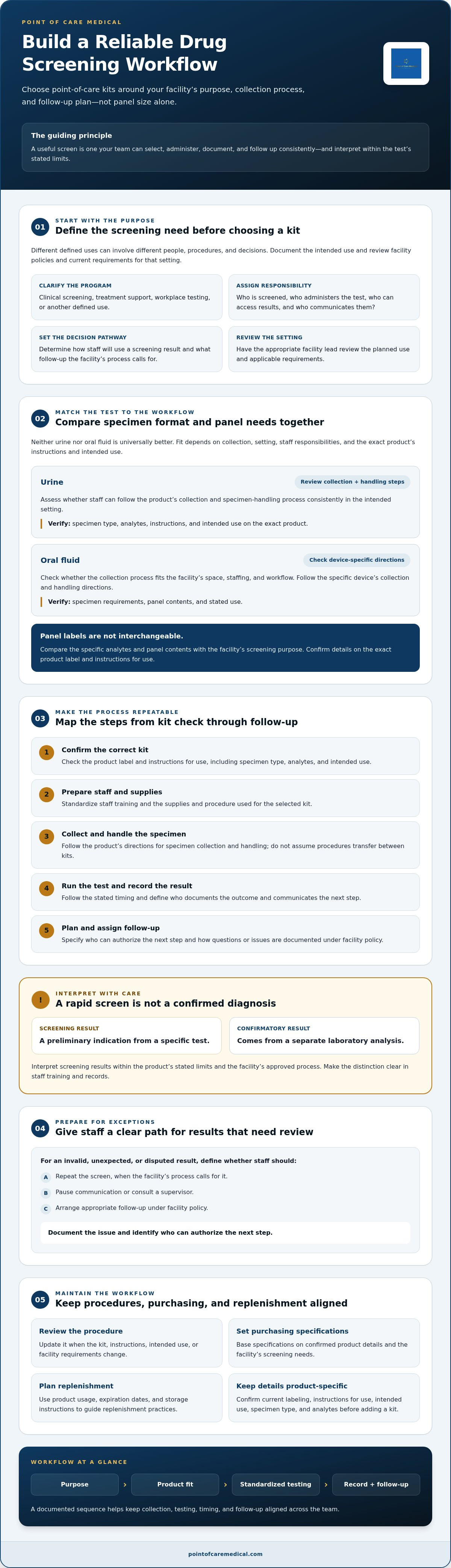
Start with the facility’s need, not the kit’s panel count. A clinical screening program, treatment support, workplace testing, and other defined uses can involve different people, procedures, and decisions. Before selecting point of care drug screening kits, document who will be tested, who will administer the test, and how staff will use the result. Check facility policies and verify current requirements for the intended setting.
Point-of-care testing makes testing available near the person being screened rather than relying only on a traditional laboratory process. This Point-of-care testing (POCT) overview provides background on the approach. The workflow still needs clear limits: a rapid screening result can inform next steps, but it doesn’t establish a confirmed diagnosis.
Define the purpose and setting before selecting a kit
Write down the program’s objective and decision pathway. For example, determine whether staff need an initial screen to guide a clinical conversation, support a treatment plan, or follow an employment policy. Identify who can access results and who is responsible for communicating them. Don’t assume procedures or rules transfer between clinical, treatment, and employment settings. Have the appropriate facility lead review the planned use and applicable requirements before implementation.
Map the steps from collection through follow-up
Turn the intended use into a written procedure staff can follow consistently. Define each handoff, from confirming the correct kit and reviewing its instructions to collecting the specimen, running the test, recording the result, and communicating the next step. Assign responsibility for checking the instructions for use, documenting the outcome, and escalating questions. Follow the product’s directions for specimen handling and test timing. Don’t rely on memory or a procedure written for a different kit.
A screening result is a preliminary indication from a specific test, while a confirmatory laboratory result comes from a separate laboratory analysis. Make that distinction clear in staff training and records. Interpret screening results within the product’s stated limits and the facility’s approved process.
Include a decision point for results that are invalid, unexpected, or disputed. Staff should know whether to repeat the screen, pause communication, consult a supervisor, or arrange appropriate follow-up under facility policy. Specify how to document the issue and who can authorize the next step. Clear roles help prevent inconsistent responses without treating a rapid result as conclusive.
Review the workflow with staff before use, then update it when the kit, instructions, intended use, or facility requirements change. A documented sequence gives the team a practical reference and keeps collection, testing, timing, and follow-up aligned.
How to Match Drug Screening Kits to Specimen and Panel Needs
Choose the specimen and panel together. The right fit depends on how your facility collects samples, where testing takes place, and what the screening program needs to assess. Neither urine nor oral fluid is universally better. Compare the exact product instructions and intended use before making a selection.
Choose a specimen format that fits the facility workflow
Urine cups and oral-fluid tests involve different collection processes. Consider the collection setting, staff responsibilities, specimen handling steps, and whether the product’s instructions fit your approved procedure. Don’t assume a collection method is more private, accurate, or operationally suitable without product-specific evidence and context. For additional background, see this oral fluid drug test kits guide.
| Specimen | Collection considerations | Operational fit | Verify before selection |
|---|---|---|---|
| Urine | Review the collection steps and specimen handling in the kit instructions. | Assess whether staff can follow the process consistently in the intended setting. | Confirm specimen type, analytes, instructions, and intended use on the exact product. |
| Oral fluid | Follow the specific device’s collection and handling directions. | Check that the collection process fits the facility’s space, staffing, and workflow. | Verify the product’s specimen requirements, panel contents, and stated use. |
Verify panel contents against the intended screening purpose
Panel labels are not interchangeable. Check each analyte against the exact kit labeling and documentation, then compare that list with the facility’s defined screening purpose. Don’t infer panel contents from a general product category or assume every urine cup includes fentanyl. If fentanyl is part of the program’s requirements, confirm it explicitly. For a selection-focused discussion, review this fentanyl test cup buyer’s guide.
For example, Point of Care Medical’s catalog includes the Rapid Test Cup “RTC” + Fentanyl. Before deciding whether it fits your protocol, confirm its current product labeling, specimen type, full analyte list, instructions, and intended-use statements. Apply the same checks to oral-fluid tests. A distributor can help facilities source products after requirements are defined, but your team should verify that each kit matches its documented needs.
Keep regulatory checks specific to the program. The CMS guidelines on urine drug testing address Medicare coverage and should not be treated as universal requirements for every setting. Verify current federal, state, payer, and facility policies as applicable. Once your checklist is clear, compare screening test categories against the requirements you’ve documented.
What to Evaluate Before Using Point-of-Care Drug Screening Kits
Before adopting point of care drug screening kits, compare the exact product documentation with your facility’s written requirements. A familiar specimen format or broad category description isn’t enough to establish that a kit fits your intended use. Check the details that affect collection, interpretation, staff readiness, and ongoing supply.
Facilities should verify each kit’s current labeling and instructions before adoption. Use this checklist to structure the review:
- Intended use: Does the stated use fit the facility’s program and setting?
- Specimen type: Does it match the planned collection process?
- Analytes: Does the documented panel cover the specific screening need?
- Instructions: Can staff follow the collection, timing, and result-interpretation steps as written?
- Staff capability: Are training, oversight, and documentation responsibilities assigned?
Review labeling, instructions, and quality documentation
Read the current labeling and instructions for use. Confirm the intended use, specimen type, analytes, storage conditions, and result interpretation steps. Review the manufacturer’s stated quality controls and any required procedural checks. Keep relevant documentation accessible to staff, and establish who will review updates or resolve questions about the instructions.
Verify regulatory status for the specific product and use. Don’t assume a kit is CLIA-waived or has a particular FDA status based only on its category or specimen type. Check current official sources and consult the facility’s compliance lead before making regulatory claims or approving use.
Assess operational fit before ordering
A kit can meet the documented screening need and still be difficult to maintain in practice. Estimate expected demand using the facility’s own usage records. Check that storage conditions can be maintained, staff can complete required training, and the process identifies who records results and manages documentation. Base replenishment decisions on actual use and the product’s storage and expiration information.
Compare supplier details with the facility’s specifications, not general descriptions. Ask for the current product labeling and instructions needed to verify the specimen, panel contents, intended use, storage requirements, and quality checks. Record the decision and its supporting documentation. If a product, procedure, or intended use changes, review the fit again before continuing the workflow.
How to Prepare Staff and Standardize On-Site Drug Screening
Consistent use of point of care drug screening kits depends on a shared procedure, not individual habits. Give staff a clear reference for preparation, specimen handling, test timing, result recording, and escalation. Adapt the checklist below to the facility’s approved procedures and the instructions supplied with the selected kit.
Train staff to follow the kit instructions consistently
Train each assigned staff member on the exact product they’ll use. Instructions can differ between kits, so don’t transfer timing or steps from one product to another. Show staff how the product documentation defines valid, invalid, and unreadable results. Record training and competency activities according to facility policy, and make current instructions accessible wherever testing is performed.
- Confirm the kit. Check that the product matches the planned screening procedure and that its instructions are available and current.
- Prepare the testing area. Gather required materials and confirm that the kit has been stored as directed. Follow facility procedures for identifying the person and specimen.
- Collect and handle the specimen. Use the kit’s collection and handling instructions. Keep specimen identification and required safeguards consistent with facility policy.
- Run the test and track timing. Follow the product’s steps and timing exactly. Don’t estimate or substitute intervals based on another kit.
- Interpret and record the result. Apply the product’s interpretation guidance. Record the result and relevant kit details in the facility’s approved system.
- Resolve exceptions. Follow the defined escalation process for invalid, unreadable, unexpected, or disputed results.
Set up documentation, quality checks, and escalation
Assign responsibility for recording the result, test date, kit identification, procedural checks, and follow-up actions. Define which identifiers your facility requires, such as product or lot details, and where staff must record them. Use the manufacturer’s stated quality controls and facility-approved checks. For treatment-center workflows, see this drug test cup selection guide for treatment centers.
Make the next step clear before testing begins. Staff should know whom to contact when a result is unclear, when to pause and review the procedure, and how to document the decision. Escalation and any decision about confirmatory testing should follow applicable facility policy and professional guidance. A rapid screening result is not itself a confirmed diagnosis.
Review the checklist when products or procedures change, and keep staff training aligned with current instructions. To compare available urine-cup and oral-fluid test options, start with your facility’s documented requirements.
How to Source Point-of-Care Drug Screening Kits and Maintain the Workflow
A sourcing plan should translate the facility’s approved procedure into clear purchasing specifications. For point of care drug screening kits, document the required product category, specimen type, confirmed analytes, intended use, and supporting documentation before comparing suppliers. This keeps procurement tied to operational needs rather than broad panel descriptions or assumptions about product features.
Create a repeatable procurement and inventory process
Assign responsibility for ordering, receiving, storage checks, and routine inventory review. Use facility usage records to estimate replenishment needs, then account for each product’s expiration dates and storage instructions. Set a review schedule that fits local consumption patterns and helps staff identify stock that needs attention before it is used.
At receipt, check the shipment against the order and the facility’s purchasing specifications. Verify the product labeling, quantity, packaging condition, and expiration details. Confirm that supplies can be stored under the conditions stated in the product documentation. Record discrepancies and resolve them through the facility’s receiving process before adding the kits to available inventory.
Review specifications whenever screening needs, written procedures, or product documentation change. A change in intended use or analyte requirements may affect which product is suitable. Keep purchasing records aligned with the current protocol so staff and procurement teams refer to the same requirements.
Find a supplier that can support professional screening needs
Ask suppliers for current product details and clear answers about intended use, specimen type, analytes, instructions, storage, and available documentation. Compare those details with the facility’s written requirements. Confirm specifics against the product’s current labeling before approval. A general category description alone isn’t enough to establish fit.
Point of Care Medical distributes rapid diagnostic supplies for professional organizations, including urine-cup and oral-fluid drug test categories. Its catalog includes the Rapid Test Cup “RTC” + Fentanyl. Confirm the current labeling and instructions for any specific kit before deciding whether it meets your protocol. Treat product selection, staff procedures, and inventory management as one connected process: the product must fit the need, staff must follow its directions, and supply records must support routine use.
Once your requirements are documented, you can review Point of Care Medical’s drug screening supplies as one sourcing option. Verify the product details your facility needs before making a purchasing decision.
Build a Workflow Your Team Can Maintain
A dependable screening process starts with the facility’s intended use. Select the specimen and panel to match that need, verify current product labeling and instructions, and give staff a consistent procedure for collection, testing, documentation, and follow-up.
Keep the workflow practical after implementation. Assign responsibility for training, inventory, and exception handling. Use facility usage records, expiration dates, and storage instructions to guide replenishment. Treat rapid screening results as screening information, not as a diagnosis or confirmatory finding.
When sourcing point of care drug screening kits, compare documented product details with your facility’s requirements. Point of Care Medical distributes professional screening supplies nationally across the United States, including the Rapid Test Cup RTC + Fentanyl and oral-fluid tests. Verify each product’s labeling, specimen type, analytes, and intended use before adoption.
Review Point of Care Medical’s drug screening supplies as you evaluate options for your program. With clear specifications and a repeatable protocol, your team can manage screening consistently.
Frequently Asked Questions
What are point-of-care drug screening kits?
Point-of-care drug screening kits are tests used near the person being screened to produce an initial screening result without sending every specimen through a laboratory process first. Formats and panel contents vary by product. A result can support screening decisions, but it doesn’t by itself establish a diagnosis or provide laboratory confirmation. Check the kit’s labeling and instructions to confirm its specimen type, analytes, intended use, and result interpretation steps.
How do facilities choose a point-of-care drug screening kit?
Choose a kit based on the facility’s defined screening purpose and workflow. Identify who will be tested, how specimens will be collected, which analytes are needed, and how staff will use and document results. Then compare those requirements with the exact product labeling and instructions. Confirm that staff can follow the collection, timing, handling, and interpretation steps, and verify current requirements for the specific setting.
Are urine or oral-fluid drug screening kits better?
Neither specimen type is universally better. The appropriate choice depends on the facility’s collection process, setting, staffing, and the selected product’s intended use. Compare the collection and handling instructions for the specific urine or oral-fluid test, then confirm its documented analytes and workflow requirements. Don’t assume one format has a particular privacy or accuracy advantage without evidence that applies to the exact product and use.
Do point-of-care drug tests provide confirmed results?
No. Point-of-care drug tests provide screening results, which are preliminary and must be interpreted according to the product instructions and facility procedure. They don’t automatically establish a diagnosis or constitute laboratory confirmation. If a result is unexpected, disputed, or requires further evaluation, follow the facility’s approved escalation process and applicable professional guidance to determine appropriate next steps. Document the screening result clearly so it isn’t mistaken for a confirmed finding.
How should staff handle an invalid point-of-care drug screen?
Staff should follow the kit’s instructions and the facility’s written procedure for an invalid result. Don’t record or communicate it as a valid positive or negative finding. Check the product documentation for how invalid results are identified and what action is specified. The facility’s procedure should identify who reviews the issue, whether another test is appropriate, and how the event and follow-up decision are documented.
What should a facility verify before ordering drug screening kits?
Before ordering, confirm that the product’s intended use, specimen type, and labeled analytes match the facility’s written requirements. Review current instructions, interpretation guidance, storage conditions, expiration information, and stated quality-control steps. Verify applicable regulatory or facility requirements rather than inferring status from the product category. Also check that staff training, documentation, storage capacity, and replenishment processes can support routine use.
Can point-of-care drug screening kits be used in workplace programs?
They may be considered only when the specific kit and workflow are appropriate for the workplace program and its applicable requirements. Don’t assume a general point-of-care product is suitable for every employment setting or regulated testing program. Confirm the program’s current rules and policies with the responsible compliance personnel, and verify product labeling and intended use. Establish how results will be documented, communicated, and escalated before testing begins.


