

Integrating POCT into clinical workflows works best when testing is mapped from patient selection through result review and documentation. Define who is tested, who performs each task, how results reach the clinical information system, and which measures will show whether the process is working. Treat the result pathway as part of the workflow, not as a separate technology task.
Rapid testing can support timely decisions, but it also adds staff steps and creates information that must be documented and acted on. Manual handoffs or disconnected records can make consistent testing and access to results more difficult.
This guide explains how to map the complete testing process, identify patients and operators, and pilot workflow changes before wider adoption. It also covers practical measures for tracking uptake, time, and workflow performance, plus the key considerations for connecting POCT results with clinical information systems. The goal is a process that fits clinical practice and gives care teams usable results where they need them.
Key Takeaways
- Map each testing step, from patient identification and specimen collection to result review, so staff responsibilities and handoffs are clear.
- Use patient, specimen, and operator identification to support accurate documentation and traceability.
- Pilot workflow changes in a defined setting, then use staff feedback and process observations to refine them before wider adoption.
- Track adoption alongside turnaround time, workflow delays, and user experience to understand whether testing fits clinical practice.
- Plan how results will move into the clinical information system, with attention to reliable transmission and accessible patient records.
Barcode-based patient, specimen, and operator identification
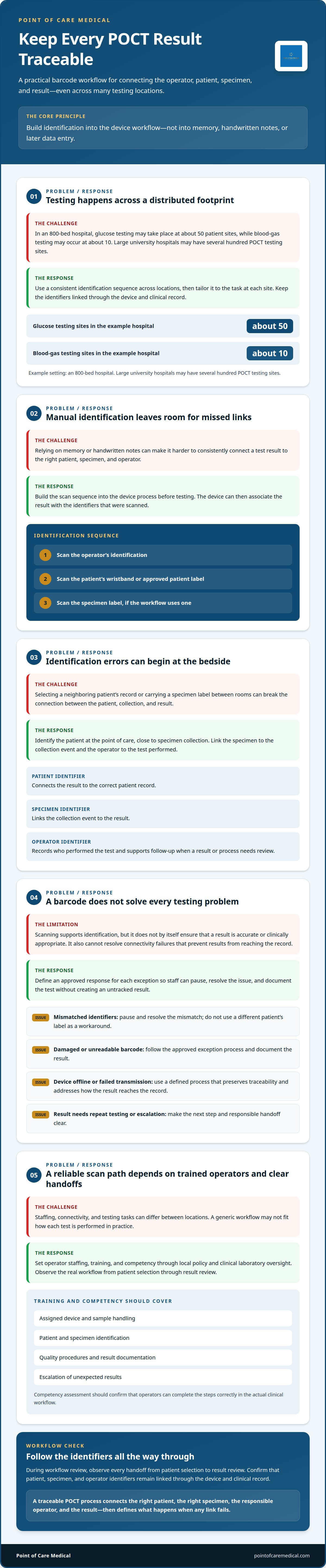
Barcode identification connects each POCT result to the right patient, specimen, and operator. In an 800-bed hospital, glucose testing may take place at about 50 patient sites, while blood-gas testing may occur at about 10. Large university hospitals may have several hundred POCT testing sites. A consistent identification sequence helps staff manage these decentralized locations and maintain a traceable record.
Build the scan sequence into the device process rather than relying on memory or handwritten notes. Before testing, the operator scans their identification, the patient’s wristband or approved patient label, and the specimen label if the workflow uses one. The device can then associate the result with those identifiers. For example, scanning a patient label before a bedside glucose test can link the result to that patient instead of relying on later entry from a paper note.
Identify patients at the point of care, close to specimen collection. This reduces the chance of selecting a neighboring patient’s record or carrying a specimen label between rooms. Specimen identification links the collection event to the result, while operator identification records who performed the test. That information supports follow-up when a result needs review or a process needs investigation.
Define POCT operator staffing, training, and competency through local policy and clinical laboratory oversight. Training should cover the assigned device, patient and specimen identification, sample handling, quality procedures, result documentation, and escalation of unexpected results. Competency assessment should confirm that operators can complete these steps correctly in the actual clinical workflow.
Barcode controls reduce identification errors, but they cannot correct every testing or information problem. Barcode scanning can support identification, but it does not by itself ensure that every result is accurate or clinically appropriate. Scanning also cannot resolve connectivity failures that prevent results from reaching the record. Establish a response process for mismatched identifiers, unreadable labels, failed transmission, and results requiring repeat testing or escalation.
Design exceptions alongside the standard scan path. If a barcode is damaged, the device is offline, or the patient’s identity cannot be matched, staff need an approved way to pause, resolve the issue, and document the result without creating an untracked test. Avoid workarounds such as scanning a different patient’s label. A defined exception process preserves traceability and helps protect patient outcomes.
During workflow review, observe each handoff from patient selection to result review. Confirm that patient, specimen, and operator identifiers remain linked through the device and clinical record. Because staffing and connectivity can differ between testing sites, tailor the scan sequence to the task at each location.
Mapping the complete testing workflow
Map POCT from the clinical question to the action taken after results reach the care team. Include patient-facing steps, quality checks, documentation, and follow-up handoffs.
POCT Tests in Clinical Use
Point-of-care testing (POCT) means testing performed near the patient, with results available to inform care without relying solely on a central laboratory pathway. Common clinical examples include glucose, blood-gas, and anticoagulation testing. The benefit depends on fitting the test to a decision the care team needs to make.
For example, a clinic may incorporate fingerstick PT/INR testing into an anticoagulation visit, while a hospital may use bedside blood-gas testing when clinicians need results during care. The patient, operator, specimen, and result-review steps differ, so map each test as its own process rather than applying one generic workflow.
End-to-End Testing Process
An end-to-end workflow records every action from the test order through clinical interpretation and follow-up. Start with the reason for testing, then document patient selection, specimen collection, processing, result review, communication, and any resulting care action.
A continuous time-motion study at an ambulatory, multi-specialty primary care clinic in Indianapolis, Indiana, examined staff performing POCT and clinical laboratory testing. Nurses directed both workflows. Use that lens to identify who owns each handoff, where work pauses, and whether results reach the person responsible for action. DIN EN ISO 22870 describes the optimal organization of POCT.
Capture routine and exception paths. Note what happens when a sample cannot be processed or a result needs clinical review. Record where documentation occurs, who receives the result, and how unresolved steps are handed to another team member. This map gives operations, clinical, and IT leaders a shared view of the process.
Quality Control and Proficiency
A POCT quality plan defines the checks that support reliable testing across operators and locations. Specify applicable quality-control procedures, calibration responsibilities, proficiency-testing approach, documentation, and the response to a failed check. Use the test system’s instructions and local policy to establish a process for each method.
In the United States, assess CLIA applicability for each test and testing setting, along with relevant state and federal requirements. Before implementation, document the applicable classification, oversight, operator responsibilities, and quality records in the workflow. Match requirements to the test and setting rather than assuming they are identical across all POCT.
Review the map with the people who perform and support the work. Clinical leaders can confirm that results lead to an appropriate action, while operations and IT teams can identify handoffs that interrupt documentation. For workflows that include oral fluid testing, oral fluid tests can be considered within the same defined process for ordering, handling, results, and follow-up.
Pilot testing and continuous improvement
A pilot tests a defined POCT process in its intended clinical setting before broader implementation. It helps teams identify workflow changes and operational issues while the scope remains manageable.
Planning a Pilot
Set a clear purpose for the pilot, such as introducing a test at a specific point of care or improving an existing handoff. Define the patient group, testing location, operator roles, and result pathway. A focused scope makes it easier to see how the proposed process works in practice and where it needs adjustment.
Document the current process before introducing changes. Trace how an order moves from a clinician to the operator, how the test is performed, and how the result reaches the person making the care decision. This baseline gives the pilot team a practical comparison and helps distinguish new workflow issues from existing ones.
Include clinical, operations, laboratory, and IT stakeholders in planning. Each group sees different dependencies: clinicians know when a result informs care, laboratory staff understand oversight and quality processes, and IT teams can assess data flow. If an AI tool is part of the proposed process, test it with the organization’s own data before implementation.
Implementation Practices and Pitfalls
Good implementation practices keep the process aligned with clinical work. Test the full sequence with the staff who will perform it, including ordering, collection, analysis, result review, documentation, and follow-up. Common pitfalls include unclear responsibility at handoffs, adding steps without addressing an existing problem, and treating technical setup as a substitute for workflow planning.
Use a written pilot plan to record the intended process, assigned roles, training approach, issue reporting, and criteria for pausing or adjusting the test. If a result does not reach the expected record, for example, document where transmission stopped and who handles the exception. Avoid informal workarounds that leave results or actions outside the agreed process.
Review feedback and process observations at regular project check-ins. Group issues by cause, such as operator training, device handling, ordering, or data connectivity, then assign an owner and next action. This turns staff reports into specific improvement work rather than a general request to “use the system more.”
After each adjustment, repeat the affected part of the workflow with the relevant staff. A change to ordering may require a fresh review of result routing, while a change to the operator process may affect documentation. Expand implementation only after the pilot team can follow the revised process consistently and knows how to manage exceptions.
Before implementation, test AI tools using the organization’s own data so the evaluation reflects that data rather than assumptions about other settings.
Adoption, time, alert, and satisfaction metrics
Measure whether POCT fits clinical practice by tracking use, workflow time, alerts, and staff experience. Interpret each measure in relation to the clinical task it represents, rather than treating test volume as proof of successful adoption.
Start with adoption. Compare the number of eligible testing opportunities with completed tests, then review use by site, shift, and operator group. Hospitals generally perform about 50-100 POCT analyses annually per bed. Use this as context, not a target: patient mix, test purpose, and service design affect local volume. A site with low use may need workflow review, while high use still requires checks for appropriate ordering and result handling.
Measure elapsed time across the full clinical pathway. Record when testing is ordered, when the specimen is collected, when the result becomes available, and when the care team acts. In a CV/OR workflow, mean total “vein to brain” time for blood-gas testing was 15:23 min:sec, compared with mean in-lab STAT testing time of 2:36 min:sec. These measures show why instrument run time alone cannot describe the experience. Collection, transport, processing, result receipt, and clinical response each contribute.
For context, CV/OR surgeons reported a typical 15-minute turnaround for blood gases sent to a central laboratory by pneumatic tube. The central laboratory’s in-lab turnaround typically averaged 2.5 minutes. Compare local POCT and central-lab pathways using the same start and end points. This helps identify whether delays occur before analysis, during reporting, or after a result reaches the clinical team.
Track alerts by type and outcome. For each alert, record whether staff acknowledged it, took the intended action, or documented a reason for override. A historical review of computerized medication-safety alerts reported override rates ranging from 49% to 96%. That range concerns medication alerts, not POCT, but illustrates why alert counts alone don’t show whether a notification supports clinical action.
Assess satisfaction with focused feedback from operators and clinicians. Ask whether the testing process fits the care task, whether results arrive in a usable format, and where staff experience extra steps. Pair feedback with observed workflow data. In decentralized anticoagulation clinics, visits typically lasted 7-10 minutes, so a new testing step should be evaluated within the visit rather than in isolation.
Review these measures together at each improvement cycle. If adoption falls at one site while completion time rises, examine staffing, process design, and result access before changing the test pathway. A balanced dashboard helps healthcare teams distinguish a training need from a workflow or connectivity issue and decide which practice adjustment to test next.
Integrating POCT with clinical information systems
A connected POCT pathway links a test result to the patient record and clinical action. Plan the data route alongside the clinical workflow, including what happens when transmission or order matching fails.
Clinical Information System Connections
Clinical information system integration moves POCT results from a device through an LIS to the EPR or EHR. Communication may use HL7, HCM, ASTM Protocol, or POCT1A. The benefit is a result available in the patient record for review and follow-up, rather than information isolated on paper or a device screen.
Map the data route before configuring interfaces. Identify where the order is created, how the device associates a result with the patient, which system receives it, and where clinicians view it. A known challenge is that few LIS can generate an order at the same time results are transmitted. Define how the workflow handles this gap, including how results are matched and exceptions documented.
Manual entry and records split across paper, web portals, and EHRs can create documentation gaps. In an Indianapolis primary care clinic study, POCT results were recorded directly in patient charts rather than electronically. Clinical laboratory results were stored in an EMR and printed for chart storage. These examples show why a connected process should specify the authoritative record and prevent parallel documentation from becoming the default.
Assessing Needs and Selecting Devices
Assess clinical need by identifying the care decision, patient setting, and result timing required for that decision. Select a device and workflow that fit those needs, available operators, quality oversight, and the organization’s information systems.
A test used in a clinic room may need a different result route from one performed at a bedside. Include clinical, laboratory, operations, and IT leaders in the selection review. Confirm that the planned connection supports patient identification, result transmission, review, and documentation. A device that produces a result without a workable route into the record leaves an operational gap.
POCT costs depend on the device and test materials, staffing, quality processes, connectivity, and implementation work. Assess these components together across the intended workflow rather than considering the device purchase alone. Staffing needs also depend on who performs testing and manages results at each site.
Before rollout, test a representative order and result through the complete interface, then confirm that the result appears in the intended patient record. Include a failed transmission scenario and document its resolution path. Review rapid testing supplies for your program as you plan the tests your clinical workflow will support.
Point of Care Medical
Point of Care Medical supplies targeted rapid testing products for healthcare and screening facilities. Once your workflow defines the tests, operators, quality processes, and result pathway, its offerings can support the testing needs identified in that plan.
For respiratory testing, available options include the GenBody COVID-19 Rapid Antigen Test and ViraDx™ SARS-CoV-2/Flu A+B Rapid Antigen Test. The catalog also includes the SURE CHECK HIV 1/2 Assay and Rapid Test Cup “RTC” + Fentanyl. These products fit programs planning for those specific testing categories; they do not replace workflow design, operator training, or clinical information system integration.
Contact Point of Care Medical to discuss which rapid testing supplies align with your program’s planned testing needs.
Make Your POCT Plan Sustainable
The next phase is to make workflow ownership part of routine operations. Assign responsibility for reviewing how testing fits clinical needs, staff roles, and information systems. Revisit the process when service needs or technology change, so the testing pathway remains aligned with care delivery.
This ongoing attention gives teams a practical way to improve integrating POCT into clinical workflows. Treat changes as operational decisions: identify the issue, assess its effect on staff and result use, then evaluate the revised process. Clear ownership keeps those decisions connected to patient care rather than isolated technical updates.
For programs selecting rapid tests, Point of Care Medical offers the GenBody COVID-19 Rapid Antigen Test, Rapid Test Cup “RTC” + Fentanyl, and ViraDx™ SARS-CoV-2/Flu A+B Rapid Antigen Test. These offerings support programs whose planned testing needs include those categories.
Contact Point of Care Medical to discuss supplies for your testing program. A well-owned plan gives your team a clear foundation for its next improvement.
Frequently Asked Questions
What are the steps for integrating POCT into existing clinical workflows and EHR systems?
Start by selecting a clinical decision that needs a timely test result, then design the process around that decision. For example, an outpatient clinic could define who orders a test, where collection occurs, and which clinician reviews the result before the patient leaves. Next, align device output with the EHR’s patient and result fields, test common exceptions, and pilot the process before expanding it. Integrating POCT into clinical workflows requires clinical and technical planning together.
How does POCT affect turnaround time, clinical decisions, patient outcomes, and workflow efficiency?
POCT can reduce steps between specimen collection and result availability when testing occurs near the patient. Its clinical value depends on whether the result reaches the right clinician in time to inform a decision. A result available during an appointment, for instance, may support a decision before the patient leaves. Assess the full pathway, including review and follow-up, because faster analysis alone does not establish improved outcomes or efficiency.
How should organizations measure POCT performance and return on investment?
Use a baseline and compare it with performance after implementation. Track completed tests, end-to-end turnaround, results requiring correction, documentation gaps, staff time, and whether results support the intended clinical action. To assess return on investment, compare local program costs, including testing materials, staffing, training, quality activities, and connectivity, with documented operational value, such as reduced manual entry or specimen transport. Review measures together: test volume alone cannot establish value.
What U.S. CLIA rules and other regulations apply to point-of-care testing?
Assess CLIA applicability for each test and testing setting, along with relevant state and federal requirements. Document the applicable classification, oversight, operator responsibilities, and quality records in the workflow. Requirements vary by test and setting.


