
A faster test does not automatically mean lower costs. In a U.S. hospital model, a cost benefit analysis of rapid diagnostic testing found that molecular testing combined with an antimicrobial stewardship program had an 80.0% chance of being cost-effective. The modeled value depended on how quickly results could support treatment decisions and reduce avoidable complications.
That distinction matters when evaluating diagnostic pathways: test costs are only one part of the equation. Patient outcomes, treatment changes and time to diagnosis can also shape the balance, while COVID-19 testing models found that cost-effectiveness varied with disease prevalence.
This article explains what researchers modeled and found, and how to interpret the results without treating them as a universal savings estimate. You’ll see how rapid and conventional approaches compare, why faster identification can affect outcomes, and how COVID-19 prevalence changes the analysis. A decision guide brings the main comparison criteria together for practical review.
Key Takeaways
- Assess diagnostic strategies by their effects on treatment and patient outcomes, not test costs alone.
- Interpret modeled savings in context: COVID-19 and influenza prevalence can change the value of testing.
- Consider whether faster results can support earlier treatment decisions and reduce avoidable complications.
- Review how length of stay and adverse events influence the overall cost comparison.
- Use the decision guide to match testing approaches with the clinical setting and the outcomes that matter most.
Incremental costs and patient outcomes
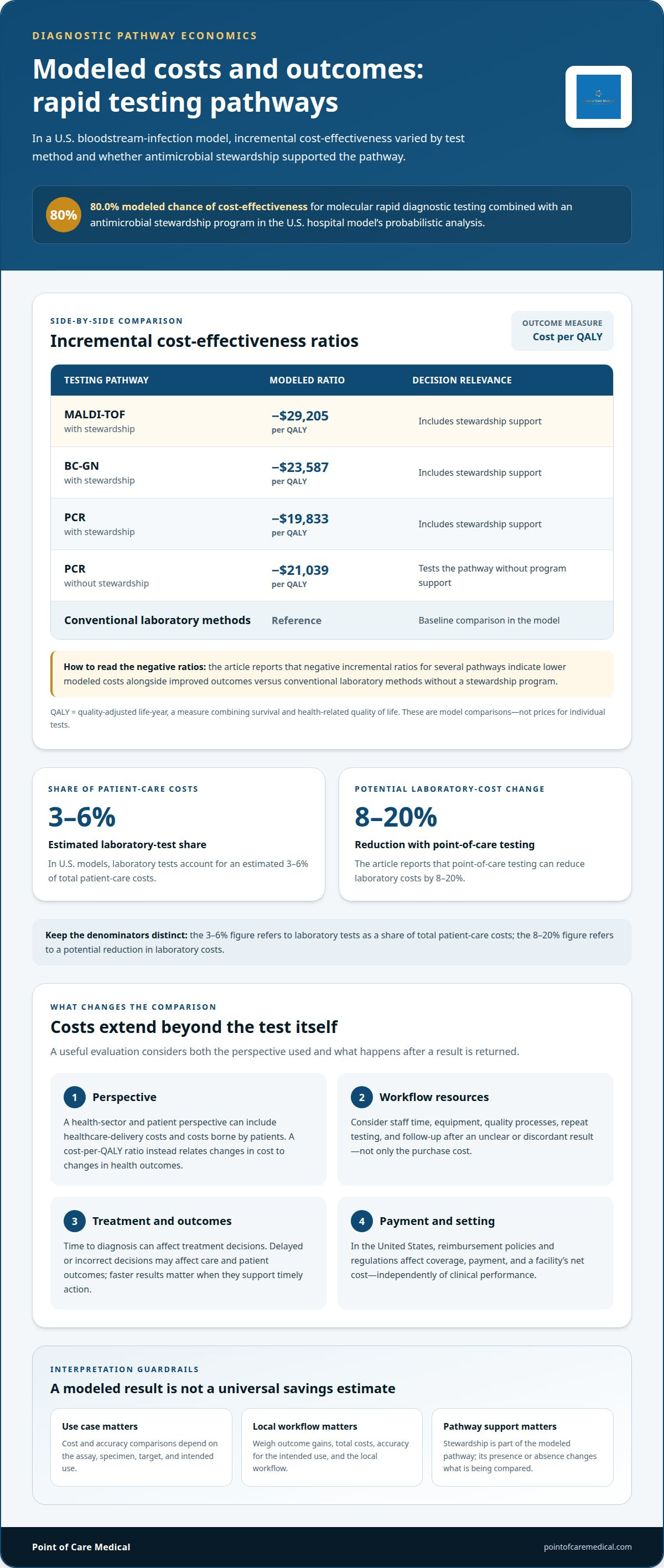
Incremental analysis compares the added costs of a testing pathway with changes in patient outcomes. In U.S. bloodstream-infection models, results varied by diagnostic method and by whether antimicrobial stewardship accompanied testing.
Costs and Quality-Adjusted Life-Years
A quality-adjusted life-year (QALY) combines survival and health-related quality of life. The modeled incremental cost-effectiveness ratios were negative for several pathways, indicating lower modeled costs alongside improved outcomes versus conventional laboratory methods without a stewardship program. MALDI-TOF with stewardship reached -$29,205 per QALY; BC-GN with stewardship reached -$23,587 per QALY. These are model comparisons, not a price for an individual test.
Health-Sector and Patient Costs
A health-sector and patient perspective captures more than a laboratory’s test expenditure. It considers costs across healthcare delivery and costs borne by patients, including the consequences of waiting for results or receiving treatment that later needs adjustment. This differs from a cost-per-QALY ratio, which relates changes in costs to health outcomes. The perspective chosen can change which costs count in an economic evaluation.
Rapid and Laboratory-Based Testing
Rapid tests can provide results sooner, while laboratory-based methods may follow different workflows and provide different information. Cost and accuracy comparisons depend on the specific assay, specimen, target, and intended use; a modeled economic result alone does not establish that one method is more accurate. In U.S. models, laboratory tests account for an estimated 3-6% of total patient-care costs, while point-of-care testing can reduce laboratory costs by 8-20%.
In the United States, reimbursement policies and regulations affect who pays, which testing services receive coverage, and how payment is made. These factors influence a facility’s net cost, independently of the test’s clinical performance.
Risks and Hidden Testing Costs
A narrow comparison of purchase costs can overlook staff time, equipment, quality processes, repeat testing, and follow-up after an unclear or discordant result. Delayed or incorrect decisions can also affect treatment and patient outcomes. These downstream effects are distinct from the costs modeled directly, so include workflow and subsequent care when assessing a testing pathway.
| Testing pathway | Modeled comparison | Decision relevance |
|---|---|---|
| MALDI-TOF with stewardship | -$29,205 per QALY | Includes stewardship support |
| BC-GN with stewardship | -$23,587 per QALY | Includes stewardship support |
| PCR with stewardship | -$19,833 per QALY | Includes stewardship support |
| PCR without stewardship | -$21,039 per QALY | Tests the pathway without program support |
| Conventional laboratory methods | Reference comparison | Baseline in the model |
The Study authors reported an 80.0% chance that molecular rapid diagnostic testing combined with an antimicrobial stewardship program would be cost-effective in probabilistic analysis. Choose by weighing outcome gains, total costs, accuracy for the intended use, and the local workflow.
Cost-effectiveness of COVID-19 testing in low- and middle-income countries
COVID-19 testing can support treatment decisions for patients with severe or critical COVID-like illness. Its economic value changes with SARS-CoV-2 and influenza prevalence in the population being assessed.
Cost-Effectiveness by Country Income Level
The analysis covered 129 low- and middle-income countries: 27 low-income, 54 lower-middle-income, and 48 upper-middle-income. Molecular rapid diagnostic testing was dominant and cost-effective in 85.1% of probabilistic model simulations. These results describe modeled populations, not a single cost-effectiveness result for every country or income group.
Country-level value depends on disease prevalence and the costs and outcomes represented in each setting. The study found testing could be cost-effective for severe COVID-like illness depending on SARS-CoV-2 and influenza prevalence. A population with different prevalence may obtain a different balance between testing costs and treatment benefits. Compare local conditions rather than applying one income-group result across all settings.
Test Sensitivity and Specificity
Sensitivity affects how often a test identifies people who have the target infection; specificity affects how often it correctly identifies people without it. Missed infections and false-positive results can change follow-up testing, treatment decisions, and total costs. The COVID-19 model’s cost-effectiveness findings should therefore be interpreted alongside test performance for the intended population and use.
To assess whether rapid testing is cost-effective, healthcare organizations can define the patient group, compare testing with usual-care pathways, and specify the outcomes and costs included. Then examine prevalence assumptions, treatment effects, test performance, and uncertainty across model scenarios. This makes the analysis useful for local decisions rather than treating modeled effectiveness as universal.
Include treatment side effects when they affect patient outcomes or resource use. For example, an analysis can account for the consequences of treatment following a positive result alongside the value of timely care. Separate health-sector costs from patient costs, and document which items are included. Licensing and implementation requirements can also affect adoption costs, so include them where applicable without treating one country’s process as universal.
A UK scenario provides a separate economic reference: a £13,000-per-QALY cost-effectiveness threshold has been proposed. It is not a universal rule for U.S. organizations. Use it only as context, and assess U.S. testing decisions against the relevant population, outcomes, and payment conditions.
For organizations assessing respiratory testing workflows, review rapid testing options alongside the population and outcomes the analysis is designed to serve.
Length-of-stay and adverse-event cost savings
Rapid testing can influence treatment decisions when results help clinicians identify a pathogen and adjust therapy. In a bloodstream-infection model, fewer avoidable complications could affect length of stay and patient outcomes, but those effects depend on the pathway being modeled.
Hospital stay is a cost driver because additional days use beds and clinical resources. A U.S. publication used to estimate bloodstream-infection length of stay included 830 patients. The model applied added stays for two adverse events: Clostridioides difficile infection added 3.66 days, while acute kidney injury added 4.31 days. These are model assumptions, not guaranteed reductions from testing.
These assumptions show why adverse events matter in an economic comparison. If earlier pathogen identification supports more appropriate treatment, the modeled pathway may reduce care-related complications, affecting both patient outcomes and resource use. However, a test does not itself prevent an event. The connection depends on whether results change decisions and whether those decisions alter the patient’s course.
For a practical review, separate the pathway into these steps:
- Identify when the result becomes available within the bloodstream-infection workflow.
- Determine whether the result changes antimicrobial selection or other treatment decisions.
- Track the modeled impact on adverse events, including Clostridioides difficile infection and acute kidney injury.
- Translate any modeled change in length of stay into its effect on patient care and hospital resources.
Use the same population and time horizon when comparing rapid testing with standard care. Otherwise, differences in length of stay may reflect unlike patient groups rather than the diagnostic strategy. The estimate is also sensitive to the assumed frequency of adverse events and the additional days attributed to each event. Keep these inputs visible so decision-makers can see what drives the result.
When interpreting the research, distinguish observed patient data from assumptions used in a model. The 830-patient publication informed length-of-stay estimates, while the added 3.66 and 4.31 days represent modeled effects of specific complications. A model author should show how those inputs connect to treatment changes, rather than presenting reduced stay as an automatic consequence of rapid testing.
For each pathway, compare test-related costs with downstream consequences. Consider whether faster information changes therapy, while accounting for complications and the additional hospital days attributed to them. This keeps the analysis focused on patient outcomes and resource use, not simply how quickly a result is available.
Model assumptions about time to diagnosis and treatment optimization
In a U.S. bloodstream-infection model, the time to a useful result shaped when treatment could be reviewed. The model distinguished early empiric treatment from later pathogen identification and therapy optimization.
For suspected bloodstream infection, patients are typically treated rapidly, within an hour. Initial treatment commonly uses two broad-spectrum antimicrobials while clinicians await more specific information. This step matters when interpreting rapid diagnostic tests: the model evaluates how later results may inform treatment, not whether testing replaces initial therapy.
The model assumed molecular rapid diagnostic test results would reach clinicians within 3 hours after Gram stain. It also assumed molecular testing reduced time to pathogen identification by 21 hours for non-resistant pathogens and 45 hours for resistant pathogens. Those differences distinguish the modeled timing benefit by pathogen resistance category.
Identification and treatment optimization are related but separate milestones. For pathogens with intrinsic or typically well-known resistance patterns, the model assumed clinicians could receive information to optimize therapy 48 hours after Gram stain. This provides a comparison point for the earlier modeled molecular result. The distinction helps show why a rapid result may affect a decision even when initial treatment has already begun.
- Initial treatment: suspected bloodstream infection receives rapid empiric therapy, typically within an hour.
- Early result: the modeled molecular result reaches clinicians within 3 hours after Gram stain.
- Identification change: modeled time to pathogen identification falls by 21 hours for non-resistant pathogens and 45 hours for resistant pathogens.
- Optimization reference: the model places information for selected resistance patterns at 48 hours after Gram stain.
Read these intervals as model inputs, not interchangeable measures. Time to identification describes when a pathogen is identified; time to optimization describes when information can guide a treatment adjustment. A hospital comparing pathways should preserve this distinction, then link each timing assumption to the clinical decision it could support.
Molecular rapid diagnostic tests can detect a range of bloodstream-infection pathogens within a few hours after a blood culture bottle flags positive. This workflow starts at a different point from the model’s Gram-stain timing. Aligning the start point is essential when comparing elapsed time across diagnostic pathways.
The model used a 30-day time horizon and did not discount costs. That scope connects modeled timing changes with outcomes inside the same period. It also limits interpretation: effects beyond the 30-day horizon are outside this model. Reviewers can therefore trace each assumption from result timing, to treatment decision, to outcomes counted during the analysis.
COVID-19 and influenza prevalence assumptions
Prevalence shapes how a testing strategy performs across a patient population. The model explored COVID-19 prevalence from 0% to 30%, then varied influenza prevalence among patients with COVID-like illness who did not have COVID-19.
These scenarios help explain why one cost-effectiveness result cannot represent every clinical setting. At 0% COVID-19 prevalence, the modeled population contains no COVID-19 cases under that assumption. At 30%, COVID-19 makes up a larger share of the modeled group. Those endpoints test how changing the underlying probability affects the economic case for testing.
Influenza was also represented through two assumptions. One scenario used 1% influenza prevalence among patients with COVID-like illness who did not have COVID-19. The other used 10% for that same group. Keeping this denominator clear matters: these figures do not describe influenza prevalence across all patients or all countries.
COVID-19 and influenza prevalence influence the expected distribution of test results. When prevalence changes, the proportion of patients with each infection changes too. That can alter how many results may inform treatment decisions, and therefore the balance between testing costs and modeled clinical value. The analysis found COVID-19 testing could be cost-effective for severe COVID-like illness depending on SARS-CoV-2 and influenza prevalence.
For a practical comparison, examine each assumption separately:
- COVID-19 range: test the model across 0% to 30% prevalence.
- Lower influenza scenario: use 1% among COVID-like patients without COVID-19.
- Higher influenza scenario: use 10% for that same subgroup.
- Clinical interpretation: connect each prevalence scenario to the population and treatment decisions being assessed.
These inputs are model scenarios, not current U.S. prevalence estimates. They show how evidence can be tested under different conditions. For an organization applying the findings, the key questions are whether its patient population resembles a modeled scenario and whether test results can support a clinical decision.
Prevalence should also be considered alongside the purpose of testing. A model designed to support treatment for severe or critical COVID-like illness addresses a different decision from broad screening. The population definition, SARS-CoV-2 prevalence, and influenza prevalence all affect how closely the modeled effectiveness applies to a specific use case.
Use the prevalence range to frame scenario analysis, then align each scenario with the intended patient group and decision. Explore rapid testing options for respiratory testing workflows.
Point of Care Medical
Point of Care Medical supplies rapid testing products for organizations assessing diagnostic options and their role in clinical workflows. Its offerings include the GenBody COVID-19 Rapid Antigen Test, ViraDx™ SARS-CoV-2/Flu A+B Rapid Antigen Test, Rapid Test Cup "RTC" + Fentanyl, and SURE CHECK HIV 1/2 Assay.
Consider these products when your testing needs align with their diagnostic categories. The economic models discussed above help frame broader decisions, but they do not establish the cost-effectiveness of a specific product in every setting. Match the testing option to the clinical use and population under consideration.
Contact Point of Care Medical to discuss its rapid testing products and your organization’s needs.
Turn the analysis into a practical decision
A cost benefit analysis of rapid diagnostic testing is most useful when it informs a specific operational decision. Apply the model to your setting by defining the patient group, intended clinical use, and outcomes your organization wants to assess. Then identify who will review results and how findings can support the existing workflow.
Set a clear review process before adopting a testing pathway. Document the assumptions behind your decision, including how the test fits current practice and which outcomes matter to your organization. This creates a consistent basis for evaluating whether the approach remains appropriate as patient needs and operating conditions change.
For the next step, connect your testing needs with products designed for the relevant diagnostic category. Contact Point of Care Medical to discuss its rapid testing offerings and your organization’s requirements. A structured evaluation can help your team move forward with clarity and confidence.
Frequently Asked Questions
What did the researchers do and find?
Researchers compared conventional laboratory methods with MALDI-TOF, BC-GN, and PCR pathways, with and without antimicrobial stewardship, in a U.S. hospital model. They assessed mortality and cost-effectiveness. Modeled approaches that included molecular rapid testing dominated standard care. Study authors estimated an 80.0% chance of cost-effectiveness when molecular testing was combined with stewardship. These findings describe the model’s assumptions and comparisons, not outcomes guaranteed for every hospital.
Why was this study done?
The study examined whether faster pathogen identification could improve treatment decisions enough to justify the added costs of a different diagnostic pathway. For hospital decision-makers, test expenditure alone does not show the full operational or patient impact. Researchers therefore considered how diagnostic results might affect treatment, outcomes, and resource use. The analysis offers a framework for assessing testing strategies, while its conclusions remain tied to the patient group and assumptions modeled.
What is a cost-benefit analysis of rapid diagnostic testing?
A cost-benefit analysis compares the resources required for a testing strategy with the financial and practical value it may produce. In healthcare, the assessment can include test-related expenses, staff workflow, treatment decisions, and patient outcomes. A cost benefit analysis of rapid diagnostic testing should clearly define the population and comparator. It should also distinguish financial savings from health outcomes, since better outcomes do not always mean lower spending.
What are the upfront and ongoing costs of rapid diagnostic tests?
Upfront expenses may include test supplies and any equipment required by the chosen method. Ongoing costs can include replacement supplies, staff time, quality processes, and follow-up when results need further assessment. The categories depend on the assay and local workflow. For a useful budget, separate one-time setup expenses from recurring use, then include downstream steps such as repeat testing or additional laboratory work.
How much do rapid diagnostic tests cost per test in the United States?
There is no single per-test amount that applies to all rapid diagnostic tests in the United States. Costs depend on the test type, purchasing configuration, and quantities requested. Point of Care Medical provides personalized pricing after reviewing a request. Submit your product selections, quantities, and configuration notes to receive a quote tailored to your requirements, rather than relying on an assumed market-wide rate.
What health and economic benefits do rapid diagnostic tests provide?
Rapid tests can make diagnostic information available sooner, which may help clinicians review treatment choices and organize follow-up. Their economic value depends on whether results change care or resource use. For example, a result that informs a treatment adjustment may affect subsequent laboratory work or the patient’s care pathway. Include these effects in an evaluation, while distinguishing expected benefits from outcomes observed in a particular clinical setting.
What evidence and methods are used to evaluate the cost-effectiveness of rapid diagnostic tests?
Evaluations use evidence about testing pathways, patient outcomes, costs, and the timing of clinical decisions. Researchers may use decision models to compare strategies that cannot be assessed using a simple cost-per-test figure. They can also test uncertainty by varying assumptions across repeated simulations. Review the population, comparator, time horizon, outcome measure, and included costs. These details show how closely a model fits the decision your organization needs to make.


