

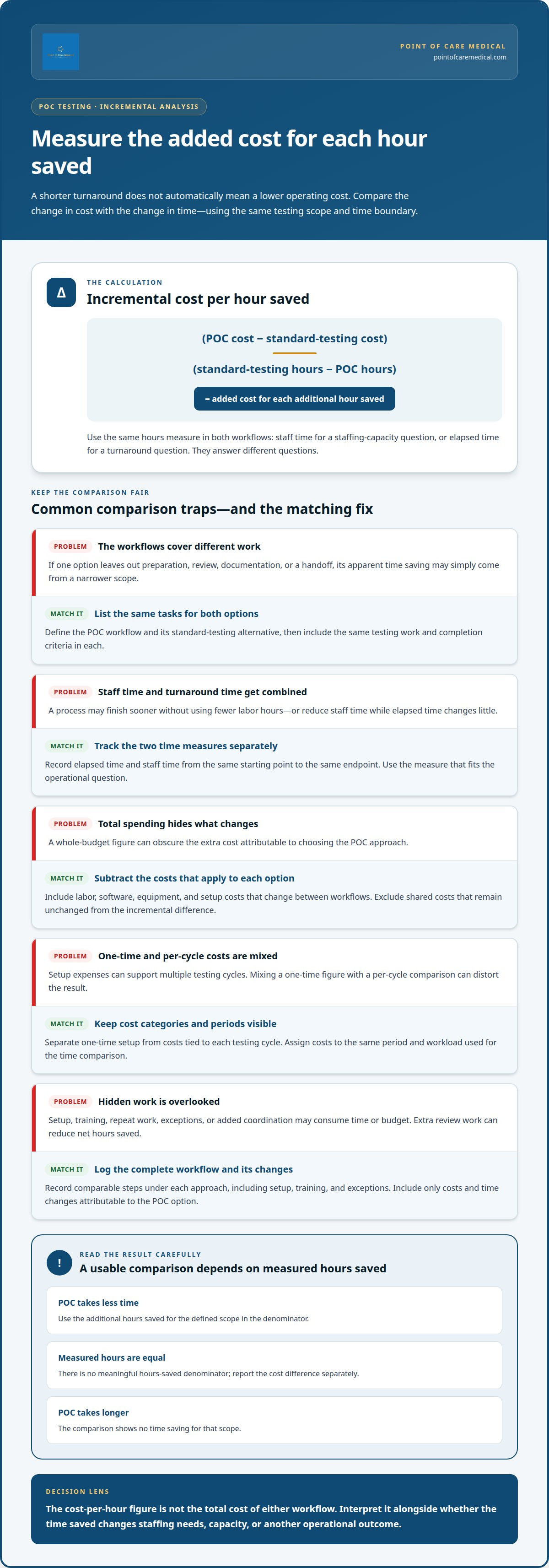
A lower turnaround time doesn’t automatically mean a lower operating cost. The incremental cost per hour saved with POC testing is the added cost of the testing approach, compared with a defined alternative, divided by the additional hours saved. The result is meaningful only when both options use the same testing scope and time boundary.
Procurement teams need a like-for-like comparison, but different pricing models can obscure which costs are included. This article explains how incremental analysis separates added costs from total costs, which labor, software, equipment, and setup expenses to consider, and how scope-based billing affects the comparison. It also shows how to assess whether the time saved with POC testing justifies its additional cost.
Key Takeaways
- Compare POC testing with a clearly defined alternative, using the same scope and time boundaries for both.
- Calculate the added cost against the additional hours saved to assess whether the efficiency gain supports the expense.
- Separate labor, software, equipment, and setup costs so the comparison reflects the full testing workflow.
- Treat pricing as scope-dependent: the work included in each model affects both the total cost and the value of the time saved.
- Estimate hours saved from the specific tasks and turnaround steps that change, rather than assuming a standard reduction across every testing process.
Incremental analysis in decision making
Incremental analysis compares two defined options by tracking the costs and outcomes that change. For POC testing, organizations can use it to assess workflow time, operating costs, and effects on capacity or profit.
Hours Saved Against Standard Testing
Hours saved are the difference between the time a POC workflow takes and the time its standard-testing alternative takes for the same scope. That difference matters because faster completion has value only when it changes staffing needs, capacity, or another operational outcome. Track both workflows from the same starting point to the same endpoint.
There is no universal figure for hours saved across POC workflows. For a practical comparison, record elapsed time and staff time separately. A shorter turnaround may reduce waiting without reducing labor hours. Conversely, a workflow that removes manual steps may reduce staff time even when total elapsed time changes little.
Measuring Actual Cost per Hour Saved
The incremental cost per hour saved is the additional cost of the POC option divided by the additional hours it saves against the baseline. To measure it, define the testing scope, record the costs for both options, and calculate their difference. Then measure hours saved using consistent start and finish points.
Include costs that change between options, such as labor, equipment, software, and setup. Exclude costs that remain the same in both cases. This keeps the overall budget from obscuring the effect of the decision and shows whether the added expense supports usable capacity or operational savings.
Calculating Incremental Cost per Hour Saved
Calculate incremental cost per hour saved by dividing added POC costs by additional hours saved. For example, if the POC approach requires added setup but saves staff time during later steps, compare the setup cost with those measured hours. Keep the calculation tied to one testing scope and period.
Incremental analysis also separates changes in total spending from changes in value. A software-development example illustrates the principle: one programmer earns twice as much as another but codes three times faster. The higher labor cost alone doesn’t determine the better choice. Decision-makers must compare the added cost with the additional output or time gained.
Time Savings Assumptions and Benchmarks
Time-saving estimates depend on the baseline workflow, included tasks, staff roles, and timing start and finish points. Use observed results from comparable testing activity as the benchmark. Keep workload and completion criteria consistent across both options.
Organizations can measure actual POC savings by logging the same workflow steps under each approach, then comparing elapsed and labor time. Distinguish routine processing from setup, training, and exceptions. If the baseline includes a handoff, include that handoff in the POC comparison too.
Hidden costs can reduce savings when setup, training, repeat work, or added coordination consumes time or budget. Record these items separately, then include only the changes attributable to the POC option. For example, a workflow that saves processing time but creates extra review work may deliver fewer net hours saved. Recalculate using the complete scope before judging its effect on profit.
How is incremental cost per hour saved calculated for POC testing?
Use a matched comparison to calculate the added cost for each additional hour saved. Measure both options against the same testing scope, staffing assumptions, and start and finish points.
Define the comparison before calculating
First, specify the POC workflow and its standard-testing alternative. List the tasks included in each, such as preparation, testing, review, and documentation. The comparison is useful only when both options cover the same work. If one option excludes a step, its apparent time saving may reflect a narrower scope rather than a more efficient process.
Next, choose the measurement period and record the relevant resource use for both options. Separate staff time from elapsed turnaround time. Staff time measures labor consumed; elapsed time measures how long the process takes from its defined start to finish. These measures answer different operational questions, so don’t combine them into one hours-saved figure.
Build the incremental cost figure
For each option, total the costs that apply to the chosen scope. Include labor and any software, equipment, or setup expenses that change between approaches. Then subtract the standard-testing total from the POC total. This difference is the incremental cost. A shared expense that remains unchanged does not affect the difference, although it may belong in a broader budget analysis.
Keep cost categories visible in a calculation sheet. Separate one-time setup from costs tied to each testing cycle. That distinction matters when a setup expense supports multiple cycles. Assign costs to the same period and workload used for the time comparison, rather than mixing a one-time figure with a per-cycle result.
Calculate the hours saved and unit result
Subtract POC hours from standard-testing hours to find hours saved for the defined scope. Use labor hours if the decision concerns staffing capacity. Use elapsed hours if it concerns turnaround. Then divide incremental cost by additional hours saved. The result expresses added cost per hour saved, not the total cost of either workflow.
For example, if the POC workflow costs more but takes less staff time, the numerator is positive and the hours saved are positive. If it takes longer, the comparison shows no time saving for that scope. If measured hours are equal, the cost-per-hour calculation has no meaningful denominator; report the cost difference separately.
Interpret the result in operational context
Use the calculation to inform the decision it supports. A lower result indicates less incremental cost for each hour saved under the chosen assumptions. It does not establish value by itself. Determine whether the released capacity can be used productively, whether saved time reduces labor needs, or whether quicker completion supports another operational objective.
Run the same calculation again when scope, staffing, or workflow steps change. This keeps comparisons consistent across POC scenarios. For a closer look at point-of-care testing options, consider how the test workflow fits the operational task being evaluated.
What are typical POC testing costs in the United States?
POC testing costs in the United States depend on the test scope, workflow, and resources included. A useful estimate separates testing materials from labor, equipment, setup, and ongoing operations. One total can conceal these differences. For example, two proposals may cover different tasks, even when both describe a POC testing workflow.
Why a single cost figure can mislead
A per-test figure describes only the costs assigned to each test, not necessarily the full operating cost. Labor, equipment, software, and setup may be billed separately or absorbed into a broader service arrangement. In a basic comparison, identify which cost categories apply to each option, then note whether each is one-time, recurring, or tied to each test.
Scope also changes what a quote means. A proposal covering testing materials alone differs from one that includes equipment and implementation work. Compare the stated deliverables before comparing totals. For instance, include a setup charge in the analysis when one option requires setup and the other does not.
How pricing models shape the budget
Pricing can be organized around units, defined scope, or a combination of both. Unit-based pricing ties charges to the number of tests or supplies used. Scope-based pricing groups specified work under one defined service. A combined model can separate materials from setup or other operational components. These structures affect how costs appear, so map each charge to the work it covers.
For a clear United States budget, document expected testing activity without assuming every cost scales in the same way. Consumables may vary with volume, while setup costs relate to implementation. Labor depends on the staff time and responsibilities included. Treat each category separately before estimating how a change in activity affects total spending.
Build a comparable estimate
Use a consistent scope to compare POC testing with its alternative. List the same workflow stages for each, such as preparation, testing, review, and documentation. Then assign costs to each stage using the pricing information available to the organization. This prevents an incomplete option from appearing less costly simply because it covers less work.
Separate recurring expenses from one-time costs in the estimate. If equipment or setup supports multiple testing cycles, allocate that expense across the same analysis period used for the comparison. Keep the allocation method consistent. A different period or workload can change the apparent cost per test without changing the underlying arrangement.
Connect cost to operational value
Cost alone does not show whether a POC approach makes financial sense. Pair the estimate with time saved, staffing effects, and the intended operational benefit. For example, a workflow that reduces manual steps may have value through released staff capacity, even when its listed charges differ from a simpler alternative.
Use the resulting estimate as an input to the incremental analysis, not as a standalone verdict. Document assumptions about scope, volume, and included resources. When any of those change, update the comparison before relying on the previous result. This keeps the budget tied to the actual testing process.
What labor, software, equipment, and setup costs are included in POC testing?
A POC testing budget includes the resources required to run the defined workflow, not only the test materials. Separate labor, software, equipment, and setup so each category’s role is visible. This breakdown helps organizations identify which expenses change between testing approaches and which remain part of the existing operation.
Labor costs
Labor includes staff time spent preparing, performing, reviewing, and documenting testing. Count the time of each role involved, including coordination or result entry when those tasks fall within scope. A worker’s hourly wage may not represent the company’s full labor cost.
That example shows why total payroll and labor hours need a consistent period. It is not a POC testing rate. For a POC comparison, assign only the labor connected to the defined workflow and period.
Software and equipment
Software costs can include tools used to support the testing workflow, where those costs apply. Distinguish a charge that changes with the POC from software already used in both options. If a tool serves several workflows, allocate only the relevant portion using a consistent method. Keep recurring charges separate from implementation or setup expenses.
Equipment costs depend on what the defined process uses. Record acquisition, use, or maintenance costs only when they apply to the comparison. If equipment supports multiple testing activities, document how its cost is assigned. This prevents a shared resource from being counted entirely against one workflow when it also supports other work.
Setup and indirect work
Setup can include the staff effort and resources needed to prepare a POC workflow. Examples include configuring a process, organizing materials, and preparing documentation. Include these costs when they differ between the POC and its baseline. Keep one-time setup distinct from expenses that recur during each testing cycle.
Indirect work can also affect the total. Coordination, training, troubleshooting, and repeat work consume resources when they occur within scope. Record them as separate categories rather than hiding them in a general labor estimate. This makes it easier to see whether an apparent time saving simply shifts effort to another task.
Make the cost breakdown useful
Use one consistent scope and period for all four categories. For each cost, record its amount, frequency, and connection to the workflow. Then identify costs shared by both approaches and costs that change. The resulting breakdown supports a more reliable incremental comparison and makes assumptions easier to explain to finance and operations teams.
How many hours can POC testing typically save compared with standard testing
Hours saved depend on which workflow steps POC testing changes, so a single figure cannot describe every comparison. Estimate the difference for a defined testing task by measuring the same start and finish points under both approaches.
Measure the workflow, not the label
“Standard testing” can describe different processes across organizations. One workflow may include preparation, testing, review, and documentation; another may assign those tasks differently. Define the exact process before comparing durations. Otherwise, an apparent time saving may come from excluding work rather than completing the same work faster.
Record elapsed time and staff time separately. Elapsed time measures the span from the chosen start to finish. Staff time captures the labor used across that span. For example, a process may finish sooner because it reduces waiting while requiring similar staff effort. These measures support different operational decisions.
Estimate hours saved using a matched baseline
Use a baseline that reflects the standard workflow for the same testing scope. Record the time each included step takes, then measure those steps under the POC process. Calculate saved hours by subtracting POC time from baseline time. Apply the calculation to either labor hours or elapsed hours, but keep the chosen measure consistent.
For example, compare preparation with preparation, testing with testing, and review with review. If the POC workflow changes only the review stage, don’t credit it with savings from preparation or testing. This task-level view shows where time changes and helps explain the result to operations teams.
Account for workflow conditions
Staff experience, workload, handoffs, and documentation can affect measured time. Record these conditions alongside each observation. If one comparison includes an experienced operator and another includes a new operator, the difference may reflect staffing rather than the testing method.
Include repeat work and interruptions when they occur in the defined process. For instance, a delayed handoff can extend elapsed time without adding direct testing labor. Separating that delay from hands-on work clarifies which part of the workflow the POC approach actually changes.
Turn observed time into a useful estimate
Use repeated observations from comparable work to understand whether the measured difference reflects the ordinary workflow. Keep task definitions, timing points, and recording methods consistent. Summarize results by task before combining them, so a change in one stage doesn’t conceal added time elsewhere.
Translate the result into an operational measure. A reduction in staff hours may release labor capacity; a shorter elapsed time may improve turnaround. Don’t treat those outcomes as interchangeable. Explore point-of-care testing options when assessing workflows that use rapid testing.
Point of Care Medical
Point of Care Medical supplies point-of-care tests for organizations assessing testing workflows and related operating costs. Its offerings include the GenBody COVID-19 Rapid Antigen Test, ViraDx™ SARS-CoV-2/Flu A+B Rapid Antigen Test, SURE CHECK HIV 1/2 Assay, and Rapid Test Cup "RTC" + Fentanyl.
Point of Care Medical supplies respiratory, HIV, and fentanyl testing products for professional and clinical teams. When evaluating these options, include the selected test’s role in the workflow scope, then assess the labor, equipment, setup, and time measures that apply to your organization. This connects product selection to the operational comparison without assuming one workflow or cost model fits every setting.
For information about these testing products, contact Point of Care Medical.
Turn the comparison into a practical next step
Use your analysis to clarify what the testing workflow needs to support next. The incremental cost per hour saved with POC testing is most useful when it informs a specific operational decision, such as whether to adjust a process or evaluate a testing option for a defined need. Keep the decision tied to your organization’s scope and measures.
Point of Care Medical offers the GenBody COVID-19 Rapid Antigen Test, Rapid Test Cup "RTC" + Fentanyl, and ViraDx™ SARS-CoV-2/Flu A+B Rapid Antigen Test. These options may be relevant when your testing requirements align with their intended categories. Consider how the appropriate test fits your workflow evaluation, then use the comparison to guide your next step.
Contact Point of Care Medical to discuss testing options for your organization. A clear operational question is a useful place to begin.
Frequently Asked Questions
What does POC testing mean in this context?
Here, POC testing means conducting a diagnostic test at or near the location where care or screening decisions are made, rather than routing the sample through a separate testing workflow. The relevant unit is the complete process, not just the test itself. For example, map where collection, test handling, result review, and documentation occur. This shows which steps the POC approach changes.
What is the cost per hour saved for POC testing compared with alternative testing methods?
There is no single cost per hour saved that applies across U.S. testing settings. Calculate it for the specific alternative by subtracting that workflow’s cost from the POC workflow’s cost, then dividing by hours saved for a matching scope. Include only costs that change, and distinguish labor hours from elapsed turnaround hours. If the comparison shows no additional time saved, report the cost difference instead of a per-hour result.


