

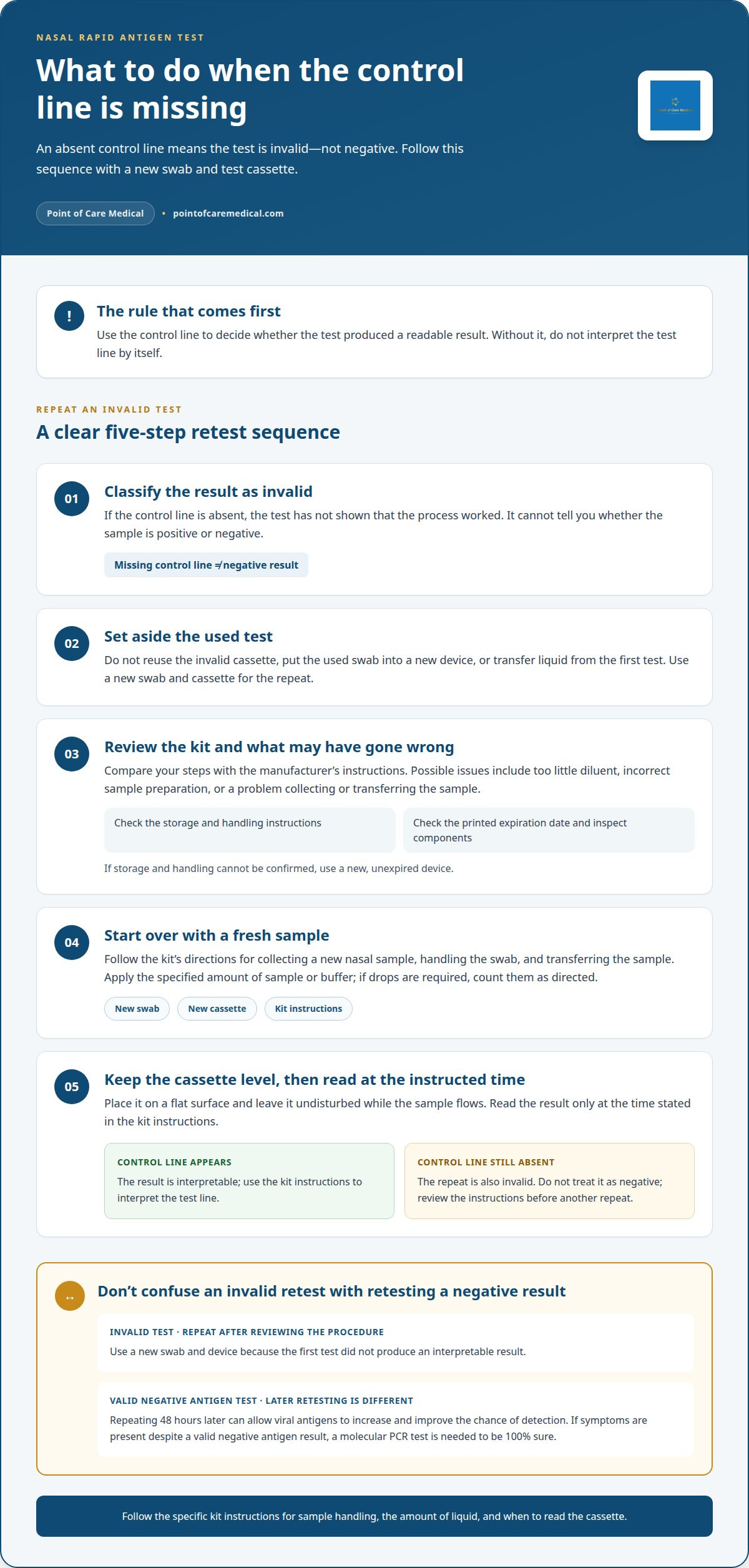
A missing control line means a nasal rapid antigen test is invalid, not negative. When troubleshooting invalid rapid test results, check for common causes such as too little diluent or a step performed incorrectly. Repeat the test with a new swab and device, following the manufacturer’s instructions.
An invalid result can be frustrating when you need a clear answer. First distinguish an invalid test from a valid positive or negative result. Then repeat the test correctly rather than trying to interpret an incomplete result.
This guide explains why the control line may be missing, how to retest, and what the C and T lines indicate. It also explains when to read the cassette: follow the time stated in the test instructions, because reading too early or after the recommended window can make the result unreliable.
Key Takeaways
- Use the control line to decide whether a test produced a readable result before interpreting the test line.
- Keep the cassette level while the sample flows, and follow the kit’s instructions for handling the swab and drops.
- Read any visible line according to the kit’s timing instructions; line darkness does not determine the result.
- Learn when a negative result may need follow-up, especially if symptoms are present.
- See how rapid testing options can support respiratory screening needs.
Why Is My Rapid Antigen Test (Nasal-Swab Samples) Showing an Invalid Result?
An invalid result means the test could not determine whether the sample was positive or negative. To troubleshoot invalid rapid test results, start by identifying possible causes, then choose the appropriate next step.
-
Identify Causes of an Indeterminate Result
Review the procedure and identify any step that may have gone wrong. Too little diluent or incorrect sample preparation can prevent the control line from appearing. Without that line, the test has not shown that the process worked, so it cannot provide an interpretable positive or negative result. Incorrect collection or transfer of a nasal sample may also interrupt the test flow.
Compare the steps you took with the kit instructions, including how you handled the swab and liquid. If the control line is absent, don’t interpret the test line by itself. The result does not establish whether infection is present.
-
Distinguish Invalid Results From False Results
Classify the result before acting: an invalid result has no valid control line, while a false positive or false negative is an incorrect result from a test that produced an interpretable outcome. A negative antigen test means the test did not detect enough antigen to reach its detection threshold. Infection may still be present if the sample’s antigen concentration is too low.
For example, symptoms with a valid negative result do not prove that COVID-19 is absent. Use the control line to decide whether the result is interpretable. If it is valid but negative and symptoms continue, consider confirmatory testing instead of treating the result as conclusive.
-
Review Storage and Handling Factors
Before using a test, check the kit’s storage and handling instructions and its printed expiration date. They specify the conditions and time limits for that test. Don’t use a test after its printed expiration date or if it was stored contrary to the instructions. Damaged components or incorrect handling can interfere with the procedure, so inspect the package and contents before starting.
Keep the instructions with the kit. If you can’t confirm that it was stored and handled as directed, use a new, unexpired device rather than relying on the questionable result.
-
Plan Follow-Up Testing and Precautions
Repeat an invalid test with a new swab and cassette after reviewing the procedure. If you have symptoms and a valid negative antigen result, a molecular PCR test is needed to be 100% sure. An invalid result alone does not answer whether you have COVID-19, so don’t treat it as negative or as clearance to stop precautions.
If you have symptoms and need guidance about testing or care, contact a healthcare provider. When troubleshooting invalid rapid test results, distinguish an invalid test from a negative one: an antigen test can miss infection when the sample’s antigen concentration is too low.
Repeating an invalid test with a new swab and cassette
After an invalid result, review the procedure and repeat the test with a new device. An immediate repeat after an invalid test is different from retesting later after a valid negative result.
-
Prepare a New Swab and Cassette
Set the used swab and cassette aside, then start again with a new swab and test cassette. An invalid device can’t determine whether the sample is positive or negative, so don’t reuse it or try to interpret its lines. Read the manufacturer’s instructions before starting, as collection and processing steps depend on the specific kit.
Check that the new components are ready to use, then follow the sequence in the instructions. Apply the specified amount of sample or buffer rather than estimating. If the kit calls for drops, count them as directed. Keep the cassette on a flat surface while the liquid flows, and avoid moving or tilting it. This helps prevent handling from disrupting the test flow.
Use the new cassette, not the earlier invalid device, to determine whether the result is readable. Read it only at the time specified in the instructions.
-
Repeat the Swab After an Invalid Result
Collect a fresh nasal sample with the new swab and repeat the entire process. A new sample is important because the invalid result did not establish a positive or negative finding. Follow the kit’s collection directions, then transfer and process the sample as instructed. Don’t put the used swab into the new device or transfer liquid from the first test.
After applying the sample, place the cassette level and leave it undisturbed while the reaction develops. Check for the control line when you read the result at the specified time. If it’s absent, the repeat is also invalid; don’t treat the missing control line as a negative result. Review the instructions before trying again, and use a new device for every repeat.
This immediate repeat addresses a failed test process. It differs from repeating a valid negative antigen test later, which may help detect infection if antigen levels increase.
-
Repeat Antigen Testing After the Waiting Period
If your first antigen test was valid but negative, repeating it 48 hours later can allow viral antigens to increase and improve the chance of detection. This waiting period applies to retesting after a negative result, not to an invalid cassette that needs replacement. For an invalid result, review the steps and repeat with a new swab and device.
Keep the purpose of each test clear: an immediate repeat checks whether a correctly performed test can produce a valid result; a later test checks for infection after more time has passed. Follow the kit instructions for every test, including sample collection and reading time. If symptoms are present despite a negative antigen result, a molecular PCR test is needed to be 100% sure.
Record whether each result was invalid or valid and negative. This distinction helps determine whether to repeat the procedure or allow time before retesting.
Interpreting COVID-19 rapid antigen test lines
Without checking the control line, you may mistake an invalid result for a positive or negative one. First confirm that the control line appears, then read the test line according to the kit instructions.
-
Interpret the Test Lines
Check the C and T regions on the cassette. C means Control, and T means Test. Colored lines in both regions indicate a positive result; a visible T line counts even if it is faint. The darkness of the line does not change the interpretation.
If C appears without T, the result is negative. If C is absent, the test is invalid, whether or not a mark appears at T. Don’t call a missing control line a negative result. Read the cassette at the time specified in its instructions, as reading it too late can distort the result.
-
Consider Test Accuracy and Authorization
Use a COVID-19 antigen test authorized by the FDA for emergency use. A valid negative result does not rule out infection in every case: antigen tests are generally less sensitive than RT-PCR and other nucleic acid amplification tests. The difference matters when symptoms persist despite a negative result.
Study findings also vary by timing and test outcome. In one study, home antigen tests correctly identified 78.9% of people with COVID-19 from symptom onset through days 0 to 12, and 96.2% within 3 days of symptom onset. The same review reported correct identification of 97.1% of people without COVID-19 over days 0 to 12.
- Apply those figures to the right question. The 78.9% and 96.2% figures describe positive identification among people with COVID-19, while 97.1% describes correct negative identification among people without it. They do not make an invalid test usable, and they should not replace the cassette’s line-reading instructions.
A positive antigen result with symptoms should be treated as positive. If symptoms are present and the antigen result is negative, a molecular PCR test is needed to be 100% sure. PCR and antigen tests detect infection differently, so their results may not match in every situation.
- Assess the lines separately from the test’s validity. A faint but visible T line still counts, provided C also appears and you read the cassette within the instructed window. For example, C plus a faint T is positive; C without T is negative; no C means invalid.
Use that three-way distinction before deciding what to do next. A valid positive result and a valid negative result can be interpreted; an invalid result needs a new test. This prevents a missing control line from being misread as evidence for or against COVID-19.
Reading the test before the recommended time
Use the reading time specified in the test instructions, not an estimate. Reading too early may mean the sample reaction has not fully developed.
-
Wait Until the Instructed Reading Time
Set a timer for the exact reading time stated in the kit instructions. Rapid antigen tests commonly take about 15-20 minutes, while most currently authorized SARS-CoV-2 antigen tests return results in approximately 15 minutes. The timing for your specific kit takes priority over a general estimate.
Don’t interpret a cassette at 5 or 10 minutes if its instructions require a longer wait. The sample reaction may still be developing, so a line that has not appeared yet could lead you to misread the result. Keep the test in the position described by its instructions while the timer runs.
-
Read Results at the Instructed Time
Check the cassette when the timer reaches the manufacturer’s stated reading time. Apply the interpretation rules for that specific test and record what appears within the directed window. This gives the sample the instructed time to react and avoids a premature reading.
A test checked again hours after the recommended reading period is not valid. Don’t use a later appearance or change in the lines to revise the result. If you missed the reading window, follow the kit instructions for handling that test and repeat with a new device when needed.
- Match the clock to the instructions before deciding what the result means. For example, if the kit directs a reading at 15 minutes, a check at 5 minutes is early, and a check several hours later is outside the valid period. Neither substitutes for reading at the stated time.
Keep the instructions beside the cassette while testing. Rapid antigen tests may have different reading times, so don’t carry the timing from one brand or test type over to another. Use the instructions for the specific test to determine when to read the sample.
- Keep timing separate from interpretation. At the correct time, assess the visible lines using the test’s instructions; don’t rely on what appeared before the timer ended or after the instructed period. A result read too early may not reflect the completed reaction, while a later reading can be distorted by overdevelopment.
If you didn’t read the result at the instructed time, don’t treat a later check as definitive. Start again with a new test and follow its timing directions from the beginning. This aligns the sample, reaction period, and reading window for an interpretable result.
How can I troubleshoot an invalid rapid test step by step?
- Set the invalid cassette aside and record its status. A rapid antigen test without a control line is invalid, not positive or negative. Handling or procedural issues can interrupt sample flow and contribute to a missing control line. Don’t rely on a cassette checked hours after its instructed reading period, as that later reading is not valid. Recording the result as invalid distinguishes a failed test process from an interpretable finding.
- Review the instructions for the specific kit before repeating the test. Check the sample collection method, required liquid amount, and sequence of steps. Too little diluent or an incorrect procedure can prevent the control line from appearing. Follow the manufacturer’s directions rather than relying on steps remembered from another kit, as instructions can differ. This review may help identify a correctable handling issue before you use another device.
- Repeat the procedure with a new swab and cassette. Collect a fresh sample, then process it exactly as the kit directs. Don’t reuse the invalid cassette or transfer the first sample into a new device. If the instructions call for drops, apply the stated amount rather than estimating. A fresh device and sample let you see whether the test produces a readable result when performed as directed.
- Keep the cassette on a flat surface while liquid moves through it. Don’t tilt or move the device during this stage, as that may disrupt the flow. Wait until the reading time specified in the kit instructions, then check the result within that window. Reading too early can catch the reaction before it develops; checking hours later falls outside the valid reading period.
- Use the control line to decide whether the repeat can be interpreted. If C appears, interpret the test line according to the kit instructions. If C is absent, the repeat is invalid, not negative. Troubleshooting invalid rapid test results means keeping an invalid outcome separate from a valid negative result. A valid negative antigen test may be repeated 48 hours later. For ongoing testing needs, review rapid testing options.
Point of Care Medical: Oral Fluid tests
Point of Care Medical offers Oral Fluid tests alongside rapid testing options for respiratory screening, including the GenBody COVID-19 Rapid Antigen Test and ViraDx™ SARS-CoV-2/Flu A+B Rapid Antigen Test. These offerings support different testing needs; they do not replace the steps for resolving an invalid nasal antigen result.
Organizations reviewing testing options should consider which test type fits their intended screening need. An invalid rapid test still requires a valid repeat or appropriate follow-up; a different test should not be treated as a direct confirmation.
For information about testing options, contact Point of Care Medical.
Make a Clear Next Step Part of Your Testing Process
A consistent approach to troubleshooting invalid rapid test results can help keep decisions clear in individual and workplace testing. Treat each result as a decision point: record its status, follow the appropriate next step, and don’t use an uninterpretable result to make a screening decision. This supports a consistent response when testing is part of routine operations.
Teams should define how to document an invalid result and handle a repeat or follow-up. Keep the relevant kit instructions accessible so the person administering the test can follow the correct procedure and reading window. A documented process also helps distinguish an invalid test from a valid result when reviewing records.
When you’re considering rapid testing options for your organization, choose based on the testing need and intended use. Point of Care Medical offers testing products for different screening needs.
Contact Point of Care Medical to discuss your testing needs. A clear process helps your team take the next step with confidence.
Frequently Asked Questions
How accurate are rapid COVID-19 tests?
Rapid antigen tests are generally less sensitive than RT-PCR and other nucleic acid amplification tests. Their ability to detect infection can depend on factors such as symptom timing and the amount of antigen in the sample. A valid negative result may not rule out infection, particularly when symptoms are present. For example, someone with symptoms and a negative antigen result may need a molecular PCR test for confirmation.
What causes an invalid rapid antigen test result?
An invalid result can occur when the test’s control process fails. Too little diluent or an incorrect procedure may prevent the control line from appearing. Sample handling can also interrupt test flow. Check the instructions for the specific kit and consider whether you followed each step as directed. Without a valid control line, the result cannot be interpreted as positive or negative.
How soon should I repeat a rapid test after an invalid result?
Repeat an invalid test after reviewing the instructions, using a new swab and a new cassette. The 48-hour interval applies to repeating a valid negative antigen test, not to replacing an invalid test. For example, if the control line is absent, don’t wait two days to repeat the procedure. If the repeat is valid but negative and symptoms continue, consider molecular PCR testing.
Should I use a new test kit or a different brand after an invalid result?
For a repeat, use a new test device, including a fresh swab and cassette. Guidance for an invalid result calls for a new device, not necessarily a different brand. Follow the instructions supplied with the kit, as collection, sample preparation, and reading directions can vary. Don’t reuse the cassette that produced the invalid result or apply another kit’s instructions to it.
When should I get a lab-based test after an invalid rapid test?
After an invalid result, repeat the test with a new swab and cassette. If the repeat is valid but negative and you have symptoms, get a molecular PCR test to be 100% sure.


