

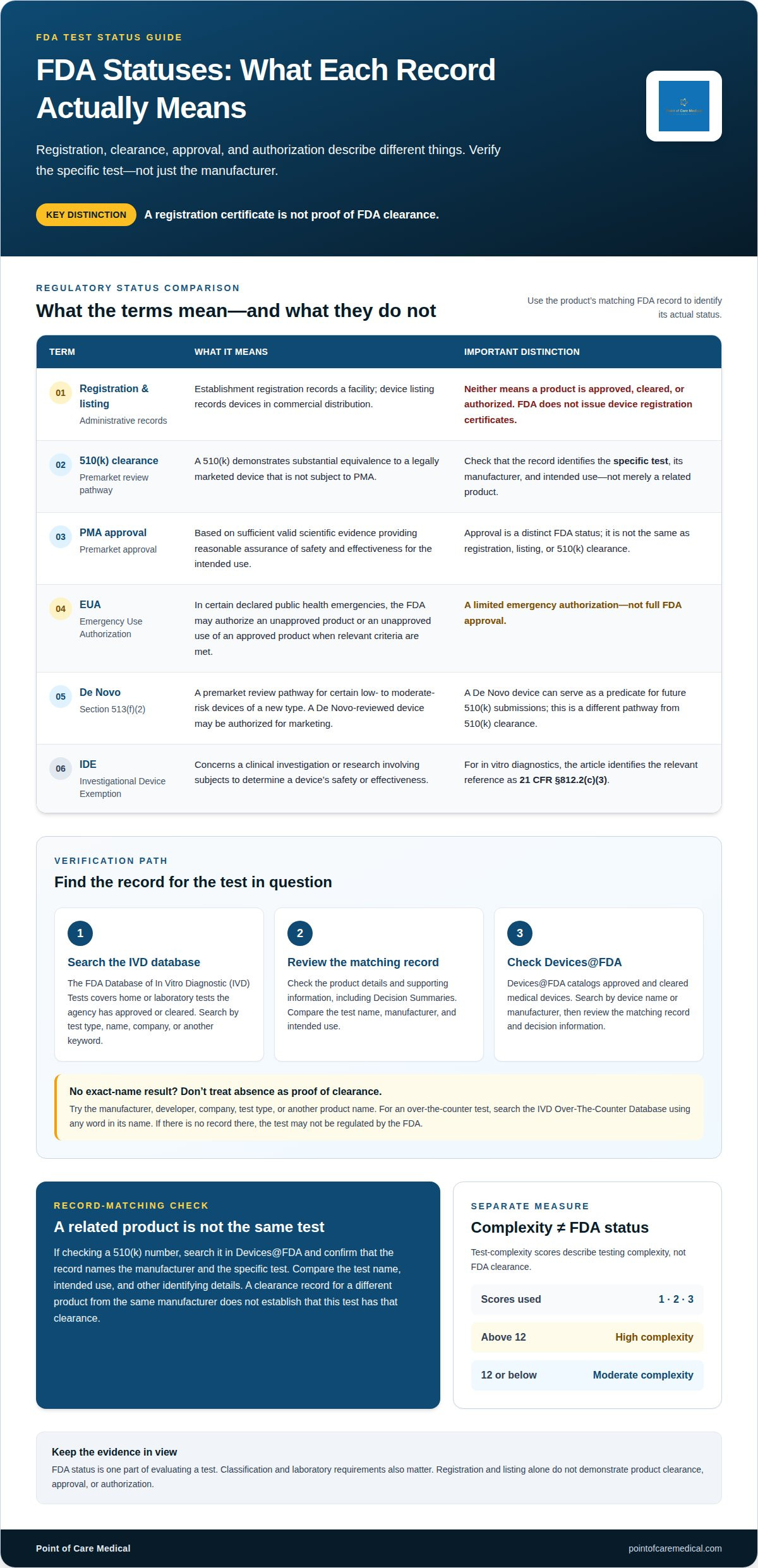
An FDA registration certificate is not proof that a test has FDA clearance. FDA does not issue device registration certificates, and establishment registration or device listing does not mean a test is approved, cleared, or authorized. To learn how to verify a test's FDA clearance, search FDA records for the specific test and read the status attached to its record.
It’s understandable to see “FDA registered” as a sign of review, but registration, clearance, approval, and emergency use authorization refer to different regulatory statuses. The FDA’s IVD test database covers approved or cleared in vitro diagnostic tests, while Devices@FDA catalogs approved and cleared medical devices. Search the IVD database by test type, name, company, or another keyword. An EUA is a limited authorization, not full FDA approval. This guide explains where to search, what each status means, and how to interpret results when a test name or manufacturer is difficult to match.
Key Takeaways
- FDA registration and device listing do not establish that a test is approved, cleared, or authorized.
- Use FDA’s IVD test database to look up a test by name, company, type, or another keyword.
- Distinguish FDA approval, 510(k) clearance, and Emergency Use Authorization; they represent different regulatory statuses.
- Review a matching database record and its supporting documents to understand the test’s status and intended use.
- FDA status is only one part of evaluating a test; classification and laboratory requirements also matter.
How Do You Know if the FDA Approved, Cleared, or Authorized a Medical Device?
Search FDA records for the specific test’s regulatory status, not just its manufacturer’s registration. Approval, clearance, and authorization reflect different FDA decisions.
Distinguishing FDA Regulatory Terms
Registration records an establishment, while approval, clearance, and authorization describe a product’s regulatory status. FDA establishment registration and device listing do not mean a device is approved, cleared, or authorized. A 510(k) clearance indicates substantial equivalence to a legally marketed device not subject to PMA. PMA approval relies on sufficient valid scientific evidence providing reasonable assurance of safety and effectiveness for the intended use.
An Emergency Use Authorization, or EUA, is a limited authorization, not full FDA approval. A De Novo decision is a premarket review pathway for certain low- to moderate-risk devices of a new type. These distinctions matter: a registration entry or an EUA does not establish the same status as FDA clearance or approval.
Locating Approved and Cleared Tests
The FDA’s Database of In Vitro Diagnostic (IVD) Tests provides information about home or laboratory tests the agency has approved or cleared. Search by test type, name, company, or another keyword. Review matching product records and supporting details, including Decision Summaries. Devices@FDA is the FDA catalog for approved and cleared medical devices.
To check a diagnostic test’s De Novo authorization, search FDA’s IVD test database using the test name or company, then review the matching record and its decision information. FDA’s De Novo pathway is identified under Section 513(f)(2), and a device reviewed through it may be authorized for marketing in the United States.
Handling Missing Clearance Records
A missing search result does not establish FDA clearance. Search the IVD database again using the manufacturer, company, test type, or another name associated with the product. For over-the-counter tests, search the IVD Over-The-Counter Database using any word in the test name. If there is no record in that database, the test may not be regulated by the FDA.
If a test claims clearance but no searchable record appears, distinguish the claim from the evidence: registration and listing alone do not demonstrate clearance. Search FDA records using the manufacturer or developer name, then review matching records for the actual status. A healthcare professional can provide that name if the patient does not know it; it is also included in the patient fact sheet.
Test complexity is separate from FDA approval or clearance status. The U.S. Food and Drug Administration uses scores of 1, 2, and 3 for each test-complexity criterion; a score above 12 classifies a test as high complexity. According to the U.S. Food and Drug Administration, a CLIA test-complexity score of 12 or below classifies a test as moderate complexity. These categories describe testing complexity, not FDA clearance.
FDA device classification and marketing requirements
FDA classification helps determine which review pathway and marketing requirements apply to a medical device. Registration, listing, and a searchable product record serve different purposes.
Medical device establishments generally register with the FDA annually, and manufacturers list devices in commercial distribution. These administrative steps do not mean the FDA approved, cleared, or authorized a device. The FDA does not issue device registration certificates to medical device facilities, so such a certificate is not evidence of product review.
For devices subject to 510(k), the U.S. Food and Drug Administration requires a submission at least 90 days before marketing, unless the device is exempt from 510(k) requirements. A 510(k) submission demonstrates substantial equivalence to a legally marketed device that is not subject to PMA. Most Class I tests are exempt from FDA review of submissions, but manufacturers still register, list products in commercial distribution, and follow Quality Systems Regulations.
Emergency Use Authorization applies in certain declared public health emergencies. The FDA may authorize an unapproved medical product or an unapproved use of an approved product when the relevant criteria are met. EUA is a distinct emergency pathway, not the same status as clearance or approval. An investigational device exemption, or IDE, concerns a clinical investigation or research involving subjects to determine a device’s safety or effectiveness. For in vitro diagnostics, the relevant investigational-device reference is 21 CFR §812.2(c)(3).
Searching Devices@FDA
Devices@FDA catalogs information on approved and cleared medical devices. Search by device name or manufacturer, then review the matching record and its decision information. This helps distinguish a product record from an establishment registration. If a test does not appear under its exact name, try the manufacturer’s name or another product identifier before drawing conclusions.
Matching Tests to 510(k) Records
To verify a 510(k) clearance number, search that number in Devices@FDA and open its matching record. Confirm that the record identifies the manufacturer and the specific test, not merely a related device. Compare the test name, intended use, and other identifying details with the product in question. A clearance record for a different product from the same manufacturer does not establish that the test itself has that clearance.
De Novo is another premarket review pathway, identified under Section 513(f)(2), for low- to moderate-risk devices of a new type. A De Novo-reviewed device may be authorized for marketing and can serve as a predicate for future 510(k) submissions. Its record therefore documents a different pathway from a 510(k) clearance.
Searching FDA’s IVD test database
The FDA’s IVD test database helps identify in vitro diagnostic tests the agency has approved or cleared. Search by test name, manufacturer, test type, or another keyword, then review matching products and their associated information. A Decision Summary can provide further details about the record and its regulatory decision.
Start with the exact product name on the test packaging or patient information. If there is no match, try the manufacturer or developer name and a broader test-type term. Compare each result with the product name and intended use. A similar name alone does not establish that a record applies to the test you are evaluating.
For an over-the-counter test, use the IVD Over-The-Counter Database. Search using any word in the test name; entering the test type is optional. Select a matching record to view its details. If the database returns no record, the test may not be regulated by the FDA. Treat that result as a reason to examine the product claim carefully, not as proof that the test is FDA-cleared or unregulated.
A laboratory-developed test (LDT) or a test performed under CLIA requires a separate distinction. CLIA quality standards address laboratory testing, but CLIA oversight is separate from FDA oversight and does not establish FDA clearance. Laboratories may assess a test’s performance before using it in clinical practice. Laboratories may need to assess modified tests and LDTs before clinical use.
Verification and validation assess different performance characteristics. For an unmodified cleared or approved test, verification assesses applicable analytical accuracy, precision, and reportable range. Validation of a modified test or LDT assesses those characteristics, plus applicable analytical sensitivity, specificity, and other performance characteristics needed to evaluate analytical test performance. These laboratory assessments do not make an LDT an FDA-cleared test.
For nonwaived testing, assess accuracy against a matrix-appropriate reference method or another established comparative method. Assess precision within-run and between-run over time. When a laboratory uses another party’s verification work, it must keep records showing correlation with in-house performance, including tests of known specimens by laboratory personnel. Each identical test and instrument combination also requires separate verification of performance specifications.
To assess an FDA-cleared laboratory test, search the IVD database using the test and manufacturer details, then match the record to the exact product. If the test is an LDT, CLIA status or laboratory validation describes a separate oversight and performance process, not FDA clearance.
Class II 510(k) premarket notification
A Class II in vitro diagnostic test often follows the 510(k) premarket notification pathway. The submission compares the test’s analytical performance with a legally marketed predicate device. The purpose is to demonstrate substantial equivalence, not to obtain PMA approval. This distinction helps readers interpret a test’s regulatory status and avoid treating “FDA cleared” and “FDA approved” as interchangeable claims.
The predicate provides a reference point for the proposed device. FDA considers whether the new test has the same intended use and whether differences affect safety or effectiveness. Analytical performance comparisons may address how the test performs on relevant samples. Clinical data may sometimes be needed to support the intended use. A 510(k) record therefore relates to a particular device and its described use, not every product made by the same company.
To assess a Class II test’s 510(k) status, locate its record in Devices@FDA or the FDA’s IVD test database. Then compare the record’s product name, manufacturer, and intended use with the test being evaluated. Review the decision information and any available summary. A similar product name is not enough: a matching record must correspond to the exact test and use. If the product is described as a modified version, examine whether the record supports that version or only an earlier device.
What the 510(k) comparison establishes
A 510(k) clearance indicates FDA found a device substantially equivalent to a legally marketed predicate not subject to PMA. It does not mean FDA approved the device through the PMA pathway. The comparison is tied to the submitted device and its intended use. As a result, a cleared test’s record should not be treated as evidence for a different test merely because both share a manufacturer or product family.
Class II classification and 510(k) review also do not replace laboratory responsibilities. Laboratories generally assess a test’s performance in their own setting before clinical use. A modified cleared test requires laboratory validation. Those processes address performance in the laboratory’s setting; they do not change the FDA status shown in the 510(k) record.
For a practical review, keep four details together: the test’s exact name, manufacturer, intended use, and 510(k) record. If one detail differs, determine whether the database record describes the same device. A Class II label alone does not prove clearance, and a 510(k) number alone does not establish that the number applies to the product in hand. The decisive evidence is the match between the FDA record and the exact test.
FDA authority over in vitro diagnostic products
In the United States, in vitro diagnostic products fall within the FDA’s medical device framework. The Medical Device Amendments enacted in 1976 amended the Federal Food, Drug, and Cosmetic Act. Section 210(h) of that act defines in vitro diagnostic products as medical devices. This legal classification is why FDA records can show a test’s device review pathway, rather than simply laboratory oversight.
Not every FDA device record is evidence of product review. Establishment registration and device listing are administrative records, not proof that a test has FDA approval, clearance, or authorization. The FDA does not issue device registration certificates to medical device facilities. A certificate presented as evidence of FDA approval or review can therefore mislead. Firms that display misleading registration certificates to imply FDA review or approval misbrand the device under the Federal Food, Drug, and Cosmetic Act.
Some in vitro diagnostic products are also biological products subject to section 351 of the Public Health Service Act. That classification matters because the applicable regulatory framework depends on the product, not just the word “test” on packaging. When reviewing a product claim, identify the exact test and the regulatory status stated in its FDA record. A company’s registration status alone does not establish which pathway applies to a particular assay.
Laboratory oversight adds another distinct layer. The Clinical Laboratory Improvement Amendments of 1988 established a framework for laboratory testing separate from FDA oversight. CLIA quality standards address the accuracy, reliability, and timeliness of laboratory testing. They do not require laboratory-developed tests to meet the same safety and efficacy requirements as FDA oversight. A laboratory’s CLIA status therefore does not itself establish FDA clearance for an LDT.
FDA’s approach to laboratory-developed tests has also been the subject of agency activity. On July 31, 2014, FDA notified Congress of its plan to issue draft guidance on LDT regulation. That historical notice should not be confused with a particular test’s current FDA status. For a specific diagnostic product, the useful evidence remains its matching FDA record and the decision or authorization documents associated with that product.
Keep these distinctions clear: the FDA regulates medical device and applicable biological product pathways; CLIA addresses laboratory testing quality; registration identifies establishments and listed devices. Each record answers a different question. A documented FDA status and a laboratory’s testing framework may both matter, but neither substitutes for the other when assessing a test’s regulatory standing.
For operational testing needs, review diagnostic testing options alongside the regulatory record relevant to your intended use.
Point of Care Medical: Oral Fluid tests
Point of Care Medical offers Oral Fluid tests for organizations sourcing testing products after reviewing their regulatory requirements. FDA status depends on the specific test and its record, so match the product to the intended use and applicable documentation before procurement. For other testing needs, Point of Care Medical also offers the GenBody COVID-19 Rapid Antigen Test, Rapid Test Cup "RTC" + Fentanyl, and ViraDx™ SARS-CoV-2/Flu A+B Rapid Antigen Test. These offerings address different testing categories, so select based on the organization’s testing needs and the relevant product information. For product inquiries, contact Point of Care Medical.
Make Regulatory Review Part of Procurement
Make FDA status review a consistent part of test selection. A documented process for verifying a test’s FDA clearance can help teams connect the product record to the exact test, intended use, and purchasing decision. Keep those details together so colleagues can understand the basis for a selection and revisit it when requirements change.
Regulatory status informs procurement, but it is not the only consideration. The test must also fit the organization’s testing needs and operational context. Point of Care Medical supplies diagnostic testing products for organizations evaluating their options, including respiratory and other testing categories. Matching product choice to intended use supports a more informed purchasing decision.
For information about available testing products, contact Point of Care Medical. A clear record and a defined procurement process can help your team move forward with confidence.
Frequently Asked Questions
Are there FDA Certificates?
The FDA does not issue device registration certificates to medical device facilities. A registration or listing record also does not show that a particular test received FDA review. If a supplier presents a certificate as proof of approval or clearance, identify the product’s FDA record and regulatory decision instead. What matters is whether the record names the specific test and its status, not whether a facility has registration paperwork.
How do I search FDA databases for a cleared medical test?
Start with the test’s full name in the FDA’s IVD test database, then search by manufacturer or test type if needed. Review the matching product entry and its decision information. For example, a facility evaluating a home test can search a distinctive word from the product name in the IVD Over-The-Counter Database. Compare the result with the exact test packaging instead of relying on a similar name.
How do I verify FDA approval versus clearance or authorization?
Check the specific status shown in the FDA record and the pathway associated with its decision. A PMA record indicates approval, a 510(k) decision indicates clearance, and an EUA indicates limited emergency authorization. These terms are not interchangeable. To understand how to verify a test’s FDA clearance, make sure the record’s product identity and intended use match the test being considered, not simply its manufacturer.
Where can I find a test’s FDA decision summary and intended use?
Open the matching product record in the FDA’s IVD test database and review its supporting information, including any Decision Summary. The summary can clarify which device the FDA reviewed and the use described in its decision. Compare that intended use with the setting and purpose for which the test is being considered. A summary for a related product does not establish the intended use of a different test.
How do I check FDA EUA status for a diagnostic test?
Search the FDA’s EUA chart using the test manufacturer’s or developer’s name, then identify the corresponding product entry. If you do not know the name, a healthcare professional can provide it; it is also included in the patient fact sheet. Read the authorization information for the specific test. An EUA is a limited emergency authorization, so it should not be described as full FDA approval.
What FDA databases list cleared in vitro diagnostic tests?
Use the FDA’s Database of In Vitro Diagnostic (IVD) Tests for approved or cleared home and laboratory tests. The IVD Over-The-Counter Database focuses on consumer tests, while Devices@FDA catalogs approved and cleared medical devices. Choose the database that fits the test and setting, then search by product name or company. Match any result to the exact test and its intended use.


