

The faster test isn't automatically the cheaper one. In a lab-based testing vs. point-of-care cost comparison, neither option is always less expensive: laboratory charges vary by test and location, while point-of-care testing can reduce the time and steps involved in getting a result. The right choice depends on the information needed and how quickly it must be available.
It’s reasonable to expect a quick test to cost less, or a more detailed lab test to cost more. But total cost can also depend on where testing happens, how the test is processed, and whether further analysis is needed. Consider speed, stated performance, and level of detail alongside the price.
This article explains how testing location can affect lab costs, what quality comparisons can and can’t tell you, and when a rapid point-of-care result may fit the need. It also explains when lab testing may be appropriate for broader or more detailed analysis, helping you weigh the options in practical terms.
Key Takeaways
- Compare the full testing cost, including where the test is performed and any related collection or processing charges.
- Assess quality by the test’s intended use, quality-control practices, and applicable testing standards, not price alone.
- Point-of-care testing can support decisions during a visit, while laboratory testing can offer broader or more detailed analysis.
- Match the testing approach to the clinical question, the urgency of the result, and the level of detail needed.
- Use the cost examples and testing differences in the article to identify which factors matter most for your setting.
How lab place of service affects member costs
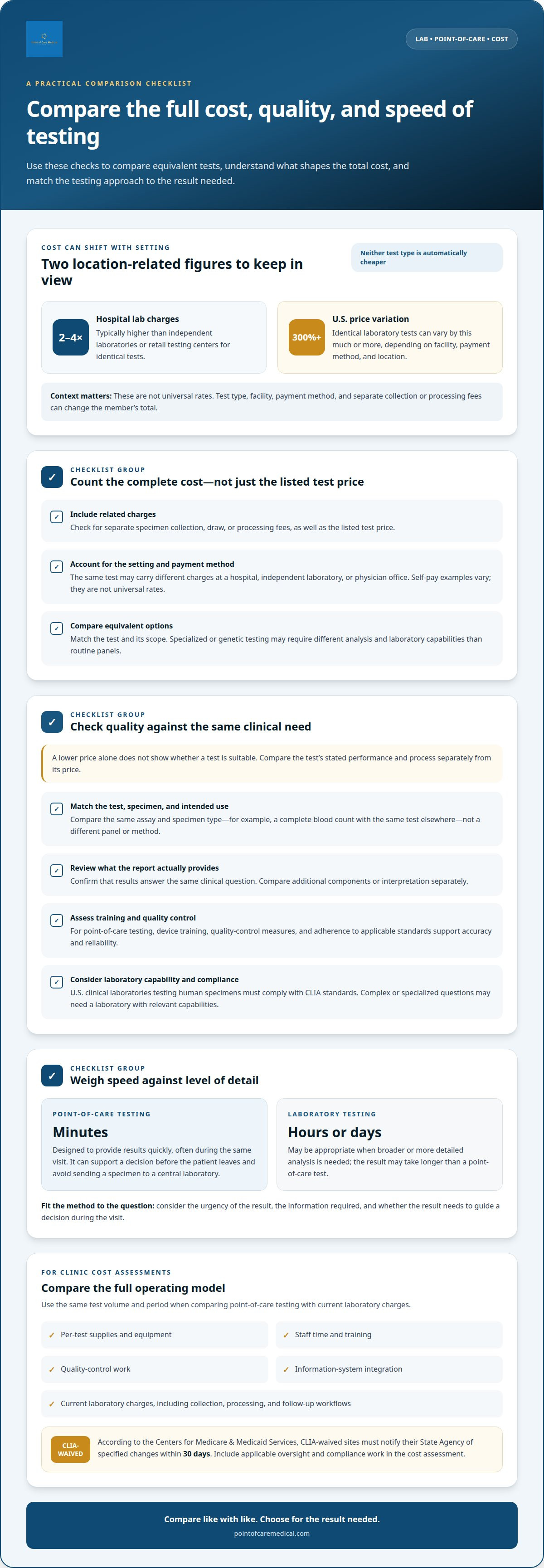
The same diagnostic test can carry different charges at a hospital, independent laboratory, or physician office. Hospital-based laboratories typically charge 2-4 times more than independent laboratories or retail testing centers for identical tests. The place of service, payment method, and any collection or processing fees shape the member’s total.
Per-test costs for lab-based and point-of-care testing vary by assay and setting; neither is automatically cheaper. Point-of-care testing may reduce sample transport and speed decisions, while laboratory charges can include separate collection or processing fees.
For uninsured patients, self-pay examples show how much location and payment method can matter. These examples aren’t universal rates: test type and facility affect the amount.
Specialized diagnostic testing can require more analysis than routine panels. Genetic testing is another case where independent laboratories may offer lower-cost options while maintaining compliance with regulatory standards. The test’s scope and the laboratory’s capabilities help determine the appropriate setting.
Geography adds another layer. Identical laboratory tests in the United States can vary in price by 300% or more, depending on facility, payment method, and location. A hospital laboratory in one market may charge differently from a physician office or independent laboratory elsewhere. For members, the listed test price alone may not show the full cost if a separate draw or processing charge applies.
There is no single typical U.S. price for point-of-care testing across all assays and facilities. Cost depends on the test, equipment and supplies, and how the facility incorporates testing into care. A rapid result may also reduce time spent waiting for a central laboratory result, which can affect operational costs.
To estimate switching costs, a clinic should total per-test supplies and equipment, staff time, training, quality-control work, and any information-system integration. Compare that amount with current laboratory charges, including sample collection, processing, and follow-up workflows. Use the same test volume and period for both models to make the comparison meaningful.
Testing location also affects operational requirements. According to the Centers for Medicare & Medicaid Services, CLIA-waived sites must notify their State Agency of specified changes within 30 days. Include applicable oversight and compliance work in a clinic’s cost assessment, alongside the direct cost of each test.
Comparing the stated quality of lower-cost and hospital lab testing
A lower price alone doesn’t show whether a lab test is suitable. Compare the same test, specimen type, and intended clinical use. Independent laboratories may offer lower-cost alternatives, and lower-cost options can maintain the same standards as hospital labs while reducing overhead. The facility’s price and the test’s stated performance are separate questions.
Start with the test itself. Compare a complete blood count from one facility with the same test from another, not with a different panel or testing method. Confirm that both options address the same clinical question and provide the information the care team needs. If one report includes additional components or interpretation, compare those deliverables separately rather than treating the tests as identical.
Quality also depends on how a facility performs and manages testing. In the United States, clinical laboratories testing human specimens must comply with CLIA standards, according to the Centers for Medicare & Medicaid Services. For point-of-care testing, accuracy and reliability require device training, quality-control measures, and adherence to applicable regulatory standards. Assess a lower-cost option against these operational factors, not its price alone.
For a practical facility review, compare the following across the hospital and lower-cost option:
- Test scope: Match the assay, specimen, and intended use.
- Reported result: Compare the details provided and whether they answer the same clinical question.
- Quality process: Review how staff training and quality control support reliable results.
- Operational fit: Determine whether the facility can perform the test consistently within its workflow.
These checks help distinguish a cost reduction from a change in testing capability. A routine test available through an independent laboratory may suit a facility’s needs, while a complex or specialized diagnostic question can require a laboratory with relevant capabilities. The decision depends on the result needed and the facility’s ability to deliver it appropriately.
For point-of-care testing, the same principle applies. A result produced near the patient may support a decision during the visit, but speed doesn’t replace training, quality control, or a suitable test method. Assess the testing process alongside the result. This keeps cost analysis focused on equivalent clinical needs, rather than assuming hospital testing is inherently superior or a lower-cost alternative is interchangeable.
Differences in speed and level of detail
Point-of-care testing is designed to provide results quickly, often during the same visit. A point-of-care test can produce results in minutes, while laboratory results may take hours or days. The difference matters when a healthcare provider needs information to guide a decision before the patient leaves.
Point-of-care testing can also eliminate the step of sending a specimen to a central laboratory. That can shorten the path from collection to result, particularly when the test supports an immediate assessment. By contrast, a laboratory workflow may involve specimen transport, processing, and reporting before the care team can act on the result.
Test volume and turnaround time affect the total cost of each approach. Higher volume can spread equipment and setup costs across more tests, while low volume can make those costs weigh more per test. Longer laboratory turnaround can also add staff time for follow-up and result communication; faster results may streamline those steps.
Speed isn’t the only consideration. Laboratory testing can provide detailed results and a broader range of testing for complex or rare conditions. A central laboratory is useful when the clinical question requires extensive analysis or a result beyond the scope of an available point-of-care test.
For routine decisions, the timing may change the care workflow. A point-of-care result can be available while the healthcare provider is still with the patient. Laboratory testing can require a later review or follow-up after results arrive. Point-of-care testing has been reported to reduce patient wait times by 46 minutes per patient, although the workflow and test determine how that benefit applies.
Use the required result and decision timing to guide the comparison:
- Choose rapid testing when a result during the visit can support an immediate decision.
- Consider laboratory testing when the clinical question needs broader or more detailed analysis.
- Compare volume and workflow by including staff time, specimen handling, and result follow-up.
Monitoring needs can also shape the choice. For example, a provider monitoring glucose may value timely results that support care during the encounter. A complex diagnostic question may instead call for a laboratory’s broader testing capability. These examples show why faster testing doesn’t automatically replace laboratory analysis.
Match the method to the clinical question, required detail, and time by which the result must be available. This gives facilities a clearer view of how turnaround affects workflow and testing costs, without treating speed as a substitute for the information needed.
Definition and uses of point-of-care testing
Point-of-care testing is performed at or near where a patient receives care, rather than in a centralized laboratory. A clinic may use it at the bedside or during an office visit, so staff can process a sample nearby. Portable devices can support testing in settings with limited access to centralized laboratories.
The main operational difference is where the sample is analyzed. Point-of-care testing can allow a sample to be analyzed near the patient rather than sent to a central laboratory. This can significantly shorten turnaround time and make a result available during the visit. The appropriate method still depends on the test and the information required.
Point-of-care devices are used for several diagnostic purposes. Examples include blood glucose monitoring for diabetes and coagulation monitoring for patients receiving anticoagulant therapy. Facilities may also use point-of-care tests for infectious diseases, cardiac markers, metabolic conditions, and chronic diseases. These uses show how a quick result can support a specific care decision or monitoring task.
Location also affects access. A bedside test can support urgent decisions when waiting for central laboratory processing would delay care. Portable devices can support screening in underserved populations with limited laboratory access. In each case, the healthcare team selects a test that addresses the clinical question, then considers whether its result provides enough detail for the next decision.
Point-of-care testing isn’t a single method or universal device. Test types differ in purpose, procedure, and result. A glucose check, an infectious-disease screen, and a cardiac-marker test answer different questions. A facility should match each use case to the device and workflow, rather than treating all rapid testing as interchangeable.
Reliable results require more than placing a device near the patient. Staff training, quality-control measures, and applicable regulatory standards support accuracy and consistency. Facilities also need to consider how point-of-care devices fit into broader operations, including staff responsibilities and information systems. These factors shape implementation alongside the test itself.
Point-of-care testing can work alongside laboratory testing rather than replace it. A rapid result may guide an immediate action, while a central laboratory can provide broader or more detailed analysis when the clinical question requires it. A facility can distinguish between those roles by considering:
- Care setting: Whether testing must occur at the bedside, in a clinic, or centrally.
- Decision timing: Whether the result is needed during the encounter.
- Testing purpose: Whether the task is screening, diagnosis, or ongoing monitoring.
- Result detail: Whether the point-of-care result answers the clinical question.
What is the typical cost of lab-based testing in the United States?
There is no single U.S. price for lab-based testing. Listed costs vary by test, facility, location, and payment method. These ranges illustrate why the test name alone doesn’t determine what a patient pays.
Other tests show similar variation. These are examples, not a single rate that applies to every laboratory or member.
Panel pricing can also differ from ordering individual components. This example shows how the structure of an order can affect the total. Both the requested test and included components matter.
Test complexity changes the scale of possible charges. A routine blood test and a specialized diagnostic panel shouldn’t be treated as comparable price points.
Location may shift the amount further. Identical U.S. laboratory tests can vary in price by 300% or more, depending on facility, payment method, and location. Hospital-based laboratories typically charge 2-4 times more than independent laboratories or retail testing centers for identical tests. A member comparing costs should distinguish the test itself from the place where it is performed.
Payment route also matters. Some providers offer lower lab test rates to patients who pay directly rather than use insurance. Insurance-billed amounts and self-pay listings can differ substantially, as the TSH and vitamin D examples show. A facility’s total may also include separate blood draw or processing charges, depending on where testing occurs.
For a useful estimate, identify the exact test, its components, the facility, and the payment method. Then account for any collection or processing charges shown in the total. This approach helps compare like-for-like options instead of relying on a broad price range. For facilities reviewing rapid diagnostic supply needs, point-of-care testing supplies provide a relevant next step.
Point of Care Medical
Point of Care Medical supplies targeted rapid diagnostic tests for healthcare and screening facilities evaluating where point-of-care testing fits their workflows. Its offerings include respiratory tests, such as the GenBody COVID-19 Rapid Antigen Test and ViraDx™ SARS-CoV-2/Flu A+B Rapid Antigen Test, as well as the Rapid Test Cup "RTC" + Fentanyl and SURE CHECK HIV 1/2 Assay.
These supplies may suit facilities assessing rapid testing for specific screening or diagnostic needs. The choice between point-of-care and laboratory testing still depends on the clinical question, required result detail, workflow, and total operating cost. Contact Point of Care Medical to discuss its rapid diagnostic testing supplies for your facility.
Make testing decisions part of operational planning
Treat the lab-based testing vs. point-of-care cost decision as an operational review, not a one-time purchasing choice. As testing needs change, reassess whether the selected approach still fits your facility’s patient population, care workflows, and clinical priorities. A method that suits one testing use may not suit every use across the organization.
Bring clinical and operational teams into the discussion. Their perspectives connect test selection with staff decisions and the processes they must maintain. Record the reasoning behind each choice, then revisit it when testing demand or care workflows change. A periodic lab-based testing vs. point-of-care cost review gives your team a practical basis for adapting its approach without assuming one testing model fits every situation.
For facilities considering rapid testing supplies for specific screening needs, contact Point of Care Medical to discuss its available options. A measured review can help your team align testing choices with its operational goals.
Frequently Asked Questions
Which type of testing is better?
Neither method is universally better; the best fit depends on the clinical decision and setting. For example, a clinic managing a result during the patient visit may prioritize point-of-care testing, while a team investigating a complex question may need laboratory analysis. Consider the information required, the workflow, and how the result will be used. A facility can use both methods for different testing needs.
What factors affect the cost of lab-based testing?
Lab-based test costs depend on the assay, facility, location, payment method, and order structure. A panel and its component tests ordered separately can have different totals. Collection, processing, or interpretation charges can also affect the bill. For a useful comparison, identify the exact test and components, then distinguish the laboratory charge from related service charges.
What factors affect the cost of point-of-care testing?
Point-of-care costs reflect more than the individual test. A facility’s total can include testing supplies, device costs, staff preparation and training, quality-control work, and workflow integration. Test volume affects how those expenses are distributed across performed tests. For example, the same setup expense has a different per-test effect in a low-volume clinic than in a high-volume program. Include ongoing operations in the estimate.
How do insurance coverage and out-of-pocket costs compare for lab-based and point-of-care tests?
Insurance coverage and patient responsibility depend on the plan, test, and billing method. A high deductible or coverage limitation can leave a patient responsible for more than expected. Point-of-care testing performed during a visit can be part of the visit’s billing, while a laboratory test can appear as a separate charge. Compare the relevant billing details, not just the test’s listed price.
How do costs vary by test type, such as COVID-19, glucose, or strep tests?
Costs differ because each test uses a different assay, testing process, and clinical workflow. A glucose check for ongoing monitoring is not directly comparable with a COVID-19 or strep test used to assess an infectious disease. The setting and payment method also affect the amount. Compare the same test type and purpose across options, and account for any related visit or specimen-processing charges.
What Medicare or CLIA rules affect point-of-care testing costs in the U.S.?
CLIA compliance can create operational requirements for facilities performing human testing. According to the Centers for Medicare & Medicaid Services, clinical laboratories testing human specimens must comply with CLIA standards. CLIA-waived sites must notify their State Agency of specified changes within 30 days, also according to the Centers for Medicare & Medicaid Services. Medicare payment is a separate consideration, so its effect depends on the billed service and coverage.


